Denosumab, Romosozumab, and Teriparatide
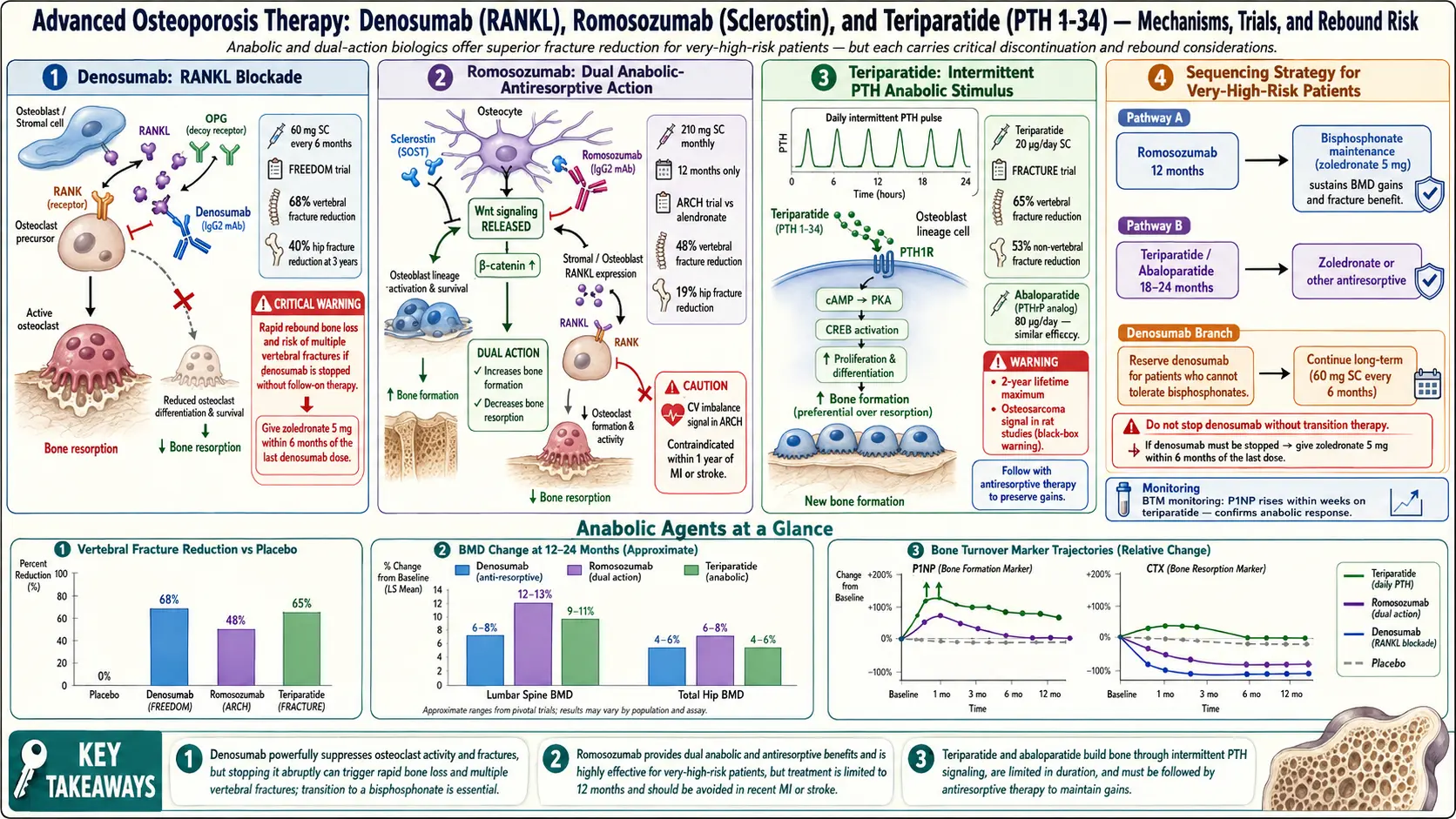
Table of Contents
- Who These Drugs Are For
- Two Categories: Antiresorptive vs. Anabolic
- Denosumab — How It Works
- Denosumab Evidence: The FREEDOM Trial
- The Rebound Fracture Problem
- Teriparatide — Recombinant PTH(1-34)
- Abaloparatide — The PTHrP Analog
- Romosozumab — The Dual-Action Drug
- The Romosozumab Cardiovascular Warning
- Sequencing: What the Trials Show About Order
- Side Effects and Monitoring
- Cost and Insurance Coverage
- Questions Worth Raising With a Clinician
- Key Research Papers
- Connections
- Featured Videos
Who These Drugs Are For
People usually meet these drugs after a DEXA scan that came back worse than expected, a fracture from a minor fall, or a clinician raising an injectable treatment. The three drugs in the title — denosumab, teriparatide, and romosozumab — are injectable osteoporosis drugs. Their US labels describe their use in postmenopausal women at high risk for fracture, defined as a history of osteoporotic fracture or multiple risk factors for fracture, or in patients who have failed or are intolerant to other available osteoporosis therapy. The 2020 Endocrine Society guideline update describes romosozumab as a treatment option for postmenopausal women at very high risk for osteoporotic fracture. How fracture risk is scored is covered in the FRAX article.
Oral bisphosphonates — alendronate, risedronate, ibandronate — do not suit everyone. Some people cannot tolerate them (reflux, esophagitis), some absorb them poorly, and some continue to lose bone or sustain fractures while taking them. The pivotal trials of the three drugs on this page enrolled women with very low bone density or prior fractures, and one of them (ARCH) compared romosozumab directly against an oral bisphosphonate.
This page walks through what each drug does, the pivotal trials, the traps (especially the denosumab discontinuation rebound and the romosozumab cardiovascular signal), how they are sequenced, and what is known about cost and coverage.
Two Categories: Antiresorptive vs. Anabolic
Bone is constantly remodeled. Osteoclasts chew up old bone (resorption). Osteoblasts lay down new bone (formation). In a healthy young adult the two processes balance. In osteoporosis, resorption outpaces formation and net bone mass falls.
Osteoporosis drugs split into two mechanistic camps:
- Antiresorptive drugs slow the osteoclasts. Less bone is chewed away, so net density rises. Bisphosphonates and denosumab work this way. Think of it as cutting spending rather than earning more.
- Anabolic drugs stimulate the osteoblasts to build fresh bone. Teriparatide and abaloparatide are pure anabolics. Romosozumab is the hybrid: its pivotal trial reports describe it as both increasing bone formation and decreasing bone resorption.
The distinction has two consequences that run through the labels and trials. First, the anabolic drugs are time-limited: the romosozumab label limits use to 12 monthly doses because its anabolic effect wanes, the abaloparatide label does not recommend use for more than 2 years in a lifetime, and the teriparatide limit was revised in 2020 (see below). Second, bone density gained on an anabolic drug declines after it stops unless an antiresorptive follows — the DATA-Switch investigators note that discontinuing teriparatide or denosumab results in rapidly declining bone density — so the pivotal trials studied these drugs as part of a sequence.
Denosumab — How It Works
Denosumab is a fully human monoclonal antibody that binds RANKL (receptor activator of nuclear factor kappa-B ligand). RANKL is the signal osteoblasts and other cells send to osteoclast precursors saying "grow up and start dissolving bone." When denosumab binds RANKL, that signal never reaches the receptor (RANK) on the osteoclast precursor. No signal, no mature osteoclast, no resorption. According to the label, the resorption marker CTX falls by about 85% within 3 days of a dose, with maximal reductions by 1 month.
The label dose is 60 mg by subcutaneous injection every six months, given by a healthcare provider in the upper arm, upper thigh, or abdomen; the label also states that all patients should receive calcium 1000 mg and at least 400 IU of vitamin D daily. Because it is an injection, the fasting and stay-upright instructions and the esophageal irritation that come with oral bisphosphonates do not apply.
The same molecule is also marketed as a separate product at a higher dose — 120 mg every 4 weeks, per its own label — for bone metastases from solid tumors, multiple myeloma and other cancer-related bone indications. That is a different product, dose and indication from the 60 mg osteoporosis product discussed here.
Denosumab Evidence: The FREEDOM Trial
The pivotal study was FREEDOM (Fracture Reduction Evaluation of Denosumab in Osteoporosis Every 6 Months), published by Cummings and colleagues in the New England Journal of Medicine in 2009. It enrolled 7,868 women aged 60 to 90 with a T-score below −2.5 but not below −4.0 at the lumbar spine or total hip, randomized to denosumab 60 mg or placebo every 6 months for 36 months. Compared with placebo:
- New radiographic vertebral fractures: 2.3% vs. 7.2% (risk ratio 0.32), a 68% relative decrease.
- Hip fractures: 0.7% vs. 1.2% (hazard ratio 0.60), a 40% relative decrease.
- Non-vertebral fractures: 6.5% vs. 8.0% (hazard ratio 0.80), a 20% relative decrease.
- The label reports treatment differences in BMD at 3 years of 8.8% at the lumbar spine and 6.4% at the total hip.
The open-label FREEDOM Extension enrolled 4,550 of the original participants for up to seven more years, giving up to ten years of denosumab for women who had started on it. In that long-term group, BMD rose from the original baseline by 21.7% at the lumbar spine and 9.2% at the total hip, which the investigators describe as continued increases without a plateau. The yearly incidence of new vertebral fractures during the extension ranged from 0.90% to 1.86%. Seven cases of osteonecrosis of the jaw and one atypical femoral fracture were reported in the long-term group.
The Rebound Fracture Problem
When denosumab is stopped, its effect does not simply fade — it reverses. In the FREEDOM analysis described below, bone turnover markers rose 3 months after a scheduled dose was omitted, were above baseline by 6 months, and BMD fell back to baseline by 12 months. The current US label describes turnover above pretreatment values 9 months after the last dose, BMD back to pretreatment values within 18 months, and new vertebral fractures as early as 7 months (on average 19 months) after the last dose. A 2017 review of 24 women with fractures after stopping denosumab counted 112 vertebral fractures — a mean of 4.7 per patient, i.e. multiple vertebral compression fractures — all occurring 8 to 16 months after the last injection.
Cummings and colleagues' 2018 post hoc analysis of FREEDOM and its extension followed 1,001 women who stopped denosumab. Their vertebral fracture rate rose from 1.2 per 100 participant-years on treatment to 7.1 off treatment — similar to the 8.5 seen in women who stopped placebo. The difference lay in clustering: among women with a vertebral fracture after stopping, 60.7% of the denosumab group had more than one, versus 38.7% after placebo, and a prior vertebral fracture raised the odds of multiple fractures 3.9-fold. A commonly proposed explanation is that denosumab suppresses osteoclast formation without removing the precursor cells, so that when the antibody wears off, resorption resumes above its old level.
What the label and expert position statements say:
- Missed doses. The label states that a missed dose is given as soon as the patient is available, with injections then scheduled every 6 months from that date. The 2017 case review concluded that denosumab doses should not be delayed or omitted.
- Stopping. The label states that patients who discontinue denosumab should be transitioned to an alternative antiresorptive therapy. The 2020 European Calcified Tissue Society (ECTS) position statement advises starting that treatment 6 months after the final denosumab injection, and reports only partial efficacy of follow-on antiresorptives, seemingly dependent on how long denosumab was taken.
- Drug holidays. Bisphosphonates are given drug holidays (see the bisphosphonates article). The ECTS notes that, unlike bisphosphonates, denosumab does not incorporate into bone matrix and bone turnover is not suppressed after it stops, so the drug-holiday approach does not carry over.
Insurance changes and lapsed prior authorizations are among the ways injections get delayed; the timing data above are why such delays matter.
Teriparatide — Recombinant PTH(1-34)
Teriparatide is recombinant parathyroid hormone 1-34 — the first 34 amino acids of human PTH, the hormone the parathyroid glands secrete. Chronic elevation of PTH (as in hyperparathyroidism) dissolves bone. But pulsed PTH exposure — a once-daily injection that peaks and falls within hours — does the opposite. It preferentially activates osteoblasts, which build new bone faster than osteoclasts can remove it. The Fracture Prevention Trial investigators summarized the earlier work: once-daily injections of PTH or its fragments increase bone formation and bone mass.
The label dose is 20 micrograms by subcutaneous injection once daily into the thigh or abdomen, self-injected from a multi-dose pen that delivers 28 daily doses. The label notes that the first doses are given where the patient can sit or lie down, because transient orthostatic hypotension (a drop in blood pressure on standing) can occur.
The pivotal Fracture Prevention Trial (FPT), published by Neer and colleagues in NEJM in 2001, randomized 1,637 postmenopausal women with prior vertebral fractures to 20 or 40 micrograms of teriparatide daily or placebo. Over a median 21 months of observation, new vertebral fractures occurred in 14% of the placebo group and 5% of the 20-microgram group (relative risk 0.35, a 65% lower risk), and new non-vertebral fragility fractures in 6% versus 3% (relative risk 0.47, 53% lower). The phase 3 trials were stopped early because of a preclinical finding of osteosarcoma in rats given high doses for nearly their whole lifetime. Two later studies linking pharmacy claims to cancer registries found no increase in osteosarcoma in people using teriparatide, and in 2020 the US label was updated to remove the boxed warning and revise the 2-year lifetime limit.
Duration. The original approval carried a 2-year lifetime limit. The current label states that use for more than 2 years during a patient's lifetime should only be considered if the patient remains at, or has returned to, high risk for fracture. Bone density gained on teriparatide declines after it stops unless an antiresorptive follows; in DATA-Switch, women who moved from teriparatide to denosumab continued to gain bone density.
Abaloparatide — The PTHrP Analog
Abaloparatide is a synthetic analog of PTH-related protein (PTHrP), a paracrine signaling molecule involved in skeletal development. The ACTIVE investigators describe it as a selective activator of the PTH type 1 receptor (PTH1R), the same receptor teriparatide acts on. A proposed explanation for differences between the two drugs is that abaloparatide favors a different receptor conformation; that idea has not been tested in a trial comparing fracture outcomes.
The label dose is 80 micrograms by subcutaneous injection once daily into the abdomen around the navel, from a prefilled pen. The label states that use for more than 2 years during a patient's lifetime is not recommended, and that abaloparatide caused a dose-dependent increase in osteosarcoma in rats, while an increased risk of osteosarcoma has not been observed in observational studies in humans.
The ACTIVE trial (Miller et al., JAMA 2016) randomized 2,463 postmenopausal women with osteoporosis to blinded abaloparatide or placebo, or open-label teriparatide, for 18 months. According to the label, new vertebral fractures occurred in 0.6% with abaloparatide versus 4.2% with placebo (relative risk reduction 86%), and non-vertebral fractures in 2.7% versus 4.7% (43%). Hypercalcemia occurred in 3.4% with abaloparatide versus 6.4% with teriparatide. The investigators wrote that further research is needed on the efficacy of abaloparatide versus other osteoporosis treatments.
Romosozumab — The Dual-Action Drug
Romosozumab is a humanized monoclonal antibody against sclerostin, a protein secreted by osteocytes (the mature bone cells embedded in mineralized bone) that normally suppresses the Wnt signaling pathway in osteoblasts. Sclerostin is, in effect, bone's built-in brake on construction. Remove the brake and osteoblasts proliferate and lay down matrix. But the biology has a second dimension: the same Wnt signaling that drives osteoblasts also, indirectly, reduces RANKL and therefore slows osteoclasts. Romosozumab is simultaneously anabolic and antiresorptive: the FRAME and ARCH reports describe it as increasing bone formation and decreasing bone resorption.
The label dose is 210 mg by subcutaneous injection once monthly for 12 doses, given by a healthcare provider as two 105 mg injections one after the other, in the abdomen, thigh, or upper arm. The label limits use to 12 monthly doses because the anabolic effect wanes, and states that if osteoporosis therapy remains warranted, continued therapy with an antiresorptive should be considered.
Two pivotal trials:
- FRAME (Cosman et al., NEJM 2016). 7,180 postmenopausal women with a T-score of −2.5 to −3.5 at the total hip or femoral neck; romosozumab or placebo monthly for 12 months, then denosumab for both groups for 12 months. At 12 months, new vertebral fractures occurred in 0.5% versus 1.8% (a 73% lower risk) and clinical fractures were 36% lower; the difference in non-vertebral fractures (1.6% vs. 2.1%) was not statistically significant. At 24 months, after both groups had switched to denosumab, vertebral fractures were 75% lower in the group that started on romosozumab. The label reports a 12.7% treatment difference in lumbar-spine BMD at 12 months.
- ARCH (Saag et al., NEJM 2017). 4,093 postmenopausal women with osteoporosis and a fragility fracture; monthly romosozumab or weekly oral alendronate 70 mg for 12 months, then open-label alendronate for both groups. Over 24 months, new vertebral fractures were 48% lower in the romosozumab-to-alendronate group (6.2% vs. 11.9%). At the primary analysis, clinical fractures were 27% lower, non-vertebral fractures 19% lower, and hip fractures 38% lower (2.0% vs. 3.2%).
ARCH compared two active drugs on fracture outcomes rather than against placebo. The 2020 Endocrine Society guideline update concluded that romosozumab can be considered a treatment option for postmenopausal women at very high risk for osteoporotic fracture.
The Romosozumab Cardiovascular Warning
ARCH also produced a cardiovascular signal. During the 12-month double-blind period, positively adjudicated serious cardiovascular adverse events occurred in 2.5% of romosozumab patients versus 1.9% on alendronate. The US label reports the narrower composite of major adverse cardiac events (MACE: cardiovascular death, non-fatal myocardial infarction, non-fatal stroke) for the same period as 2.0% versus 1.1% (hazard ratio 1.87, 95% CI 1.11 to 3.14). In the placebo-controlled FRAME trial, MACE occurred in 0.8% of each group (hazard ratio 1.03). The US label, first approved in 2019, carries a boxed warning that romosozumab may increase the risk of myocardial infarction, stroke, and cardiovascular death.
What the boxed warning and guideline state:
- Recent heart attack or stroke. The label states that romosozumab should not be initiated in patients who have had a myocardial infarction or stroke within the preceding year. This sits in the boxed warning; the label's formal contraindications are hypocalcemia and prior systemic hypersensitivity to the drug.
- Other cardiovascular risk factors. The label asks prescribers to consider whether the benefits outweigh the risks, and the 2020 Endocrine Society update calls for careful consideration of each woman's cardiovascular risk profile.
- Events during treatment. If a myocardial infarction or stroke occurs during therapy, the label states that romosozumab should be discontinued.
The trials did not identify which individual patients carry the excess cardiovascular risk; the boxed warning applies to everyone considered for the drug.
Sequencing: What the Trials Show About Order
The DATA-Switch investigators noted that osteoporosis treatment has generally been limited to a single drug, and that in practice many patients receive two or more drugs in sequence. Several trials have examined whether the order matters.
The trials below favor an anabolic drug followed by an antiresorptive over the reverse order.
In DATA-Switch, women who moved from denosumab to teriparatide had progressive or transient bone loss, while women who moved from teriparatide to denosumab kept gaining: over four years total-hip BMD rose 6.6% in the teriparatide-to-denosumab group versus 2.8% in the denosumab-to-teriparatide group (the spine difference was not statistically significant). In the STRUCTURE trial of women switching from at least 3 years of oral bisphosphonate — whose investigators note that previous bisphosphonate treatment attenuates the bone-forming effect of teriparatide — total-hip BMD changed by −0.6% over 12 months with teriparatide and by +2.6% with romosozumab. A proposed explanation is that prolonged suppression of resorption before an anabolic drug limits the remodeling activity that anabolic drugs act on.
Sequences studied in the trials and described in the labels:
- Romosozumab, then an antiresorptive: 12 months of romosozumab followed by denosumab (FRAME) or alendronate (ARCH); the label states that continued antiresorptive therapy should be considered after the 12 doses.
- Teriparatide or abaloparatide, then an antiresorptive: teriparatide followed by denosumab (DATA-Switch); abaloparatide for 18 months followed by alendronate, with new vertebral fractures still 87% lower than placebo-then-alendronate at 25 months (abaloparatide label).
- After oral bisphosphonates: in STRUCTURE, romosozumab raised hip BMD over 12 months in women switching from bisphosphonates, while teriparatide did not.
- Leaving denosumab: the label calls for transition to an alternative antiresorptive; the 2020 ECTS statement advises starting it 6 months after the final injection and says bone turnover markers may help define the optimal regimen.
These findings are why the order of drugs is often discussed at diagnosis rather than only after a first drug has been used for years: in STRUCTURE, teriparatide given after years of bisphosphonate did not raise hip BMD over 12 months.
Side Effects and Monitoring
Denosumab. The label lists back pain, pain in extremity, musculoskeletal pain, high cholesterol, and bladder infection (cystitis) as the most common adverse reactions in postmenopausal osteoporosis. Its warnings cover hypocalcemia (pre-existing hypocalcemia is a contraindication and must be corrected before starting), serious infections, skin reactions such as dermatitis, eczema and rashes, osteonecrosis of the jaw, atypical femoral fractures, and multiple vertebral fractures after stopping. In January 2024 the FDA added a boxed warning: people with advanced chronic kidney disease (eGFR below 30), including those on dialysis, are at greater risk of severe hypocalcemia after a dose, with hospitalizations, life-threatening events and deaths reported. The label calls for evaluating these patients for chronic kidney disease–mineral and bone disorder before starting, with treatment supervised by a clinician experienced in that disorder (FDA Drug Safety Communication, 19 January 2024).
Teriparatide and abaloparatide. The teriparatide label lists arthralgia, pain, and nausea as the most common adverse reactions (over 10%). Both labels warn of transient orthostatic hypotension with early doses and of hypercalcemia (in ACTIVE, 6.4% with teriparatide and 3.4% with abaloparatide). The current teriparatide label's only contraindication is severe hypersensitivity; both labels place osteosarcoma under warnings and state that use is to be avoided in people at increased risk of it — open growth plates, Paget disease and other metabolic bone diseases, bone metastases or a history of skeletal cancer, prior radiation therapy involving the skeleton, and hereditary disorders predisposing to osteosarcoma.
Romosozumab. The label lists arthralgia and headache as the most common adverse reactions (5% or more). Beyond the cardiovascular warning above, it warns of hypersensitivity reactions, hypocalcemia (pre-existing hypocalcemia is a contraindication and must be corrected first), osteonecrosis of the jaw, and atypical femoral fractures. FRAME recorded one atypical femoral fracture and two cases of osteonecrosis of the jaw in the romosozumab group.
Osteonecrosis of the jaw (ONJ) is rare at osteoporosis doses. The 2015 international task force estimated its incidence in the osteoporosis population at 0.001% to 0.01%, marginally higher than in the general population (under 0.001%), against 1% to 15% in cancer patients given high, frequent doses of antiresorptives. The task force lists prevention strategies as eliminating or stabilizing oral disease before starting an antiresorptive and maintaining good oral hygiene; the denosumab label calls for a routine oral exam by the prescriber before starting, and a dental examination with preventive dentistry for people with risk factors such as planned invasive dental procedures.
Atypical femoral fractures are also rare. The 2014 American Society for Bone and Mineral Research task force put the absolute risk in people taking bisphosphonates at 3.2 to 50 cases per 100,000 person-years (about 100 per 100,000 with long-term use), and noted that they have also been reported with denosumab and occur in people never exposed to either drug. The labels describe new or unusual thigh, hip, or groin pain as a reason to evaluate for an incomplete femur fracture.
Calcium, vitamin D and monitoring. The denosumab label states that all patients should receive calcium 1000 mg and at least 400 IU of vitamin D daily; the romosozumab label calls for adequate calcium and vitamin D supplementation, and the teriparatide and abaloparatide labels for supplements when dietary intake is inadequate. Repeat bone density scans and bone turnover markers (CTX, P1NP) are used to track response; the 2020 ECTS statement notes that turnover markers may help guide treatment after denosumab is stopped. Label statements on this page are from the current US prescribing information on DailyMed (denosumab 60 mg, teriparatide, abaloparatide, romosozumab, denosumab 120 mg; read October 2026). See the calcium, vitamin D, and protein article for details.
Cost and Insurance Coverage
Prices for these drugs vary by country, insurer, plan year and pharmacy and change often, so this page does not list them. In the United States, the drugs given by a healthcare provider (denosumab and romosozumab, per their labels) and the daily self-injected drugs (teriparatide and abaloparatide) are often covered under different parts of an insurance plan, which can change the out-of-pocket cost considerably. Teriparatide is also available from more than one manufacturer.
Insurers commonly require prior authorization, typically asking for documentation of fracture risk (a qualifying DEXA T-score or a fragility fracture), previous osteoporosis treatment, and the planned follow-on treatment. Coverage decisions can be appealed, and the pivotal trials on this page (FREEDOM, the Fracture Prevention Trial, ACTIVE, FRAME and ARCH) are the evidence base such requests draw on. Manufacturer and charitable patient-assistance programs exist for some uninsured or underinsured patients; eligibility rules vary.
Questions Worth Raising With a Clinician
- Given my T-score, FRAX, and fracture history, am I in the "high" or "very high" risk category?
- Would an anabolic drug (teriparatide, abaloparatide, or romosozumab) be considered before an oral bisphosphonate in my case?
- What is the full sequence you envision — not just the first drug but the follow-on?
- If romosozumab is on the table, what is my cardiovascular risk, and do we need a cardiology opinion first?
- If denosumab is on the table, do we have a contingency plan if insurance ever lapses so I do not miss a dose?
- Do I need a dental clearance before starting?
- What bone turnover markers (if any) will we check, and how often?
- What is the realistic out-of-pocket cost, and are copay or assistance programs available?
Key Research Papers
Pivotal trials, long-term extensions, and discontinuation studies for denosumab, teriparatide, abaloparatide, and romosozumab, together with the sequencing and combination evidence that determines how these agents are used in practice.
- Cummings SR, San Martin J, McClung MR, et al. Denosumab for Prevention of Fractures in Postmenopausal Women with Osteoporosis (FREEDOM). New England Journal of Medicine. 2009;361(8):756–765. — doi:10.1056/NEJMoa0809493
- Bone HG, Wagman RB, Brandi ML, et al. 10 Years of Denosumab Treatment in Postmenopausal Women with Osteoporosis: Results from the Phase 3 Randomised FREEDOM Trial and Open-Label Extension. Lancet Diabetes & Endocrinology. 2017;5(7):513–523. — doi:10.1016/S2213-8587(17)30138-9
- Cummings SR, Ferrari S, Eastell R, et al. Vertebral Fractures After Discontinuation of Denosumab: A Post Hoc Analysis of the Randomized Placebo-Controlled FREEDOM Trial and Its Extension. Journal of Bone and Mineral Research. 2018;33(2):190–198. — doi:10.1002/jbmr.3337
- Anastasilakis AD, Polyzos SA, Makras P, Aubry-Rozier B, Kaouri S, Lamy O. Clinical Features of 24 Patients with Rebound-Associated Vertebral Fractures After Denosumab Discontinuation: Systematic Review and Additional Cases. Journal of Bone and Mineral Research. 2017;32(6):1291–1296. — doi:10.1002/jbmr.3110
- Neer RM, Arnaud CD, Zanchetta JR, et al. Effect of Parathyroid Hormone (1-34) on Fractures and Bone Mineral Density in Postmenopausal Women with Osteoporosis (Fracture Prevention Trial). New England Journal of Medicine. 2001;344(19):1434–1441. — doi:10.1056/NEJM200105103441904
- Miller PD, Hattersley G, Riis BJ, et al. Effect of Abaloparatide vs Placebo on New Vertebral Fractures in Postmenopausal Women with Osteoporosis: A Randomized Clinical Trial (ACTIVE). JAMA. 2016;316(7):722–733. — doi:10.1001/jama.2016.11136
- Cosman F, Crittenden DB, Adachi JD, et al. Romosozumab Treatment in Postmenopausal Women with Osteoporosis (FRAME). New England Journal of Medicine. 2016;375(16):1532–1543. — doi:10.1056/NEJMoa1607948
- Saag KG, Petersen J, Brandi ML, et al. Romosozumab or Alendronate for Fracture Prevention in Women with Osteoporosis (ARCH). New England Journal of Medicine. 2017;377(15):1417–1427. — doi:10.1056/NEJMoa1708322
- Leder BZ, Tsai JN, Uihlein AV, et al. Denosumab and Teriparatide Transitions in Postmenopausal Osteoporosis (the DATA-Switch Study): Extension of a Randomised Controlled Trial. Lancet. 2015;386(9999):1147–1155. — doi:10.1016/S0140-6736(15)61120-5
- Tsai JN, Uihlein AV, Lee H, et al. Teriparatide and Denosumab, Alone or Combined, in Women with Postmenopausal Osteoporosis: The DATA Study Randomised Trial. Lancet. 2013;382(9886):50–56. — doi:10.1016/S0140-6736(13)60856-9
- Eastell R, Rosen CJ, Black DM, Cheung AM, Murad MH, Shoback D. Pharmacological Management of Osteoporosis in Postmenopausal Women: An Endocrine Society Clinical Practice Guideline. Journal of Clinical Endocrinology & Metabolism. 2019;104(5):1595–1622. — doi:10.1210/jc.2019-00221
- Khan AA, Morrison A, Hanley DA, et al. Diagnosis and Management of Osteonecrosis of the Jaw: A Systematic Review and International Consensus. Journal of Bone and Mineral Research. 2015;30(1):3–23. — doi:10.1002/jbmr.2405
- Shoback D, Rosen CJ, Black DM, Cheung AM, Murad MH, Eastell R. Pharmacological Management of Osteoporosis in Postmenopausal Women: An Endocrine Society Guideline Update. Journal of Clinical Endocrinology & Metabolism. 2020;105(3):587–594. — doi:10.1210/clinem/dgaa048
- Tsourdi E, Langdahl B, Cohen-Solal M, et al. Discontinuation of Denosumab Therapy for Osteoporosis: A Systematic Review and Position Statement by ECTS. Bone. 2017;105:11–17. — PubMed PMID: 28789921
- Tsourdi E, Zillikens MC, Meier C, et al. Fracture Risk and Management of Discontinuation of Denosumab Therapy: A Systematic Review and Position Statement by ECTS. Journal of Clinical Endocrinology & Metabolism. 2021;106(1):264–281 (published online 2020). — PubMed PMID: 33103722
- Krege JH, Gilsenan AW, Komacko JL, Kellier-Steele N. Teriparatide and Osteosarcoma Risk: History, Science, Elimination of Boxed Warning, and Other Label Updates. JBMR Plus. 2022;6(9):e10665. — PubMed PMID: 36111201
- Langdahl BL, Libanati C, Crittenden DB, et al. Romosozumab (Sclerostin Monoclonal Antibody) versus Teriparatide in Postmenopausal Women with Osteoporosis Transitioning from Oral Bisphosphonate Therapy: A Randomised, Open-Label, Phase 3 Trial (STRUCTURE). Lancet. 2017;390(10102):1585–1594. — PubMed PMID: 28755782
- Shane E, Burr D, Abrahamsen B, et al. Atypical Subtrochanteric and Diaphyseal Femoral Fractures: Second Report of a Task Force of the American Society for Bone and Mineral Research. Journal of Bone and Mineral Research. 2014;29(1):1–23. — PubMed PMID: 23712442
PubMed Topic Searches
Live PubMed queries that update as new papers are indexed.
- PubMed: denosumab FREEDOM
- PubMed: denosumab rebound fractures
- PubMed: teriparatide fracture prevention
- PubMed: abaloparatide ACTIVE
- PubMed: romosozumab FRAME ARCH
- PubMed: romosozumab cardiovascular
- PubMed: anabolic to antiresorptive sequencing
- PubMed: DATA-Switch trial
- PubMed: sclerostin and Wnt signaling
- PubMed: ONJ antiresorptives
Connections
- Rheumatology
- Bone Remodeling & Calcium Balance — interactive animation
- Osteoporosis
- Bisphosphonates
- Calcium, Vitamin D and Protein Intake
- DEXA Scan: T-Score and Z-Score
- FRAX Risk Assessment
- Secondary Osteoporosis Causes
- Fracture Prevention and Fall Risk
- Postmenopausal Osteoporosis and Hormone Therapy
- Weight-Bearing and Resistance Exercise
- Calcium
- Vitamin D3
- Arthritis
- Stroke
- Hyperparathyroidism
- Kidney Disease