Micronized Progesterone vs Synthetic Progestins
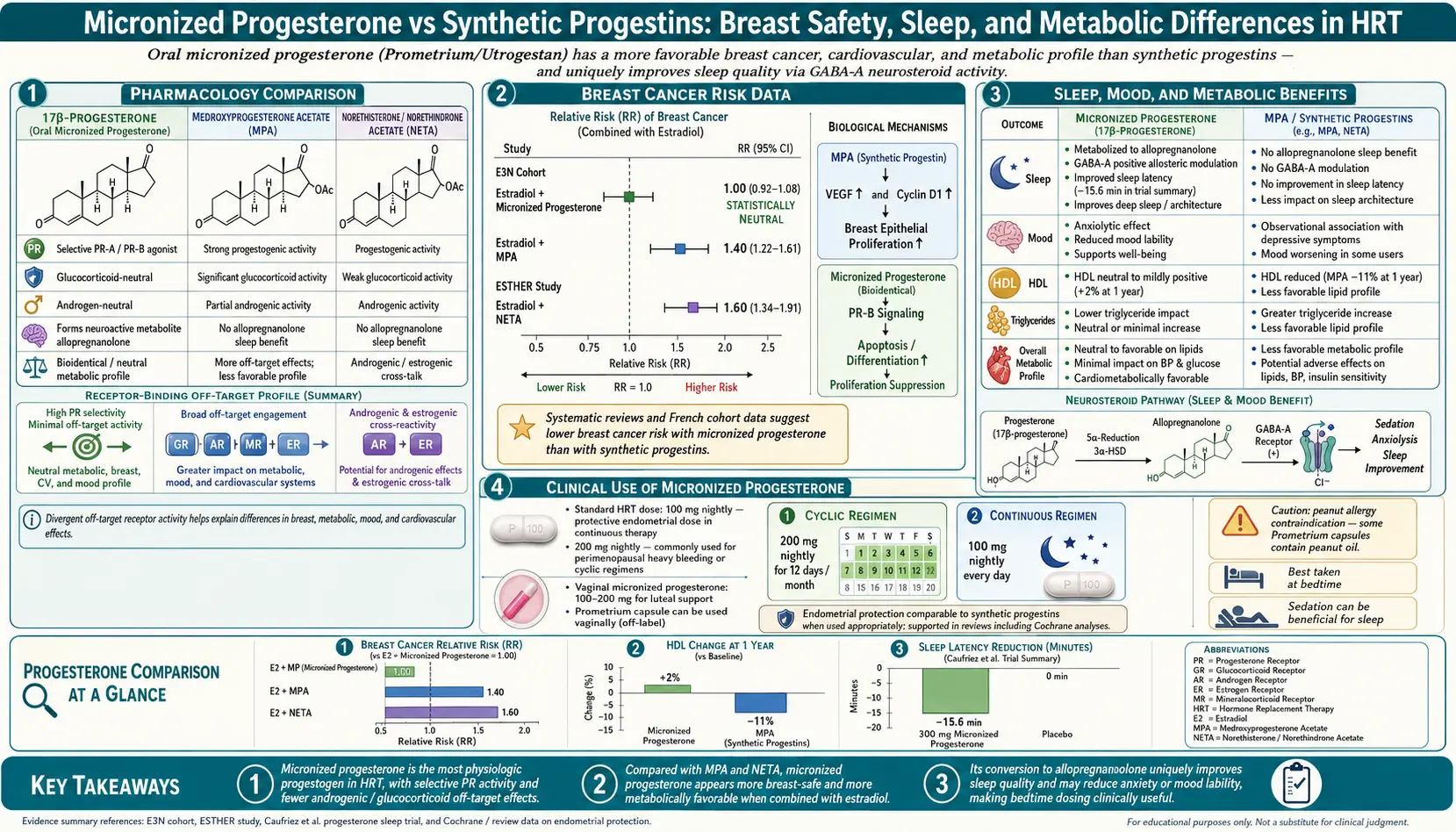
Women who have a uterus and use systemic estrogen for menopause symptoms are given a progestogen alongside it. Estrogen alone stimulates the lining of the uterus (the endometrium), and unopposed stimulation raises the risk of endometrial hyperplasia and endometrial cancer. Opposing that effect on the lining is the progestogen's job in menopausal hormone therapy (HRT); the 2022 position statement of The North American Menopause Society (NAMS, since renamed The Menopause Society) describes endometrial protection as the menopause-related indication for a progestogen.
Progestogens fall into two broad groups. Micronized progesterone is chemically identical to the progesterone made by the ovary. The synthetic progestins — medroxyprogesterone acetate (MPA), norethisterone, levonorgestrel, drospirenone, dydrogesterone and others — share progesterone's effect on the endometrium but differ from it, and from one another, in their other biological effects. The Women's Health Initiative (WHI) trial that raised the breast cancer concern in 2002 tested a single combination, conjugated equine estrogens with MPA; the WHI trial of conjugated equine estrogens alone, in women without a uterus, found lower breast cancer incidence than placebo over long-term follow-up. The two trials enrolled different women, so that contrast is not a randomized test of the progestin itself. Comparisons between progestogen types come mainly from observational studies, which are set out below with their limits.
This article sets out the differences between the two groups as the research reports them: the molecules, the doses used in trials and on labels, the breast cancer, blood clot and stroke findings, bleeding patterns, side effects, the non-oral options, and the situations in which no progestogen is used.
Interactive Visualization Menopause — run the hormones down and set off a hot flash Empty the ovarian follicle pool and watch estradiol swing, then flatten, while FSH climbs — then trigger a hot flash and see the narrowed thermoneutral zone behind it. Launch →Table of Contents
- Why Progestogen Is Needed With Estrogen
- The Two Families — Bioidentical vs Synthetic
- Micronized Progesterone — How It Works
- Synthetic Progestins — MPA, Norethisterone, Levonorgestrel
- The Breast Cancer Evidence — WHI, E3N and Pooled Studies
- Blood Clots and Stroke by Progestogen Type
- Dosing Schedules — Continuous vs Cyclical
- Bleeding Patterns — What Is Normal
- Mood, Sleep, and Other Side Effects
- Vaginal Progesterone and the Levonorgestrel IUD
- When a Progestogen Is Not Part of the Regimen
- Key Research Papers
- PubMed Topic Searches
- Connections
- Featured Videos
Why Progestogen Is Needed With Estrogen
Estrogen is a growth signal for the endometrium. Every month before menopause, rising estradiol in the first half of the cycle builds up the uterine lining; then progesterone surges after ovulation, converts the lining to a secretory state, and — if no pregnancy occurs — allows it to shed as a period. That monthly progesterone pulse is the body's natural brake on estrogen's growth effect.
Systemic estrogen in menopausal HRT is usually given every day, with no cycle to supply that brake. In the 3-year PEPI randomized trial (endometrial histology in 596 postmenopausal women aged 45 to 64), women given conjugated equine estrogens 0.625 mg alone developed simple, complex and atypical hyperplasia far more often than women on placebo (27.7% vs 0.8%, 22.7% vs 0.8%, and 11.8% vs 0%); the three estrogen-plus-progestogen regimens — cyclic MPA 10 mg for 12 days a month, continuous MPA 2.5 mg, and cyclic micronized progesterone 200 mg for 12 days a month — had hyperplasia rates similar to placebo. A 1995 meta-analysis of 30 studies put the relative risk of endometrial cancer at 2.3 (95% CI 2.1–2.5) for users of unopposed estrogen compared with non-users, and at 9.5 for 10 or more years of use.
The 2022 NAMS statement reports that when adequate progestogen is combined with systemic estrogen, the risk of endometrial neoplasia is not higher than in untreated women. In the WHI randomized trial, continuous conjugated equine estrogens plus MPA gave endometrial cancer rates similar to placebo over 5.6 years (hazard ratio 0.81, 95% CI 0.48–1.36), and NAMS cites a significant reduction after a median 13 years of cumulative follow-up (HR 0.67, 95% CI 0.49–0.91). Whether micronized progesterone gives the same protection over long use is less certain. In the French E3N cohort (65,630 postmenopausal women, mean follow-up 10.8 years), ever use of estrogen plus micronized progesterone was associated with a higher endometrial cancer risk than never use (HR 1.80, 95% CI 1.38–2.34; for more than 5 years of use, HR 2.66, 1.87–3.77), and the authors concluded that micronized progesterone at the doses used in France may not be sufficient to prevent estrogen-induced endometrial cancers. A 2016 systematic review of 28 studies reported that micronized progesterone increased endometrial cancer risk "notably, also when administered continuously."
The 2022 NAMS statement's recommendation is that women with an intact uterus who use systemic estrogen receive adequate progestogen, unless they are taking conjugated estrogens combined with bazedoxifene, a combination that studies of up to 2 years suggest protects the endometrium without a progestogen. The authors of a 2012 Cochrane review of 46 randomized trials concluded that hormone therapy for postmenopausal women with an intact uterus needs to include both an estrogen and a progestogen to reduce the risk of endometrial hyperplasia. When the FDA asked in November 2025 for the cardiovascular, breast cancer and probable-dementia language to be removed from the boxed warnings of menopausal hormone therapy labels, it kept the endometrial-cancer boxed warning on systemic estrogen-alone products.
The Two Families — Bioidentical vs Synthetic
The word "progesterone" is often used loosely. Chemically, these are distinct molecules:
- Micronized progesterone (oral capsules, sold under brand names and as generics). The U.S. label describes it as chemically identical to progesterone of human ovarian origin and states that it is synthesized from a starting material from a plant source. "Micronized" refers to the manufacturing process — the progesterone is milled into very small particles, which the label states increases its oral bioavailability, and the capsule holds it in oil. A plant starting material does not make the finished drug a plant product: the end product is the same molecule as human progesterone.
- Synthetic progestins. A 2003 classification review groups them as retroprogesterone (dydrogesterone), 17α-hydroxyprogesterone derivatives (including MPA), 19-norprogesterone derivatives, 19-nortestosterone derivatives (including norethisterone and levonorgestrel) and spironolactone derivatives (drospirenone), and notes that while the progestogenic effect is common to all of them, their other biological effects differ widely. Depending on the molecule, they also act to varying degrees on androgen, glucocorticoid or mineralocorticoid receptors, which is one reason their side-effect profiles differ.
The synthetic progestins discussed here:
- Medroxyprogesterone acetate (MPA) — a 17α-hydroxyprogesterone derivative; the progestin used, with conjugated equine estrogens, in the WHI estrogen-plus-progestin trial.
- Norethisterone / norethindrone — a 19-nortestosterone derivative (structurally related to testosterone rather than progesterone), with some androgenic activity.
- Levonorgestrel — also 19-nortestosterone-derived; the hormone released by levonorgestrel intrauterine systems (IUDs).
- Drospirenone — a spironolactone derivative with antimineralocorticoid and anti-androgenic activity; combined with estradiol in some menopausal hormone products.
- Dydrogesterone — a retroprogesterone, structurally close to progesterone; used in Europe, and with no U.S. label listed in DailyMed, the National Library of Medicine's database of U.S. drug labels.
Progestin is not progesterone. The largest randomized trial of a combined regimen, the WHI estrogen-plus-progestin trial, tested a single combination: conjugated equine estrogens with MPA.
"Bioidentical" and compounded products. The 2022 NAMS statement notes that the term "bioidentical" can be misleading because there are both government-approved and compounded bioidentical hormone therapies. FDA-approved bioidentical hormones, it states, include estradiol, estrone and micronized progesterone, which are regulated and monitored for purity and efficacy and are dispensed with package inserts; compounded preparations are made by a compounding pharmacist from a prescriber's prescription. NAMS found insufficient evidence to support overall clinical use of compounded bioidentical hormone therapy for menopause symptoms, and lists its safety concerns as minimal government regulation and monitoring, overdosing and underdosing, impurities and lack of sterility, lack of scientific efficacy and safety data, and lack of a label outlining risks. A 2012 committee opinion of the American College of Obstetricians and Gynecologists (ACOG) and the American Society for Reproductive Medicine states that evidence is lacking to support claims that compounded bioidentical hormones are superior to conventional menopausal hormone therapy, and that they carry the additional risks of variable purity and potency.
Micronized Progesterone — How It Works
The U.S. label for oral micronized progesterone directs that the capsules be taken as a single daily dose at bedtime and states that they may cause transient dizziness and drowsiness; it also describes a few women who, during initial therapy, experienced extreme dizziness or drowsiness, blurred vision, slurred speech or difficulty walking. The 2022 NAMS statement describes oral micronized progesterone as mildly sedating, reducing wakefulness without affecting daytime cognitive function, possibly through a GABA-agonistic effect, and for that reason specifies night-time dosing. The label reports that peak serum concentrations are reached within 3 hours of an oral dose.
The label states that progesterone is metabolized primarily by the liver, largely to pregnanediols and pregnanolones. Among the neurosteroid metabolites is allopregnanolone; preclinical research has shown that progesterone metabolites act as positive allosteric modulators of the GABA-A receptor, the receptor through which benzodiazepines and Z-drugs also act, and this is the mechanism proposed for the sedative effect.
A 2021 meta-analysis of randomized trials (9 trials, 388 participants, 8 of them in postmenopausal women) found that micronized progesterone improved sleep onset latency compared with placebo (effect size 7.10, 95% CI 1.30–12.91, pooled from 4 trials), while the pooled results for total sleep time and sleep efficiency were not significant; self-reported sleep improved in most trials, and concurrent estradiol use and relief of hot flashes limited conclusions in some studies.
Doses described in labels, trials and guidance:
- 200 mg at bedtime for 12 days of each 28-day cycle — the U.S. labeled regimen for preventing endometrial hyperplasia in women taking daily conjugated estrogens, and the regimen used in PEPI and in the KEEPS randomized trial (727 recently menopausal women randomized to oral conjugated equine estrogens 0.45 mg/day or transdermal estradiol 50 mcg/day, each with this progesterone regimen, or to placebo, for 48 months). The 2022 NAMS statement gives 200 mg/day for 12–14 days a month as an example of adequate dosing, and a 2016 expert-panel systematic review found oral micronized progesterone protective when given sequentially for 12–14 days a month at 200 mg/day for up to 5 years. A sequential regimen is designed to produce a monthly withdrawal bleed.
- 100 mg every day — a continuous-combined regimen intended to produce no monthly bleed. It is not the U.S. labeled regimen. The PROBES randomized trial in Sweden (protocol published 2024) is testing 100 mg daily with estradiol 1 mg for breast and endometrial safety, and its protocol notes that comparative randomized trial data are lacking.
In the United States, oral micronized progesterone capsules come in 100 mg and 200 mg strengths. The U.S. reference label lists peanut oil among the inactive ingredients and lists allergy to peanuts as a contraindication; the U.S. generic capsule labels checked in DailyMed (October 2026) also list peanut (arachis) oil.
Synthetic Progestins — MPA, Norethisterone, Levonorgestrel
Medroxyprogesterone acetate (MPA). The WHI investigators described conjugated equine estrogens 0.625 mg plus MPA 2.5 mg daily as the most commonly used combined hormone preparation in the United States. The U.S. MPA tablet label gives 5 or 10 mg daily for 12 to 14 consecutive days a month for postmenopausal women receiving 0.625 mg conjugated estrogens; continuous 2.5 mg daily was the regimen tested in the WHI and in one PEPI arm. In PEPI, both MPA regimens protected the endometrium. PEPI also measured HDL cholesterol: it rose by 1.2 to 1.6 mg/dL with the MPA regimens and by 4.1 mg/dL with cyclic micronized progesterone (5.6 mg/dL with estrogen alone; it fell by 1.2 mg/dL on placebo), and the investigators concluded that, in women with a uterus, estrogen with cyclic micronized progesterone had the most favorable effect on HDL cholesterol. In the WHI estrogen-plus-MPA trial, the risks of coronary heart disease, breast cancer, stroke and pulmonary embolism were increased (figures in the next two sections). The WHI estrogen-alone trial also found an increased stroke risk (HR 1.39, 95% CI 1.10–1.77) but no effect on coronary heart disease (HR 0.91, 0.75–1.12), so the stroke excess was not confined to the trial that included MPA.
Norethisterone / norethindrone. Structurally a modified testosterone molecule, with some androgenic activity. A 2024 systematic review of 84 randomized trials of endometrial protection found that norethisterone acetate was the most-studied progestogen, followed by MPA, micronized progesterone, dydrogesterone and levonorgestrel. The 2012 Cochrane review found that low-dose estrogen continuously combined with at least 1 mg norethisterone acetate gave a hyperplasia risk not significantly different from placebo at two years. In the United States it is combined with estradiol in tablet products.
Levonorgestrel. Also 19-nortestosterone-derived. Released from an intrauterine system, it acts mainly on the endometrium (see the section on vaginal progesterone and the levonorgestrel IUD below).
Drospirenone. Combined with estradiol in some menopausal products; it has antimineralocorticoid and anti-androgenic activity. The large UK study of hormone therapy and venous thromboembolism (Vinogradova 2019) had too few users of estradiol with drospirenone to assess that combination on its own, so it reported no separate clot estimate for it.
Dydrogesterone. In the E3N cohort, estrogen plus dydrogesterone was not significantly associated with breast cancer (relative risk 1.16, 95% CI 0.94–1.43), and in the 2019 Collaborative Group meta-analysis the breast cancer risk "appeared to be somewhat lower" for estrogen plus dydrogesterone than for other combinations. In the UK study, estradiol with dydrogesterone had the lowest venous thromboembolism estimate among the oral combined preparations (odds ratio 1.18, 0.98–1.42). In E3N, use for more than 5 years was associated with a higher endometrial cancer risk (HR 1.69, 1.06–2.70).
The Breast Cancer Evidence — WHI, E3N and Pooled Studies
Breast cancer is the outcome on which progestogen types have been compared most often. The evidence comes from one large randomized trial of a single combination and from observational studies of the others.
The Women's Health Initiative (WHI) estrogen-plus-progestin trial, 2002. 16,608 postmenopausal women aged 50 to 79 with a uterus were randomized to conjugated equine estrogens 0.625 mg plus MPA 2.5 mg daily or to placebo. The trial was stopped after a mean 5.2 years of follow-up because invasive breast cancer crossed its stopping boundary and the global index of risks and benefits supported risks exceeding benefits: hazard ratio 1.26 (nominal 95% CI 1.00–1.59), or 8 more invasive breast cancers per 10,000 person-years. Over more than 20 years of median cumulative follow-up, breast cancer incidence remained higher with estrogen plus MPA (HR 1.28, 95% CI 1.13–1.45), with no significant difference in breast cancer mortality (HR 1.35, 0.94–1.95).
The WHI estrogen-alone trial. 10,739 women with prior hysterectomy were randomized to conjugated equine estrogens 0.625 mg alone or to placebo. At an average 6.8 years, breast cancer was not increased (HR 0.77, 95% CI 0.59–1.01). In long-term follow-up, breast cancer incidence was significantly lower than with placebo (HR 0.78, 0.65–0.93), and so was breast cancer mortality (HR 0.60, 0.37–0.97). Because the two WHI trials enrolled different women (with and without a uterus), the contrast between them is not a randomized comparison of MPA against no MPA.
The French E3N cohort. A prospective cohort of French women followed by questionnaire. In the 2005 analysis (54,548 postmenopausal women, mean follow-up 5.8 years, mean hormone-therapy use 2.8 years), the breast cancer relative risk was 0.9 (95% CI 0.7–1.2) for estrogen with micronized progesterone and 1.4 (1.2–1.7) for estrogen with synthetic progestins. In the 2008 analysis (80,377 postmenopausal women, mean 8.1 postmenopausal years of follow-up, 2,354 invasive breast cancers), the relative risks were 1.00 (0.83–1.22) for estrogen plus progesterone, 1.16 (0.94–1.43) for estrogen plus dydrogesterone and 1.69 (1.50–1.91) for estrogen plus other progestagens, whose different types did not differ significantly from one another; estrogen alone was associated with 1.29 (1.02–1.65). The key 2008 paper is Fournier et al., Breast Cancer Research and Treatment. In a 2014 update (78,353 women followed 1992–2008), among women who had used hormone therapy for 5 years or less, only current users of estrogen with a progestagen other than progesterone or dydrogesterone had a significantly elevated risk (HR 1.70, 1.50–1.91); long-term current use of that type was associated with HR 2.02 (1.81–2.26).
Pooled analyses. A 2016 meta-analysis of two cohort studies and one case-control study (86,881 women) found progesterone associated with lower breast cancer risk than synthetic progestins, each given with estrogen (relative risk 0.67, 95% CI 0.55–0.81). The 2019 Collaborative Group on Hormonal Factors in Breast Cancer individual-participant meta-analysis of prospective studies (108,647 postmenopausal women who developed breast cancer) found that every type of menopausal hormone therapy except vaginal estrogen was associated with excess breast cancer risk, increasing with duration and greater for estrogen-progestagen than for estrogen-only therapy. Among current users the relative risks were 1.60 (1.52–1.69) for estrogen-progestagen and 1.17 (1.10–1.26) for estrogen-only in years 1–4, and 2.08 (2.02–2.15) and 1.33 (1.28–1.37) in years 5–14. In years 5–14, risk was higher with daily than with less frequent progestagen (2.30, 2.21–2.40, vs 1.93, 1.84–2.01). In that analysis the risk did not differ substantially by progestagen type, including the rarely used micronized progesterone (RR 2.05, 1.38–3.56, in years 5–14), although it appeared somewhat lower for estrogen plus dydrogesterone. If the associations are largely causal, the authors estimated that for women of average weight in developed countries, 5 years of therapy starting at age 50 would increase breast cancer incidence at ages 50–69 by about one in every 50 users of estrogen plus daily progestagen, one in every 70 users of estrogen plus intermittent progestagen, and one in every 200 users of estrogen alone.
Limits of the evidence. E3N and the other progestogen comparisons are observational and open to confounding. A 2018 expert-panel systematic review concluded that estrogen combined with oral or vaginal micronized progesterone does not increase breast cancer risk for up to 5 years of use, and that there is limited evidence that more than 5 years of estrogen with oral micronized progesterone is associated with an increased risk. The 2022 NAMS statement summarizes that some but not all observational data suggest micronized progesterone and dydrogesterone may have a lesser association with breast cancer than synthetic progestogens such as MPA, and that randomized trials are needed to confirm this.
Labeling. On 10 November 2025 the FDA asked the companies that hold approvals for menopausal hormone therapy to remove the cardiovascular, breast cancer and probable-dementia language from the boxed warning, while keeping the cardiovascular and breast cancer information elsewhere in the labels of systemic products. On 12 February 2026 it announced approval of the first six revised labels, covering all four product categories, one of which is systemic progestogen-alone therapy for women with a uterus who use systemic estrogen. These steps are reported on the pages FDA Requests Removal of Hormone Therapy Boxed-Warning Risks (2025) and FDA Approves New Menopausal Hormone Therapy Labels (2026).
Blood Clots and Stroke by Progestogen Type
In the WHI estrogen-plus-MPA trial, the hazard ratios were 2.13 (nominal 95% CI 1.39–3.25) for pulmonary embolism, 1.41 (1.07–1.85) for stroke and 1.29 (1.02–1.63) for coronary heart disease, corresponding to 8 more pulmonary embolisms, 8 more strokes and 7 more coronary heart disease events per 10,000 person-years. The WHI did not test other progestogens; the comparisons by type come from observational studies:
- ESTHER (France, case-control study; 271 women aged 45 to 70 with a first idiopathic venous thromboembolism and 610 controls): oral estrogen odds ratio 4.2 (95% CI 1.5–11.6), transdermal estrogen 0.9 (0.4–2.1). Micronized progesterone (OR 0.7, 0.3–1.9) and pregnane derivatives (OR 0.9, 0.4–2.3) were not significantly associated with clots; norpregnane derivatives were associated with a 4-fold increased risk (OR 3.9, 1.5–10.0).
- E3N (prospective cohort; 80,308 postmenopausal women, average follow-up 10.1 years, 549 first idiopathic clots): oral estrogen HR 1.7 (1.1–2.8), transdermal estrogen HR 1.1 (0.8–1.8). There was no significant association with progesterone (HR 0.9, 0.6–1.5), pregnanes (1.3, 0.9–2.0) or nortestosterones (1.4, 0.7–2.4); norpregnanes were associated with HR 1.8 (1.2–2.7).
- Vinogradova 2019 (UK, two nested case-control studies; 80,396 women aged 40 to 79 with venous thromboembolism and 391,494 controls): oral therapy OR 1.58 (1.52–1.64) overall, 1.40 (1.32–1.48) for estrogen-only and 1.73 (1.65–1.81) for combined preparations. Conjugated equine estrogen with MPA had the highest risk (OR 2.10, 1.92–2.31) and estradiol with dydrogesterone the lowest (OR 1.18, 0.98–1.42). Transdermal preparations were not associated with increased risk (OR 0.93, 0.87–1.01). The study did not report a separate estimate for micronized progesterone.
- Ischemic stroke (France, nested case-control study of women aged 51 to 62 in the national health-insurance database; 3,144 cases and 12,158 controls): oral estrogen OR 1.58 (1.01–2.49), transdermal estrogen 0.83 (0.56–1.24). There was no association with progesterone (OR 0.78, 0.49–1.26), pregnanes (1.00, 0.60–1.67) or nortestosterones (1.26, 0.62–2.58); norpregnanes were associated with OR 2.25 (1.05–4.81).
Vinogradova and colleagues describe the pregnane class in the French studies as including dydrogesterone and MPA, and note that those two studies were insufficiently powered and produced findings with wide confidence intervals. The 2022 NAMS statement notes that clinical trials directly comparing the risks of heart attack, stroke, breast cancer and venous thromboembolism across estrogen routes and doses are lacking, and that it is unknown whether non-oral routes carry lower risks than oral routes because trials have not been designed to examine those outcomes.
Dosing Schedules — Continuous vs Cyclical
Two main schedules are used. Both are designed to protect the endometrium; they differ in bleeding pattern and in the evidence behind each progestogen dose. The 2022 NAMS statement notes that progestogen regimens that give endometrial safety depend on the potency of the progestogen and vary with the estrogen dose, and that many women opt for regimens without periodic menstrual bleeding.
Continuous combined. Estrogen and a progestogen every day, with the aim of no bleeding. For MPA the continuous dose tested in the WHI and PEPI was 2.5 mg daily; the 2012 Cochrane review found that low-dose estrogen continuously combined with at least 1.5 mg MPA or 1 mg norethisterone acetate gave a hyperplasia risk not significantly different from placebo at two years. For micronized progesterone the continuous dose being studied is 100 mg daily, a regimen outside the U.S. label whose breast and endometrial safety is being tested in the PROBES trial; a 2016 systematic review of endometrial cancer concluded that continuous combined therapy "seems risk free, but possibly not when micronized progesterone is used."
Cyclical / sequential. Estrogen every day plus a progestogen for 12–14 days each month, followed by a progestogen-free interval during which the endometrium sheds as a withdrawal bleed. For micronized progesterone the labeled and trial schedule is 200 mg at bedtime for 12 days of each 28-day cycle (12–14 days in the NAMS example). For MPA the U.S. label gives 5 or 10 mg daily for 12 to 14 consecutive days a month, and PEPI used 10 mg for 12 days.
The 2022 NAMS statement notes that the different types and doses of progestogens, routes and regimens (sequential or continuous-combined) may have different associations with health outcomes.
Bleeding Patterns — What Is Normal
Bleeding patterns differ by schedule. What studies and guidance report:
- On cyclical dosing, a withdrawal bleed after each progestogen phase is the intended pattern of the regimen.
- On continuous combined dosing, a 1995 review of 42 studies of continuous regimens reported irregular uterine bleeding as a common problem in the first 6 months of treatment, after which most studies reported amenorrhea rates of 75% or more. In the WHI estrogen-plus-MPA trial, more women on hormones than on placebo needed endometrial biopsies (33% vs 6%), which the investigators described as a burden of assessing vaginal bleeding.
- Bleeding that guidance says to investigate: the 2022 NAMS statement's recommendation is that unscheduled bleeding occurring more than 6 months after starting estrogen-plus-progestogen therapy be investigated. In the 1995 review, the two endometrial adenocarcinomas documented occurred in women with a history of atypical hyperplasia and bleeding after established amenorrhea. For postmenopausal bleeding generally, ACOG Committee Opinion 734 (2018) describes transvaginal ultrasonography as a reasonable alternative to endometrial sampling as the first approach, notes that an endometrial thickness of 4 mm or less has a greater than 99% negative predictive value for endometrial cancer, and describes further testing such as hysteroscopy with dilation and curettage for persistent or recurrent bleeding; ACOG published a focused update of this ultrasound guidance in 2026.
Mood, Sleep, and Other Side Effects
Side-effect comparisons between progestogens come from labels, small crossover trials and observational data.
Micronized progesterone. The U.S. label's table from the 3-year, 875-woman placebo-controlled trial (cyclic 200 mg with conjugated estrogens 0.625 mg, compared with placebo) lists, among others, headache (31% vs 27%), breast tenderness (27% vs 6%), depression (19% vs 12%), dizziness (15% vs 9%) and abdominal bloating (12% vs 5%). In a randomized crossover trial in 43 postmenopausal women taking estradiol, negative mood during oral micronized progesterone treatment (30, 60 and 200 mg/day) was significantly higher when serum allopregnanolone was in the 1.5–2 nmol/L range than at lower or higher concentrations; the 30 mg dose increased negative mood while the higher doses did not, and the authors described the association as bimodal. A similar crossover trial with vaginal progesterone found that, in women without a history of premenstrual syndrome, natural progesterone caused negative mood effects similar to those induced by synthetic progestogens. The sleep findings are in the micronized progesterone section above.
Synthetic progestins. The 2022 NAMS statement lists mood swings as a progestogen-related adverse event among the more common side effects of hormone therapy, alongside nausea, bloating, weight gain, fluid retention, breakthrough bleeding, headaches and breast tenderness. In a double-blind crossover trial in 51 postmenopausal women given estradiol 2 mg with sequential MPA 10 mg or norethindrone 1 mg for 12 days of each cycle, negative mood and physical symptoms peaked in the late progestogen phase; women with a history of premenstrual syndrome responded strongly to both progestogens, MPA produced less negative mood than norethindrone in women without that history, and MPA caused more physical symptoms in both groups.
Decisions about changing a progestogen or a regimen belong with a clinician.
Vaginal Progesterone and the Levonorgestrel IUD
Two non-oral ways of giving the progestogen have been studied:
Vaginal micronized progesterone. Non-oral routes bypass the first-pass effect in the liver, as the 2022 NAMS statement notes. A 2016 expert-panel systematic review concluded that vaginal micronized progesterone may provide endometrial protection if used sequentially for at least 10 days a month as a 4% gel (45 mg/day) or every other day at 100 mg/day, for up to 3–5 years, and that this use is off-label; the same review concluded that transdermal micronized progesterone does not provide endometrial protection. The ELITE trial, described in the 2022 NAMS statement, gave women with a uterus a 45 mg progesterone vaginal gel sequentially with oral estradiol 1 mg/day.
Levonorgestrel intrauterine system (IUD). A 2006 review describes the system as delivering 20 micrograms of levonorgestrel per day into the uterus and reports that no cases of endometrial hyperplasia or carcinoma, and no significant increase in endometrial thickness, had been reported in clinical trials of its use with estrogen. Its use for endometrial protection is off-label in the United States; a 2026 review in the journal Menopause states that it is approved for this use in more than 100 countries for up to 5 years, that some systems are approved for contraception for 8 years, and that it is unresolved whether they protect the endometrium adequately with estrogen beyond 5 years. The 2022 NAMS statement notes that off-label use may spare women the systemic effects of progestogens and can protect against unwanted pregnancy in women starting hormone therapy before their final menstrual period, and that limited clinical trial data support this use.
When a Progestogen Is Not Part of the Regimen
The main situation is after hysterectomy, when there is no uterus and no endometrium to protect, so the indication NAMS gives for a progestogen does not apply. The WHI estrogen-alone trial studied conjugated equine estrogens without a progestogen in women with prior hysterectomy (findings in the breast cancer section above). The other exception NAMS names is conjugated estrogens combined with bazedoxifene. Low-dose vaginal estrogen for genitourinary symptoms is a separate case: the 2022 NAMS statement reports that it does not appear to increase endometrial cancer risk, although trials with endometrial biopsy end points last only 1 year, and its guidance does not include a progestogen with low-dose vaginal estrogen, although intermittent use may be considered in women at increased risk of endometrial cancer.
Two situations after hysterectomy are less settled, and the 2022 NAMS statement addresses neither:
- History of endometriosis. A 2017 systematic review found case reports of endometriosis recurrence and malignant transformation in women treated for menopausal symptoms, but sparse high-quality evidence (few observational studies and two randomized trials); it concluded that no definitive conclusions on risk can be drawn and that the impact of HRT on these outcomes is not known.
- Supracervical (subtotal) hysterectomy, in which the cervix is left in place. None of the trials, reviews or guidance summarized on this page reports on progestogen use after this operation.
Key Research Papers
- Fournier A, et al. Unequal risks for breast cancer associated with different hormone replacement therapies: results from the E3N cohort study. Breast Cancer Res Treat. 2008;107(1):103–11. — doi:10.1007/s10549-007-9523-x
- Writing Group for the Women's Health Initiative Investigators. Risks and benefits of estrogen plus progestin in healthy postmenopausal women: principal results from the Women's Health Initiative randomized controlled trial. JAMA. 2002;288(3):321–333. — doi:10.1001/jama.288.3.321
- Schindler AE, et al. Classification and pharmacology of progestins. Maturitas. 2003;46 Suppl 1:S7–S16. — PubMed PMID: 14670641
- Stute P, Neulen J, Wildt L. The impact of micronized progesterone on the endometrium: a systematic review. Climacteric. 2016;19(4):316–28. — PubMed PMID: 27277331
- Nolan BJ, Liang B, Cheung AS. Efficacy of micronized progesterone for sleep: a systematic review and meta-analysis of randomized controlled trial data. J Clin Endocrinol Metab. 2021;106(4):942–951. — PubMed PMID: 33245776
- Voedisch AJ. Use of progestin-containing intrauterine systems in hormone therapy regimens: what are the data? Menopause. 2026;33(1):86–87. — PubMed PMID: 40957020
- Fournier A, et al. Breast cancer risk in relation to different types of hormone replacement therapy in the E3N-EPIC cohort. Int J Cancer. 2005;114(3):448–54. — PubMed PMID: 15551359
- Fournier A, et al. Risk of breast cancer after stopping menopausal hormone therapy in the E3N cohort. Breast Cancer Res Treat. 2014;145(2):535–43. — PubMed PMID: 24781971
- Collaborative Group on Hormonal Factors in Breast Cancer. Type and timing of menopausal hormone therapy and breast cancer risk: individual participant meta-analysis of the worldwide epidemiological evidence. Lancet. 2019;394(10204):1159–1168. — PubMed PMID: 31474332
- Asi N, et al. Progesterone vs. synthetic progestins and the risk of breast cancer: a systematic review and meta-analysis. Syst Rev. 2016;5(1):121. — PubMed PMID: 27456847
- Stute P, Wildt L, Neulen J. The impact of micronized progesterone on breast cancer risk: a systematic review. Climacteric. 2018;21(2):111–122. — PubMed PMID: 29384406
- Chlebowski RT, et al. Association of menopausal hormone therapy with breast cancer incidence and mortality during long-term follow-up of the Women's Health Initiative randomized clinical trials. JAMA. 2020;324(4):369–380. — PubMed PMID: 32721007
- Anderson GL, et al. Effects of conjugated equine estrogen in postmenopausal women with hysterectomy: the Women's Health Initiative randomized controlled trial. JAMA. 2004;291(14):1701–12. — PubMed PMID: 15082697
- Anderson GL, et al. Effects of estrogen plus progestin on gynecologic cancers and associated diagnostic procedures: the Women's Health Initiative randomized trial. JAMA. 2003;290(13):1739–48. — PubMed PMID: 14519708
- The Writing Group for the PEPI Trial. Effects of hormone replacement therapy on endometrial histology in postmenopausal women. The Postmenopausal Estrogen/Progestin Interventions (PEPI) Trial. JAMA. 1996;275(5):370–5. — PubMed PMID: 8569016
- The Writing Group for the PEPI Trial. Effects of estrogen or estrogen/progestin regimens on heart disease risk factors in postmenopausal women. The Postmenopausal Estrogen/Progestin Interventions (PEPI) Trial. JAMA. 1995;273(3):199–208. — PubMed PMID: 7807658
- Harman SM, et al. Arterial imaging outcomes and cardiovascular risk factors in recently menopausal women: a randomized trial. Ann Intern Med. 2014;161(4):249–60. — PubMed PMID: 25069991
- Grady D, et al. Hormone replacement therapy and endometrial cancer risk: a meta-analysis. Obstet Gynecol. 1995;85(2):304–13. — PubMed PMID: 7824251
- Fournier A, et al. Risks of endometrial cancer associated with different hormone replacement therapies in the E3N cohort, 1992–2008. Am J Epidemiol. 2014;180(5):508–17. — PubMed PMID: 25008104
- Sjögren LL, Mørch LS, Løkkegaard E. Hormone replacement therapy and the risk of endometrial cancer: a systematic review. Maturitas. 2016;91:25–35. — PubMed PMID: 27451318
- Furness S, et al. Hormone therapy in postmenopausal women and risk of endometrial hyperplasia. Cochrane Database Syst Rev. 2012;(8):CD000402. — PubMed PMID: 22895916
- Stute P, et al. Progestogens for endometrial protection in combined menopausal hormone therapy: a systematic review. Best Pract Res Clin Endocrinol Metab. 2024;38(1):101815. — PubMed PMID: 37634998
- Lundell C, et al. Breast and endometrial safety of micronised progesterone versus norethisterone acetate in menopausal hormone therapy (PROBES): study protocol of a double-blind randomised controlled trial. BMJ Open. 2024;14(10):e082749. — PubMed PMID: 39448218
- "The 2022 Hormone Therapy Position Statement of The North American Menopause Society" Advisory Panel. The 2022 hormone therapy position statement of The North American Menopause Society. Menopause. 2022;29(7):767–794. — PubMed PMID: 35797481
- Canonico M, et al. Hormone therapy and venous thromboembolism among postmenopausal women: impact of the route of estrogen administration and progestogens: the ESTHER study. Circulation. 2007;115(7):840–5. — PubMed PMID: 17309934
- Canonico M, et al. Postmenopausal hormone therapy and risk of idiopathic venous thromboembolism: results from the E3N cohort study. Arterioscler Thromb Vasc Biol. 2010;30(2):340–5. — PubMed PMID: 19834106
- Vinogradova Y, Coupland C, Hippisley-Cox J. Use of hormone replacement therapy and risk of venous thromboembolism: nested case-control studies using the QResearch and CPRD databases. BMJ. 2019;364:k4810. — PubMed PMID: 30626577
- Canonico M, et al. Postmenopausal hormone therapy and risk of stroke: impact of the route of estrogen administration and type of progestogen. Stroke. 2016;47(7):1734–41. — PubMed PMID: 27256671
- Andréen L, et al. Allopregnanolone concentration and mood — a bimodal association in postmenopausal women treated with oral progesterone. Psychopharmacology (Berl). 2006;187(2):209–21. — PubMed PMID: 16724185
- Björn I, et al. Negative mood changes during hormone replacement therapy: a comparison between two progestogens. Am J Obstet Gynecol. 2000;183(6):1419–26. — PubMed PMID: 11120505
- Andréen L, et al. Progesterone effects during sequential hormone replacement therapy. Eur J Endocrinol. 2003;148(5):571–7. — PubMed PMID: 12720542
- Sturdee D. Levonorgestrel intrauterine system for endometrial protection. J Br Menopause Soc. 2006;12 Suppl 1:1–3. — PubMed PMID: 16513011
- Udoff L, Langenberg P, Adashi EY. Combined continuous hormone replacement therapy: a critical review. Obstet Gynecol. 1995;86(2):306–16. — PubMed PMID: 7617369
- ACOG Committee Opinion No. 734: The role of transvaginal ultrasonography in evaluating the endometrium of women with postmenopausal bleeding. Obstet Gynecol. 2018;131(5):e124–e129. — PubMed PMID: 29683909
- American College of Obstetricians & Gynecologists. Updated guidance regarding the role of transvaginal ultrasonography in evaluating the endometrium of individuals with postmenopausal bleeding. Obstet Gynecol. 2026;148(1):e87–e91. — PubMed PMID: 41990335
- Committee on Gynecologic Practice and the American Society for Reproductive Medicine Practice Committee. Committee opinion No. 532: compounded bioidentical menopausal hormone therapy. Obstet Gynecol. 2012;120(2 Pt 1):411–5. — PubMed PMID: 22825109
- Gemmell LC, et al. The management of menopause in women with a history of endometriosis: a systematic review. Hum Reprod Update. 2017;23(4):481–500. — PubMed PMID: 28498913
PubMed Topic Searches
For further reading, these PubMed topic searches return current peer-reviewed work on progestogen choice in menopausal HRT:
- Micronized progesterone versus MPA and breast cancer risk
- E3N cohort, progestogen type, and breast cancer
- Oral progesterone, sleep, and menopause
- Vaginal progesterone for endometrial protection
- Levonorgestrel IUD in menopausal hormone therapy
- Continuous combined HRT bleeding patterns
- Cyclical sequential HRT and endometrial hyperplasia
- Progestin effects on mood and depression in HRT
- Dydrogesterone and breast cancer risk in HRT
- Post-hysterectomy estrogen-only HRT outcomes
- Classification and pharmacology of progestins
- Micronized progesterone and endometrial protection in HRT
- Allopregnanolone, GABA-A modulation, and sleep
- Levonorgestrel IUD for endometrial protection in menopausal HRT
Connections
- Reproductive Medicine
- Menopause: Why the Hormones Fall and What Changes — interactive animation
- Perimenopause Symptom Tracker and Hormonal Testing
- Perimenopause
- Depression
- Estradiol Formulations: Patch, Gel, Oral Routes
- HRT Risks: Breast Cancer, Clots and Stroke
- Testosterone Therapy for Women
- Vasomotor Symptoms: Hot Flashes and Night Sweats
- Genitourinary Syndrome of Menopause and Vaginal Estrogen
- Non-Hormonal Options: SSRIs, Gabapentin, Fezolinetant
- Bone Loss Prevention and HRT
- Insomnia
- Menopause and HRT
- Cardiovascular Disease
- Hormone Panel
- Anxiety
- Testosterone
- Osteoporosis
- Endometriosis
- Covered in depth on its own page: Menopause