Rotavirus
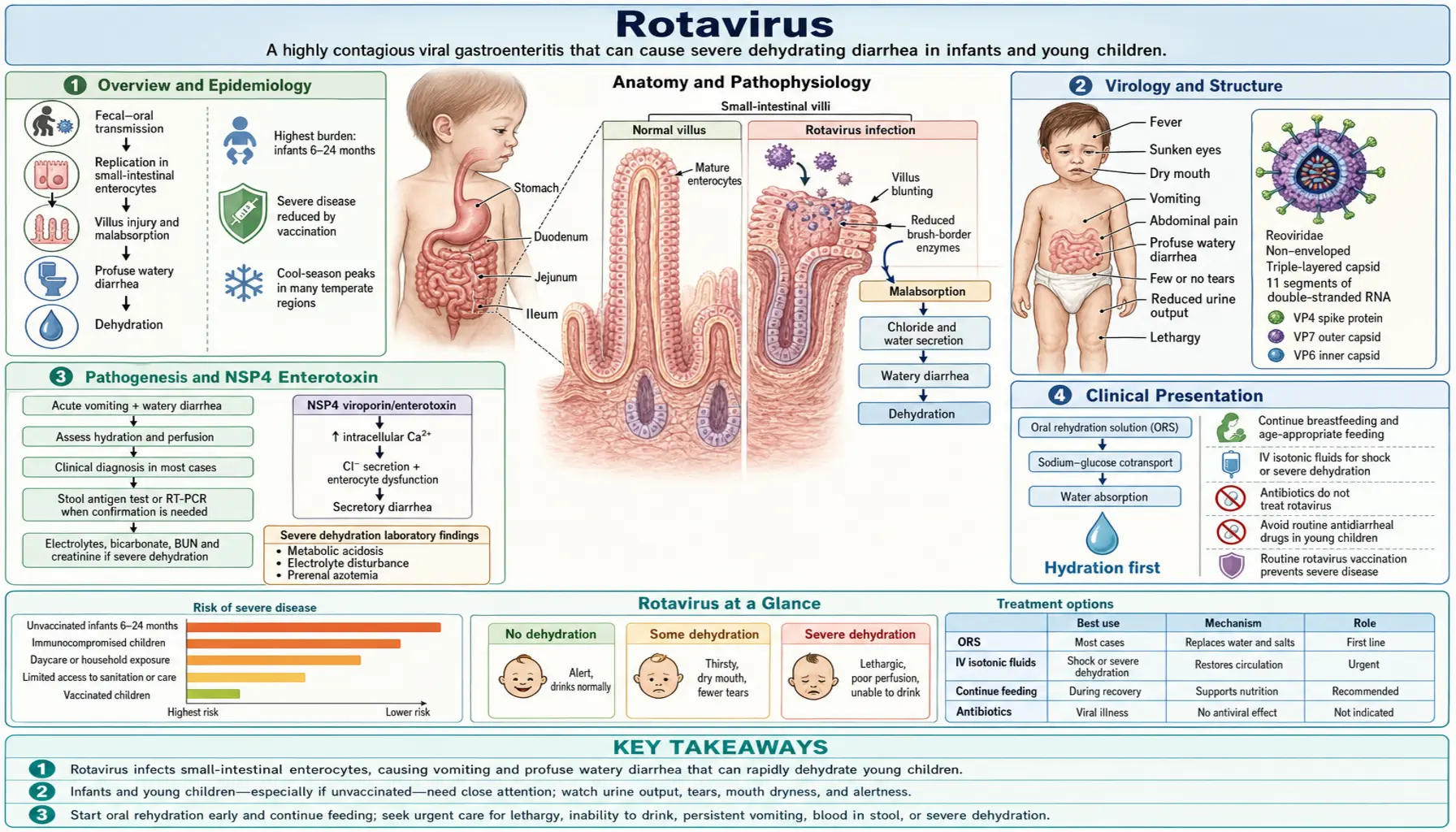
- Overview and Epidemiology
- Virology and Structure
- Pathogenesis and NSP4 Enterotoxin
- Clinical Presentation
- Diagnosis
- Treatment and Rehydration
- Assessing and Managing Dehydration
- Prevention — Vaccines
- Natural Immunity and Reinfection
- Key Research Papers
- Connections
Overview and Epidemiology
Rotavirus is the leading cause of severe diarrheal disease in young children worldwide and was, before the vaccine era, the single most important cause of childhood gastroenteritis hospitalizations in high-income countries. It is a double-stranded RNA virus belonging to the family Reoviridae that targets the mature enterocytes lining the small intestinal villi, causing a combination of malabsorption and secretory diarrhea that can rapidly dehydrate infants.
Nearly every child on earth is infected with rotavirus at least once before the age of 5, regardless of sanitation infrastructure — a defining feature that distinguishes it from most other enteric pathogens. Before widespread vaccination, rotavirus caused an estimated 527,000 deaths per year in children under 5 globally (Tate JE et al., 2012), with the greatest burden in sub-Saharan Africa and South Asia. In the United States pre-vaccine, rotavirus was responsible for approximately 55,000–70,000 hospitalizations and 20–60 deaths annually in children under 5.
Rotavirus predominantly affects infants and toddlers aged 6 to 24 months, with the highest severity in the 6–12 month age group. Neonates can be infected but often have attenuated disease, possibly due to passive maternal antibody transfer or unique neonatal intestinal physiology. Disease in older children and adults is typically mild because immunity accumulates with each successive infection.
In temperate climates, rotavirus follows a clear winter seasonality — the US "rotavirus belt" historically swept from the Southwest in November through the Northeast by March–April. This seasonal pattern has been substantially disrupted by vaccination, which blunted epidemic peaks and shifted timing in many regions. In tropical countries, rotavirus circulates year-round with less pronounced seasonality.
Virology and Structure
Rotavirus is named for its distinctive wheel-like appearance under electron microscopy (rota = Latin for wheel). The virion is a non-enveloped, triple-layered icosahedral particle approximately 75 nm in diameter — one of the most structurally complex and stable viruses known to infect humans.
Genome organization. The rotavirus genome consists of 11 segments of double-stranded RNA, each encoding one or two proteins. This segmented organization has important biological consequences: when two different rotavirus strains simultaneously infect the same cell, genome segments can be exchanged (genetic reassortment), generating novel strains. This process is analogous to influenza's genetic shift and is a major driver of rotavirus diversity.
Triple-layered capsid. The three concentric protein layers serve distinct functions:
- Inner core (VP2/VP1/VP3): VP2 encases the RNA segments; VP1 is the RNA-dependent RNA polymerase; VP3 is the capping enzyme. Together they form the replication machinery.
- Middle layer (VP6): Encoded by gene segment 6. VP6 is the most abundant structural protein and the target of the immunofluorescence-based diagnostic tests. Its subgroup antigen (SGA) defines Group A (the predominant human pathogen) from Groups B, C, etc.
- Outer layer (VP7 and VP4): VP7 is a glycoprotein (G antigen); VP4 is a protease-cleaved spike protein (P antigen) that mediates cell attachment. The combination of G and P types defines the rotavirus genotype, which determines the G-P binary classification system used in epidemiological surveillance and vaccine matching.
Common strains. Five G-P combinations account for approximately 90% of human rotavirus disease globally: G1P[8] (historically dominant in North America and Europe), G2P[4], G3P[8], G4P[8], and G9P[8]. Both licensed vaccines — Rotarix (G1P[8] monovalent) and RotaTeq (G1-G4 + G6-type VP7 pentavalent) — were designed around these dominant strains. Emerging G12 strains and P[6] strains in Africa and Asia are subjects of ongoing surveillance to ensure continued vaccine coverage.
Environmental stability. Rotavirus is extraordinarily environmentally stable. It survives on hard surfaces for days to weeks, resists many common hand sanitizers (alcohol-based formulations are less effective than soap and water), and retains infectivity in water. The infectious dose is extremely low — approximately 10 viral particles — making fecal-oral transmission efficient even with minor hygiene lapses. A single gram of stool from an infected child may contain up to 10 trillion virions.
Pathogenesis and NSP4 Enterotoxin
The pathogenesis of rotavirus diarrhea is multifactorial and involves two distinct mechanisms acting simultaneously: a malabsorptive component from enterocyte destruction and a secretory component driven by the non-structural protein NSP4 acting as a viral enterotoxin. This dual mechanism explains why rotavirus diarrhea is more severe and more rapidly dehydrating than enteritides driven by malabsorption alone.
Enterocyte infection and villus destruction. Rotavirus preferentially infects the mature, differentiated enterocytes at the tips of small intestinal villi — the cells most responsible for nutrient absorption and disaccharidase enzyme expression (including lactase, sucrase, and maltase). VP4 binds to cell surface integrins (particularly alpha2beta1 and alphaVbeta3) and sialic acid residues; VP7 interacts with heat shock cognate protein Hsc70 on the cell surface. Following receptor engagement, the virus is endocytosed and uncoated.
Viral replication within the enterocyte leads to cell death within 12–24 hours. Loss of villus tip enterocytes produces villus blunting and relative preservation of immature crypt cells (which proliferate to replace lost cells but initially lack full absorptive function). The net effect is:
- Reduced absorptive surface area → malabsorption of glucose, sodium, and water
- Lactase deficiency (secondary, due to loss of lactase-expressing villus tip cells) → osmotic diarrhea from unabsorbed lactose; this can persist for 1–2 weeks after clinical recovery and may necessitate temporary lactose reduction in formula-fed infants with severe disease
- Disrupted Na+/glucose co-transporter (SGLT1) expression → the physiological basis for why glucose-coupled ORS solutions still work (SGLT1 is partially preserved in crypt cells that survive)
NSP4: the world's first described viral enterotoxin. In 1996, Estes MK and colleagues demonstrated that the non-structural rotavirus protein NSP4 (encoded by gene segment 10) functions as an enterotoxin independent of the structural viral damage described above — the first viral protein shown to act in this way (Ball JM et al., 1996). NSP4 is a transmembrane glycoprotein that accumulates in the endoplasmic reticulum of infected cells and is secreted extracellularly.
Secreted NSP4 binds to uninfected neighboring enterocytes and activates a phospholipase C / IP3 / intracellular Ca2+ signaling cascade that mobilizes calcium from endoplasmic reticulum stores. Elevated intracellular Ca2+ triggers chloride secretion through calcium-activated chloride channels (CaCC, particularly TMEM16A) independently of cAMP — the mechanism by which classical bacterial enterotoxins like cholera toxin act. NSP4 also activates the enteric nervous system (via serotonin/5-HT3 pathway), stimulating neurally mediated fluid secretion and contributing to the vomiting response. The combined effect creates a secretory diarrhea that persists even in areas of intestine where enterocyte infection has not yet occurred.
Immune response. Rotavirus induces both innate (type I/III interferons, NK cells) and adaptive (virus-specific CD4+ and CD8+ T cells, mucosal IgA, systemic IgA/IgG) immunity. Mucosal rotavirus-specific IgA correlates most strongly with protection from subsequent disease. The adaptive immune response clears primary infection within 7–10 days, but rotavirus actively suppresses innate interferon signaling through NSP1, allowing initial establishment of infection.
Clinical Presentation
Rotavirus gastroenteritis follows a characteristic pattern that distinguishes it clinically from bacterial enteritides and other viral gastroenteritis syndromes. Recognizing this pattern helps clinicians anticipate severity and guide appropriate management.
Incubation period: 1–3 days. The interval between exposure and symptom onset is short and relatively consistent, reflecting efficient viral replication in a susceptible host.
Onset: abrupt, with vomiting preceding diarrhea. The illness typically begins abruptly with vomiting — often the dominant and most distressing early symptom — which then transitions to watery diarrhea within 12–24 hours. This vomiting-first pattern, driven by NSP4's activation of the enteric nervous system, is characteristic and clinically useful: most bacterial gastroenteritides present primarily with diarrhea, while rotavirus and norovirus begin prominently with vomiting.
Fever is present in approximately 50–60% of cases, typically in the range of 38–39°C (100.4–102.2°F), and usually resolves within the first 2 days. High fever persisting beyond 48–72 hours should raise concern for a bacterial superinfection or alternative diagnosis.
Diarrhea is watery, non-bloody, and non-mucoid — appearing pale yellow or white ("rice-water" in severe cases). Stool frequency is typically 5–10 episodes per day but can exceed 20 in severe disease. The absence of blood and mucus distinguishes rotavirus from invasive bacterial enteritides (Salmonella, Shigella, Campylobacter, enterohemorrhagic E. coli) and from inflammatory bowel disease flares. Bloody diarrhea in an infant or toddler should NOT be attributed to rotavirus and warrants further evaluation.
Duration: 3–8 days. Most children recover within 3–5 days, though diarrhea may persist up to 8 days in severe cases. A second wave of diarrhea occurring after apparent improvement may indicate secondary lactose intolerance from villus tip damage rather than treatment failure.
Dehydration risk. The combination of high-volume vomiting (limiting oral fluid intake) and high-frequency watery diarrhea (causing large fluid losses) creates a perfect storm for rapid dehydration — particularly in infants 6–24 months, who have the smallest absolute fluid reserves and the greatest surface-area-to-volume ratio driving insensible losses. Clinical dehydration develops in 40–50% of children requiring medical attention, and severe dehydration (>10% body weight lost) occurs in 10–15% of hospitalized cases.
Clinical scoring. The Vesikari Clinical Severity Scoring System (vomiting duration/frequency + diarrhea duration/frequency + maximum temperature + dehydration + treatment required) is used in clinical trials to standardize severity assessment. Scores ≥11 define severe rotavirus gastroenteritis — the primary vaccine efficacy endpoint in pivotal trials.
Atypical presentations. In immunocompromised children (primary immunodeficiencies, post-transplant, HIV-infected), rotavirus can cause protracted diarrhea lasting weeks to months with progressive malnutrition. Rotavirus has also been detected in the CSF during febrile seizures and in the blood during severe gastroenteritis in immunocompromised hosts, though systemic dissemination in immunocompetent children is rare.
Diagnosis
Rotavirus gastroenteritis is primarily a clinical diagnosis in the appropriate epidemiological context — an infant or toddler presenting in winter with abrupt-onset vomiting followed by watery non-bloody diarrhea. Laboratory confirmation is not required to initiate management and is not routinely performed in clinical practice.
When stool testing is indicated:
- Hospitalized patients (for cohorting and infection control)
- Immunocompromised children (guides antiviral decisions and duration of isolation)
- Outbreak investigation in institutional settings (day care centers, neonatal units)
- Epidemiological surveillance and vaccine effectiveness studies
- Atypical clinical features where diagnosis is uncertain
Diagnostic tests:
- Stool enzyme immunoassay (EIA) / lateral flow rapid antigen test: Detects VP6 antigen (Group A rotavirus). Sensitivity 70–95%, specificity >98%. Results available within 15–30 minutes for rapid tests. The most widely used point-of-care test in clinical and outbreak settings. May remain positive for several days after clinical recovery.
- Stool RT-PCR: Highest sensitivity (>98%) and allows G/P genotyping for surveillance. Gold standard for vaccine effectiveness studies. Not routinely needed clinically but increasingly available via multiplex gastrointestinal panels (e.g., BioFire FilmArray GI Panel, which detects rotavirus among 22 pathogens simultaneously).
- Electron microscopy: Historically used for diagnosis and identified rotavirus in 1973 (Bishop RF et al.); now supplanted by antigen tests and PCR.
Stool characteristics: Bloody or mucoid stool is NOT consistent with rotavirus and should prompt evaluation for bacterial enteritis (stool culture ± PCR for Shiga toxin-producing E. coli). Stool pH <5.5 and reducing substances in stool may indicate secondary lactose intolerance.
Blood tests are not routinely indicated. Electrolyte measurement (sodium, potassium, bicarbonate) is important when moderate-to-severe dehydration is present, as rotavirus-associated dehydration is typically isotonic (plasma sodium 130–150 mEq/L); however, hypernatremic dehydration (>150 mEq/L) can occur when caregivers offer hyperosmolar fluids or inadequate free water. Metabolic acidosis (bicarbonate <15 mEq/L) with elevated anion gap indicates significant volume depletion and lactic acidemia requiring IV correction.
Treatment and Rehydration
There is no specific antiviral therapy for rotavirus in immunocompetent children. The cornerstone of management is prevention and correction of dehydration. All other interventions are adjunctive. Antibiotics are never indicated for uncomplicated rotavirus gastroenteritis.
Oral rehydration solution (ORS): the cornerstone of treatment. ORS is one of the most impactful public health interventions of the 20th century and remains the first-line treatment for mild-to-moderate dehydration globally. The WHO/UNICEF formulation contains:
- Sodium 75 mmol/L
- Chloride 65 mmol/L
- Glucose (anhydrous) 75 mmol/L (13.5 g/L)
- Potassium 20 mmol/L
- Citrate 10 mmol/L (bicarbonate equivalent)
- Osmolarity 245 mOsm/L (reduced osmolarity, 2002 reformulation)
The glucose-sodium co-transport mechanism (SGLT1) is preserved even in rotavirus-damaged intestinal cells because crypt enterocytes — which repopulate the damaged villi — retain functional SGLT1. Each molecule of glucose absorbed carries one sodium ion and water by osmotic coupling, enabling active intestinal hydration even during active diarrhea. ORS is as effective as IV rehydration for mild-to-moderate dehydration and reduces hospitalization when started early at home.
Practical ORS administration: Give 5 mL every 1–2 minutes by teaspoon or syringe; avoid offering large volumes that trigger the vomiting reflex. If the child vomits, wait 5–10 minutes then restart. Electrolyte solutions (Pedialyte, Enfalyte) are appropriate; avoid juice, sports drinks, and broth — their electrolyte composition is inappropriate for rehydration. Continue age-appropriate diet alongside ORS once vomiting has subsided (do not withhold feeds).
IV rehydration is required for severe dehydration (>10% body weight), shock (altered consciousness, absent or faint pulses, extreme tachycardia), inability to drink or persistent vomiting preventing ORS administration, or signs of ileus. Standard initial resuscitation: 20 mL/kg isotonic saline (0.9% NaCl) or Ringer's lactate as a rapid bolus, repeated until circulation improves. Subsequent fluid therapy targets deficit replacement over 4–6 hours plus ongoing losses.
Ondansetron (Zofran). A 5-HT3 receptor antagonist that reduces vomiting and improves ORS tolerance. A single oral dose (0.15 mg/kg, max 8 mg) significantly reduces vomiting frequency, decreases IV fluid requirement, and reduces hospitalization rates in children with gastroenteritis-related vomiting. Meta-analyses confirm clinical benefit with an acceptable safety profile. Ondansetron is now standard in ED management of pediatric gastroenteritis with prominent vomiting where ORS is otherwise not tolerated.
Zinc supplementation. WHO guidelines recommend 10 mg/day (infants <6 months) or 20 mg/day (children ≥6 months) for 10–14 days in children with acute diarrhea in developing countries. Multiple RCTs demonstrate that zinc supplementation reduces diarrhea duration by approximately 18–24 hours and severity by ~30%, and reduces the risk of subsequent diarrheal episodes for up to 3 months. The mechanism involves enhancement of intestinal immune function and enterocyte repair. Zinc is most beneficial in populations with underlying zinc deficiency, which is common in low-income countries; evidence in well-nourished children in high-income settings is weaker.
Probiotics. Some evidence supports modest reduction in diarrhea duration with specific probiotic strains (particularly Lactobacillus rhamnosus GG and Saccharomyces boulardii). However, effect sizes are modest (approximately 1 day reduction in duration), trial quality is variable, and the 2018 AAP clinical report downgraded recommendations due to heterogeneity of evidence. Probiotics are not routinely recommended but are unlikely to cause harm in immunocompetent children.
Nitazoxanide. An antiprotozoal and antiviral agent with documented in vitro activity against rotavirus. Small RCTs in immunocompromised and healthy children suggest modest clinical benefit. Not approved by the FDA specifically for rotavirus, and not currently recommended as standard therapy in immunocompetent children. May have a role in immunocompromised patients with prolonged rotavirus diarrhea.
Assessing and Managing Dehydration
Accurate dehydration assessment is the most critical clinical skill in managing rotavirus gastroenteritis. Underestimating dehydration risks preventable complications including shock, seizures (from electrolyte disturbance), and acute kidney injury. Overestimating triggers unnecessary IV placement and hospitalization.
WHO/IMCI dehydration classification:
- No dehydration (<3% body weight lost): Normal sensorium, moist mucous membranes, normal skin turgor (pinch recoil <2 seconds), normal eyes, urine output normal. Management: maintenance ORS + early refeeding at home.
- Some dehydration (3–9% body weight lost): Restless or irritable, slightly sunken eyes, dry mucous membranes, skin recoil 2–3 seconds, decreased urine output. Management: ORS 50–100 mL/kg over 4 hours in medical setting; reassess.
- Severe dehydration (>10% body weight lost): Lethargic or unconscious, sunken eyes + fontanelle, very dry mucous membranes, skin recoil >3 seconds ("tenting"), absent or greatly reduced urine output, shock signs (tachycardia, weak or absent peripheral pulses, prolonged capillary refill >3 seconds, altered consciousness). Management: immediate IV resuscitation with 20 mL/kg isotonic saline bolus; do not attempt ORS until circulation restored.
Important caveats:
- Skin turgor is less reliable in malnourished children (skin tents even without dehydration) and in hypernatremic dehydration (skin may remain turgid even with significant fluid deficit because intracellular water is better preserved when plasma osmolality is high)
- Capillary refill time is unreliable in cold environments and in dark-skinned infants — assess in a warm room with adequate lighting
- Weight loss (comparing to a recent pre-illness weight) is the most objective dehydration measure when available
- Sunken eyes and fontanelle are specific but insensitive — absence does not exclude dehydration
Electrolyte monitoring in hospitalized patients. Obtain serum sodium, potassium, bicarbonate, BUN, and creatinine in any child requiring IV fluids. Correct hypokalemia (common in prolonged diarrhea) by adding potassium to IV fluids once urine output is established. Correct hypernatremia slowly (reduce plasma sodium by no more than 10–12 mEq/L per day) to prevent cerebral edema from rapid osmotic shifts.
Prevention — Vaccines
The development and global implementation of rotavirus vaccines represents one of the greatest achievements of 21st-century pediatric medicine. Two vaccines are currently WHO-prequalified and widely used:
Rotarix (GlaxoSmithKline). A live attenuated oral vaccine containing a single human G1P[8] strain (derived from a natural human rotavirus isolate). Administered as two oral doses at 2 and 4 months of age. Rotarix provides broad protection through cross-reactive immune responses to non-G1 strains (G2, G3, G4, G9) as well as the homologous G1 strain. Phase 3 trials demonstrated >85% efficacy against severe rotavirus gastroenteritis in high-income settings and 50–73% in low-income African and Asian settings.
RotaTeq (Merck). A live reassortant oral vaccine containing five human-bovine reassortant viruses expressing human rotavirus VP7 antigens G1, G2, G3, G4, and the human P[8] antigen on bovine VP7 backbone. Administered as three oral doses at 2, 4, and 6 months of age. The pivotal REST trial (Vesikari T et al., 2006) demonstrated 98% efficacy against severe rotavirus gastroenteritis and 96% reduction in hospitalizations due to rotavirus in the first rotavirus season after vaccination.
Real-world impact in the United States. Following ACIP recommendation and routine vaccination beginning in 2006, rotavirus hospitalizations in US children under 5 declined by 85–90% within 3 years. Rotavirus emergency department visits and outpatient visits declined by 50–60%. Herd protection extended to unvaccinated infants too young for vaccination and to adults, demonstrating indirect community immunity effects.
Global deployment. As of 2023, rotavirus vaccine has been introduced into national immunization programs in over 120 countries. WHO estimates that rotavirus vaccination prevents approximately 150,000–200,000 deaths per year globally, with the largest absolute mortality reduction in sub-Saharan Africa. The GAVI Alliance has facilitated introduction in low-income countries at subsidized prices.
Safety: intussusception. An earlier rotavirus vaccine (RotaShield, 1999) was withdrawn from the US market after post-marketing surveillance identified a small but real increased risk of intussusception (approximately 1 in 10,000 vaccine recipients). The current vaccines (Rotarix and RotaTeq) were studied in pre-licensure trials explicitly designed to rule out a similar risk and showed no significant intussusception signal. However, post-licensure surveillance in some countries (Australia, Mexico, Brazil) identified a very small increased risk of intussusception following dose 1, approximately 1–6 excess cases per 100,000 first doses. This risk is substantially smaller than the intussusception risk avoided by preventing rotavirus disease itself; for every excess intussusception case attributable to vaccination, the vaccine prevents thousands of hospitalizations and dozens of deaths. Current guidance supports continued vaccination with awareness of the small absolute risk.
Administration precautions: Rotavirus vaccines are live oral vaccines; they are contraindicated in infants with severe combined immunodeficiency (SCID) (fatal vaccine-derived rotavirus disease has been reported) and should not be administered after 15 weeks of age for dose 1 or after 8 months for the last dose. Shedding in stool occurs for up to 15 days after vaccination; immunocompromised household contacts should be counseled about hand hygiene.
Natural Immunity and Reinfection
Immunity following rotavirus infection is protective but incomplete, and reinfection is the rule rather than the exception. Understanding this pattern explains both the epidemiology of disease across the lifespan and the immunological basis for vaccine efficacy.
Protection by infection number. The first rotavirus infection (typically during infancy) tends to be the most severe, often causing clinically significant dehydration requiring medical attention. The second infection (typically toddlerhood) is usually milder, with shorter duration and fewer stool episodes. By the third or fourth infection, disease is generally subclinical. This stepwise immunity means that adolescents and adults who are re-exposed may experience vomiting and loose stools but rarely develop the dehydrating illness seen in infants. This pattern was elegantly documented in the Bangladeshi birth cohort studies of Velazquez FR and colleagues.
Correlates of protection. Serum rotavirus-specific IgA antibodies correlate best with protection from disease in natural infection and vaccination studies. Mucosal IgA in the intestinal lumen provides the first line of defense against reinfection. Serum IgA levels >200 U/mL are generally considered protective. Cell-mediated immunity (rotavirus-specific CD8+ cytotoxic T lymphocytes) contributes to viral clearance during active infection but correlates less consistently with protection from disease on re-exposure.
Strain heterogeneity and reinfection. While immunity following natural infection or vaccination is broadly cross-protective (heterotypic immunity), it is not completely type-independent. Infection with G1P[8] produces strong homotypic protection against G1P[8] reinfection but partial heterotypic protection against G2P[4] or G12P[8] strains. Strain evolution and emergence of novel genotypes is therefore a continuing challenge for both vaccine coverage and natural immunity landscapes.
Maternal antibodies. Transplacental transfer of maternal rotavirus IgG provides partial passive protection to neonates, particularly in the first weeks of life. This may explain why neonatal rotavirus infections, though common, are often asymptomatic or mild. Breast milk containing secretory IgA and lactoferrin also confers some protection; exclusive breastfeeding is associated with lower rates of symptomatic rotavirus infection in observational studies, though it does not fully prevent disease.
Key Research Papers
- Search PubMed — Landmark phase 3 trial of RotaTeq in 68,038 infants demonstrating 98% efficacy against severe rotavirus gastroenteritis and 96% reduction in hospitalizations due to any rotavirus strain, establishing the evidence base for universal infant rotavirus vaccination in the United States.
- Ruiz-Palacios GM et al., 2006 — Safety and Efficacy of an Attenuated Vaccine against Severe Rotavirus Gastroenteritis (Rotarix) — New England Journal of Medicine — PMID: 16549574 — Phase 3 trial of Rotarix in 63,225 infants in Latin America, demonstrating 85% efficacy against severe rotavirus gastroenteritis and 96% against hospitalizations due to rotavirus, leading to WHO prequalification and global deployment.
- Search PubMed — Original paper demonstrating that NSP4 functions as a viral enterotoxin — the first viral protein shown to cause diarrhea by direct secretory mechanisms — establishing a new paradigm for understanding rotavirus pathogenesis beyond simple enterocyte destruction.
- Search PubMed — Systematic analysis estimating 453,000 rotavirus deaths per year globally in children under 5 in 2008, establishing the scale of the pre-vaccine burden and providing the primary justification for global vaccine scale-up.
- Search PubMed — Comprehensive epidemiological analysis documenting the dramatic reductions in rotavirus hospitalizations and emergency visits in the United States (85–90% decline) within 3 years of vaccine introduction, confirming real-world effectiveness exceeding trial estimates.
- Search PubMed — Post-licensure surveillance study identifying a very small increased risk of intussusception following rotavirus vaccination (approximately 1–5 excess cases per 100,000 first doses) while demonstrating that the public health benefits of vaccination greatly outweigh this rare risk.
- Search PubMed — Comprehensive evidence-based clinical guidelines establishing ORS as cornerstone therapy and supporting ondansetron use for vomiting in pediatric gastroenteritis management.
- Search PubMed — Randomized controlled trial demonstrating that a single oral dose of ondansetron significantly reduced vomiting, decreased IV fluid requirements, and reduced hospitalization rates in children with acute gastroenteritis presenting to the emergency department.
- Search PubMed — Prospective birth cohort study in Mexico City demonstrating that successive rotavirus infections confer progressively greater protection, with the first infection preventing severe disease in 77% of subsequent infections and the second infection preventing all severe disease — establishing the natural immunity gradient that informs vaccine design.
- Search PubMed — Systematic review and meta-analysis of zinc supplementation in childhood diarrhea confirming significant reductions in duration and severity and supporting WHO recommendations for zinc supplementation during acute diarrheal illness in resource-limited settings.
- Search PubMed — Original discovery paper identifying rotavirus (then called "duovirus") in intestinal epithelial cells of children with gastroenteritis by electron microscopy — the foundational discovery leading to understanding of the world's most common cause of severe childhood diarrhea.
- PubMed: reduced osmolarity ORS rotavirus diarrhea meta-analysis — Hahn S et al. and subsequent WHO meta-analysis establishing the superiority of the reduced-osmolarity ORS (245 mOsm/L) over the original higher-osmolarity formula (311 mOsm/L) for childhood diarrhea, leading to the 2002 WHO reformulation that is now the global standard.
Connections
- Pediatrics
- RSV Bronchiolitis
- Kawasaki Disease
- Croup
- Acute Gastroenteritis
- Norovirus
- Cholera
- Zinc
- Dehydration