Rotator Cuff Tear
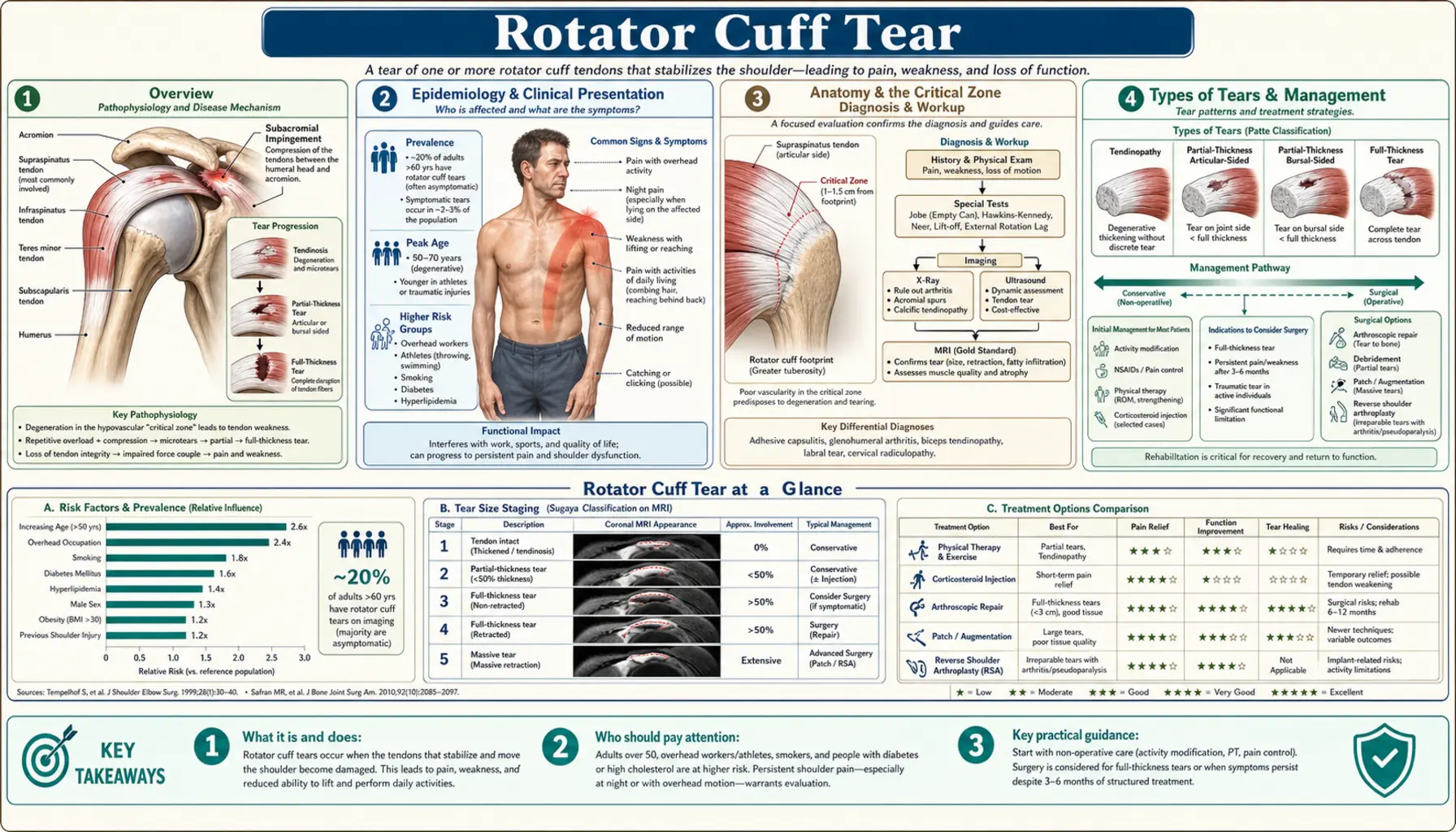
Table of Contents
1. Overview
The rotator cuff is a group of four muscles and their tendons that wrap around the humeral head, holding the ball of the shoulder against the socket while the arm moves. When one or more of those tendons tears, the shoulder can lose both stability and strength. Disorders of the rotator cuff tendons are among the most common causes of shoulder pain and disability, according to a 2013 Cochrane review (Lenza and colleagues). In an ultrasound screening of 664 residents of one Japanese village, 22.1% had a full-thickness rotator cuff tear, and about two-thirds of those tears caused no symptoms (Minagawa and colleagues, 2013).
Rotator cuff tears range from partial fraying of the tendon fibers to a complete rupture of one or more tendons. Randomised trials have compared physiotherapy with surgical repair, mostly in older adults with small, non-traumatic tears, and their results differ with tear size, follow-up length and outcome measure; they are summarised in the Treatment and Surgical Management sections below.
2. Epidemiology
Rotator cuff tears become much more common with age. In the Japanese village screening, full-thickness tears were found in 0% of people in their 20s to 40s, 10.7% in their 50s, 15.2% in their 60s, 26.5% in their 70s and 36.6% in their 80s; tears were more common in men than in women in the 50s and 60s, but not in the 70s and 80s (Minagawa and colleagues, 2013). A 2014 pooled analysis of 30 studies (6,112 shoulders) found rotator cuff abnormalities in 9.7% of people aged 20 and younger and in 62% of those aged 80 and older, with a similar rise with age whether or not people had symptoms; the authors concluded that cuff degeneration can be considered a common part of normal aging, which makes it hard to tell whether a tear seen on imaging is the cause of a person's pain (Teunis and colleagues).
Among the patterns reported:
- Age is strongly linked to tears. In 588 consecutive patients with pain in one shoulder who had ultrasound of both shoulders, the average age was 48.7 years in those with no tear, 58.7 years in those with a tear on one side and 67.8 years in those with tears on both sides; after age 66 the likelihood of tears in both shoulders was 50% (Yamaguchi and colleagues, 2006).
- Symptomatic tears tended to be larger. In the same study, when one shoulder's tear was painful and the other's was not, the painful tear was on average 30% larger, and 35.5% of people with a painful full-thickness tear had a full-thickness tear on the other side as well.
- Traumatic and degenerative tears differ. A tear can follow a single injury, such as a fall or a sudden heavy load, or develop gradually. The 2019 Cochrane review of surgery noted that the trials comparing surgery with non-operative treatment mostly enrolled people with small degenerative supraspinatus tears, so their findings may not apply to traumatic tears, large tears involving the subscapularis, or young people (Karjalainen and colleagues).
3. Anatomy and the Critical Zone
Four muscles form the rotator cuff, each with a distinct role:
- Supraspinatus helps lift the arm away from the body (abduction). It runs beneath the acromion through the subacromial space and is the tendon most often involved in tears; most of the randomised trials described below enrolled people with supraspinatus tears. The part of the tendon near its attachment on the greater tuberosity is often called the "critical zone", a region described as having a relatively poor blood supply.
- Infraspinatus rotates the arm outward (external rotation). In Goutallier's 1994 CT study, fatty degeneration of the infraspinatus muscle was linked to weaker active external rotation and to worse results after supraspinatus repair.
- Subscapularis sits at the front of the shoulder and rotates the arm inward. In the same CT study it rarely showed fatty degeneration, and when it did the change was moderate.
- Teres minor assists with external rotation.
The four tendons blend together near their attachments on the humerus to form a nearly continuous "cuff", which is why large tears can involve more than one tendon.
4. Types of Tears
Partial versus full-thickness tears
Partial-thickness tears involve only part of the tendon's thickness. They can occur on the articular surface (the underside of the tendon, facing the joint) or on the bursal surface (the upper side, facing the subacromial bursa). Ellman's 1990 paper proposed a grading system for partial-thickness tears based on their location, depth and area, so that results from different investigators could be compared, and noted that the precise extent of a partial tear is difficult to define on imaging and is documented at arthroscopy.
Full-thickness tears pass completely through the tendon. They are described by size and by the number of tendons involved. Trials often group them by size: the Norwegian repair-versus-physiotherapy trial enrolled tears not exceeding 3 cm (Moosmayer and colleagues), and a 2026 meta-analysis of single-row versus double-row repair split tears at 30 mm (Seok and colleagues). Fatty degeneration and wasting of the cuff muscles, seen on CT or MRI, did not reverse after repair in two cohort studies and were linked to poorer function (Goutallier and colleagues, 1994; Gladstone and colleagues, 2007).
Traumatic versus degenerative
Traumatic tears follow a single injury in a tendon that was previously intact or only mildly worn. Degenerative tears develop over years; Ellman described the tissue changes that lead to rupture as gradual and progressive. As noted above, most randomised evidence on treatment comes from people with non-traumatic, degenerative tears.
5. Clinical Presentation and Special Tests
Common complaints are pain with overhead activity, pain at night, and weakness in movements that depend on the torn tendon. A clinical examination uses provocation and strength tests to suggest which structure is involved. A 2012 systematic review with meta-analysis of shoulder examination tests concluded that no single test can make the diagnosis on its own, and that combinations of tests improve accuracy only marginally (Hegedus and colleagues).
Special physical examination tests by tendon
Tests commonly described in the shoulder examination:
- Neer impingement sign. The examiner raises the patient's arm forward while stabilising the shoulder blade; pain suggests subacromial impingement. Pooled sensitivity 72% and specificity 60% for subacromial impingement (Hegedus and colleagues, 2012).
- Hawkins-Kennedy test. The shoulder is raised forward to 90 degrees and then turned inward. Pooled sensitivity 79% and specificity 59% for subacromial impingement (Hegedus and colleagues, 2012).
- Painful arc. Pain during a middle range of arm elevation. Pooled sensitivity 53% and specificity 76% for subacromial impingement (Hegedus and colleagues, 2012).
- Empty can (Jobe) test — supraspinatus. The arm is raised in the plane of the shoulder blade with the thumb pointing down while the patient resists downward pressure; pain or weakness points to the supraspinatus. The 2012 review listed a lateral variant of the Jobe test among tests for rotator cuff tear with promising accuracy in a single low-bias study.
- External rotation resistance — infraspinatus. With the elbow bent at the side, the patient resists the examiner turning the forearm inward.
- Lift-off and belly press tests — subscapularis. The patient pushes the back of the hand away from the lower back, or presses the hand against the abdomen. The 2012 review listed the belly-off and modified belly press tests for subscapularis problems among tests with high sensitivity and specificity in low-bias studies, each studied only once.
- Drop arm sign. The arm is raised and the patient is asked to lower it slowly; an arm that drops suddenly suggests a large tear.
6. Diagnosis
Imaging is used to confirm a tear, measure it and plan treatment. Plain radiographs show the bones and joint. MRI, MR arthrography (MRI after contrast is injected into the joint) and ultrasound are used to assess the tendons.
- Accuracy for full-thickness tears. A 2013 Cochrane review of 20 studies (1,147 shoulders) in people being considered for surgery found summary sensitivity and specificity of 94% and 93% for MRI, 94% and 92% for MR arthrography, and 92% and 93% for ultrasound, with no statistically significant difference between them. The authors judged that any of the three could be used to detect full-thickness tears, while noting that most studies were small and methodologically flawed (Lenza and colleagues).
- Accuracy for any tear. In the same review, summary sensitivity and specificity for any tear (partial or full thickness) were 98% and 79% for MRI and 91% and 85% for ultrasound. Both MRI and ultrasound may have poor sensitivity for partial-thickness tears, and the sensitivity of ultrasound may be much lower than that of MRI.
- MR arthrography. A 2009 meta-analysis of 65 articles found MR arthrography more sensitive and specific than MRI or ultrasound for both partial- and full-thickness tears, and no significant difference between MRI and ultrasound (de Jesus and colleagues).
- Muscle quality. Goutallier's 1994 study graded fatty degeneration of the cuff muscles on CT in five stages. In a 2007 prospective MRI study of 38 repairs, atrophy and fatty infiltration of the infraspinatus were the only independent predictors of shoulder scores one year after repair, tear size was the only independent predictor of whether the repair stayed intact, and neither atrophy nor fatty infiltration improved after a successful repair (Gladstone and colleagues).
7. Conservative Treatment
Non-operative care usually combines exercise therapy, pain relief and, in some cases, injections. The trials below compared it with surgery.
Physical therapy
Rehabilitation programmes for the rotator cuff commonly include:
- Rotator cuff strengthening — progressive resistance exercises for the supraspinatus, infraspinatus and subscapularis within a pain-free range.
- Shoulder-blade (periscapular) strengthening — exercises for the serratus anterior, trapezius and rhomboids to control the position of the shoulder blade.
- Posterior shoulder stretching — such as cross-body and sleeper stretches.
What the randomised trials comparing physiotherapy with surgery found:
- Finnish trial, patients over 55 (Kukkonen and colleagues). 180 shoulders with symptomatic non-traumatic supraspinatus tears were randomised to physiotherapy, acromioplasty plus physiotherapy, or cuff repair plus acromioplasty plus physiotherapy. At one year there were no between-group differences in the Constant score (Kukkonen 2014). After a mean of 6.2 years (150 shoulders, mean baseline tear size 10 mm), there were still no significant differences in the Constant score, pain or satisfaction; 8 shoulders in the physiotherapy group and 2 in the acromioplasty group had crossed over to repair, and surgery did not prevent progression of shoulder arthritis or cuff tear arthropathy (Kukkonen 2021).
- Norwegian trial, tears up to 3 cm (Moosmayer and colleagues). 103 patients were randomised to primary tendon repair or physiotherapy, with later repair allowed if needed. At five years, primary repair scored better (5.3 points on the Constant score, 9.0 points on the ASES score, 1.1 cm on a 10-cm pain scale), differences the authors described as small and possibly below clinical importance; 37% of tears treated with physiotherapy alone had grown by more than 5 mm, which was associated with a worse outcome (Moosmayer 2014). At ten years the differences had increased, to 9.6 points on the Constant score and 1.8 cm on the pain scale in favour of primary repair (Moosmayer 2019).
- Cochrane review (Karjalainen and colleagues, 2019). Across 9 trials (1,007 participants), the review concluded that it is uncertain whether repair surgery provides clinically meaningful benefits for symptomatic tears, and that it may provide little or no clinically important benefit for pain, function, quality of life or global success at one year compared with non-operative treatment. The trials had methodological concerns, none had a placebo-surgery control, and they mostly enrolled small degenerative supraspinatus tears.
Subacromial corticosteroid injection
A 2010 Lancet systematic review of 41 randomised trials of injections for tendinopathy found that corticosteroid injections consistently reduced pain in the short term compared with other interventions, but that this effect reversed at intermediate and long term in the pooled analysis for tennis elbow; for rotator cuff tendinopathy, the authors reported that the short-term efficacy of corticosteroid injections was not clear. Of 991 participants given corticosteroid injections in studies that reported adverse events, one (0.1%) had a serious adverse event, a tendon rupture (Coombes and colleagues).
Platelet-rich plasma (PRP)
PRP is a concentrate prepared from the patient's own blood. Its evidence differs by use:
- Injections without surgery. A 2019 systematic review of 5 randomised trials (214 patients) concluded that the limited evidence suggests PRP injections may not be beneficial in the short term for chronic rotator cuff disease, and that PRP did not give better function, pain or range of motion when compared directly with exercise therapy (Hurley, Hannon and colleagues). A 2021 meta-analysis of 8 randomised trials reached a different conclusion, that PRP injection was safe and effective for long-term pain and shoulder function, while noting that PRP preparation and control treatments varied between studies (A Hamid and Sazlina).
- Added to surgical repair. A 2019 meta-analysis of 18 randomised trials (1,147 patients) found lower rates of incomplete tendon healing with PRP (17.2% vs 30.5%) and small improvements in the Constant score and pain (Hurley, Lim Fat and colleagues). A 2025 meta-analysis of 9 randomised trials (537 patients) of full-thickness tears found no difference in pain, function, complications or re-tear rate with PRP added to arthroscopic repair (Xue and colleagues).
8. Surgical Management
Which tears are repaired, and when, is decided case by case. Findings that bear on the decision include the trials above, the observation in two cohort studies that fatty degeneration of the cuff muscles does not reverse after repair (Goutallier and colleagues, who wrote that it seems preferable to operate on wide tears before irreversible muscle damage; Gladstone and colleagues), and the 2019 Cochrane review's caution that the trial evidence comes mainly from small degenerative tears.
Arthroscopic rotator cuff repair
In repair, the torn tendon edge is reattached to its footprint on the humerus with sutures and bone anchors, through either small arthroscopic portals or an open incision. The UK UKUFF trial randomised 273 patients with degenerative tears to arthroscopic or open repair and found no difference in the Oxford Shoulder Score at two years (41.7 vs 41.5); re-tear rates at one year were high in both groups (46.4% arthroscopic, 38.6% open) for all tear sizes and ages, and healed repairs had the greatest improvement (Carr and colleagues, 2017). Two main anchor configurations are used:
- Single-row repair — one row of anchors fixes the tendon edge.
- Double-row repair — a medial and a lateral row of anchors cover a broader footprint.
A 2026 meta-analysis of 18 randomised trials (1,308 patients) found lower overall re-tear rates and slightly better UCLA scores and forward flexion with double-row repair, at the cost of longer operating time; for tears of 30 mm or more, double-row repair was superior in scores and re-tear rates, while for tears under 30 mm there was no significant difference (Seok and colleagues).
Subacromial decompression. Removal of bone spur and soft tissue under the acromion (acromioplasty) is often performed for shoulder pain, sometimes together with repair. Two placebo-controlled trials tested it in people with subacromial pain: in the UK CSAW trial, which excluded full-thickness tears, decompression gave no extra benefit over diagnostic arthroscopy alone at 6 months, and both surgical groups' small advantage over no treatment was not clinically important (Beard and colleagues, 2018); in the Finnish FIMPACT trial, decompression provided no benefit over diagnostic arthroscopy at 24 months (Paavola and colleagues, 2018).
Massive and irreparable tears
When a tear cannot be repaired because of retraction, severe fatty infiltration or poor tissue, several procedures are reported:
- Superior capsule reconstruction (SCR) — a graft is fixed between the top of the socket and the humerus to restore stability. In the original case series of 24 shoulders treated with a fascia lata graft, followed for 24 to 51 months, active elevation rose from 84° to 148°, the ASES score from 23.5 to 92.9, and 83.3% had no graft tear or tendon re-tear (Mihata and colleagues, 2013; no comparison group).
- Reverse total shoulder arthroplasty (RTSA) — reverses the ball-and-socket so the deltoid, rather than the cuff, powers elevation. A 2021 systematic review of 11 studies of RTSA for massive irreparable tears without arthritis found improved outcomes in all of them and described it as a reliable option for older patients with persistent pain and loss of function, but reported relatively high complication rates and caution in patients who still had active forward elevation before surgery; it noted that joint-preserving options deserve consideration in younger patients (Viswanath and colleagues).
- Tendon transfer — a nearby tendon is moved to take over the torn tendon's job. A 2026 meta-analysis of 14 studies of arthroscopically assisted lower trapezius transfer for irreparable posterosuperior tears reported improvements of 27.9° in external rotation and 32.5 points in the ASES score, graft healing of 89.4%, complications in 3.70% and conversion to reverse arthroplasty in 2.08% (Baek and colleagues; level IV evidence).
9. Complications and Outcomes
The most studied complication after repair is re-tear. A 2015 meta-analysis of 108 articles (over 8,011 shoulders) found a weighted mean re-tear rate of 26.6% at a mean of 23.7 months; re-tears were associated with more fatty infiltration, larger tear size, older age and, in that dataset, double-row repair. Patient-reported outcomes generally improved whether or not the repair healed (McElvany and colleagues). In the UKUFF trial, re-tear rates at one year were 46.4% after arthroscopic and 38.6% after open repair, and healed repairs had the best scores (Carr and colleagues).
Galatz and colleagues (2004) followed 18 patients after arthroscopic repair of large and massive tears (more than 2 cm). Ultrasound showed recurrent tears in 17 of the 18. At 12 months, despite the recurrent defects, 16 patients had less pain and better function (average ASES score 48.3 before surgery, 84.6 after), but by two years the results had deteriorated, with the average score falling to 79.9 and forward elevation from 152° to 142°.
Other outcomes reported in the studies on this page:
- Frozen shoulder. In the CSAW trial, the only study-related complications were six cases of frozen shoulder, two in each group (Beard and colleagues).
- Adverse events in the repair-versus-non-operative trials could not be estimated by the 2019 Cochrane review, because only one event was reported across the trials (Karjalainen and colleagues).
- Shoulder arthritis. In the Finnish trial, glenohumeral arthritis progressed significantly over about six years across the trial population, and surgery did not protect against it (Kukkonen 2021).
- Reverse arthroplasty carries a relatively high complication rate, according to the 2021 systematic review (Viswanath and colleagues).
Key Research Papers
- Minagawa H, Yamamoto N, Abe H, et al. (2013). Prevalence of symptomatic and asymptomatic rotator cuff tears in the general population: From mass-screening in one village. J Orthop 10(1):8-12 — PubMed PMID: 24403741
- Teunis T, Lubberts B, Reilly BT, et al. (2014). A systematic review and pooled analysis of the prevalence of rotator cuff disease with increasing age. J Shoulder Elbow Surg 23(12):1913-1921 — PubMed PMID: 25441568
- Yamaguchi K, Ditsios K, Middleton WD, et al. (2006). The demographic and morphological features of rotator cuff disease. A comparison of asymptomatic and symptomatic shoulders. J Bone Joint Surg Am 88(8):1699-704 — PubMed PMID: 16882890
- Karjalainen TV, Jain NB, Heikkinen J, et al. (2019). Surgery for rotator cuff tears. Cochrane Database Syst Rev 12(12):CD013502 — PubMed PMID: 31813166
- Goutallier D, Postel JM, Bernageau J, et al. (1994). Fatty muscle degeneration in cuff ruptures. Pre- and postoperative evaluation by CT scan. Clin Orthop Relat Res(304):78-83 — PubMed PMID: 8020238
- Gladstone JN, Bishop JY, Lo IK, et al. (2007). Fatty infiltration and atrophy of the rotator cuff do not improve after rotator cuff repair and correlate with poor functional outcome. Am J Sports Med 35(5):719-28 — PubMed PMID: 17337727
- Ellman H (1990). Diagnosis and treatment of incomplete rotator cuff tears. Clin Orthop Relat Res(254):64-74 — PubMed PMID: 2182260
- Hegedus EJ, Goode AP, Cook CE, et al. (2012). Which physical examination tests provide clinicians with the most value when examining the shoulder? Update of a systematic review with meta-analysis of individual tests. Br J Sports Med 46(14):964-78 — PubMed PMID: 22773322
- Lenza M, Buchbinder R, Takwoingi Y, et al. (2013). Magnetic resonance imaging, magnetic resonance arthrography and ultrasonography for assessing rotator cuff tears in people with shoulder pain for whom surgery is being considered. Cochrane Database Syst Rev 2013(9):CD009020 — PubMed PMID: 24065456
- de Jesus JO, Parker L, Frangos AJ, et al. (2009). Accuracy of MRI, MR arthrography, and ultrasound in the diagnosis of rotator cuff tears: a meta-analysis. AJR Am J Roentgenol 192(6):1701-7 — PubMed PMID: 19457838
- Kukkonen J, Joukainen A, Lehtinen J, et al. (2014). Treatment of non-traumatic rotator cuff tears: A randomised controlled trial with one-year clinical results. Bone Joint J 96-B(1):75-81 — PubMed PMID: 24395315
- Kukkonen J, Ryösä A, Joukainen A, et al. (2021). Operative versus conservative treatment of small, nontraumatic supraspinatus tears in patients older than 55 years: over 5-year follow-up of a randomized controlled trial. J Shoulder Elbow Surg 30(11):2455-2464 — PubMed PMID: 33774172
- Moosmayer S, Lund G, Seljom US, et al. (2014). Tendon repair compared with physiotherapy in the treatment of rotator cuff tears: a randomized controlled study in 103 cases with a five-year follow-up. J Bone Joint Surg Am 96(18):1504-14 — PubMed PMID: 25232074
- Moosmayer S, Lund G, Seljom US, et al. (2019). At a 10-Year Follow-up, Tendon Repair Is Superior to Physiotherapy in the Treatment of Small and Medium-Sized Rotator Cuff Tears. J Bone Joint Surg Am 101(12):1050-1060 — PubMed PMID: 31220021
- Coombes BK, Bisset L, Vicenzino B (2010). Efficacy and safety of corticosteroid injections and other injections for management of tendinopathy: a systematic review of randomised controlled trials. Lancet 376(9754):1751-67 — PubMed PMID: 20970844
- Hurley ET, Hannon CP, Pauzenberger L, et al. (2019). Nonoperative Treatment of Rotator Cuff Disease With Platelet-Rich Plasma: A Systematic Review of Randomized Controlled Trials. Arthroscopy 35(5):1584-1591 — PubMed PMID: 31000394
- A Hamid MS, Sazlina SG (2021). Platelet-rich plasma for rotator cuff tendinopathy: A systematic review and meta-analysis. PLoS One 16(5):e0251111 — PubMed PMID: 33970936
- Hurley ET, Lim Fat D, Moran CJ, et al. (2019). The Efficacy of Platelet-Rich Plasma and Platelet-Rich Fibrin in Arthroscopic Rotator Cuff Repair: A Meta-analysis of Randomized Controlled Trials. Am J Sports Med 47(3):753-761 — PubMed PMID: 29466688
- Xue X, Xiao C, Song Q, et al. (2025). Arthroscopic Surgery Combined With Platelet-Rich Plasma Does Not Significantly Improve Pain, Function, Complications, and Retear Rate Compared With Arthroscopic Surgery Alone for Full-Thickness Rotator Cuff Tears: A Systematic Review and Meta-analysis. Arthroscopy 41(2):289-301 — PubMed PMID: 38609023
- Carr A, Cooper C, Campbell MK, et al. (2017). Effectiveness of open and arthroscopic rotator cuff repair (UKUFF): a randomised controlled trial. Bone Joint J 99-B(1):107-115 — PubMed PMID: 28053265
- Seok HG, Park JJ, Park SG (2026). Double-Row Repair Improves Outcomes for Large Rotator Cuff Tears but Offers No Advantage for Small-to-Medium Tears: A Systematic Review and Meta-analysis of Randomized Controlled Trials. Arthroscopy 42(10):2257-2274 — PubMed PMID: 42636334
- Beard DJ, Rees JL, Cook JA, et al. (2018). Arthroscopic subacromial decompression for subacromial shoulder pain (CSAW): a multicentre, pragmatic, parallel group, placebo-controlled, three-group, randomised surgical trial. Lancet 391(10118):329-338 — PubMed PMID: 29169668
- Paavola M, Malmivaara A, Taimela S, et al. (2018). Subacromial decompression versus diagnostic arthroscopy for shoulder impingement: randomised, placebo surgery controlled clinical trial. BMJ 362:k2860 — PubMed PMID: 30026230
- Mihata T, Lee TQ, Watanabe C, et al. (2013). Clinical results of arthroscopic superior capsule reconstruction for irreparable rotator cuff tears. Arthroscopy 29(3):459-70 — PubMed PMID: 23369443
- Viswanath A, Bale S, Trail I (2021). Reverse total shoulder arthroplasty for irreparable rotator cuff tears without arthritis: A systematic review. J Clin Orthop Trauma 17:267-272 — PubMed PMID: 33936948
- Baek CH, Kim JG, Kim BT, et al. (2026). The meta-analysis and systematic review of arthroscopic lower trapezius tendon transfer for massive irreparable rotator cuff tears. Shoulder Elbow 17585732261455827 — PubMed PMID: 42255992
- McElvany MD, McGoldrick E, Gee AO, et al. (2015). Rotator cuff repair: published evidence on factors associated with repair integrity and clinical outcome. Am J Sports Med 43(2):491-500 — PubMed PMID: 24753240
- Galatz LM, Ball CM, Teefey SA, et al. (2004). The outcome and repair integrity of completely arthroscopically repaired large and massive rotator cuff tears. J Bone Joint Surg Am 86(2):219-24 — PubMed PMID: 14960664
PubMed Topic Searches
The links below run live searches on PubMed, the U.S. National Library of Medicine's database of biomedical literature.
- PubMed: Rotator cuff repair outcomes
- PubMed: Conservative rotator cuff treatment
- PubMed: Supraspinatus tear MRI diagnosis
- PubMed: Rotator cuff re-tear rates arthroscopic
- PubMed: Rotator cuff fatty infiltration outcomes
- PubMed: Superior capsule reconstruction
- PubMed: Reverse shoulder arthroplasty massive tear
- PubMed: Subacromial corticosteroid injection
- PubMed: Rotator cuff PRP treatment
- PubMed: Rotator cuff rehabilitation physical therapy
- PubMed: Subscapularis tear diagnosis
- PubMed: Asymptomatic rotator cuff tear natural history
Connections
- Orthopedics
- ACL Tear — another common soft-tissue tear in active adults; shares principles of conservative vs. surgical decision-making.
- Tendinitis — supraspinatus tendinopathy and rotator cuff impingement exist on a continuum leading to tear.
- Carpal Tunnel Syndrome — another upper-extremity entrapment/mechanical condition affecting the working-age population.
- Osteoarthritis — massive chronic rotator cuff tears cause cuff-tear arthropathy; glenohumeral OA alters treatment planning.
- Stress Fracture — both conditions illustrate how cumulative mechanical loading exceeds tissue repair capacity.
- Hip Fracture — shared osteoporosis/bone-health substrate in older patients; both require multidisciplinary perioperative management.
- All Conditions — complete disease index.