Stiff-Person Syndrome
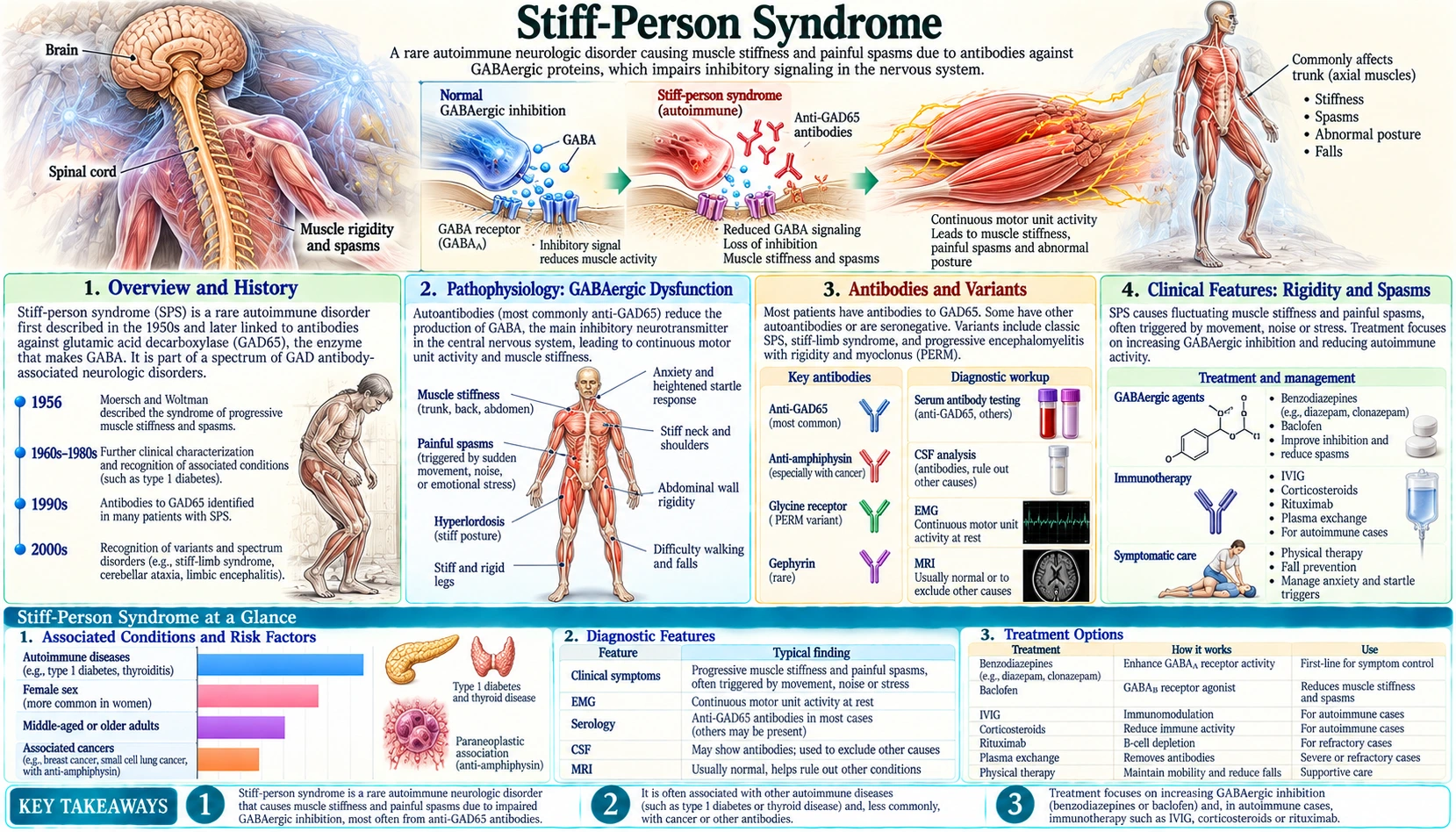
Table of Contents
- Overview and History
- Pathophysiology: GABAergic Dysfunction
- Antibodies and Variants
- Clinical Features: Rigidity and Spasms
- Autonomic and Psychological Features
- Paraneoplastic Stiff-Person Syndrome
- Diagnosis
- EMG Findings
- Treatment: GABA-Enhancing Drugs
- Treatment: Immunotherapy
- Prognosis and Living with SPS
- Key Research Papers
- Connections
- Featured Videos
Overview and History
Stiff-Person Syndrome (SPS) was originally described as "stiff-man syndrome" by Moersch and Woltman at the Mayo Clinic in 1956, who documented 14 patients with progressive fluctuating muscular rigidity and spasm (PMID 13350379). The name was changed to Stiff-Person Syndrome after recognition that the condition affects women at twice the rate of men (F:M ratio approximately 2:1).
SPS is a rare disorder with an estimated prevalence of 1–2 per million people. It is now categorized as an autoimmune central nervous system (CNS) disorder affecting spinal cord inhibitory circuits. The disease is characterized by three hallmark features: progressive rigidity primarily affecting the axial muscles, paroxysmal painful muscle spasms triggered by external stimuli, and hyperlumbar lordosis — an exaggerated inward curve of the lower back caused by continuous paraspinal muscle contraction.
SPS is frequently misdiagnosed early in its course as anxiety disorder, Parkinson's disease, multiple sclerosis, fibromyalgia, or conversion (functional neurological) disorder. The mean diagnostic delay is 5–7 years from symptom onset to correct diagnosis. SPS is strongly associated with other autoimmune diseases: type 1 diabetes mellitus (present in 30–40% of SPS patients), autoimmune thyroiditis, vitiligo, and pernicious anemia. In December 2022, singer Celine Dion publicly disclosed her SPS diagnosis, dramatically raising awareness of the condition among the general public.
Back to Table of ContentsPathophysiology: GABAergic Dysfunction
The central mechanism of SPS involves impairment of GABAergic inhibitory transmission in the spinal cord. GAD65 — glutamic acid decarboxylase, 65 kDa isoform — is the rate-limiting enzyme for gamma-aminobutyric acid (GABA) synthesis in the central nervous system. Anti-GAD65 autoantibodies found in SPS patients are present at very high titers (typically greater than 2000 U/mL), distinguishing them from the lower-titer anti-GAD65 antibodies seen in type 1 diabetes without SPS.
These antibodies are thought to impair GAD65 function, reducing gamma-aminobutyric acid synthesis in spinal interneurons. Gamma-aminobutyric acid is the primary inhibitory neurotransmitter in the central nervous system. In the spinal cord, GABAergic Renshaw cells and Ia inhibitory interneurons continuously modulate alpha-motor neuron firing, preventing excessive muscle contraction. When this GABAergic inhibition is lost, alpha-motor neurons fire tonically — producing continuous muscle contraction and the characteristic stiffness of SPS.
The loss of reciprocal inhibition is equally important: normally, contraction of an agonist muscle is coordinated with inhibition of the opposing antagonist. In SPS, this reciprocal inhibition fails, resulting in simultaneous co-contraction of both agonist and antagonist muscles. This co-contraction can be demonstrated on EMG and is one of the key diagnostic findings.
The pathophysiology of SPS at the spinal cord level closely resembles the effect of tetanus toxin, which cleaves synaptobrevin (a SNARE protein) and blocks gamma-aminobutyric acid and glycine vesicle release from inhibitory interneurons — producing the same result of uncontrolled motor neuron firing and sustained muscle rigidity.
Much of this mechanism is not settled. A 2009 review calls anti-GAD antibodies an excellent diagnostic marker but states that their role in causing the disease is uncertain (PMID 19210912). A 2012 review states that the exact mechanism is not fully worked out: infants who receive high GAD65 antibody levels from their mothers have no symptoms, and patient serum failed to produce symptoms in mice, which suggests these antibodies may not themselves cause harm (PMID 22499087). A second target has been found: antibodies against a protein called GABARAP, which reduce GABA-A receptors on neurons, in up to 65% of patients in the 2009 review (PMID 19210912) and about 70% of high-titer GAD patients in the 2012 review. For amphiphysin antibodies the case for direct harm is stronger, because transferring them into rats reproduced motor signs of the disease (PMID 22499087).
Back to Table of ContentsAntibodies and Variants
Anti-GAD65 antibodies are the most common antibody in SPS, present in 60–80% of patients. Titers above 2000 U/mL are diagnostically significant. Lower titers are commonly found in type 1 diabetes mellitus without SPS and are not specifically associated with neurological disease. Very high titers in the context of the clinical syndrome are strongly supportive of the diagnosis. The 2000 U/mL figure depends on the laboratory and the test: one NIH series of 16 patients had a mean of 51,500 U/mL (range 24,000–200,000) (PMID 15210528), the Mayo Clinic used above 20.0 nmol/L (PMID 37212351), and type 1 diabetes titers are usually 50 to 100 times lower than in this syndrome (PMID 22499087). In a Mayo Clinic cohort of 99 patients, 67% of the GAD65-positive patients had another autoimmune disease and 4% had cancer; among the seronegative patients, 25% had cancer (PMID 22332190).
Amphiphysin antibodies are present in approximately 5% of SPS cases and are strongly associated with a paraneoplastic etiology. Amphiphysin is a synaptic vesicle protein involved in endocytosis. Amphiphysin-antibody SPS is most commonly associated with breast cancer and small cell lung cancer (PMID 22499087); small cell lung cancer is usually described as the pattern in men, though no series with figures for men was found for this page. In a Yale series of 11 patients, all were women and all except one had breast cancer, and stiffness involved the neck more often than in GAD antibody disease (PMID 18971449). A 2015 review also lists colon cancer, lung cancer, Hodgkin's disease and malignant thymoma (PMID 26848416). This variant tends to present with more severe disease and may include additional features such as vertical gaze palsy, cerebellar ataxia, and upper motor neuron signs beyond typical SPS.
Glycine receptor (GlyR) antibodies are associated with a more severe condition called progressive encephalomyelitis with rigidity and myoclonus (PERM), but they are not limited to it. In a study of 81 patients with the stiff-person pattern, 12% were positive; of the 10 positive cases described, 9 had classic or variant stiff-person syndrome and 1 had PERM, 66% also carried GAD65 antibodies, and immunotherapy helped more often (6 of 7, against 7 of 25 seronegative patients) (PMID 23090334). PERM involves brainstem structures and presents with hyperekplexia (pathological startle reflex), myoclonus, and autonomic instability in addition to rigidity. PERM tends to have a more fulminant course than classic GAD65-positive SPS.
Gamma-aminobutyric acid-A and gamma-aminobutyric acid-B receptor antibodies are rarely identified in SPS-spectrum disorders. Seronegative SPS — in which no antibodies can be detected — accounts for approximately 20% of cases. In these patients, diagnosis rests on clinical features and EMG findings alone, with response to GABA-enhancing therapy providing additional diagnostic support.
Back to Table of ContentsClinical Features: Rigidity and Spasms
SPS has an insidious onset with gradual worsening over months to years. The rigidity is most prominent in the lumbar paraspinal muscles and abdominal muscles, producing the characteristic "board-like" abdomen — a hardness and firmness of the abdominal wall at rest that is a classic finding on physical examination. Proximal limb muscles are also commonly affected, while the facial and cervical muscles are typically spared in classic SPS.
Hyperlumbar lordosis — an exaggerated lumbar curve visible on standing — results from continuous paraspinal muscle contraction pulling the spine into extension. This postural change may be incorrectly attributed to an orthopedic condition such as spondylosis or disc disease, contributing to diagnostic delay. Rigidity worsens predictably with emotional stress, sudden noise, unexpected touch, and startle.
Paroxysmal spasms are sudden, extremely painful episodes of muscle contraction superimposed on the baseline rigidity. They are reliably triggered by: sudden loud noises (auditory startle), unexpected touch or physical contact, emotional upset or anxiety, and sudden voluntary movement. Spasms last seconds to minutes but are agonizing — many patients describe them as among the most painful experiences of their lives. The force generated during spasms can be powerful enough to cause fractures, particularly of the vertebrae and long bones. Falls from spasm-triggered loss of balance are a major source of injury and disability.
Walking becomes progressively more difficult due to the combination of axial rigidity, limb involvement, and the constant risk of spasm-triggered falls. The gait in established SPS is characteristically stiff, slow, and cautious. Many patients eventually use mobility aids or wheelchairs not from primary motor weakness, but from the mechanical impairment imposed by rigidity and spasm.
Back to Table of ContentsAutonomic and Psychological Features
Agoraphobia — a profound fear of open spaces and public environments — is a striking and diagnostically important feature of SPS. Unlike primary agoraphobia, which is a psychiatric disorder, the agoraphobia in SPS is a rational and understandable consequence of the disease: patients live with the constant awareness that a sudden loud noise, an unexpected touch, or an emotional trigger could produce a violent, painful spasm and cause them to fall in a public place where help may be unavailable. This distinction between rational fear of a genuine physical threat and primary psychiatric agoraphobia is important for appropriate management and validation of patient experience.
Anxiety is both a consequence of living with SPS and a potential trigger for spasms, creating a bidirectional relationship. Depression is very common in SPS, partly reactive to the loss of independence, employment, and social participation, and partly driven by chronic pain. Early in the disease course, the combination of stimulus-sensitive spasms and pronounced anxiety leads many patients to be diagnosed with panic disorder or generalized anxiety disorder before the underlying SPS is identified.
Hyperekplexia — a pathological amplification of the normal startle reflex — is particularly prominent in the GlyR-antibody/PERM variant. Autonomic dysfunction can occur during severe spasm episodes, with episodic diaphoresis (sweating), tachycardia, and blood pressure fluctuation reflecting the massive sympathetic activation produced by the pain and physical stress of the spasm. Social isolation is a nearly universal consequence of advanced SPS, driven by the unpredictability of spasms, the fear of falling, and the exhaustion of managing a high-burden chronic illness.
Back to Table of ContentsParaneoplastic Stiff-Person Syndrome
Amphiphysin-antibody SPS is almost always paraneoplastic — meaning it arises as an immune reaction to a distant cancer, with the tumor expressing amphiphysin as an aberrant antigen. The most common cancer associations are breast cancer (particularly in women) and small cell lung cancer (particularly in men). Amphiphysin is a synaptic vesicle-recycling protein normally expressed in the central nervous system, but aberrantly expressed by these tumors, triggering an immune response that cross-reacts with synaptic terminals.
Paraneoplastic SPS typically presents with more rapid onset and more severe neurological involvement than classic GAD65-positive SPS. Additional features beyond the typical SPS triad may include vertical gaze palsy, cerebellar ataxia, peripheral sensory neuropathy, and upper motor neuron signs. The constellation of encephalomyelitis with rigidity in the context of amphiphysin antibodies is a recognized reason for an immediate search for an occult malignancy.
The workup includes computed tomography (CT) or positron emission tomography with CT of the thorax, abdomen, and pelvis, and bilateral mammography or breast magnetic resonance imaging (MRI) in women, even in the absence of symptoms attributable to a primary tumor. Treatment of the underlying cancer — through surgery, chemotherapy, or radiation — is the single most important therapeutic intervention for paraneoplastic SPS and may produce neurological improvement that immunotherapy alone cannot achieve.
An important clinical point: anti-GAD65-positive SPS is generally not paraneoplastic. The association between SPS and cancer applies primarily to amphiphysin-antibody cases. Nevertheless, a full paraneoplastic antibody panel and cancer screening are commonly done in new SPS diagnoses, because amphiphysin-positive cases may initially test negative for GAD65, and early cancer detection substantially changes the prognosis.
Back to Table of ContentsDiagnosis
The diagnosis of SPS is based on clinical criteria, combined with laboratory and electrophysiological findings. A commonly used list of criteria includes: (1) stiffness of axial muscles with lumbar and abdominal muscles most prominently affected; (2) simultaneous co-contraction of agonist and antagonist muscles on EMG; (3) episodic painful muscle spasms triggered by external stimuli or emotional stress; (4) hyperlumbar lordosis; (5) continuous motor unit activity (CMUA) on EMG at rest that disappears with diazepam administration or sleep; (6) positive anti-GAD65 antibody at high titer or amphiphysin/GlyR antibody; and (7) clinical response to diazepam. Item 6 does not fit the roughly 20% of patients described above as seronegative. Criteria suggested by the Mayo Clinic in 2023 ask for clinical features confirmed by an autoimmune neurologist and high-titer GAD65 (above 20.0 nmol/L), glycine receptor or amphiphysin antibody and/or confirming electrical tests, which are essential if no antibody is found (PMID 37212351).
Misdiagnosis runs both ways. Of 173 people referred to that Mayo Clinic service for suspected disease, only 48 (28%) had it; 65% of the others had pain syndromes or functional neurological disorders. Clues that favoured the disease included an exaggerated inward lower-back curve (67% against 9%), unexplained falls (76% against 46%) and abnormal electrical tests (74% against 17%) (PMID 37212351).
Laboratory testing usually includes anti-GAD65 antibodies in serum (and cerebrospinal fluid (CSF) if serum is equivocal or negative), amphiphysin antibodies, glycine receptor antibodies, and a comprehensive paraneoplastic panel. Cerebrospinal fluid analysis may reveal oligoclonal bands and intrathecal synthesis of anti-GAD65 antibodies, which supports the diagnosis and indicates central nervous system-specific autoimmunity. Brain and spine magnetic resonance imaging is typically normal in classic SPS but is essential to exclude multiple sclerosis (MS), structural lesions, and other mimics.
The differential diagnosis is broad and reflects the typical diagnostic odyssey of SPS patients. Key conditions to exclude include: Parkinson's disease (resting tremor, bradykinesia, dopamine deficiency — responds to levodopa, not diazepam); multiple sclerosis (spasticity, magnetic resonance imaging white matter lesions, oligoclonal bands without anti-GAD65); Isaacs syndrome (peripheral nerve hyperexcitability, myokymia, CASPR2/LGI1 antibodies); tetanus (acute onset, wound history, no antibodies); primary dystonia; and anxiety or functional neurological disorder (which is itself a diagnosis of exclusion requiring positive findings). The diazepam response test — intravenous (IV) diazepam abolishing CMUA on EMG — can be both diagnostically and therapeutically informative.
Back to Table of ContentsEMG Findings
Electromyography (EMG) is one of the most important diagnostic tests in SPS, abnormal in approximately 80% of patients. The characteristic finding is continuous motor unit activity (CMUA) at rest in axial muscles — particularly lumbar paraspinals and abdominal muscles. Motor units fire continuously and involuntarily, without any effort by the patient. Importantly, these motor unit potentials are of normal amplitude and morphology, distinguishing CMUA from fasciculations (which are lower amplitude, single fiber) or myotonia (which has a characteristic waxing-and-waning pattern).
The most diagnostically significant feature of CMUA in SPS is its responsiveness to GABA-enhancing treatment: CMUA disappears completely with intravenous or oral diazepam administration, with sleep, or under general anesthesia. This pharmacological resolution confirms the GABAergic basis of the abnormal motor unit activity and is considered pathognomonic when present. A bedside diazepam test (carefully monitored intravenous diazepam while observing EMG) can provide immediate diagnostic confirmation.
During a paroxysmal spasm, EMG shows a dramatic burst of dense, continuous motor unit activity in multiple muscle groups simultaneously, including both agonists and antagonists — the electrophysiological signature of the loss of reciprocal inhibition. Surface EMG (without needle insertion) can be used in clinic to demonstrate co-contraction during voluntary movement or in response to a startle stimulus, providing a non-invasive way to document the abnormal pattern. A normal EMG does not exclude SPS, particularly in early or mild disease, but substantially reduces the likelihood.
Back to Table of ContentsTreatment: GABA-Enhancing Drugs
Diazepam is the first-line symptomatic treatment for SPS and acts as a positive allosteric modulator of gamma-aminobutyric acid-A receptors, enhancing the effect of residual gamma-aminobutyric acid at inhibitory synapses. The doses required for SPS are typically far higher than those used for anxiety — commonly 20–100 mg per day — and are titrated to symptom control while watching for sedation and respiratory depression. Stopping diazepam abruptly carries a risk of severe withdrawal. The high dose requirement reflects the profound degree of GABAergic deficiency in the spinal cord.
Baclofen, a gamma-aminobutyric acid-B receptor agonist, is used as an adjunct or alternative to benzodiazepines. Oral doses range from 40–120 mg per day. For severe or refractory cases, intrathecal baclofen (ITB) via an implanted pump delivers drug directly to the intrathecal space, allowing much higher local concentrations at spinal cord level with substantially less systemic sedation than oral dosing. ITB is a major surgical intervention but can be highly effective for patients whose rigidity and spasms are not adequately controlled by oral medications.
Clonazepam is an alternative benzodiazepine with a long half-life (typically 30 to 40 hours on its label; the diazepam label gives up to 48 hours, and up to 100 hours for its active metabolite) that some patients find preferable in terms of durability of effect and tolerability. Tizanidine (an alpha-2 agonist) and sodium valproate (which enhances GABAergic transmission through multiple mechanisms) are occasionally used as adjuncts. Pregabalin and gabapentin have limited evidence in SPS but may provide benefit for the pain component of the disease.
Physical therapy is an essential non-pharmacological adjunct. Hydrotherapy (aquatic physiotherapy) is particularly well tolerated because the buoyancy of water reduces the risk of falls during exercise, allowing patients to maintain muscle conditioning and range of motion that would be unsafe on land. Psychotherapy — particularly cognitive behavioral therapy (CBT) addressing the anxiety, agoraphobia, and depression associated with SPS — is an important complement to pharmacological treatment.
Back to Table of ContentsTreatment: Immunotherapy
Intravenous immunoglobulin (IVIG) has the strongest evidence base among immunotherapies for SPS. A landmark randomized controlled trial by Dalakas et al. published in the New England Journal of Medicine in 2001 demonstrated significant improvement in stiffness scores and in a heightened-sensitivity scale with IVIG at 2 g/kg administered over 2 days, compared to placebo (PMID 11756577). It was a crossover trial of 16 patients with GAD65 antibodies; 11 walked more easily or without assistance and fell less often, and the benefit lasted from six weeks to one year. IVIG is thought to work through multiple mechanisms including Fc receptor blockade, complement inhibition, and modulation of pathogenic antibody levels. Repeat infusions are typically required every 4–8 weeks for sustained benefit. Over longer follow-up of 36 patients on monthly infusions, 24 (67%) had a meaningful response over a median of 40 months, with less stiffness and fewer spasms, and some moved from a wheelchair or walking aid to walking unassisted. Among responders, 25% held the benefit, it declined in 29.1% over 39 months, and 12.5% showed a conditioning effect; the 12 who did not respond in the first 3 months never did (PMID 35798561).
Plasma exchange (plasmapheresis) removes circulating anti-GAD65 and other pathogenic antibodies from the bloodstream. Response is often temporary — lasting weeks — because antibody-producing B cells remain active, and antibody levels rebound after treatment. Plasmapheresis is most useful for acute severe exacerbations or as a bridge to longer-term immunotherapy.
Rituximab, an anti-CD20 monoclonal antibody that depletes B cells, is used in refractory cases. Rituximab may produce sustained improvement, particularly in seronegative SPS and in GAD65-positive patients who have not responded adequately to IVIG and steroids. Some patients achieve prolonged remissions after rituximab. The largest controlled trial in this disease tested 2 infusions of 1 g and found no statistically significant difference from placebo in stiffness or sensitivity at 3 or 6 months; improvement persisted at 6 months in 3 of 4 improved rituximab patients against 1 on placebo. The authors raise a strong placebo effect, insensitive scales, or benefit in only a small subset (PMID 28749549). Corticosteroids (prednisone) provide modest symptomatic and immunomodulatory benefit but are limited by long-term side effects including worsening of any co-existing type 1 diabetes. Mycophenolate mofetil and azathioprine are used as steroid-sparing maintenance immunosuppressants.
Autologous stem cell transplant was tested in an open trial of 23 people, with no placebo group: no treatment-related deaths, 74% responded, 47% of those stayed in remission for a mean of 3.5 years, and 26% did not respond. One participant died of disease progression a year later (PMID 33318163).
Anti-CD19 CAR T-cell therapy has been described since 2024 in single case reports of severe disease. A 69-year-old went from under 50 m to over 6 km of daily walking within 3 months (PMID 38885382); a 62-year-old reached 500 m by month 6, with moderate low white cells and no serious infections (PMID 41052399). The authors of the second report state that controlled trials are needed.
The overarching treatment principle in SPS is to address both the symptoms and the underlying autoimmunity simultaneously. GABA-enhancing drugs provide symptomatic relief by compensating for lost inhibitory tone, while immunotherapy addresses the autoimmune process driving antibody production. Most patients with established SPS require both treatment pillars long-term. For paraneoplastic SPS, treatment of the underlying cancer is the foundational intervention, with immunotherapy providing adjunctive benefit.
Back to Table of ContentsPrognosis and Living with SPS
Without treatment, SPS is progressive: rigidity and spasm frequency increase over time, mobility declines, and falls become more frequent and dangerous. With appropriate treatment combining GABA-enhancing drugs and immunotherapy, most patients achieve meaningful partial control of symptoms, but complete remission is rare. The disease typically follows a chronic relapsing-remitting or slowly progressive course in GAD65-positive patients.
Quality of life is profoundly affected. Unpredictable painful spasms, constant risk of falls, agoraphobia, social withdrawal, depression, and the high burden of complex medication regimens combine to produce severe functional limitation. The majority of patients with established, severe SPS are unable to maintain employment. SPS is a recognized basis for disability under Social Security criteria in the United States and equivalent programs in other countries.
Prognosis for paraneoplastic (amphiphysin-antibody) SPS depends primarily on the underlying cancer: early detection and successful treatment of the tumor is the single most important prognostic factor. Patients whose cancer is identified and treated early may experience significant neurological improvement. Those with occult or advanced cancer at the time of neurological presentation have a worse prognosis.
Long-term monitoring described for SPS patients includes periodic measurement of anti-GAD65 titers (to gauge immunological activity), annual cancer screening (particularly in amphiphysin-antibody cases), and routine screening for associated autoimmune diseases — specifically hemoglobin A1c (HbA1c) for type 1 diabetes and thyroid function tests. On the titers, an NIH study of 16 patients found that levels in serum and spinal fluid did not correlate with disease severity or duration, serial levels in 4 patients did not track clinical change, and the authors concluded that monitoring them may not be of practical value (PMID 15210528). Spontaneous remissions are very rare in GAD65-positive SPS; occasional near-remissions have been reported in patients with early disease and prompt, aggressive immunotherapy. The rarity of cure reinforces the importance of symptomatic management and psychosocial support as central pillars of long-term care.
Back to Table of ContentsKey Research Papers
- Moersch FP & Woltman HW (1956) Progressive fluctuating muscular rigidity and spasm ("stiff-man" syndrome); report of a case and some observations in 13 other cases. Proc Staff Meet Mayo Clin. 31(15):421-427. — PubMed PMID: 13350379
- Dalakas MC et al. (2001) High-dose intravenous immune globulin for stiff-person syndrome. N Engl J Med. — PubMed PMID: 11756577
- Solimena M et al. (1988) Autoantibodies to glutamic acid decarboxylase in a patient with stiff-man syndrome, epilepsy, and type I diabetes mellitus. N Engl J Med. — PubMed PMID: 3281011
- Dalakas MC (2009) Stiff person syndrome: advances in pathogenesis and therapeutic interventions. Curr Treat Options Neurol. — PubMed PMID: 19210912
- Levy LM et al. (1999) The stiff-person syndrome: an autoimmune disorder affecting neurotransmission of gamma-aminobutyric acid. Ann Intern Med. — PubMed PMID: 10507962
- Lichte B, Veh RW, Meyer HE, Kilimann MW (1992) Amphiphysin, a novel protein associated with synaptic vesicles. EMBO J. 11(7):2521-2530. — PubMed PMID: 1628617
- De Camilli P et al. (1993) The synaptic vesicle-associated protein amphiphysin is the 128-kD autoantigen of Stiff-Man syndrome with breast cancer. J Exp Med. 178(6):2219-2223. — PubMed PMID: 8245793
- McKeon A et al. (2013) Glycine receptor autoimmune spectrum with stiff-man syndrome phenotype. JAMA Neurol. 70(1):44-50. — PubMed PMID: 23090334
- Murinson BB & Guarnaccia JB (2008) Stiff-person syndrome with amphiphysin antibodies: distinctive features of a rare disease. Neurology. 71(24):1955-1958. — PubMed PMID: 18971449
- Baizabal-Carvallo JF & Jankovic J (2015) Stiff-person syndrome: insights into a complex autoimmune disorder. J Neurol Neurosurg Psychiatry. — PubMed PMID: 25511790
- Rakocevic G & Floeter MK (2012) Autoimmune stiff person syndrome and related myelopathies: understanding of electrophysiological and immunological processes. Muscle Nerve. 45(5):623-634. — PubMed PMID: 22499087
- Bhatti AB & Gazali ZA (2015) Recent advances and review on treatment of stiff person syndrome in adults and pediatric patients. Cureus. — PubMed PMID: 26848416
- Rakocevic G, Raju R & Dalakas MC (2004) Anti-glutamic acid decarboxylase antibodies in the serum and cerebrospinal fluid of patients with stiff-person syndrome: correlation with clinical severity. Arch Neurol. 61(6):902-904. — PubMed PMID: 15210528
- McKeon A et al. (2012) Stiff-man syndrome and variants: clinical course, treatments, and outcomes. Arch Neurol. 69(2):230-238. — PubMed PMID: 22332190
- Chia NH et al. (2023) Stiff person spectrum disorder diagnosis, misdiagnosis, and suggested diagnostic criteria. Ann Clin Transl Neurol. 10(7):1083-1094. — PubMed PMID: 37212351
- Dalakas MC et al. (2017) A double-blind, placebo-controlled study of rituximab in patients with stiff person syndrome. Ann Neurol. 82(2):271-277. — PubMed PMID: 28749549
- Yi J & Dalakas MC (2022) Long-term Effectiveness of IVIg Maintenance Therapy in 36 Patients With GAD Antibody-Positive Stiff-Person Syndrome. Neurol Neuroimmunol Neuroinflamm. 9(5):e200011. — PubMed PMID: 35798561
- Burt RK et al. (2021) Autologous Hematopoietic Stem Cell Transplantation for Stiff-Person Spectrum Disorder: A Clinical Trial. Neurology. 96(6):e817-e830. — PubMed PMID: 33318163
- Faissner S et al. (2024) Successful use of anti-CD19 CAR T cells in severe treatment-refractory stiff-person syndrome. Proc Natl Acad Sci U S A. 121(26):e2403227121. — PubMed PMID: 38885382
- Ayzenberg I et al. (2025) Anti-CD19 CAR T-Cell Therapy in Advanced Stiff-Person Syndrome and Concomitant Myasthenia Gravis. Neurol Neuroimmunol Neuroinflamm. 12(6):e200479. — PubMed PMID: 41052399