Restless Legs Syndrome (Willis-Ekbom Disease)
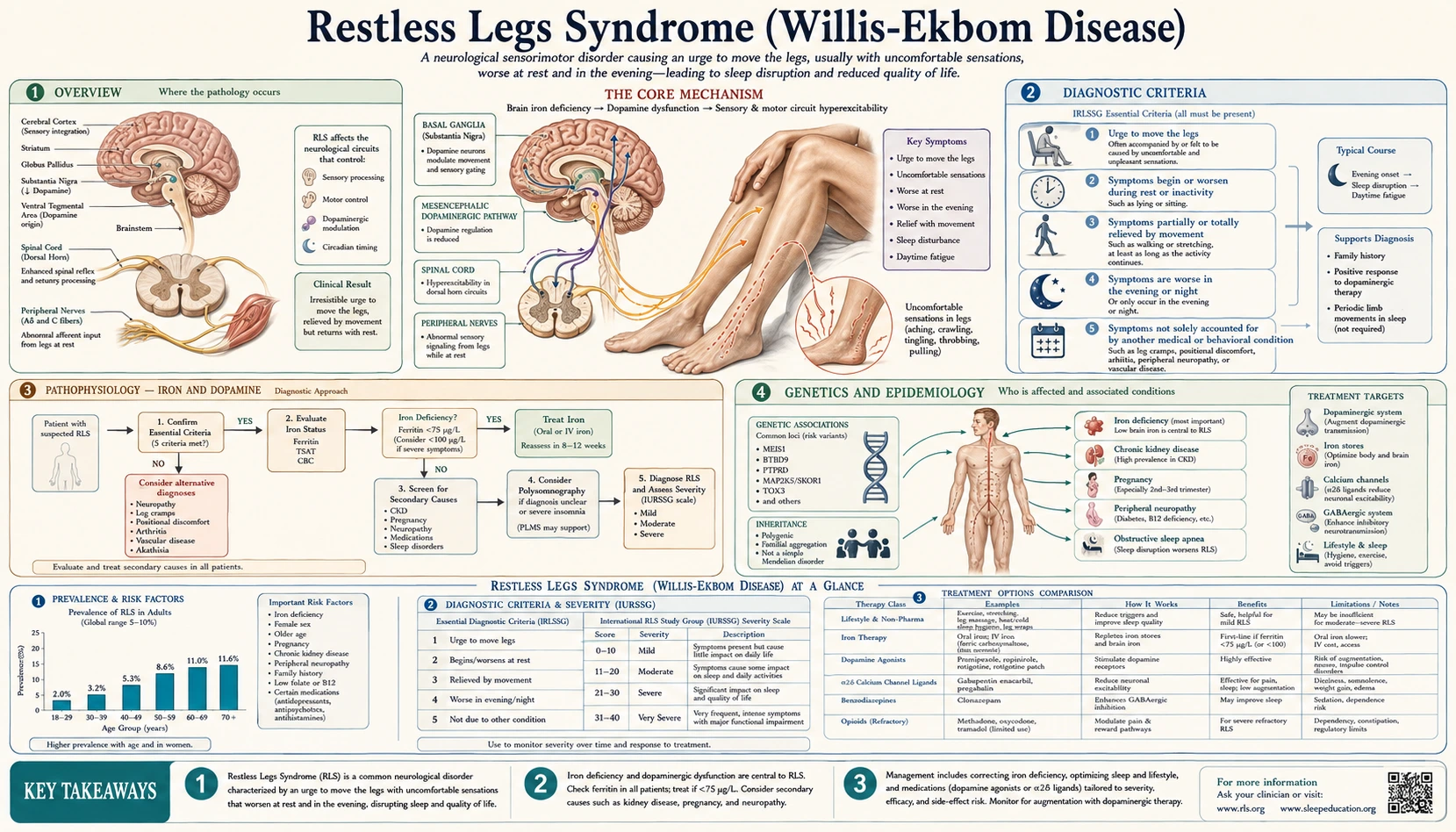
Overview
Restless Legs Syndrome (RLS), now formally called Willis-Ekbom Disease, is a neurological sensorimotor disorder characterized by an uncomfortable urge to move the legs that worsens at rest and in the evening. It affects 5–15% of adults in Western populations, making it one of the most common sleep and neurological disorders — yet it is frequently misdiagnosed or dismissed by clinicians who are unfamiliar with its distinct clinical signature. RLS can range from mild inconvenience to a severely disabling condition causing profound insomnia and reduced quality of life.
The condition was formally described by neurologist Karl-Axel Ekbom in 1945, building on earlier observations by Thomas Willis in 1685 — hence the dual eponym. Despite this centuries-long recognition, widespread clinical awareness remains inconsistent, and many patients suffer for years before receiving a correct diagnosis and appropriate treatment.
Diagnostic Criteria
The International Restless Legs Syndrome Study Group (IRLSSG) 2012 revised criteria require ALL FIVE of the following:
- Urge to move the legs — usually accompanied by uncomfortable sensations in the legs (sometimes described as crawling, creeping, pulling, throbbing, aching, itching, or electric). The discomfort is deep inside the limb, not on the skin surface.
- Worsening at rest — symptoms begin or worsen during periods of inactivity (sitting, lying down). This is what makes sleep impossible and sitting through movies or long flights torturous.
- Relief by movement — partial or complete relief when moving the legs (walking, stretching, rubbing). The relief lasts only as long as movement continues.
- Circadian pattern — symptoms are worse in the evening and night compared to daytime. This is the hallmark that distinguishes RLS from peripheral neuropathy, arthritis, and other mimics.
- Not solely accounted for by another medical or behavioral condition — excludes leg cramps, positional discomfort, myalgia, venous stasis, leg edema, arthritis, and habitual foot tapping.
Supportive clinical features (not required but strengthen diagnosis): family history, dopaminergic response (improvement with a low-dose dopamine agonist confirms diagnosis therapeutically), and periodic limb movements of sleep (PLMS) on polysomnogram.
Pathophysiology — Iron and Dopamine
The central mechanism linking the two main pathophysiological threads of RLS is iron deficiency in the brain, particularly in the substantia nigra.
Iron's Role in Dopamine Synthesis
Iron is an essential cofactor for tyrosine hydroxylase, the rate-limiting enzyme that converts tyrosine to L-DOPA and ultimately dopamine. When brain iron stores are insufficient, dopaminergic function in the striatal pathways governing sensorimotor integration is impaired. This produces the classic RLS symptoms: the sensory discomfort, the urge to move, and the failure of normal inhibitory gating during rest.
The Brain-Serum Iron Disconnect
Critically, brain iron deficiency can exist even when serum ferritin appears low-normal. The blood-brain barrier has a saturable iron transport system. Studies of post-mortem RLS brains show decreased iron in the substantia nigra despite normal peripheral iron stores in some patients. In a 2000 study of 16 people with RLS and 8 healthy controls, spinal fluid ferritin was about one-third of the controls’ level (1.11 vs 3.50 ng/mL) and spinal fluid transferrin was higher, while blood ferritin and transferrin did not differ — a pattern the authors read as low brain iron. This is why serum ferritin cutoffs matter even in the “normal” laboratory range — a ferritin of 40 μg/L may be clinically normal for a hematologist but inadequate for optimal dopamine function in a susceptible individual.
Circadian Dopamine Variation
Both dopamine and iron metabolism have circadian rhythmicity that peaks during daytime and troughs at night. This biological rhythm directly explains the characteristic evening and nighttime worsening of RLS symptoms. The dopamine system's natural nighttime ebb unmasks the underlying sensorimotor dysregulation that is held in check during the day.
Opioid System Involvement
The endogenous opioid system modulates sensorimotor gating and appears dysregulated in RLS. This explains why low-dose opioids are effective in refractory cases and why some patients report worsening with opioid antagonists. Positron emission tomography (PET) imaging studies have demonstrated altered opioid receptor availability in RLS patients, suggesting this is a distinct neurobiological feature rather than a side effect of treatment.
Genetics and Epidemiology
RLS has a strong genetic component. Earlier genome-wide association studies replicated these six susceptibility loci:
- BTBD9 (chromosome 6p21): The strongest common-variant signal; also independently associated with PLMS. The protein product is involved in ubiquitination and protein quality control.
- MEIS1 (chromosome 2p14): A homeobox transcription factor that regulates iron metabolism and limb development. Functional studies implicate it in dopaminergic neuron patterning.
- MAP2K5/SKOR1 (chromosome 15q23): Involved in MAPK signaling and neuronal development.
- PTPRD (chromosome 9p24): A receptor tyrosine phosphatase expressed in the central nervous system; also associated with restless sleep in children.
- TOX3 (chromosome 16q12): A transcription factor previously associated with breast cancer risk; its role in RLS neurobiology is incompletely understood.
- MEIS2 (chromosome 15q14): A paralog of MEIS1 with overlapping developmental roles.
A 2024 genome-wide meta-analysis of 116,647 people with RLS and 1,546,466 controls of European ancestry raised the number of risk loci eightfold, to 164 (three of them on the X chromosome). Men and women shared almost the same genetic predisposition (genetic correlation 0.96), and the analysis pointed to druggable genes such as glutamate receptors 1 and 4 as possible targets for new or repurposed medicines.
Epidemiology
- Prevalence 5–15% in North American and European adults; consistently lower in Asian populations (approximately 1–3%), suggesting genuine genetic-ethnic differences beyond diagnostic variation.
- Women are approximately twice as likely as men to be affected — partly explained by iron loss through menstruation and the RLS risk conferred by pregnancy.
- Prevalence increases with age, though RLS can present at any age, including childhood, where it is often misdiagnosed as growing pains, attention deficit disorder, or anxiety.
- Strong familial aggregation: first-degree relatives have a 3–5 times higher risk. Earlier age of onset is associated with stronger family history and a more genetic (rather than secondary/acquired) form of the disease.
Secondary Causes
Several medical conditions cause or significantly worsen RLS. Identifying and treating secondary causes can dramatically reduce — or fully resolve — symptoms.
Iron Deficiency (Most Treatable Cause)
Any cause of iron deficiency — including gastrointestinal (GI) bleeding, inadequate dietary intake, malabsorption, menorrhagia, or frequent blood donation — can trigger or worsen RLS. Serum ferritin below 75 μg/L correlates with increased RLS severity, and iron supplementation often substantially reduces symptoms. The 2025 American Academy of Sleep Medicine (AASM) guideline’s good practice statement calls for regular testing of serum iron studies, including ferritin and transferrin saturation, in all patients with clinically significant RLS.
Chronic Kidney Disease
The most important secondary cause after iron deficiency. Uremia impairs dopamine metabolism and iron utilization simultaneously. Hemodialysis patients have RLS prevalence of 25–50%. RLS in chronic kidney disease (CKD) responds to iron repletion, erythropoietin therapy, and dopaminergic medications, though management is complicated by renal constraints on drug dosing and the dialysis schedule.
Pregnancy
RLS emerges or dramatically worsens in the third trimester in 20–25% of pregnant women. Contributing factors include iron and folate deficiency, hormonal changes (particularly elevated estrogen and progesterone), and mechanical factors. Symptoms typically resolve within weeks of delivery. Management in pregnancy is limited because most RLS medications lack pregnancy safety data: iron supplementation, folate repletion, and non-pharmacologic measures are the foundation.
Peripheral Neuropathy
Particularly small-fiber neuropathy. The mechanism is independent of central dopamine pathways — peripheral sensitization of nociceptors drives the sensory discomfort. Workup for underlying cause is essential: diabetes, vitamin B12 deficiency, monoclonal gammopathy of undetermined significance (MGUS), hereditary neuropathy, and autoimmune neuropathy.
Spinal Cord Disorders
Multiple sclerosis, spinal cord injury, lumbar spinal stenosis, and myelopathy can all produce or mimic RLS through disruption of the descending inhibitory pathways that normally suppress sensorimotor signals during rest.
Medications That Worsen RLS
This is clinically critical — many commonly prescribed medications dramatically exacerbate RLS:
- Dopamine antagonists: antipsychotics (haloperidol, risperidone, quetiapine, olanzapine), antiemetics (metoclopramide, prochlorperazine, promethazine). These are potent RLS triggers; the 2025 AASM guideline lists antidopaminergic medicines among the exacerbating factors to address first in RLS management.
- Antihistamines: diphenhydramine — an extremely common and underrecognized trigger. Antihistamines such as diphenhydramine and doxylamine are present in most over-the-counter sleep aids, including acetaminophen-diphenhydramine combinations. The 2025 AASM guideline lists antihistaminergic medicines among the exacerbating factors to address first in RLS management.
- Antidepressants: mirtazapine is the strongest aggravator (5-HT2C and histamine antagonism). Selective serotonin reuptake inhibitors (SSRIs) cause moderate worsening. Tricyclic antidepressants (TCAs) cause mild worsening. Notable exceptions that do NOT worsen RLS: bupropion (it does not appear to worsen RLS, but the 2025 AASM guideline suggests against using it to treat RLS — a conditional recommendation, moderate certainty of evidence); venlafaxine (variable — mild worsening in some patients).
- Lithium: can worsen or trigger RLS through unclear mechanisms.
Periodic Limb Movements of Sleep (PLMS)
PLMS are repetitive, stereotyped limb movements during sleep, documented on polysomnography. They occur in clusters every 20–40 seconds and typically involve extension of the big toe, dorsiflexion of the ankle, and sometimes flexion at the knee and hip — a pattern reminiscent of the Babinski reflex. Each movement lasts 0.5–10 seconds.
Key Distinctions
- PLMS are present in 80–90% of RLS patients but are also common in other sleep disorders (narcolepsy, REM sleep behavior disorder, obstructive sleep apnea) and in healthy older adults without RLS.
- PLMS are not required for RLS diagnosis — clinical history alone is sufficient when the 5 IRLSSG criteria are met.
- PLMS can disturb sleep architecture independently by causing cortical arousals (detectable on electroencephalogram (EEG) as brief wakings, even without the patient's awareness), reducing deep sleep and overall sleep quality — even in individuals who do not have classic daytime RLS symptoms.
- Isolated PLMS without RLS symptoms is called “Periodic Limb Movement Disorder” (PLMD) — a separate diagnosis of exclusion requiring ruling out RLS, obstructive sleep apnea, and other causes of PLMS.
- A PLMS index greater than 15 events per hour of sleep is considered clinically significant. PLMS associated with arousals (PLMS-arousal index) is the more clinically relevant measure for sleep quality impact.
Diagnosis
Clinical Diagnosis (Primary)
RLS is fundamentally a clinical diagnosis based on the five IRLSSG criteria. A careful history asking specifically about the four cardinal features — urge to move, rest worsening, relief by movement, and circadian (evening/night) pattern — makes the diagnosis in most cases. The key is knowing to ask: patients rarely volunteer these symptoms in standard medical history-taking, and providers rarely think to ask.
IRLSSG Severity Scale
The validated 10-item International RLS Study Group Rating Scale (IRLS) quantifies symptom severity on a 0–40 scale: mild (1–10), moderate (11–20), severe (21–30), very severe (31–40). It is used in clinical trials and as a practical tool to track treatment response over time, typically completed before and after a treatment change.
Laboratory Testing
- Serum ferritin (not just serum iron or hemoglobin): Target above 75 μg/L for RLS. Below 50 μg/L is clearly inadequate. Below 75 μg/L warrants supplementation even if hemoglobin is normal — iron deficiency can be present without anemia.
- Transferrin saturation (TSAT): Assesses iron utilization; below 20% suggests functional iron deficiency.
- Complete blood count: Identify frank anemia and macrocytosis (B12/folate deficiency).
- Serum iron and TIBC: Complement ferritin for a complete picture of iron status.
- Comprehensive metabolic panel: Evaluate kidney function (creatinine, blood urea nitrogen (BUN), estimated glomerular filtration rate (GFR)) to identify chronic kidney disease as a secondary cause.
- Hemoglobin A1c (HbA1c): Screen for diabetes-associated peripheral neuropathy.
- B12 and folate: Deficiency causes neuropathy that may mimic or exacerbate RLS; folate deficiency is particularly important in pregnancy.
- Peripheral neuropathy workup if clinically indicated: nerve conduction studies and electromyography to identify large-fiber neuropathy; skin punch biopsy for small-fiber neuropathy (intraepidermal nerve fiber density).
Polysomnography
Not required for diagnosis but indicated when: the diagnosis is uncertain and objective sleep data is needed; a coexisting sleep disorder (particularly obstructive sleep apnea) is suspected; PLMS documentation and severity quantification is needed; or treatment evaluation requires objective data. PSG demonstrates PLMS and can identify sleep-stage distribution abnormalities.
Actigraphy
Wrist or ankle actigraphy may help document limb movements in the home setting over multiple nights, providing a more representative sample than a single-night lab PSG. Less definitive than PSG but useful for monitoring treatment response over time.
Treatment — Non-Pharmacologic and Iron
Non-Pharmacologic Approaches (First-Line for Mild RLS)
For patients with mild RLS (IRLS score 1–10) or who prefer to avoid medications, behavioral and lifestyle interventions can provide meaningful benefit:
- Sleep hygiene: Consistent sleep schedule, cool bedroom temperature, avoiding screens in the evening (blue light suppresses melatonin and may amplify circadian symptom peaks).
- Moderate regular exercise: Particularly walking and stretching in the morning or early afternoon. Vigorous exercise close to bedtime can paradoxically worsen symptoms — timing matters.
- Known triggers: Alcohol (worsens RLS despite initial sedation), caffeine in the afternoon and evening, antihistamines (diphenhydramine and over-the-counter (OTC) sleep aids), and all medications listed in the secondary causes section above. The 2025 AASM guideline names addressing these exacerbating factors, along with untreated obstructive sleep apnea, as the first step in RLS management.
- Mental engagement: Mentally stimulating activities — reading, video games, puzzles, engaging conversation — can suppress mild symptoms during sedentary periods by competing for attentional resources. This is a practical strategy for managing symptoms during travel or long events.
- Hot bath or leg massage at bedtime: Temporary sensory stimulation provides relief in some patients; effects are short-lived but can help initiate sleep.
- Pneumatic compression devices: U.S. Food and Drug Administration-cleared devices providing repetitive sequential pressure to the legs have randomized trial support and are an evidence-based non-pharmacologic option for patients who prefer to avoid medications or when medications are contraindicated (pregnancy).
Iron Supplementation
Oral iron: Ferrous sulfate 325 mg (65 mg elemental iron) taken with vitamin C (250–500 mg) on an empty stomach to maximize absorption. Alternate-day dosing — taking iron every other day rather than daily — has been shown in randomized studies to produce higher net absorption by allowing the intestinal mucosal iron transporter (ferroportin) to recover between doses. Target serum ferritin above 75 μg/L. Takes 3–6 months of sustained supplementation to see full RLS benefit. Gastrointestinal side effects (constipation, nausea, dark stools) limit adherence — bisglycinate forms may be better tolerated.
Intravenous iron: Indicated when serum ferritin is below 100 μg/L with oral iron intolerance or inadequate response; in chronic kidney disease (where oral absorption is impaired and gastrointestinal tolerance is worse); in malabsorption syndromes (celiac disease, gastric bypass); or when a faster therapeutic response is needed. Ferric carboxymaltose (1000 mg in a single infusion) and ferumoxytol have both demonstrated efficacy for RLS in randomized controlled trials. Target ferritin with intravenous (IV) iron replacement is above 100–150 μg/L. Response can be dramatic — significant symptom reduction within 2–4 weeks in iron-responsive cases.
Guideline iron thresholds: The 2025 AASM guideline states consensus thresholds (which, it notes, have not been empirically tested) for adults with RLS: oral or IV iron when serum ferritin is 75 ng/mL or less or transferrin saturation is under 20%, and IV iron only when ferritin is between 75 and 100 ng/mL. For children the threshold is ferritin under 50 ng/mL. The guideline describes drawing iron tests in the morning, with no iron-containing supplements or foods for at least 24 hours before. (Ferritin in ng/mL and μg/L is the same number.)
A 2024 randomized trial of IV ferric carboxymaltose: 209 adults with an IRLS score of 15 or more received 750 mg or placebo on two days, five days apart. At day 42 the IRLS score fell more on iron than on placebo (−8.0 vs −4.8 points), and fewer patients on iron needed other RLS treatments (32.7% vs 59.4%), but the second main endpoint — the share rated much or very much improved by the investigator — did not differ (35.5% vs 28.7%). Iron was well tolerated.
Treatment — Pharmacologic
Alpha-2-Delta Calcium Channel Ligands (First-Line Pharmacotherapy)
The American Academy of Sleep Medicine’s 2025 guideline gives strong recommendations for gabapentin enacarbil, gabapentin, pregabalin and IV ferric carboxymaltose (in people with appropriate iron status), and suggests against the standard use of pramipexole, ropinirole, rotigotine and levodopa because of long-term adverse effects, particularly augmentation. It suggests extended-release oxycodone and other opioids, dipyridamole and bilateral high-frequency peroneal nerve stimulation as options, suggests against bupropion, carbamazepine, clonazepam, valerian and valproic acid, and recommends against cabergoline. The Mayo Clinic updated algorithm likewise places alpha-2-delta ligands first-line for moderate-to-severe RLS, superseding dopamine agonists due to the augmentation problem.
Gabapentin enacarbil: The only non-dopamine medicine with a U.S. Food and Drug Administration (FDA) indication for moderate-to-severe primary RLS (the pramipexole and ropinirole labels also list RLS). It is a prodrug of gabapentin designed for improved and more predictable gastrointestinal absorption via active transporter-mediated uptake. Standard dose: 600 mg once daily at approximately 5 pm. Benefits: treats both RLS symptoms and comorbid restless sleep, pain, and anxiety; no risk of augmentation; once-daily dosing improves adherence. Principal side effects: dizziness and somnolence, particularly when starting.
Pregabalin: Not U.S. Food and Drug Administration-approved specifically for RLS but extensively studied in high-quality randomized trials and widely used off-label. Dose range 75–300 mg per night, titrated from a low starting dose. A landmark 52-week trial of 719 participants (Allen et al., New England Journal of Medicine 2014) found that pregabalin improved symptoms more than placebo over 12 weeks and had a significantly lower augmentation rate than pramipexole 0.5 mg — establishing alpha-2-delta ligands as the preferred first-line class for long-term management.
Gabapentin: The parent compound; lowest bioavailability and most variable absorption of the three (requires higher doses, typically 900–2400 mg per night split into two or three doses). Effective but less convenient. Least expensive option, which matters for some patients.
Dopamine Agonists (Effective but Second-Line Due to Augmentation)
Dopamine agonists were the dominant RLS treatment for two decades and remain highly effective short-term. However, augmentation — a paradoxical treatment-induced worsening of RLS — has moved them to second-line status for most patients.
Pramipexole: The FDA label’s RLS titration steps are 0.125, 0.25 and 0.5 mg, taken 2–3 hours before bedtime. Rapid and substantial relief in most patients.
Ropinirole: Dose 0.25–4 mg taken 1–3 hours before bedtime. Similar efficacy to pramipexole.
Augmentation: This is the critical long-term problem with dopamine agonists. Reported rates vary widely with the medicine, the dose and the length of follow-up: augmentation occurred in 60% of people within six months on levodopa in a European study, in 42% of a clinic cohort followed for a mean of 8 years on pramipexole, at about 7–8% a year in a 10-year tertiary-center review and a community survey, and in 5.6% pooled across 60 studies in a 2016 meta-analysis. It manifests as: symptoms appearing earlier in the day (afternoon or even morning); spread of symptoms to the arms, trunk, or face; shorter latency before symptoms appear with rest; more severe symptoms at onset; reduced duration of relief from each dose. Augmentation is described as a worsening of symptoms brought on by the treatment itself, not only a fading of its effect; overstimulation of dopamine pathways is one proposed explanation, but the 2007 international consensus conference listed the underlying biology of augmentation as an open question and called augmentation “the main complication of dopaminergic treatment.” For established augmentation, the 2016 international task force describes switching to an alpha-2-delta ligand or the rotigotine patch, and considering an opioid in more severe cases. In the 52-week pregabalin trial, augmentation occurred in 2.1% of people on pregabalin vs 7.7% on pramipexole 0.5 mg (and 5.3% on pramipexole 0.25 mg, a difference that was not statistically significant). In a 5-year open-label study of the rotigotine patch in 295 patients, clinically significant augmentation was recorded in 13%, 57% stopped treatment, and 19% stopped because of skin reactions at the patch site.
Rotigotine transdermal patch: Provides continuous (non-pulsatile) dopaminergic stimulation via a 24-hour patch. Lower augmentation risk than pulsatile oral dopamine agonists, though augmentation still occurs. U.S. Food and Drug Administration-approved for RLS at doses of 1–3 mg/24 hours. Particularly useful for patients with early-morning symptom breakthrough.
Clinicians who use dopamine agonists describe keeping to the lowest effective dose, checking for augmentation at every visit, having a clear exit plan, and telling patients that a switch to alpha-2-delta ligands may be needed.
Low-Dose Opioids (Refractory RLS)
For patients who fail alpha-2-delta ligands and dopamine agonists, or who have developed augmentation on chronic dopamine agonist therapy, low-dose opioids are an evidence-based and often dramatically effective option. The endogenous opioid system's role in RLS pathophysiology makes this mechanistically sound, not merely empirical.
- Oxycodone/naloxone extended-release: The only opioid formulation studied in a rigorous randomized controlled trial for RLS (Trenkwalder et al. 2013). The naloxone component reduces constipation and abuse potential while not crossing the blood-brain barrier at standard doses. In that trial (276 patients analysed), the dose started at oxycodone 5 mg/naloxone 2.5 mg twice a day and could be raised to a maximum of oxycodone 40 mg/naloxone 20 mg twice a day; the IRLS score fell 8.15 points more than on placebo over 12 weeks, and treatment-related adverse events occurred in 73% vs 43% on placebo.
- Tramadol: Weak mu-opioid agonist plus serotonin-norepinephrine reuptake inhibitor; 50–100 mg at bedtime. Useful for milder refractory cases.
- Oxycodone or hydrocodone: the 2018 statement of the RLS Foundation’s Scientific and Medical Advisory Board names oxycodone as one of the two most commonly used opioids for refractory RLS, with hydrocodone among the alternatives, and reports effective oxycodone doses of 10–30 mg daily — considerably lower than those used for chronic pain.
- Methadone: Extremely effective for very severe, refractory RLS — particularly after augmentation on dopamine agonists — due to its long half-life providing continuous opioid coverage. Requires specialist management; the 2018 RLS Foundation statement reports effective methadone doses of 5–20 mg daily. Reserved for cases where other treatments have failed.
Benzodiazepines
Clonazepam is sometimes used as an adjunct for PLMS-associated sleep disruption in patients who cannot tolerate other treatments, but it has no specific RLS mechanism (does not reduce the urge to move), carries dependency risk, worsens sleep apnea, and causes residual morning sedation. It is not preferred as a primary RLS treatment by any major guideline.
Key Research Papers
- Allen RP, et al. (2003). Restless legs syndrome: Diagnostic criteria, special considerations, and epidemiology. Sleep Medicine, 4(2), 101–119. — PubMed PMID: 14592341
- Earley CJ, et al. (2000). Abnormalities in CSF concentrations of ferritin and transferrin in restless legs syndrome. Neurology, 54(8), 1698–1700. — PubMed PMID: 10762522
- Winkelmann J, et al. (2007). Genome-wide association study of restless legs syndrome identifies common variants in three genomic regions. Nature Genetics, 39(8), 1000–1006. — PubMed PMID: 17637780
- Allen RP, et al. (2014). Comparison of pregabalin with pramipexole for restless legs syndrome. New England Journal of Medicine, 370(7), 621–631. — PubMed PMID: 24521108
- Allen RP, et al. (2014). Restless legs syndrome/Willis-Ekbom disease diagnostic criteria: Updated International Restless Legs Syndrome Study Group (IRLSSG) consensus criteria. Sleep Medicine, 15(8), 860–873. — PubMed PMID: 25023924
- Oertel W, et al. (2011). Long-term safety and efficacy of rotigotine transdermal patch for moderate-to-severe idiopathic restless legs syndrome: a 5-year open-label extension study. Lancet Neurology, 10(8), 710–720. — PubMed PMID: 21705273
- Silber MH, et al. (2021). The management of restless legs syndrome: An updated algorithm. Mayo Clinic Proceedings, 96(7), 1921–1937. — PubMed PMID: 34218864
- Ferini-Strambi L, Marelli S. (2014). Pharmacotherapy for restless legs syndrome. Expert Opinion on Pharmacotherapy, 15(8), 1127–1138. — PubMed PMID: 24745717
- Winkelman JW, et al. (2016). Practice guideline summary: Treatment of restless legs syndrome in adults: Report of the Guideline Development, Dissemination, and Implementation Subcommittee of the American Academy of Neurology. Neurology, 87(24), 2585–2593. — PubMed PMID: 27856776
- Trenkwalder C, et al. (2013). Prolonged release oxycodone-naloxone for treatment of severe restless legs syndrome after failure of previous treatment: a double-blind, randomised, placebo-controlled trial with an open-label extension. Lancet Neurology, 12(12), 1141–1150. — PubMed PMID: 24140442
- Earley CJ, et al. (2024). Clinical efficacy and safety of intravenous ferric carboxymaltose for treatment of restless legs syndrome: a multicenter, randomized, placebo-controlled clinical trial. Sleep, 47(7), zsae095. — PubMed PMID: 38625730
- Picchietti DL, et al. (2013). Pediatric restless legs syndrome diagnostic criteria: An update by the International Restless Legs Syndrome Study Group. Sleep Medicine, 14(12), 1253–1259. — PubMed PMID: 24184054
- Winkelman JW, et al. (2025). Treatment of restless legs syndrome and periodic limb movement disorder: an American Academy of Sleep Medicine clinical practice guideline. Journal of Clinical Sleep Medicine, 21(1), 137–152. — PubMed PMID: 39324694
- Schormair B, et al. (2024). Genome-wide meta-analyses of restless legs syndrome yield insights into genetic architecture, disease biology and risk prediction. Nature Genetics, 56(6), 1090–1099. — PubMed PMID: 38839884
- García-Borreguero D, et al. (2007). Diagnostic standards for dopaminergic augmentation of restless legs syndrome: report from a World Association of Sleep Medicine-International Restless Legs Syndrome Study Group consensus conference at the Max Planck Institute. Sleep Medicine, 8(5), 520–530. — PubMed PMID: 17544323
- Högl B, et al. (2010). Progressive development of augmentation during long-term treatment with levodopa in restless legs syndrome: results of a prospective multi-center study. Journal of Neurology, 257(2), 230–237. — PubMed PMID: 19756826
- Allen RP, et al. (2011). Restless legs syndrome (RLS) augmentation associated with dopamine agonist and levodopa usage in a community sample. Sleep Medicine, 12(5), 431–439. — PubMed PMID: 21493132
- Silver N, et al. (2011). A 10-year, longitudinal assessment of dopamine agonists and methadone in the treatment of restless legs syndrome. Sleep Medicine, 12(5), 440–444. — PubMed PMID: 21239226
- Lipford MC, Silber MH. (2012). Long-term use of pramipexole in the management of restless legs syndrome. Sleep Medicine, 13(10), 1280–1285. — PubMed PMID: 23036265
- Liu GJ, et al. (2016). Incidence of augmentation in primary restless legs syndrome patients may not be that high: evidence from a systematic review and meta-analysis. Medicine (Baltimore), 95(2), e2504. — PubMed PMID: 26765466
- Garcia-Borreguero D, et al. (2016). Guidelines for the first-line treatment of restless legs syndrome/Willis-Ekbom disease, prevention and treatment of dopaminergic augmentation: a combined task force of the IRLSSG, EURLSSG, and the RLS-foundation. Sleep Medicine, 21, 1–11. — PubMed PMID: 27448465
- Silber MH, et al. (2018). The appropriate use of opioids in the treatment of refractory restless legs syndrome. Mayo Clinic Proceedings, 93(1), 59–67. — PubMed PMID: 29304922
Connections
- Neurology
- Dopamine, Reward & How Habits Hijack You — interactive animation
- Narcolepsy
- Circadian Rhythm Sleep-Wake Disorders
- Insomnia
- Obstructive Sleep Apnea
- Iron
- Magnesium
- Vitamin B12
- Chronic Kidney Disease
- Augmentation — how dopamine medicines can make symptoms start earlier, spread and worsen, and how often it happens