Cerebellar Ataxia
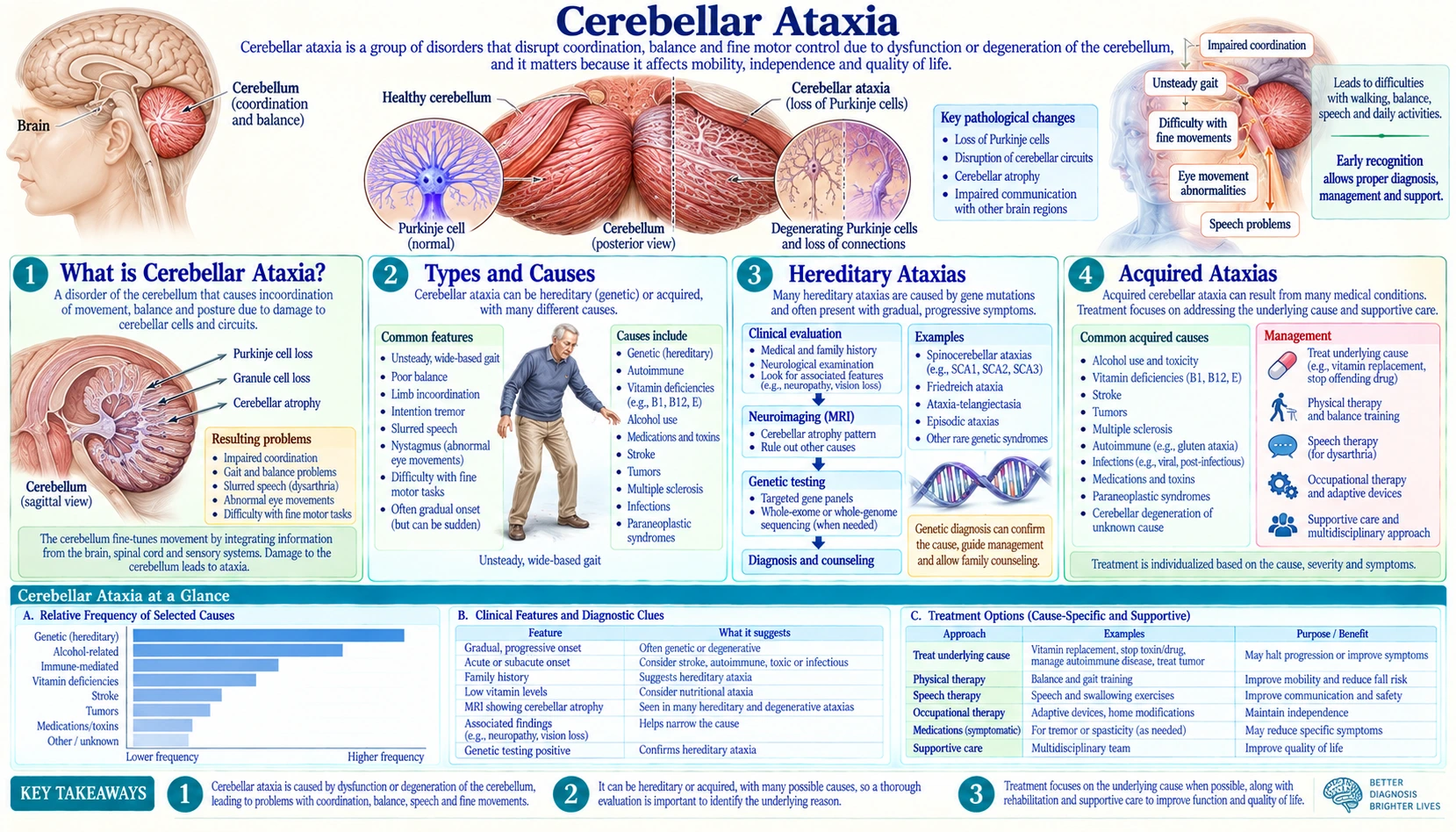
Table of Contents
What is Cerebellar Ataxia?
Cerebellar ataxia is a loss of coordination caused by damage to, or dysfunction of, the cerebellum. People with ataxia describe clumsiness, unsteadiness, incoordination and slurred speech. It can develop suddenly, over weeks, in episodes, or slowly over years, and it accompanies many conditions, including stroke, brain tumour, multiple sclerosis, head injury, toxicity and infection (PubMed PMID: 31048364).
The cerebellum plays a strong role in both motor control and motor learning (PubMed PMID: 19864636). It is densely packed with neurons: a cell-counting comparison of 19 mammal species, humans included, found on average 3.6 neurons in the cerebellum for every neuron in the cerebral cortex (PubMed PMID: 20300467).
Cerebellar ataxia is not a single disease but a collection of syndromes with genetic, acquired and degenerative causes. A 2019 review of progressive ataxia in adults notes that most forms have no treatment that halts progression, with a few notable exceptions, and that many cases stay undiagnosed ("idiopathic") (PubMed PMID: 31048364).
Types and Causes
The ataxias are broadly divided into genetic forms (with or without a family history) and acquired or degenerative forms. Inherited ataxias can be autosomal dominant, autosomal recessive, X-linked or mitochondrial (maternal) (PubMed PMID: 31048364).
- Hereditary ataxias: Over 40 dominant spinocerebellar ataxias (SCAs) have been identified, some limited to a few families or regions. Friedreich's ataxia and ataxia-telangiectasia are among the recessive forms. Some inherited metabolic disorders can present as late-onset ataxia with no family history.
- Acquired ataxias: Immune-mediated (paraneoplastic cerebellar degeneration, gluten ataxia), caused by deficiency states (vitamin B12, vitamin E), toxic (alcohol, phenytoin), or linked to infections (HIV, sporadic Creutzfeldt-Jakob disease, progressive multifocal leucoencephalopathy).
- Degenerative sporadic ataxias: For example the cerebellar type of multiple system atrophy (MSA-C). Many progressive ataxias remain without an identified cause.
The list above follows the 2019 review (PubMed PMID: 31048364).
Hereditary Ataxias
The spinocerebellar ataxias are dominantly inherited. Many SCAs are caused by expansions of a repeated CAG sequence that encodes a toxic polyglutamine stretch in the protein (PubMed PMID: 30284037). A systematic review cited there puts the global prevalence of SCA at about 3 per 100,000, with wide regional variation.
Key Autosomal Dominant SCAs
- SCA1, SCA2 and SCA3: Can be "complicated" by cognitive decline, slow saccades, ophthalmoplegia, pyramidal or extrapyramidal signs and neuropathy (PubMed PMID: 31048364).
- SCA2: Slow saccades (eye movements) are typical, and reflexes are usually reduced or absent. SCA2 is more common than SCA3 in Cuba (PubMed PMID: 30284037).
- SCA3 / Machado-Joseph disease: The most common SCA subtype worldwide (PubMed PMID: 30284037).
- SCA6: A relatively "pure" cerebellar form with CAG repeats that stay stable from one generation to the next. The same gene also causes episodic ataxia type 2, and these conditions usually show progressive ataxia after age 50. SCA6/episodic ataxia type 2 is the most common dominant ataxia in the British Isles (PubMed PMID: 31048364).
- SCA7: Usually accompanied by macular degeneration and blindness (PubMed PMID: 31048364).
Friedreich's Ataxia (Autosomal Recessive)
Friedreich's ataxia is the most common inherited ataxia. In about 96% of affected people both copies of the FXN gene carry an expanded GAA repeat in intron 1. The result is too little frataxin, a mostly mitochondrial protein, which reduces iron-sulfur cluster production and mitochondrial ATP output and raises mitochondrial iron and oxidative stress (PubMed PMID: 31494282). The gene lies on chromosome 9q13 (PubMed PMID: 8596916). The FDA puts its frequency at about one in every 50,000 people in the United States; a 2019 review gives around 1 per 20,000–50,000 in Caucasian populations (PubMed PMID: 31048364).
- Onset: Typically around puberty (PubMed PMID: 23859346). In a 1981 study of 90 families, onset was before age 25 (mean 10.5 years) in every index case (PubMed PMID: 7272714). Genetic testing later widened the range: in a 1996 series of 140 genetically confirmed patients, onset ranged from age 2 to 51, and about a quarter had atypical disease with later presentation and intact tendon reflexes (PubMed PMID: 8815938).
- Key features: Gait and limb ataxia, poor balance, leg weakness, sensory loss, absent reflexes, dysarthria, swallowing difficulty, eye-movement abnormalities, scoliosis, foot deformities, cardiomyopathy and diabetes (PubMed PMID: 23859346). Larger GAA expansions went with earlier onset and earlier loss of walking (PubMed PMID: 8815938).
- Omaveloxolone: In February 2023 the FDA approved omaveloxolone as the first treatment for Friedreich's ataxia (see Treatment and Management below). It is an Nrf2 activator; in disease models it improves mitochondrial function, restores redox balance and reduces inflammation (PubMed PMID: 33068037).
RFC1 Expansion and CANVAS
A 2019 genetic study identified a biallelic intronic AAGGG repeat expansion in the RFC1 gene as the cause of familial CANVAS (cerebellar ataxia, neuropathy, vestibular areflexia syndrome) and a frequent cause of late-onset ataxia, particularly when sensory neuronopathy and loss of vestibular function in both ears are also present. The expansion carrier frequency was 0.7% in Europeans (PubMed PMID: 30926972). Although the inheritance is recessive, CANVAS typically starts in middle age (PubMed PMID: 31048364).
Acquired Ataxias
Acquired ataxias matter because some are treatable. The 2019 review lists gluten ataxia and other immune-mediated ataxias as the main treatable groups, alongside rarer metabolic and deficiency causes (PubMed PMID: 31048364).
- Alcohol-related and nutritional cerebellar degeneration: Occurs in alcoholism and in other states that lead to malnutrition, such as gastric bypass surgery. Gait ataxia is the main sign, leg ataxia is not unusual, and arm ataxia and nystagmus are rare. The established disease shows atrophy of the anterior superior vermis. It is considered the cerebellar part of the Wernicke-Korsakoff spectrum, and a 2012 review describes active disease being treated with thiamine in the same way as Wernicke disease (PubMed PMID: 21827888). The 2019 review notes that when ataxia is attributed to alcohol, further investigation often finds other or additional explanations (PubMed PMID: 31048364).
- Paraneoplastic cerebellar degeneration: An immune attack linked to cancer. The anti-Yo (anti-PCA1) antibody marks a rapidly progressive cerebellar ataxia, is strongly associated with gynaecological and breast cancers, and the disorder can wipe out the cerebellum's Purkinje cells almost completely (PubMed PMID: 35881322). Rapid progression over weeks to months is characteristic. The tumour may be hidden and easy to miss on first imaging, and finding it may allow earlier cancer diagnosis (PubMed PMID: 31048364).
- Multiple sclerosis, stroke and tumour: All are recognised causes of ataxia (PubMed PMID: 31048364). Swelling after a large cerebellar infarct is a feared complication: the tight posterior fossa leaves little room, so swelling can compress the brainstem or block the fourth ventricle and cause hydrocephalus (PubMed PMID: 23634927).
- Drug-induced ataxia: A systematic review found ataxia reported with 93 individual drugs. The most common groups were antiepileptic drugs, benzodiazepines and cancer drugs. Symptoms usually began within days or weeks of a new drug or a dose increase and were commonly reversible, though persistent ataxia was described with lithium and certain cancer drugs (PubMed PMID: 25391707).
- Gluten ataxia: Ataxia is the most common neurological manifestation of gluten sensitivity, and it can occur with or without enteropathy, even without gut symptoms (PubMed PMID: 30806821). In the Sheffield series, gluten ataxia accounted for 25% of sporadic cases, although other centres report much lower proportions. Only half of patients with gluten ataxia have small-bowel enteropathy, so antigliadin antibodies are needed to diagnose the rest, and antibodies against transglutaminase 6 (TG6) are a potentially useful marker (PubMed PMID: 31048364).
- Other immune-mediated ataxias: Ataxia associated with anti-GAD, anti-voltage-gated calcium channel and anti-DPPX antibodies often begins acutely or subacutely (PubMed PMID: 31048364). In a series of 50 patients with anti-GAD ataxia, 70% also had serological evidence of gluten sensitivity (PubMed PMID: 33084997).
- Vitamin E deficiency: Ataxia with vitamin E deficiency mimics Friedreich's ataxia clinically and on MRI. The review describes lipid-adjusted vitamin E as the reliable measurement (PubMed PMID: 31048364).
Symptoms and Signs
The 2019 review lists the examination signs of cerebellar ataxia as gait ataxia and impaired sitting balance (usually late in the disease); gaze-evoked nystagmus, jerky (saccadic) pursuit and saccades that undershoot or overshoot; dysarthria; intention tremor; dysmetria; and dysdiadochokinesis. The signs rarely point to the cause on their own (PubMed PMID: 31048364).
- Dysmetria: Movements undershoot or overshoot their target. The SARA rating scale tests it by having the person follow the examiner's finger and by the heel-shin slide, in which the heel may slip off the shin (PubMed PMID: 31048364).
- Dysdiadochokinesia: Rapid alternating movements, such as repeatedly turning the hand palm-up and palm-down, become irregular and hard to tell apart (SARA item 7).
- Intention tremor: A kinetic tremor seen as the finger travels from the nose to a target (SARA nose-finger test).
Romberg Test
The Romberg test is positive when a person can stand with feet together and eyes open but sways or falls once the eyes close. It tests the dorsal (posterior) column pathway that carries proprioception, and it is often mistaken for a sign of cerebellar disease (PubMed PMID: 33085334). Friedreich's ataxia combines cerebellar features with sensory loss, and a 1981 study found loss of joint-position and vibration sense eventually developed in all cases (PubMed PMID: 7272714).
Additional Clues
- Reflexes: Usually reduced or absent in Friedreich's ataxia, ataxia with vitamin E deficiency, ataxia with oculomotor apraxia type 2 and SCA2; present or even brisk in most dominant SCAs and in MSA-C (PubMed PMID: 31048364).
- Eye movements: Slow saccades are typical of SCA2. Abnormal visually enhanced vestibulo-ocular reflexes are characteristic of CANVAS (PubMed PMID: 31048364). Downbeat nystagmus occurs in episodic ataxia type 2, along with attacks of vertigo and ataxia (PubMed PMID: 24222635).
- Autonomic signs: A drop in blood pressure on standing, often with impotence and urinary urgency or incontinence, points towards MSA-C (PubMed PMID: 31048364).
- Age at onset and speed of progression: The review calls these perhaps the two most useful pointers to the cause. Most ataxias that start before age 20 prove to be genetic, dominant ataxias tend to start from the third and fourth decades, and progression within weeks to months is characteristic of paraneoplastic degeneration and sporadic Creutzfeldt-Jakob disease (PubMed PMID: 31048364).
Diagnosis
Diagnosis combines history, neurological examination, brain imaging, and targeted laboratory and genetic testing. The points below follow the 2019 review based on Ataxia UK's guidelines (PubMed PMID: 31048364).
- Brain MRI: Described as essential in almost everyone with ataxia (CT if MRI cannot be done). It is rarely diagnostic on its own but gives clues and rules out structural causes. It usually shows cerebellar atrophy. The "hot-cross bun" sign in the pons is listed for MSA-C and also occurs in dominant SCAs. Upper cervical cord atrophy suggests Friedreich's ataxia or vitamin E deficiency.
- SARA (Scale for the Assessment and Rating of Ataxia): An 8-item scale (gait, stance, sitting, speech, finger chase, nose-finger test, fast alternating hand movements, heel-shin slide); higher scores mean more severe ataxia. In its 2006 validation in 167 and 119 patients with SCA, interrater reliability was 0.98 and test-retest reliability 0.90, and the authors judged it an appropriate primary outcome for clinical trials (PubMed PMID: 16769946).
- Laboratory tests listed in the review:
- Primary care: kidney function and electrolytes, full blood count, ESR/CRP, liver enzymes, thyroid function, vitamin B12, folate, glucose, chest X-ray
- Secondary care: alpha-fetoprotein, caeruloplasmin/copper, coeliac screen, creatine kinase, lactate, lipid-adjusted vitamin E and lipoproteins
- Anti-Hu/Yo and other paraneoplastic antibodies, anti-GAD antibody, anti-voltage-gated calcium channel antibody
- Lumbar puncture and CT of chest, abdomen and pelvis where the clinical picture calls for them
- Genetic testing: First-line tests listed are Friedreich's ataxia, SCA1, 2, 3, 6, 7 (12, 17) and fragile X tremor-ataxia syndrome; next-generation sequencing panels, then exome or whole-genome sequencing when the diagnosis remains unclear. The review notes that genetic testing may be considered even without a family history, and that a positive result has implications for relatives.
- Search for cancer: Rapid progression over months prompts a search for an underlying malignancy, including paraneoplastic antibodies; a fluorodeoxyglucose PET scan may be used even when CT is normal.
- Nerve conduction studies: After Friedreich's ataxia is excluded, recessive ataxias sort into four groups: no neuropathy, pure sensory neuronopathy (including RFC1), axonal sensorimotor neuropathy, and demyelinating neuropathy.
Treatment and Management
A 2014 expert consensus paper stated that, apart from aminopyridines and acetazolamide in episodic ataxia type 2, no medication had been proven effective for degenerative cerebellar ataxia, and that the mainstays of treatment were physiotherapy, occupational therapy and speech therapy (PubMed PMID: 24222635). A 2026 review describes omaveloxolone for Friedreich's ataxia and off-label agents such as riluzole, 4-aminopyridine and varenicline as showing subtype-specific benefits, with rehabilitation and multidisciplinary care foundational across all subtypes (PubMed PMID: 41387161).
Disease-Modifying and Cause-Specific Treatments
- Omaveloxolone (Friedreich's ataxia): The FDA approved it in February 2023 as the first treatment for Friedreich's ataxia; the current label covers adults and adolescents aged 16 and older, at a recommended 150 mg once daily. In the MOXIe trial, a registrational phase 2 study, 103 patients aged 16 to 40 were randomised to omaveloxolone or placebo for 48 weeks. The modified Friedreich's Ataxia Rating Scale (mFARS) changed by −1.55 on omaveloxolone and +0.85 on placebo, a difference of −2.40 points (p = 0.014; lower is better). Transient, reversible rises in liver aminotransferases were seen, and headache, nausea and fatigue were more common on the drug (PubMed PMID: 33068037). The FDA lists raised liver enzymes, headache, nausea, abdominal pain, fatigue, diarrhoea and musculoskeletal pain as the most common side effects.
- Riluzole: In a 2010 pilot trial of 40 patients with cerebellar ataxias of mixed causes, 13 of 19 on riluzole and 1 of 19 on placebo improved by at least 5 points on the ICARS ataxia scale after 8 weeks (PubMed PMID: 20211908). A 12-month trial in 55 patients with SCA or Friedreich's ataxia used 50 mg twice daily: 50% on riluzole versus 11% on placebo had a lower SARA score (PubMed PMID: 26321318). A 2022 trial restricted to SCA2 (45 patients, 12 months) found no improvement in clinical or MRI outcomes (PubMed PMID: 35063116). The 2014 consensus paper noted that the experience of many ataxia clinics was less promising than the trials (PubMed PMID: 24222635).
- Immunotherapy for immune-mediated ataxias: The 2019 review raises the possibility that immune modulation may help stabilise these ataxias (PubMed PMID: 31048364). In the anti-GAD series, mycophenolate was used in 16 patients and 7 improved; the authors report that patients without gluten sensitivity responded well to immunosuppression (PubMed PMID: 33084997).
- Gluten-free diet: A 2019 review describes a strict gluten-free diet as an effective first-line treatment for the neurological manifestations of gluten sensitivity, with very few patients needing added immunosuppression (PubMed PMID: 30806821). The 2019 ataxia review notes that symptoms may take up to a year to stabilise or improve and describes repeating antibody tests every 6 months to confirm adherence (PubMed PMID: 31048364). In the anti-GAD series, of 35 patients with gluten sensitivity who went gluten-free, 18 improved and 13 stabilised (PubMed PMID: 33084997).
- Thiamine: For nutritional (including alcohol-related) cerebellar degeneration, active disease is described as treated with thiamine as for Wernicke disease (PubMed PMID: 21827888).
- Rare treatable metabolic ataxias: The 2019 review lists vitamin E replacement for ataxia with vitamin E deficiency, CoQ10 for some CoQ10-deficiency ataxias, chenodeoxycholic acid for cerebrotendinous xanthomatosis and miglustat for Niemann-Pick type C (PubMed PMID: 31048364).
Symptomatic Medical Treatments
- Varenicline (SCA3): In an 8-week randomised trial in 20 patients with SCA3, varenicline improved the SARA gait, stance and rapid-alternating-movement subscores and the timed 25-foot walk, with only a trend for the total SARA score (p = 0.06); nausea was the most common side effect (PubMed PMID: 22323747). The consensus paper notes that a 40% dropout rate prevented the planned crossover (PubMed PMID: 24222635).
- Acetazolamide and aminopyridines (episodic ataxia type 2): About two-thirds of people with episodic ataxia type 2 respond to acetazolamide, although there are no placebo-controlled trials and side effects such as kidney stones often limit its use. Aminopyridines are also effective in episodic ataxia type 2 and in a subset of people with downbeat nystagmus (PubMed PMID: 24222635).
- Amantadine: In one trial cited by the consensus paper, 30 patients with olivopontocerebellar atrophy received amantadine 200 mg daily or placebo for 3 to 4 months; the amantadine group improved on seven of eight reaction-time and movement-time measures (PubMed PMID: 24222635).
- Buspirone: A 3-month double-blind crossover trial in 20 patients, summarised in the consensus paper, found no evidence of an effect on the ICARS ataxia scale (PubMed PMID: 24222635).
Rehabilitation
The 2014 consensus paper names physiotherapy, occupational therapy and speech therapy as the current mainstays of treatment for degenerative cerebellar ataxia and states that evidence-based physiotherapy guidelines still need to be developed (PubMed PMID: 24222635).
- Intensive coordinative training: In a 2009 study by Ilg and colleagues, 16 patients completed 4 weeks of intensive coordinative training. Ataxia scores and motor performance improved and the gains held at 8-week follow-up. People with predominantly cerebellar ataxia improved more than those whose ataxia came from loss of sensory input (PubMed PMID: 19864636). With a home programme afterwards, improvements in motor performance and daily activities persisted at 1 year despite gradual disease progression (PubMed PMID: 20737551).
- Randomised trial of intensive rehabilitation: In a 2012 trial, 42 patients with pure cerebellar degeneration received 4 weeks of inpatient physical and occupational therapy (2 hours on weekdays, 1 hour at weekends), either at once or after a 4-week delay. The immediate group gained more in ataxia, gait speed and daily activities. Gains in ataxia lasted to 12 weeks and in gait to 24 weeks, and more than half kept at least one gain at 24 weeks (PubMed PMID: 22140200).
- Dose: The consensus paper reads these studies as showing benefit with at least 3 hours of training per week for 4 weeks, and states that it is not clear whether more training brings further improvement (PubMed PMID: 24222635).
- Speech, swallowing and occupational therapy: The 2019 review describes speech and language therapy as running through the whole course of the illness, from monitoring swallowing early on to planning gastrostomy feeding. It notes that almost all of these management interventions lack an evidence base from randomised trials (PubMed PMID: 31048364).
Prognosis
Prognosis varies widely by cause. The 2019 review notes that many people with progressive ataxia have a normal life expectancy, while some forms, such as MSA-C, can progress rapidly and shorten life (PubMed PMID: 31048364).
- SCA1, 2, 3 and 6: In the EUROSCA cohort of 462 patients followed for a median of 49 months, the SARA score rose each year by 2.11 points in SCA1, 1.49 in SCA2, 1.56 in SCA3 and 0.80 in SCA6. SCA6 was the slowest-progressing of the four (PubMed PMID: 26377379).
- Friedreich's ataxia: In the 1981 study of 90 families the disorder progressed in every case; the mean age at losing the ability to walk was 25 years, and 95% used a wheelchair by age 44 (PubMed PMID: 7272714). In a 2011 mortality study, cardiac dysfunction caused 59% of deaths, most often heart failure or arrhythmia (PubMed PMID: 21652007).
- Paraneoplastic cerebellar degeneration: The disorder progresses rapidly, and the Purkinje cell loss is often severe to total (PubMed PMID: 35881322).
Key Research Papers
- Lynch DR, Chin MP, Delatycki MB, et al. (2021). Safety and Efficacy of Omaveloxolone in Friedreich Ataxia (MOXIe Study). Annals of Neurology — PubMed PMID: 33068037
- Romano S, Coarelli G, Marcotulli C, et al. (2015). Riluzole in patients with hereditary cerebellar ataxia: a randomised, double-blind, placebo-controlled trial. Lancet Neurology — PubMed PMID: 26321318
- Ristori G, Romano S, Visconti A, et al. (2010). Riluzole in cerebellar ataxia: a randomized, double-blind, placebo-controlled pilot trial. Neurology — PubMed PMID: 20211908
- Coarelli G, Heinzmann A, Ewenczyk C, et al. (2022). Safety and efficacy of riluzole in spinocerebellar ataxia type 2 in France (ATRIL): a multicentre, randomised, double-blind, placebo-controlled trial. Lancet Neurology — PubMed PMID: 35063116
- Zesiewicz TA, Greenstein PE, Sullivan KL, et al. (2012). A randomized trial of varenicline [brand name omitted] for the treatment of spinocerebellar ataxia type 3. Neurology — PubMed PMID: 22323747
- Ilg W, Synofzik M, Brötz D, et al. (2009). Intensive coordinative training improves motor performance in degenerative cerebellar disease. Neurology — PubMed PMID: 19864636
- Ilg W, Brötz D, Burkard S, et al. (2010). Long-term effects of coordinative training in degenerative cerebellar disease. Movement Disorders — PubMed PMID: 20737551
- Miyai I, Ito M, Hattori N, et al. (2012). Cerebellar ataxia rehabilitation trial in degenerative cerebellar diseases. Neurorehabilitation and Neural Repair — PubMed PMID: 22140200
- Ilg W, Bastian AJ, Boesch S, et al. (2014). Consensus paper: management of degenerative cerebellar disorders. Cerebellum — PubMed PMID: 24222635
- Ariello LE, Rastall DPW, Rosenthal LS (2026). Treatment of primary adult-onset neurodegenerative cerebellar ataxias. Neurotherapeutics — PubMed PMID: 41387161
- de Silva RN, Vallortigara J, Greenfield J, et al. (2019). Diagnosis and management of progressive ataxia in adults. Practical Neurology — PubMed PMID: 31048364
- Sullivan R, Yau WY, O'Connor E, Houlden H (2019). Spinocerebellar ataxia: an update. Journal of Neurology — PubMed PMID: 30284037
- Schmitz-Hübsch T, du Montcel ST, Baliko L, et al. (2006). Scale for the assessment and rating of ataxia: development of a new clinical scale. Neurology — PubMed PMID: 16769946
- Jacobi H, du Montcel ST, Bauer P, et al. (2015). Long-term disease progression in spinocerebellar ataxia types 1, 2, 3, and 6: a longitudinal cohort study. Lancet Neurology — PubMed PMID: 26377379
- Harding AE (1981). Friedreich's ataxia: a clinical and genetic study of 90 families with an analysis of early diagnostic criteria and intrafamilial clustering of clinical features. Brain — PubMed PMID: 7272714
- Campuzano V, Montermini L, Moltò MD, et al. (1996). Friedreich's ataxia: autosomal recessive disease caused by an intronic GAA triplet repeat expansion. Science — PubMed PMID: 8596916
- Dürr A, Cossee M, Agid Y, et al. (1996). Clinical and genetic abnormalities in patients with Friedreich's ataxia. New England Journal of Medicine — PubMed PMID: 8815938
- Parkinson MH, Boesch S, Nachbauer W, et al. (2013). Clinical features of Friedreich's ataxia: classical and atypical phenotypes. Journal of Neurochemistry — PubMed PMID: 23859346
- Delatycki MB, Bidichandani SI (2019). Friedreich ataxia- pathogenesis and implications for therapies. Neurobiology of Disease — PubMed PMID: 31494282
- Tsou AY, Paulsen EK, Lagedrost SJ, et al. (2011). Mortality in Friedreich ataxia. Journal of the Neurological Sciences — PubMed PMID: 21652007
- Cortese A, Simone R, Sullivan R, et al. (2019). Biallelic expansion of an intronic repeat in RFC1 is a common cause of late-onset ataxia. Nature Genetics — PubMed PMID: 30926972
- Laureno R (2012). Nutritional cerebellar degeneration, with comments on its relationship to Wernicke disease and alcoholism. Handbook of Clinical Neurology — PubMed PMID: 21827888
- Greenlee JE, Brashear HR (2023). The Discovery of Anti-Yo (Anti-PCA1) Antibody in Patients with Paraneoplastic Cerebellar Degeneration: Opening a Window into Autoimmune Neurological Disease. Cerebellum — PubMed PMID: 35881322
- Zis P, Hadjivassiliou M (2019). Treatment of Neurological Manifestations of Gluten Sensitivity and Coeliac Disease. Current Treatment Options in Neurology — PubMed PMID: 30806821
- Hadjivassiliou M, Sarrigiannis PG, Shanmugarajah PD, et al. (2021). Clinical Characteristics and Management of 50 Patients with Anti-GAD Ataxia: Gluten-Free Diet Has a Major Impact. Cerebellum — PubMed PMID: 33084997
- van Gaalen J, Kerstens FG, Maas RP, et al. (2014). Drug-induced cerebellar ataxia: a systematic review. CNS Drugs — PubMed PMID: 25391707
- Neugebauer H, Witsch J, Zweckberger K, Jüttler E (2013). Space-occupying cerebellar infarction: complications, treatment, and outcome. Neurosurgical Focus — PubMed PMID: 23634927
- Herculano-Houzel S (2010). Coordinated scaling of cortical and cerebellar numbers of neurons. Frontiers in Neuroanatomy — PubMed PMID: 20300467
- Forbes Kaprive J, Munakomi S, Cronovich HA (2023). Romberg Test. StatPearls — PubMed PMID: 33085334
- U.S. Food and Drug Administration (2023). FDA approves first treatment for Friedreich's ataxia. — fda.gov
PubMed Topic Searches
- PubMed: Spinocerebellar ataxia CAG repeat expansion
- PubMed: Friedreich ataxia frataxin omaveloxolone
- PubMed: Cerebellar ataxia SARA scale clinical trial
- PubMed: Riluzole spinocerebellar ataxia randomized
- PubMed: Paraneoplastic cerebellar degeneration anti-Yo
- PubMed: Gluten ataxia anti-gliadin treatment
- PubMed: Alcoholic cerebellar degeneration Purkinje cell
- PubMed: Cerebellar ataxia rehabilitation coordination training
- PubMed: Downbeat nystagmus cerebellar pathology
- PubMed: Machado-Joseph disease SCA3 clinical features
- PubMed: Cerebellar ataxia autoimmune GAD65 CASPR2
- PubMed: Episodic ataxia type 2 acetazolamide CACNA1A