Liver Disease: History and Discovery
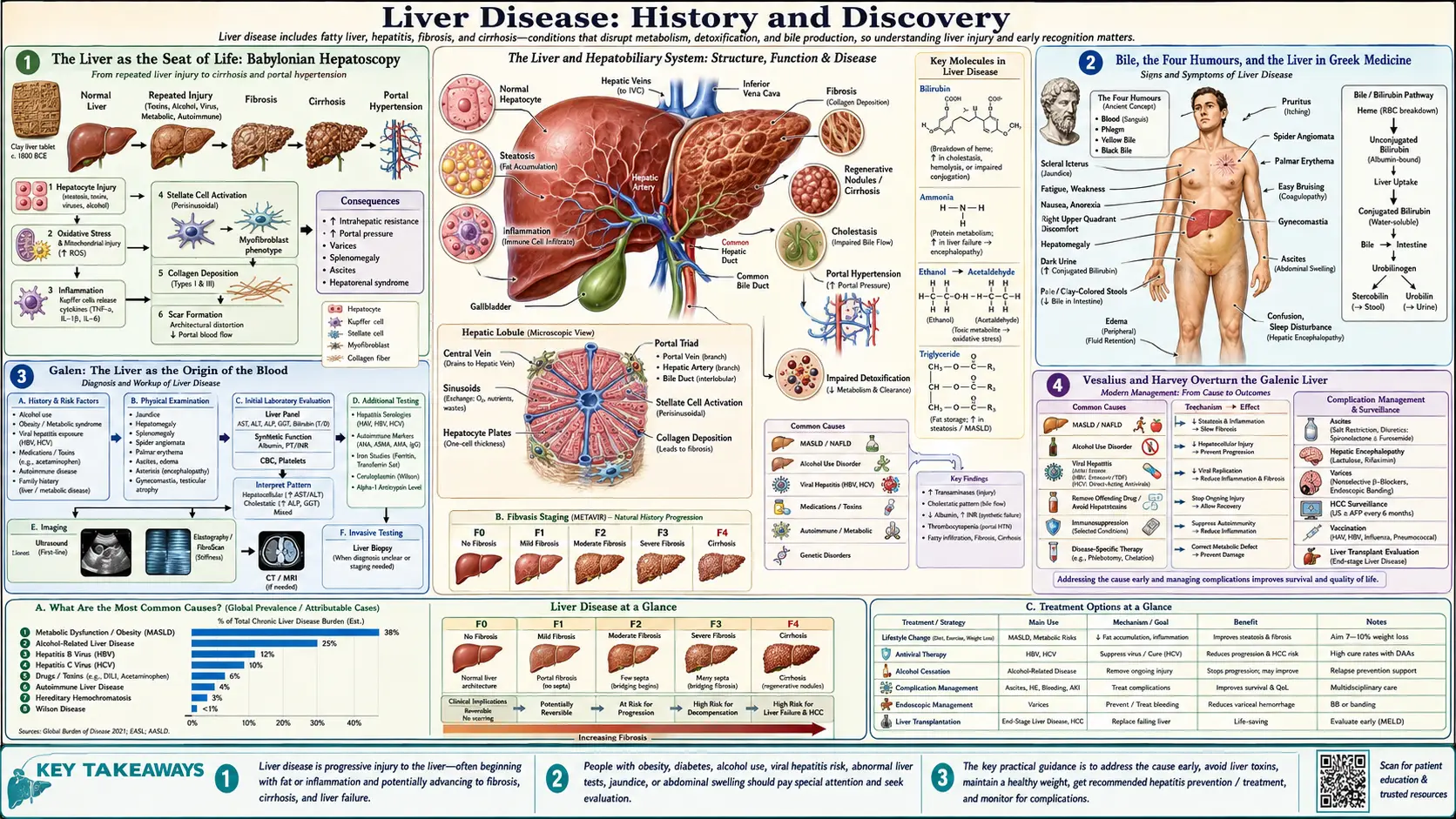
No organ has occupied a stranger place in the human imagination than the liver. To the Babylonians it was the seat of life and the soul, and they read the future in the livers of sacrificed sheep — a practice called hepatoscopy. To Galen it was the origin of all venous blood and the home of one of the body's three governing spirits, a doctrine that ruled medicine for roughly fourteen centuries until William Harvey described the true circulation of the blood in 1628. Only in the eighteenth, nineteenth, and twentieth centuries did the liver's real work emerge: the manufacture of bile, the storage of fuel as glycogen (isolated by Claude Bernard in 1857), and the detoxification of the blood. "Hepatology," the modern science of the liver, did not even acquire its name until the twentieth century. This page traces that long road — from the divining priest's altar to the biochemistry bench — and explains the recurring signs (above all jaundice) and the liver's almost mythic power to heal itself, a power the Greeks attributed to Prometheus.
Table of Contents
- The Liver as the Seat of Life: Babylonian Hepatoscopy
- Bile, the Four Humours, and the Liver in Greek Medicine
- Galen: The Liver as the Origin of the Blood
- Vesalius and Harvey Overturn the Galenic Liver
- Claude Bernard and the Glycogenic Liver (1857)
- Bile, Detoxification, and the Metabolic Liver
- Jaundice: The Liver's Ancient Warning Sign
- Prometheus and the Regenerating Liver
- The Birth of Hepatology as a Modern Specialty
- Key Research Papers
- Connections
- Featured Videos
The Liver as the Seat of Life: Babylonian Hepatoscopy
The recorded history of the liver in medicine begins not with anatomy but with prophecy. In ancient Mesopotamia, the liver — the largest internal organ and the one most engorged with blood — was regarded as the seat of life itself, and even of the soul, intellect, and emotion. Because the gods were thought to write their intentions into the organ at the moment a sacrificial animal was killed, priests developed an elaborate art of reading the liver of a sheep to discover the divine will. This practice is called hepatoscopy (from the Greek hepar, liver), or more broadly extispicy; the diviner who performed it among the later Etruscans and Romans was the haruspex. Texts and physical models attesting to it survive from the second millennium BCE onward.
The most famous surviving artifacts are the Babylonian clay liver models. One well-known example in the British Museum dates to roughly 1900–1600 BCE; the Science Museum in London holds copies of a model dated about 2050–1750 BCE. These clay livers are divided into squares and zones inscribed with omens, so that a blemish, lobe, or marking in a given region of a real liver could be matched against the model and read as a favorable or unfavorable sign — for a king, a battle, a harvest, or a siege. They functioned as both reference charts and teaching tools for trainee diviners, making them, in a sense, among the oldest known anatomical diagrams of any human or animal organ. The much later Etruscan bronze Liver of Piacenza continued the same divinatory tradition in Italy.
It is easy to dismiss hepatoscopy as mere superstition, but it carried a serious unintended consequence: in order to read livers, priests had to examine them closely and repeatedly, learning the normal lobes, vessels, and the gallbladder, and noting when disease had scarred or deformed the organ. The conviction that the liver was the wellspring of life — "the basis of life itself," in the words of one modern review of the Mesopotamian models — would echo through Greek medicine and survive, in transformed form, all the way to Galen.
Bile, the Four Humours, and the Liver in Greek Medicine
Greek medicine inherited the idea that the liver was a vital organ and wove it into the dominant medical theory of antiquity: humourism. As systematized in the Hippocratic writings (Hippocrates lived roughly 460–370 BCE) and elaborated by Galen, health was a balance of four cardinal humours — blood, phlegm, yellow bile, and black bile — and two of those four were the bilious products associated with the liver. Yellow bile (Greek kholē, the root of "choler" and "choleric") was held to be produced in or by the liver and to govern an ambitious, hot-tempered temperament. Black bile (melaina kholē) was linked to a cold, brooding temperament; the very word melancholy descends from the Greek for "black bile." Humoural theory would remain a central framework of Western medicine from antiquity through the nineteenth century.
Within this scheme the liver was understood as a great cooking-vessel of the body, a place where food was "concocted" into blood and where the bilious humours arose. This was, of course, mistaken physiology — black bile in particular has no real anatomical existence as the humouralists imagined it — but the framework had genuine observational anchors. Physicians could see real bile, a yellow-green fluid, draining from the gallbladder, and they could watch a sick patient's skin and eyes turn the same yellow color in jaundice. The liver was therefore firmly established, well before anyone understood what it actually did, as a master organ of nourishment, temperament, and disease.
This humoural liver mattered for centuries of practice: bloodletting, purging, and dietary regimens were all aimed at correcting an imagined excess or deficiency of bile. The error was profound, but the attention was real, and it kept the liver at the center of medical thought just long enough for one towering figure — Galen of Pergamon — to give it the most influential, and most wrong, role of all.
Galen: The Liver as the Origin of the Blood
Galen of Pergamon (c. 129 – c. 216 CE), physician to Roman emperors and the most influential medical writer in history, built a complete and internally consistent physiology in which the liver held pride of place. In Galen's system the body was animated by three "spirits" or pneumata, each seated in a major organ and corresponding to a faculty of the soul: the animal spirit in the brain (governing sensation and thought), the vital spirit in the heart (governing the pulse and innate heat), and the natural spirit in the liver (governing nutrition and growth). The liver was thus the organ of the lowest, vegetative soul — the seat of the body's nourishing power.
Crucially, Galen taught that the liver was the origin of the venous blood. In his model, food digested in the gut became chyle, was carried to the liver, and there was transformed into dark venous blood and charged with natural spirit. This blood then ebbed and flowed outward through the veins to nourish the body, where it was consumed — a one-way tide, continually manufactured anew by the liver, with no true circulation. Arterial blood, in his scheme, arose separately in the heart. The liver, in short, was the body's blood-factory and the headwater of the entire venous system.
This was an elegant theory, and it was wrong in nearly every particular — yet Galen's enormous authority, reinforced through medieval Islamic and European medicine, meant that the liver-as-origin-of-blood doctrine went essentially unchallenged for roughly fourteen hundred years. To question it was to question the foundations of medicine. Overturning it would require both a new willingness to dissect the human body directly and a new insistence on trusting observation over the printed authority of the ancients.
Vesalius and Harvey Overturn the Galenic Liver
The first great crack in the Galenic edifice came from the anatomist Andreas Vesalius (1514–1564). In his landmark 1543 work De Humani Corporis Fabrica ("On the Fabric of the Human Body"), based on his own human dissections, Vesalius corrected a long list of Galenic errors — many of which had persisted because Galen had dissected animals, not humans. Among the corrections was the shape of the liver: Galenic tradition described a multi-lobed (often five-lobed) human liver, and Vesalius showed from direct observation that the human liver is not built that way. More important than any single correction was the precedent: Vesalius demonstrated that Galen could no longer be treated as the final, unquestionable authority on the human body.
The decisive blow to Galen's liver, however, came from the English physician William Harvey (1578–1657). In his short, revolutionary 1628 treatise Exercitatio Anatomica de Motu Cordis et Sanguinis in Animalibus — usually shortened to De Motu Cordis, "On the Motion of the Heart" — Harvey demonstrated through measurement and experiment that the blood circulates: the heart pumps the same blood around the body in a continuous loop, through the lungs and back, far faster and in far greater volume than any organ could possibly manufacture from food. If the heart drove many liters of blood through itself every hour, the liver could not possibly be brewing all of it fresh from chyle. Galen's one-way tide of liver-made venous blood was impossible.
Harvey's discovery, grounded in his refusal to "believe uncritically what he was taught," dethroned the liver from its 1,400-year reign as the source of the blood and placed the heart at the center of the circulation. The liver was not diminished as an organ — it remained obviously vital — but the question of what it actually does was now wide open. Answering it would be the work of the chemists and physiologists of the eighteenth, nineteenth, and twentieth centuries.
Claude Bernard and the Glycogenic Liver (1857)
The single most important nineteenth-century discovery about the liver belongs to the French physiologist Claude Bernard (1813–1878), one of the founders of experimental medicine. Bernard set out to study how the body handled sugar and made a finding that overturned prevailing assumptions: the liver does not merely receive sugar from food and pass it along — it actively manufactures and stores it. He showed that the liver builds up a white, starch-like reserve substance from blood sugar, banks it, and releases sugar back into the blood as the body needs it, helping to keep the level of blood sugar roughly constant. This is the liver's glycogenic function.
Bernard named the stored substance glycogen ("sugar-former"). On 21 March 1857 he communicated the isolation of glycogen from liver tissue, and its chemical and physical properties, to the Société de Biologie in Paris, with a companion communication to the Académie des Sciences two days later; the underlying discovery had taken shape over the preceding year or two. The breakthrough is often traced to a telling experiment in which Bernard washed a liver free of all sugar, left it overnight, and found it full of sugar again the next day — proof that the organ was generating sugar internally, not merely holding what it had absorbed.
The implications were enormous. Bernard had shown that an organ could perform internal secretion — building up a complex molecule and dispensing its products into the blood — a concept that helped open the entire field of metabolism and, later, endocrinology. The discovery of glycogen storage is also the historical root of our modern understanding of how liver disease deranges blood sugar, and it sits behind the broader idea, which Bernard championed, that the body maintains a stable internal environment (the milieu intérieur). For the first time, the liver had a clearly demonstrated, chemically defined job.
Bile, Detoxification, and the Metabolic Liver
Bernard's glycogen was one piece of a larger picture assembled across roughly two centuries of physiology and biochemistry: the liver as the body's central chemical-processing plant. Long before its other roles were understood, the liver's production of bile — the digestive fluid stored in the gallbladder and released to help absorb fats — was at least observable, since bile could be seen and collected. Over the eighteenth and nineteenth centuries, physiologists clarified that bile is made continuously by the liver, concentrated in the gallbladder, and that obstruction of its flow produces the yellow staining of jaundice, tying a visible sign to a definable plumbing failure.
The liver's role as a detoxifying organ was worked out later and more gradually. A landmark came in 1932, when the biochemists Hans Krebs and Kurt Henseleit, working with slices of liver tissue, elucidated the urea cycle (also called the ornithine cycle) — the sequence of reactions by which the liver converts highly toxic ammonia, a byproduct of protein breakdown, into harmless, water-soluble urea that the kidneys can excrete. This was, notably, the first metabolic cycle ever discovered in biochemistry, predating Krebs's more famous citric-acid cycle. It explained at a stroke why severe liver failure causes ammonia to accumulate and poison the brain — the condition now called hepatic encephalopathy.
Piece by piece, the modern liver came into focus: a single organ that stores and releases sugar, manufactures bile, builds blood proteins, processes fats and cholesterol, metabolizes drugs and alcohol, and neutralizes nitrogenous waste. Far from Galen's blood-factory or the humouralists' cooking-pot, the liver revealed itself as a true biochemical hub — which is precisely why its diseases (cirrhosis, hepatitis, fatty liver, and others, covered on their own pages) ripple outward to affect digestion, the brain, bleeding, and the whole metabolism of the body.
Jaundice: The Liver's Ancient Warning Sign
If one clinical sign has signaled liver trouble across every era of medicine, it is jaundice — the yellow discoloration of the skin and the whites of the eyes. The name comes from the French jaune, "yellow" (jaunisse, "yellow disease"); its formal medical synonym is icterus, a word whose curious folk etymology connected the condition to a yellow bird thought to cure it by being looked at. Ancient physicians could not have explained the chemistry, but they could not miss the color, and a yellow patient was recognized as gravely ill from earliest recorded medicine onward.
The modern explanation is that jaundice reflects a buildup in the blood of bilirubin, the yellow-orange pigment produced when worn-out red blood cells are broken down. Normally the liver takes up bilirubin, processes ("conjugates") it, and excretes it into the bile and onward into the gut. When red cells are destroyed too fast, when liver cells are damaged (as in hepatitis or cirrhosis), or when the bile ducts are blocked (as by a gallstone or tumor), bilirubin backs up and stains the tissues. Jaundice typically becomes visible once the blood bilirubin reaches roughly 2 to 3 mg/dL. It is, importantly, a sign rather than a disease — a single yellow flag that can be raised by problems in the blood, the liver itself, or the biliary drainage.
Because jaundice can arise at three different points — before the liver (excess red-cell breakdown), within the liver (hepatocellular damage), or after it (obstructed bile flow) — the careful evaluation of a jaundiced patient became one of the founding clinical exercises of hepatology. The same yellow color that the humouralists once read as an excess of bile, modern medicine reads as a precise diagnostic clue. A dedicated companion page on this site treats Jaundice as a symptom in its own right.
Prometheus and the Regenerating Liver
The liver possesses an ability that no other major internal human organ can match: it can regenerate, regrowing lost tissue and restoring a large fraction of its mass after injury or surgical removal. Remarkably, the ancient Greeks appear to have intuited this, encoding it in one of their most enduring myths. In the legend of Prometheus, the Titan who stole fire to give to humankind is punished by Zeus by being chained to a rock, where each day an eagle devours part of his liver — and each night the liver grows back, so that the torment can begin again the following day. That the Greeks chose the liver, specifically, for an organ that perpetually renews itself is a striking coincidence with biological fact, whether or not it reflects any real anatomical knowledge on their part.
Modern science has confirmed the underlying phenomenon, though not in the literal nightly form of the myth. After partial removal, the mammalian liver can restore a very large proportion of its volume — studies in animal models classically describe recovery of up to roughly 70 percent of the organ's mass — driven chiefly by the division of mature liver cells called hepatocytes, supported by growth factors, hormones, and signaling molecules. This capacity is what makes living-donor liver transplantation possible: a healthy donor can give a portion of their liver, and both the donated piece and the donor's remaining liver can grow toward a functional size.
This regenerative power is double-edged, and it frames much of liver disease. On one hand, it is why the liver can often endure and recover from substantial injury, and why early-stage damage may be reversible. On the other hand, when injury is relentless — from chronic alcohol use, ongoing viral hepatitis, or persistent fatty-liver inflammation — repeated cycles of damage and repair lay down scar tissue, and the liver's attempts to rebuild itself can become disordered, contributing to cirrhosis and raising the long-term risk of liver cancer. The Prometheus myth, in other words, captures both the hope and the limit of the liver: extraordinary resilience, but not an inexhaustible one.
The Birth of Hepatology as a Modern Specialty
For all its ancient prominence, the study of the liver as a distinct medical specialty — with the name hepatology — is a creation of the twentieth century. The word combines the Greek hepar (liver) with -logy (study of), and it came into use as the tools to investigate the living liver matured: percutaneous needle biopsy made it possible to sample liver tissue from a patient, liver-function blood tests gave quantitative measures of the organ's health, and, later, imaging and viral diagnostics transformed the field. Before these advances, liver disease was largely a matter of bedside observation and post-mortem description.
Two figures are widely regarded as the founders of modern hepatology. The Austrian-born pathologist Hans Popper (1903–1988), who continued his career in the United States after being forced from Austria in 1938, is credited with moving the study of the liver from a chiefly descriptive discipline toward a quantitative science of structure and function; many modern concepts and terms — chronic hepatitis, cholestasis, and the modern understanding of cirrhosis among them — are associated with his work. Alongside him, the British physician Dame Sheila Sherlock (1918–2001) is celebrated as a founder of clinical hepatology, whose teaching and influential textbook helped establish liver disease as a coherent clinical field.
From divination on a Babylonian altar to needle biopsy and molecular virology, the liver has traveled a longer conceptual road than almost any organ in medicine. It was worshipped as the seat of the soul, miscast as the fountainhead of the blood for fourteen centuries, and only in the modern era understood for what it truly is: a tireless chemical workshop whose health underpins digestion, metabolism, and the clearance of toxins. The specific diseases that befall it — cirrhosis, the viral hepatitides, fatty liver disease, and more — are explored on their own pages, but they all rest on this remarkable history of how humanity slowly learned to read the organ it once used to read the future.
Key Research Papers
The list below pairs key peer-reviewed and historical sources on the history of the liver with curated PubMed topic-search links into the relevant literature. Ancient and early-modern primary texts (the Babylonian liver omens, the Hippocratic corpus, Galen's physiological works, Vesalius's De Humani Corporis Fabrica, and Harvey's De Motu Cordis) are named in the article as historical primary sources rather than as modern citations. Each link opens in a new tab.
- Yapijakis C, Vichas G. History of liver anatomy: Mesopotamian liver clay models. Hepatology (review of Mesopotamian liver models). — PMC: History of liver anatomy — Mesopotamian liver clay models
- Singer C. Galen's physiology and the doctrine of the three spirits / souls (liver, heart, brain). — PubMed: Galen, the three souls/spirits, and the liver
- ElMaghawry M, Zanatta A, Zampieri F. The discovery of pulmonary circulation: from Galen to William Harvey. — doi:10.5339/gcsp.2014.31
- Ribatti D. William Harvey and the discovery of the circulation of the blood. Journal of Angiogenesis Research — doi:10.1186/2040-2384-1-3
- Vesalius and the correction of Galenic anatomy (De Humani Corporis Fabrica, 1543), including the lobes of the liver. — PubMed: Vesalius, the Fabrica, and the correction of Galenic anatomy. — Search PubMed
- Young FG. Claude Bernard and the discovery of glycogen. British Medical Journal. 1957;1(5033):1431-1437. — doi:10.1136/bmj.1.5033.1431
- Claude Bernard, the glycogenic function of the liver, and the milieu intérieur — historical perspective. — PubMed: Claude Bernard and the glycogenic function of the liver. — Search PubMed
- Krebs HA, Henseleit K. Untersuchungen über die Harnstoffbildung im Tierkörper (the discovery of the urea/ornithine cycle in liver, 1932). — PubMed: Krebs and Henseleit and the urea cycle
- Michalopoulos GK, DeFrances MC. Liver regeneration. Science. 1997;276(5309):60-66. — doi:10.1126/science.276.5309.60
- Power C, Rasko JEJ. Whither Prometheus' liver? Greek myth and the science of regeneration. Annals of Internal Medicine. 2008;149(6):421-426. — doi:10.7326/0003-4819-149-6-200809160-00009
- History of jaundice and the discovery of bilirubin metabolism — from icterus to conjugation. — PubMed: history of jaundice and bilirubin metabolism
- Reuben A. Hans Popper and the founding of modern hepatology (history of the specialty). — PubMed: Hans Popper and the founding of modern hepatology
- Dame Sheila Sherlock and the development of clinical hepatology. — PubMed: Sheila Sherlock and clinical hepatology
- Hepatoscopy, the haruspex, and the liver as the seat of the soul in the ancient world. — Britannica: Hepatoscopy (liver divination)
External Authoritative Resources
Connections
- Nephrology & Hepatology
- Liver Disease (Overview)
- Cirrhosis
- Non-Alcoholic Fatty Liver Disease
- Hepatitis
- Jaundice
- Gallbladder Disease
- All Conditions