Appendicitis
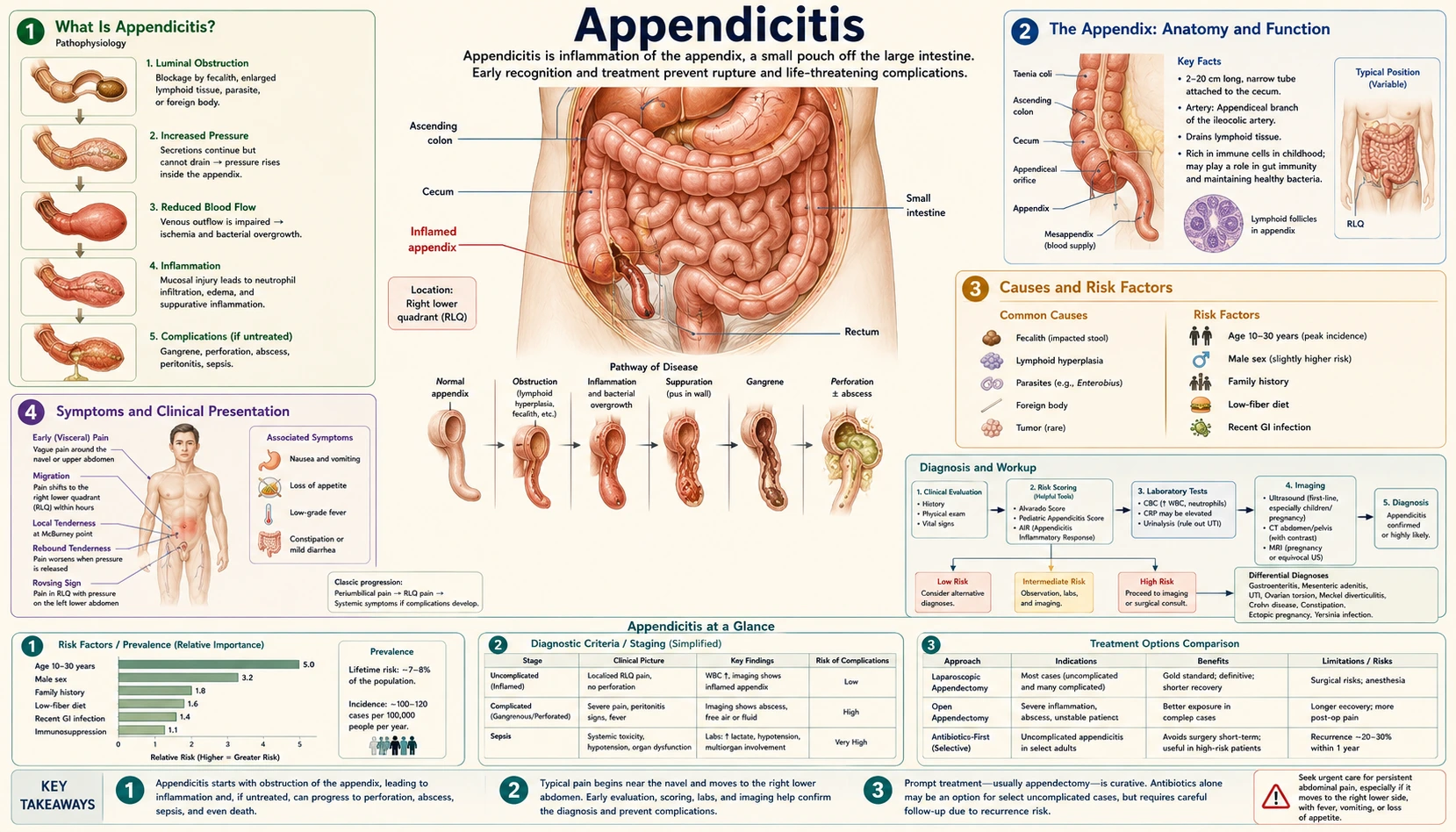
Table of Contents
- Appendicitis Explained
- The Appendix: Anatomy and Function
- Causes and Risk Factors
- Symptoms and Clinical Presentation
- The Alvarado Score
- Imaging: Computed Tomography, Ultrasound, and Magnetic Resonance Imaging
- Treatment: Surgery vs. Antibiotics
- Laparoscopic vs. Open Appendectomy
- Complications and Perforation
- Recovery and Prognosis
- Key Research Papers
- Connections
- Featured Videos
Appendicitis Explained
Appendicitis is inflammation of the vermiform appendix, a small finger-shaped pouch attached to the cecum at the start of the large intestine. It is the most common cause of acute abdominal pain requiring emergency surgery worldwide, with a lifetime risk of approximately 7–8% in the general population. It peaks in the second and third decades of life but can occur at any age.
Without treatment, an inflamed appendix can rupture (perforate), spilling intestinal contents into the peritoneal cavity and causing peritonitis — a potentially life-threatening infection. Historically, appendicitis was uniformly fatal before surgical treatment became available. Today, when diagnosed and treated promptly, outcomes are excellent: mortality from non-perforated appendicitis is less than 0.1%.
Appendicitis is classified as simple (non-perforated) or complicated, the latter including perforation, abscess formation, or phlegmon (a diffuse inflammatory mass). This distinction drives treatment decisions, particularly the debate between antibiotics-first and immediate surgery.
The Appendix: Anatomy and Function
The appendix arises from the posteromedial cecum, approximately 2–3 cm below the ileocecal valve. Its length averages 9 cm but can range from 1 to 30 cm. The position is variable — it can be retrocecal (65% of cases), pelvic (31%), or anterior to the ileum — which partly explains the diverse presentations of appendicitis (retrocecal appendicitis may cause flank pain resembling renal colic; pelvic appendicitis may mimic gynecologic pathology).
The function of the appendix has historically been dismissed as vestigial, but modern immunological research suggests it serves as a "safe house" for gut bacteria — a reservoir that can repopulate the colon with beneficial flora after diarrheal illness. The appendix wall contains abundant lymphoid tissue (gut-associated lymphoid tissue, GALT) that is most prominent in youth, explaining the peak incidence of appendicitis in adolescence and young adulthood.
Causes and Risk Factors
The fundamental mechanism of appendicitis is luminal obstruction followed by bacterial overgrowth and progressive inflammation:
- Fecaliths (appendicoliths) — hardened fecal matter that plugs the appendiceal lumen; found in 30–40% of cases. More common in complicated (perforated) appendicitis.
- Lymphoid hyperplasia — the dominant cause in children and young adults; viral infections (adenovirus, measles) or intestinal infections trigger lymphoid tissue swelling that compresses the lumen.
- Tumors — carcinoid tumors, adenocarcinomas, and mucoceles can obstruct the appendix lumen; doctors look for them in older adults presenting with appendicitis.
- Parasites — Enterobius vermicularis (pinworm) is identified in 1–4% of surgically removed appendices, particularly in children.
- Diet — low-fiber diets have been proposed as a risk factor (the hygiene hypothesis for appendicitis), though evidence is inconsistent. Appendicitis is less common in parts of Africa with high dietary fiber intakes.
Once obstruction occurs, intraluminal pressure rises, impairing venous drainage and lymphatic flow. The resulting hypoxia and mucosal breakdown allow gut bacteria (E. coli, Bacteroides, and anaerobes) to invade the wall. Progressive transmural inflammation can lead to ischemia and, ultimately, perforation — typically within 48–72 hours of symptom onset, though the timeline is highly variable.
Symptoms and Clinical Presentation
Classic appendicitis follows a predictable sequence, though up to 40% of patients deviate from this pattern:
- Periumbilical pain — dull, crampy, diffuse pain around the navel, typically the first symptom. This is visceral pain from the distended appendix (transmitted via T10 afferents).
- Anorexia and nausea — nearly universal; vomiting follows in ~75% of patients.
- Pain migration to the right lower quadrant (RLQ) — as inflammation reaches the parietal peritoneum, pain becomes localized to McBurney's point (1/3 of the way from the right anterior superior iliac spine to the umbilicus). This migration, occurring over 4–12 hours, is the most diagnostically useful symptom.
- Low-grade fever — typically 37.5–38.5°C. High fever (>39°C) suggests perforation or abscess.
Clinical Signs
- McBurney's point tenderness — maximal tenderness at the classic RLQ location
- Rebound tenderness (Blumberg's sign) — pain worsens when pressure over the RLQ is suddenly released
- Rovsing's sign — palpation of the left lower quadrant causes pain in the right lower quadrant (suggests peritoneal irritation)
- Psoas sign — pain with passive extension of the right hip (inflamed appendix overlying the psoas muscle; suggests retrocecal position)
- Obturator sign — pain with internal rotation of the flexed right hip (suggests pelvic appendicitis)
- Guarding and rigidity — involuntary muscle tensing over the RLQ; diffuse rigidity ("board-like abdomen") suggests perforation with peritonitis
The Alvarado Score
The Alvarado score (also called the MANTRELS score) is a validated clinical decision tool developed in 1986 to estimate the probability of appendicitis. It assigns points to clinical findings:
- Migration of pain to RLQ — 1 point
- Anorexia — 1 point
- Nausea or vomiting — 1 point
- RLQ tenderness — 2 points
- Rebound tenderness — 1 point
- Elevated temperature (>37.3°C) — 1 point
- Leukocytosis (WBC >10,000) — 2 points
- Shift to the left (a raised share of neutrophils, the white cells that fight bacteria, usually over 75%) — 1 point
Alvarado's 1986 study of 305 patients found eight useful predictive factors; in order of diagnostic weight they were right-lower-quadrant tenderness, leukocytosis, migration of pain, shift to the left, temperature elevation, nausea-vomiting, anorexia and rebound pain. The maximum score is 10.
Total score interpretation:
- 1–4 — low probability; usually managed by observation
- 5–6 — intermediate probability; usually followed by imaging
- 7–8 — high probability; in classic cases surgeons may operate without imaging
- 9–10 — very high probability; usually leads to an immediate surgical assessment
The Alvarado score performs well in men and older children. In women of childbearing age, where gynecologic diagnoses (ectopic pregnancy, ovarian torsion, PID) are more common, imaging is generally used even at higher scores. The Pediatric Appendicitis Score (PAS) is widely used in children under 12.
Imaging: Computed Tomography, Ultrasound, and Magnetic Resonance Imaging
- Computed tomography (CT) scan (abdomen/pelvis with intravenous (IV) contrast) — the most widely used imaging modality for suspected appendicitis in adults. Sensitivity 94–98%, specificity 94–97%. Computed tomography findings include an enlarged appendix (>6 mm diameter), peri-appendiceal fat stranding, appendicolith, and abscess. The high radiation dose (4–10 mSv per scan) has led to protocols favoring low-dose computed tomography in young patients or deferring to ultrasound or magnetic resonance imaging (MRI) when feasible.
- Ultrasound — first-line imaging in children and pregnant patients due to absence of ionizing radiation. Sensitivity 71–94%, specificity 81–98%; highly operator-dependent. A non-compressible, blind-ending tubular structure >6 mm arising from the cecum is diagnostic. Ultrasound is most useful when positive; a negative study does not exclude appendicitis (appendix is not visualized in up to 50% of studies, particularly in obese patients).
- Magnetic resonance imaging — preferred in pregnant patients when ultrasound is inconclusive; sensitivity ~91%, specificity ~97%. No radiation. Limitations include cost, availability, and scan time. Routine fetal magnetic resonance imaging safety is well-established after the first trimester.
- Plain abdominal X-ray (AXR) — low diagnostic yield for appendicitis (can show an appendicolith in ~10% of cases); not used as a primary diagnostic tool but may rule out other causes of abdominal pain (obstruction, free air).
- Laboratory tests — white blood cell count is elevated (>10,000/μL) in 70–90% of cases but is non-specific. C-reactive protein (CRP) elevation improves diagnostic accuracy when combined with clinical scoring. Normal WBC and C-reactive protein together make appendicitis unlikely but do not exclude it.
Treatment: Surgery vs. Antibiotics
For decades, emergency appendectomy was the universal treatment for acute appendicitis. This paradigm has been challenged by robust evidence that antibiotic-first therapy is safe and effective for uncomplicated (non-perforated) appendicitis in selected patients.
Antibiotics-First (Non-operative Management)
The APPAC trial (Finnish Appendicitis Trial, 2015) randomized 530 adults with uncomplicated computed tomography-confirmed appendicitis to appendectomy vs. Intravenous ertapenem followed by oral levofloxacin + metronidazole. Key findings:
- 72.7% of antibiotic-treated patients (186 of 256) did not need surgery during the 1-year follow-up.
- The trial could not show that antibiotics were non-inferior to appendectomy: against its prespecified non-inferiority margin of 24%, antibiotic treatment did not meet the criterion.
- 27.3% of antibiotic-treated patients (70 of 257) had an appendectomy within 1 year; none of these delayed operations led to an intra-abdominal abscess or other major complication.
- By 5-year follow-up, 39% eventually had an appendectomy, typically for recurrence.
The 5-year follow-up also measured the trade-offs. The overall complication rate (wound infections, incisional hernias, abdominal pain and obstructive symptoms) was 24.4% in the appendectomy group and 6.5% in the antibiotic group, and people who had surgery took 11 more days of sick leave; length of hospital stay did not differ.
The 10-year follow-up (published 2026) assessed 253 of the 257 people first given antibiotics. A true recurrence (appendicitis confirmed under the microscope) occurred in 37.8%, and 44.3% eventually had their appendix removed. Over 10 years, complications occurred in 27.4% of the appendectomy group and 8.5% of the antibiotic group, and quality of life did not differ between the groups.
The APPAC II trial (2017–2018, 599 adults) compared 7 days of moxifloxacin tablets alone with 2 days of intravenous ertapenem followed by 5 days of levofloxacin and metronidazole tablets. Treatment success at 1 year was 70.2% with tablets alone and 73.8% with the intravenous-then-tablet course; both were above 65%, but the trial could not show that tablets alone were non-inferior.
The subsequent CODA trial (2020, n=1,552) comparing antibiotics to appendectomy found similar results and added important patient-centered data: at 90 days, 71% of antibiotic-treated patients avoided appendectomy and had comparable health status to surgical patients. In the antibiotic group, 41% of those with an appendicolith on imaging and 25% of those without one had undergone appendectomy by 90 days.
CODA also counted the costs of each choice. Complications were more common in the antibiotic group (8.1 vs. 3.5 per 100 participants), and the excess came from people with an appendicolith (20.2 vs. 3.6 per 100); in people without an appendicolith the rates were about the same (3.7 vs. 3.5 per 100). On the other side, 47% of those assigned antibiotics were never admitted to hospital for their first treatment.
The groups in whom antibiotic-first treatment has been studied and offered include:
- Adults with uncomplicated appendicitis (no perforation, abscess, or appendicolith)
- Patients who prefer to avoid surgery or have comorbidities that increase surgical risk
- Patients who have been told beforehand about the ~25–39% chance of needing appendectomy within 1–5 years
Antibiotics-first is not generally offered for complicated appendicitis (perforation, abscess) or to patients who cannot return for reliable follow-up, and in the CODA trial people with an appendicolith on imaging had more complications on antibiotics (20.2 vs. 3.6 per 100).
Complicated Appendicitis: Abscess and Phlegmon
When appendicitis is complicated by a well-formed abscess or phlegmon (no free perforation), immediate appendectomy is technically difficult and carries higher complication rates. A 2010 meta-analysis of 17 non-randomized studies (1,572 patients) found fewer complications and reoperations with conservative treatment than with immediate appendectomy, with a similar hospital stay. The approach usually described is:
- Intravenous antibiotics to control infection
- Percutaneous computed tomography-guided drainage if the abscess is >3 cm
- "Interval appendectomy" 6–8 weeks later (now controversial — evidence suggests many patients can be observed without interval surgery if imaging is normal)
Laparoscopic vs. Open Appendectomy
Laparoscopic appendectomy (LA) has become the dominant surgical approach worldwide, replacing open appendectomy (OA) in most centers:
- Laparoscopic advantages — shorter hospital stay, faster return to work, less postoperative pain, lower wound infection rate, better cosmesis. Diagnostic advantage: allows simultaneous visualization of the entire abdominal cavity to identify alternative diagnoses.
- Open appendectomy advantages — historically lower rate of intra-abdominal abscess formation after perforated appendicitis, though this difference has narrowed with improved laparoscopic irrigation techniques. OA remains preferred when laparoscopic expertise is unavailable or when dense adhesions impede laparoscopic access.
- Conversion rate — LA is converted to OA in approximately 1–2% of non-perforated and 5–10% of perforated cases.
Both approaches use general anesthesia and take approximately 30–60 minutes for uncomplicated cases. The appendix is ligated at its base, removed, and sent to pathology. Incidental appendectomy (removal of a normal-appearing appendix during another abdominal surgery) is no longer routine practice.
Complications and Perforation
- Perforation — occurs in 20–30% of all appendicitis cases overall; rises to 50–70% in children under 5 and the elderly, who typically present later. Perforation dramatically increases morbidity — mortality rises from <0.1% to 0.5–5%, hospitalization is prolonged, and abscess formation occurs in 20–40%.
- Wound infection — the most common post-appendectomy complication (~5% for laparoscopic, 10–15% for open); higher in perforated cases. Managed with wound opening and antibiotics.
- Intra-abdominal abscess — pelvic or paracolic abscess forms in 3–4% of laparoscopic cases, more often after perforated appendicitis. Usually managed with computed tomography-guided drainage.
- Ileus and small bowel obstruction — post-operative adhesion formation can cause bowel obstruction, more common after open surgery or complicated appendicitis.
- Negative appendectomy — surgery for normal appendix (histologically confirmed); rate approximately 5–15%. Higher in women of childbearing age (up to 25%) due to diagnostic confusion with gynecologic pathology. Computed tomography-guided diagnosis has reduced this rate significantly from pre-imaging era highs of 25–40%.
Risk Factors for Perforation
- Age extremes (young children and elderly): delayed presentation and atypical symptoms
- Duration of symptoms >36–48 hours before treatment
- Appendicolith on imaging
- Immunosuppression
- Male sex (paradoxically, lower negative appendectomy rates but comparable perforation rates)
Recovery and Prognosis
- Laparoscopic appendectomy for simple appendicitis — most patients are discharged within 24 hours and return to light activity in 1–2 weeks. Return to full activity in 2–4 weeks.
- Open or complicated appendicitis — hospital stay 3–7 days; return to full activity in 4–6 weeks.
- Antibiotic-treated patients — typically discharged after 24–48 hours of intravenous antibiotics, completing a 7–10 day oral course at home.
- Histopathology of the specimen — always performed; unexpected carcinoid tumors are found in ~1% of appendectomies (most <2 cm and cured by appendectomy), and mucinous tumors are occasionally discovered.
- Long-term prognosis — excellent for uncomplicated appendicitis; fertility is unaffected in women who have not developed pelvic sepsis. Long-term bowel function is normal after appendectomy.
Key Research Papers
- Alvarado A. A practical score for the early diagnosis of acute appendicitis. Ann Emerg Med. 1986;15(5):557-564. — PubMed PMID: 3963537 · doi:10.1016/S0196-0644(86)80993-3
- Salminen P, Paajanen H, Rautio T, et al. Antibiotic therapy vs appendectomy for treatment of uncomplicated acute appendicitis: the APPAC randomized clinical trial. JAMA. 2015;313(23):2340-2348. — PubMed PMID: 26080338 · doi:10.1001/jama.2015.6154
- CODA Collaborative. A randomized trial comparing antibiotics with appendectomy for appendicitis. N Engl J Med. 2020;383(20):1907-1919. — PubMed PMID: 33017106 · doi:10.1056/NEJMoa2014320
- Salminen P, Tuominen R, Paajanen H, et al. Five-year follow-up of antibiotic therapy for uncomplicated acute appendicitis in the APPAC randomized clinical trial. JAMA. 2018;320(12):1259-1265. — PubMed PMID: 30264120 · doi:10.1001/jama.2018.13201
- Simillis C, Symeonides P, Shorthouse AJ, Tekkis PP. A meta-analysis comparing conservative treatment versus acute appendectomy for complicated appendicitis (abscess or phlegmon). Surgery. 2010;147(6):818-829. — PubMed PMID: 20149402 · doi:10.1016/j.surg.2009.11.013
- Flum DR, Morris A, Koepsell T, Dellinger EP. Has misdiagnosis of appendicitis decreased over time? A population-based analysis. JAMA. 2001;286(14):1748-1753. — PubMed PMID: 11594900 · doi:10.1001/jama.286.14.1748
- Andersson RE. The natural history and traditional management of appendicitis revisited: spontaneous resolution and predominance of prehospital perforations imply that a correct diagnosis is more important than an early diagnosis. World J Surg. 2007;31(1):86-92. — doi:10.1007/s00268-006-0056-y · PubMed PMID: 17180556
- Peltokallio P, Tykka H. Evolution of the age distribution and mortality of acute appendicitis. Arch Surg. 1981;116(2):153-156. — PubMed PMID: 7469742 · doi:10.1001/archsurg.1981.01380140015003
- Bhangu A, Søreide K, Di Saverio S, et al. Acute appendicitis: modern understanding of pathogenesis, diagnosis, and management. Lancet. 2015;386(10000):1278-1287. — PubMed PMID: 26460662 · doi:10.1016/S0140-6736(15)00275-5
- Ingraham AM, Cohen ME, Bilimoria KY, Pritts TA, Ko CY, Esposito TJ. Comparison of outcomes after laparoscopic versus open appendectomy for acute appendicitis at 222 ACS NSQIP hospitals. Surgery. 2010;148(4):625-635. — doi:10.1016/j.surg.2010.07.025 · PubMed PMID: 20797745
- Andersson M, Andersson RE. The appendicitis inflammatory response score: a tool for the diagnosis of acute appendicitis that outperforms the Alvarado score. World J Surg. 2008;32(8):1843-1849. — PubMed PMID: 18553045 · doi:10.1007/s00268-008-9649-y
- Di Saverio S, Podda M, De Simone B, et al. Diagnosis and treatment of acute appendicitis: 2020 update of the WSES Jerusalem guidelines. World J Emerg Surg. 2020;15(1):27. — PubMed PMID: 32295644 · doi:10.1186/s13017-020-00306-3
- Sippola S, Haijanen J, Grönroos J, et al. Effect of oral moxifloxacin vs intravenous ertapenem plus oral levofloxacin for treatment of uncomplicated acute appendicitis: the APPAC II randomized clinical trial. JAMA. 2021;325(4):353-362. — doi:10.1001/jama.2020.23525 · PubMed PMID: 33427870
- Salminen P, Salminen R, Kallio J, et al. Antibiotic therapy for uncomplicated acute appendicitis: ten-year follow-up of the APPAC randomized clinical trial. JAMA. 2026;335(12):1041-1049. — doi:10.1001/jama.2025.25921 · PubMed PMID: 41563747
PubMed Topic Searches
Curated PubMed topic searches of peer-reviewed literature on appendicitis. Each link opens a live PubMed query so you always see the most current studies.
- PubMed: Antibiotics for appendicitis (APPAC)
- PubMed: CT diagnosis appendicitis
- PubMed: Alvarado score appendicitis
- PubMed: Laparoscopic appendectomy outcomes
- PubMed: Perforated appendicitis management
- PubMed: Pediatric appendicitis diagnosis
- PubMed: Appendicitis ultrasound MRI pregnancy
- PubMed: Interval appendectomy after abscess
- PubMed: Fecalith appendicolith appendicitis
- PubMed: Negative appendectomy rate imaging