Meningitis
What Meningitis Is
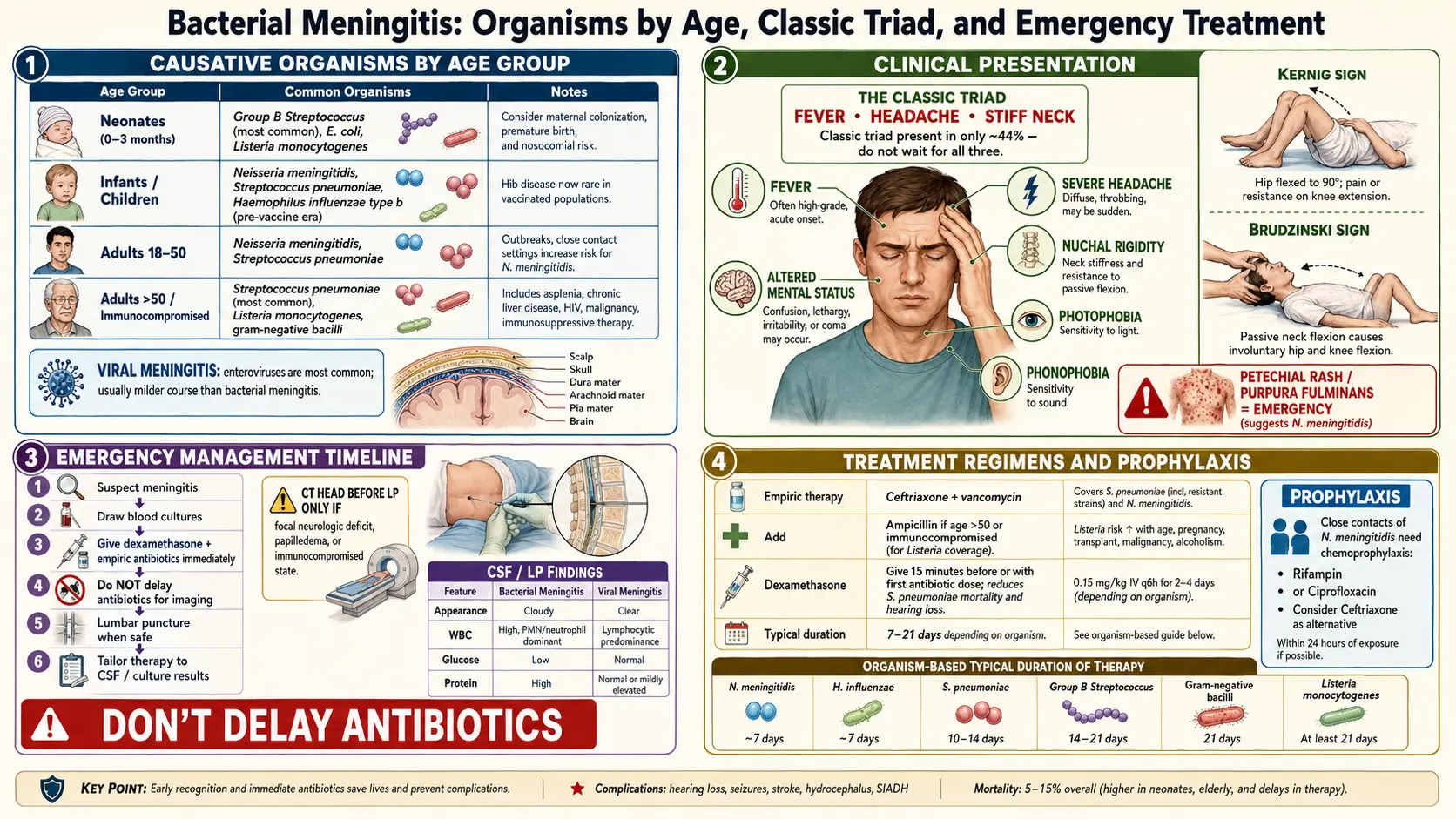
Meningitis is an inflammation of the protective membranes (meninges) covering the brain and spinal cord. It is most commonly caused by infections, but can also result from other factors such as autoimmune diseases or certain medications. Meningitis can be life-threatening and requires immediate medical attention.
Types of Meningitis
1. Bacterial Meningitis
- Most serious form and can be life-threatening if not treated promptly.
- Common causes: Neisseria meningitidis, Streptococcus pneumoniae, and Haemophilus influenzae type B.
- Requires immediate treatment with antibiotics and sometimes corticosteroids.
2. Viral Meningitis
- More common but typically less severe than bacterial meningitis.
- Common causes: Enteroviruses, herpes simplex virus, and mumps virus.
- Treatment: Supportive care, as it often resolves on its own.
3. Fungal Meningitis
- Rare and typically affects people with weakened immune systems.
- Common cause: Cryptococcus species.
- Treatment: Antifungal medications.
4. Parasitic and Non-Infectious Meningitis
- Parasitic meningitis: Caused by parasites and is rare.
- Non-infectious meningitis: Can result from autoimmune diseases, cancer, or medications.
Common Symptoms of Meningitis
Symptoms can develop suddenly and may include:
- Severe headache
- Stiff neck
- High fever
- Nausea and vomiting
- Confusion or altered mental state
- Sensitivity to light (photophobia)
- Seizures
- Skin rash (more common in meningococcal meningitis)
Causes and Risk Factors
- Bacteria and viruses: Most common causes include meningococcal, pneumococcal, and viral infections.
- Weakened immune system: Increases the risk of fungal and other opportunistic infections.
- Close contact and outbreaks: Spread in places with close contact such as schools, dormitories, or military barracks.
- Age: Infants and young children are at higher risk, as well as adults over 60.
Diagnosis
- Medical history and physical examination: To check for classic signs like neck stiffness and fever.
- Blood cultures: To detect and identify bacteria in the blood.
- Imaging tests: computed tomography (CT) scan or magnetic resonance imaging (MRI) to check for brain swelling or complications.
- Lumbar puncture (spinal tap): The most definitive test for diagnosing meningitis, used to analyze cerebrospinal fluid (CSF).
Treatment Options
- Bacterial Meningitis:
- Antibiotics: Given intravenously to fight the infection.
- Corticosteroids: Given alongside antibiotics to damp down the inflammation around the brain. A 2015 Cochrane review (25 trials, 4,121 people) found that they lowered severe hearing loss (risk ratio 0.67) and lasting nerve and brain problems (risk ratio 0.83), but did not significantly reduce overall deaths (17.8% vs 19.9%, risk ratio 0.90). Deaths did fall in pneumococcal meningitis (risk ratio 0.84), and no benefit was seen in low-income countries.
- Viral Meningitis:
- Supportive care: Rest, hydration, and pain relievers.
- Antiviral medications: For cases caused by herpes simplex or other treatable viruses.
- Fungal Meningitis:
- Antifungal drugs: Such as amphotericin B and flucytosine.
- Non-infectious Meningitis:
- Treatment of underlying cause: Involves managing the condition causing inflammation (e.g., autoimmune disease).
Treatment guidelines include the 2004 Infectious Diseases Society of America guideline, the 2016 European Society of Clinical Microbiology and Infectious Diseases (ESCMID) guideline on diagnosis and treatment of acute bacterial meningitis, and the 2025 World Health Organization (WHO) Global Guidelines on Meningitis Diagnosis, Treatment, and Care — the first global effort to bring diagnosis, treatment and long-term care together, including structured follow-up for the lasting effects many survivors live with.
Prevention Strategies
- Good hygiene practices: Spread is reduced by hand washing and by not sharing utensils or drinks.
- Close contacts: Preventative antibiotics may be given to those in close contact with a person diagnosed with bacterial meningitis.
Complications of Meningitis
- Hearing loss: Permanent damage to hearing may occur.
- Brain damage: Can result from increased pressure in the brain or severe infection.
- Seizures
- Kidney failure
- Shock: Severe cases may lead to septic shock, especially in bacterial meningitis.
- Death: Meningitis can be fatal if not treated promptly, especially bacterial forms.
How Vaccines Changed Bacterial Meningitis
- Haemophilus influenzae type b (Hib) vaccine: US bacterial meningitis rates fell by 55% in the early 1990s, when the Hib conjugate vaccine for infants was introduced.
- Pneumococcal conjugate vaccine: In US surveillance of about 17.4 million people, bacterial meningitis fell a further 31% from 1998–1999 to 2006–2007 (from 2.00 to 1.38 cases per 100,000), as pneumococcal vaccination and screening of pregnant women for group B streptococcus spread. Of 3,155 patients with known outcomes, 14.8% died, and the median age of patients rose from 30 to 42 years — the burden now falls more on older adults.
- Five-in-one meningococcal vaccines: In the United States, a pentavalent vaccine covering serogroups A, B, C, W and Y (MenACWY-TT/MenB-FHbp) has been licensed since October 2023, and the Food and Drug Administration licensed a second one (MenACWY-CRM/MenB-4C) on February 14, 2025, both for people aged 10–25. On April 16, 2025, the Advisory Committee on Immunization Practices (ACIP) recommended that the second vaccine may be used when both MenACWY and MenB vaccines are due at the same visit.
Key Research Papers
Historical Background
Meningitis was first described in detail by the Geneva physician Gaspard Vieusseux during an outbreak in 1805. The causative bacterium Neisseria meningitidis (meningococcus) was identified by Anton Weichselbaum in 1887. The introduction of sulfonamides in the 1930s and penicillin in the 1940s transformed meningitis from a near-universally fatal disease into a treatable one.
Key Research Papers
- van de Beek D, de Gans J, Tunkel AR, Wijdicks EFM. Community-acquired bacterial meningitis in adults. New England Journal of Medicine. 2006;354(1):44-53. — doi:10.1056/nejmra052116
- de Gans J, van de Beek D; European Dexamethasone in Adulthood Bacterial Meningitis Study Investigators. Dexamethasone in adults with bacterial meningitis. New England Journal of Medicine. 2002;347(20):1549-1556. — doi:10.1056/nejmoa021334
- Brouwer MC, Tunkel AR, van de Beek D. Epidemiology, diagnosis, and antimicrobial treatment of acute bacterial meningitis. Clinical Microbiology Reviews. 2010;23(3):467-492. — PubMed PMID: 20610819
- Thigpen MC, Whitney CG, Messonnier NE, et al. Bacterial meningitis in the United States, 1998-2007. New England Journal of Medicine. 2011;364(21):2016-2025. — doi:10.1056/NEJMoa1005384
- Tunkel AR, Hartman BJ, Kaplan SL, et al. Practice guidelines for the management of bacterial meningitis. Clinical Infectious Diseases. 2004;39(9):1267-1284. — doi:10.1086/425368
- McGill F, Heyderman RS, Panagiotou S, et al. Acute bacterial meningitis in adults. The Lancet. 2016;388(10063):3036-3047. — doi:10.1016/S0140-6736(16)30654-7
- Oordt-Speets AM, Bolijn R, van Hoorn RC, et al. Global etiology of bacterial meningitis: a systematic review and meta-analysis. PLoS ONE. 2018;13(6):e0198772. — doi:10.1371/journal.pone.0198772
- Tunkel AR, Glaser CA, Bloch KC, et al. The management of encephalitis: clinical practice guidelines by the Infectious Diseases Society of America. Clinical Infectious Diseases. 2008;47(3):303-327. — doi:10.1086/589747
- Stephens DS, Greenwood B, Brandtzaeg P. Epidemic meningitis, meningococcaemia, and Neisseria meningitidis. The Lancet. 2007;369(9580):2196-2210. — doi:10.1016/s0140-6736(07)61016-2
- van de Beek D, Brouwer MC, Thwaites GE, Tunkel AR. Advances in treatment of bacterial meningitis. The Lancet. 2012;380(9854):1693-1702. — doi:10.1016/s0140-6736(12)61186-6
- van de Beek D, Cabellos C, Hasbun R, Tunkel AR. Community-acquired bacterial meningitis. Nature Reviews Disease Primers. 2016;2:16074. — doi:10.1038/nrdp.2016.74
- Brouwer MC, McIntyre P, Prasad K, van de Beek D. Corticosteroids for acute bacterial meningitis. Cochrane Database of Systematic Reviews. 2015;(9):CD004405. — PubMed PMID: 26362566
- van de Beek D, Cabellos C, Dzupova O, Esposito S, Klein M, Kloek AT, Leib SL, Mourvillier B, Ostergaard C, Pagliano P, Pfister HW, Read RC, Sipahi OR, Brouwer MC; ESCMID Study Group for Infections of the Brain (ESGIB). ESCMID guideline: diagnosis and treatment of acute bacterial meningitis. Clinical Microbiology and Infection. 2016;22 Suppl 3:S37-62. — PubMed PMID: 27062097
- Amin AB, Collins JP, Dong X, Leidner AJ, Loehr J, Moser CA, McNamara LA. Use of the GSK MenACWY-CRM/MenB-4C pentavalent meningococcal vaccine among persons aged ≥10 years: recommendations of the Advisory Committee on Immunization Practices — United States, 2025. MMWR Morbidity and Mortality Weekly Report. 2026;75(1):7-14. — PubMed PMID: 41505372
- Alviz LF, Hasbun R, Thakur KT. Global bacterial meningitis guidelines: from policy to action. Current Opinion in Infectious Diseases. 2026;39(3):272-279. — PubMed PMID: 42019482
PubMed Topic Searches
The following PubMed topic searches retrieve current peer-reviewed literature on Meningitis. Each link opens a live PubMed query so you always see the most recent publications.
- PubMed: Bacterial meningitis review
- PubMed: Viral meningitis clinical features
- PubMed: Meningococcal meningitis Neisseria
- PubMed: Streptococcus pneumoniae meningitis
- PubMed: Haemophilus influenzae type b meningitis
- PubMed: Dexamethasone bacterial meningitis adjunctive
- PubMed: Meningitis vaccine conjugate
- PubMed: Lumbar puncture meningitis CSF
- PubMed: Cryptococcal meningitis HIV
- PubMed: Tuberculous meningitis diagnosis
- PubMed: IDSA bacterial meningitis guideline
- PubMed: Meningitis belt Africa epidemiology
Connections
- Infectious Disease
- The Blood-Brain Barrier: The Brain’s Bouncer — interactive animation
- Encephalitis
- Granulomatous Amebic Encephalitis
- Silver Nanoparticles and Meningitis
- Sepsis
- Immune Boosting
- Vitamin C
- Goldenseal
- Vitamin D3
- Echinacea
- Staphylococcus Aureus
- Lyme Neuroborreliosis
- Cellulitis
- Headache
- Nausea and Vomiting
- Silver Nanoparticles
- Zinc
- Garlic
- Tick Bite First Aid
- Escherichia Coli
- Tuberculosis
- Ear Infections
- Measles
- Pneumococcal Meningitis and Invasive Disease — the leading bacterial cause in adults.
- Neonatal Sepsis — group B strep and E. coli seed the meninges in the first weeks of life, so meningitis and sepsis are worked up together.
- Treating Meningococcal Disease: Ceftriaxone, Dexamethasone, and Intensive Care Unit Care — time-to-antibiotic, dexamethasone timing, raised intracranial pressure, and septic shock care.
- Streptococcus pneumoniae: Pneumococcal Disease, Pneumonia, and Meningitis — the bacterium behind the deadliest form of bacterial meningitis in adults, plus the vaccines that prevent it.
- Diagnosis: Lumbar Puncture and Cerebrospinal Fluid Analysis — when to tap, cerebrospinal fluid findings, Gram stain, and polymerase chain reaction (PCR).
- Streptococcus pneumoniae: Symptoms and Who Is at Risk — pneumococcal disease spectrum and high-risk groups.
- E. coli Symptoms and Infections — K1-capsule strains are the second most common cause of neonatal meningitis, and the newborn signs look nothing like the adult ones.
- Antibiotics for Pneumococcal Infections: Beta-Lactams and Alternatives — ceftriaxone plus vancomycin, dexamethasone timing, and why cerebrospinal fluid penetration drives the drug choice.