Quercetin: History and Discovery
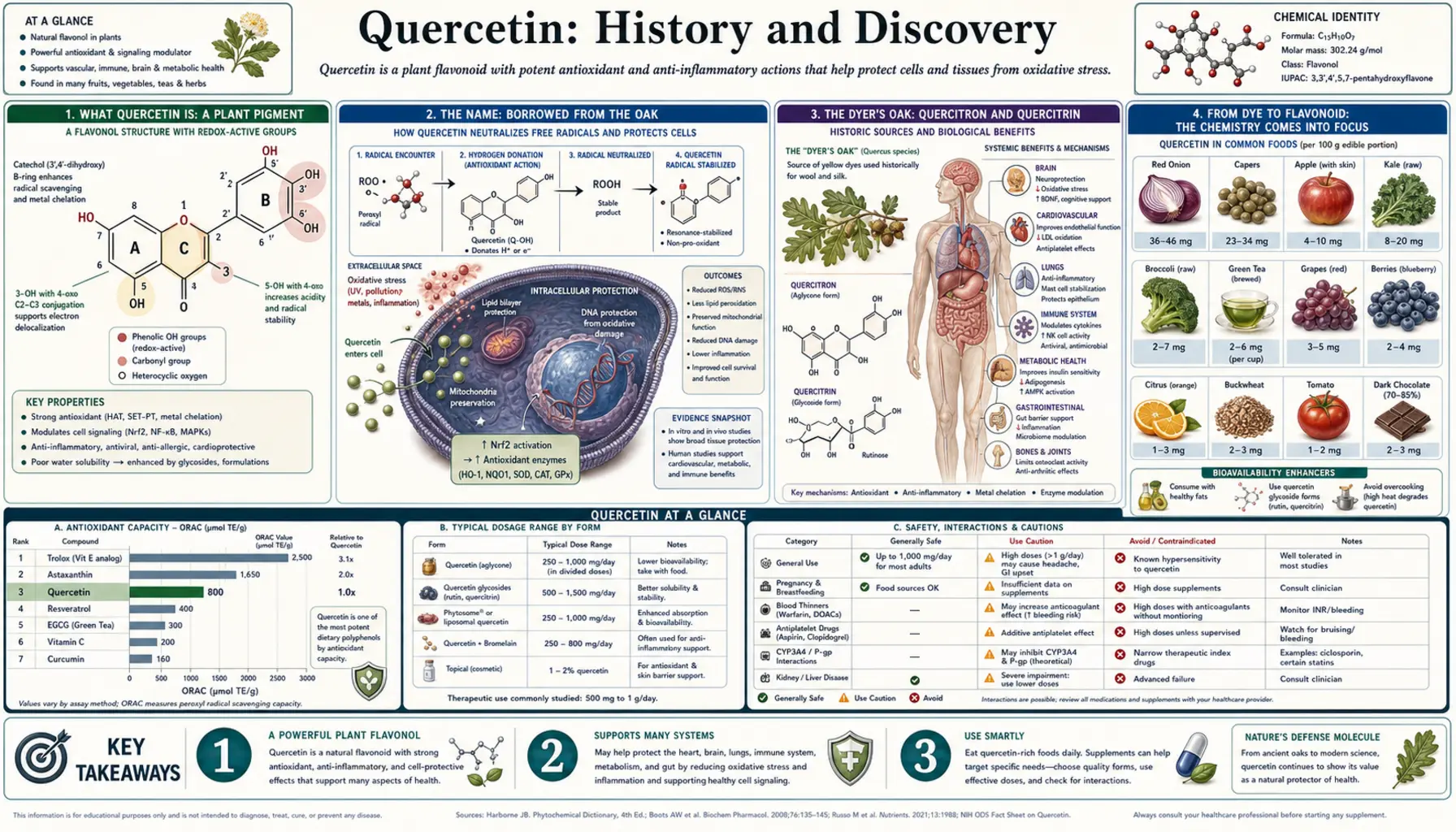
Quercetin is one of the most common plant pigments on Earth — the yellow flavonol that colours onion skins, gives some apples and berries their hue, and was once extracted from oak bark to dye cloth a deep, lasting yellow. Its history is mostly a scientific one: a name borrowed from the oak, a nineteenth-century career as a textile dye, a famous twentieth-century mix-up in which flavonoids were briefly mistaken for a vitamin, and a modern second life as a research molecule — from antioxidant to allergy compound to one half of the first drug pair ever shown to clear "senescent" aging cells. This article tells that story plainly and sticks to what the record actually supports. Where a name or a date is firmly documented we say so; where an attribution is uncertain or contested, we say that too.
Table of Contents
- What Quercetin Is: A Plant Pigment
- The Name: Borrowed From the Oak
- The Dyer's Oak: Quercitron and Quercitrin
- From Dye to Flavonoid: The Chemistry Comes Into Focus
- The "Vitamin P" Episode (1936)
- A Pigment in the Diet: Onions, Apples, Tea
- A Modern Second Life: The Senolytic Era (2015–)
- What the History Does and Does Not Tell Us
- Research Papers and References
- Connections
- Featured Videos
What Quercetin Is: A Plant Pigment
Before any of the history makes sense, it helps to know what quercetin actually is. It is a flavonoid — one of a large family of plant compounds responsible for many of the colours, flavours, and defensive chemicals in fruits, vegetables, flowers, and bark. Within that family quercetin belongs to a subgroup called the flavonols, and chemically it is a yellow, crystalline pigment. Plants rarely store it in its bare form; instead they usually attach a sugar to it, producing compounds called glycosides. Quercetin with its sugar removed — the "naked" molecule — is called the aglycone, and this is the form most people mean when they say "quercetin."
This distinction is not a technicality; it is the thread that runs through the whole history. The compounds that nineteenth-century chemists first isolated from plants were the sugar-bearing glycosides — substances such as quercitrin and rutin. Quercetin itself was obtained from those glycosides by stripping the sugar away. So the story of quercetin's discovery is really the story of chemists working backward from coloured plant extracts to the simple pigment hiding inside them. The widely studied antioxidant, anti-inflammatory, and other biological roles of the compound are covered on the main Quercetin page and in the Quercetin Benefits articles; this page is concerned only with where it came from and how it came to be understood.
The Name: Borrowed From the Oak
The word quercetin has a tidy and well-documented origin. Standard reference dictionaries record that the name has been in use since 1857 and is derived from the Latin quercetum, meaning "oak forest," which in turn comes from Quercus, the botanical genus of the oaks. In other words, quercetin is "the oak substance" — named not because oaks are its only or its richest source, but because of the particular oak-derived material from which it was first prepared.
That material was a yellow dye made from oak bark, and the dye's own name carries the same root. The connection between quercetin and the oak is therefore not folklore or marketing — it is built into the molecule's name and reflects a real historical fact about where chemists first encountered it. The next section follows that dye back to its source.
The Dyer's Oak: Quercitron and Quercitrin
Long before quercetin had a name, the bark of an American oak was a valuable article of trade as a yellow dye. The dye is called quercitron, obtained from the inner bark of the Eastern black oak (Quercus velutina), a forest tree native to North America. The name quercitron is itself a blend — from Latin quercus (oak) and citron (lemon, for the yellow colour) — and it was coined by Edward Bancroft (1744–1821), who in 1785 obtained special privileges from the British Parliament regarding the importation and use of the dye. Quercitron became a widely used source of yellow and gold shades for wool and other textiles.
What gives quercitron bark its colour is a glycoside named quercitrin. When quercitrin is treated with dilute acid it splits into two pieces: a sugar (the methyl-pentose rhamnose) and the yellow pigment quercetin itself. This is the chemical heart of the whole story — the dye contains the glycoside, and the glycoside yields quercetin. It also explains the family of names that cluster together here: the tree (Quercus), the dye (quercitron), the glycoside (quercitrin), and the freed pigment (quercetin) all share the same oak-derived root, and that shared root is why the pigment ended up being called "the oak substance."
It is worth being precise about attribution. Edward Bancroft is documented as the man who named and commercialised the dye in the eighteenth century; he is not the "discoverer of quercetin" in the modern chemical sense, and this page does not claim he was. The isolation and naming of the pigment quercetin as a distinct chemical substance belongs to the following century, as the chemistry of plant dyes was gradually worked out.
From Dye to Flavonoid: The Chemistry Comes Into Focus
The nineteenth century was the age in which organic chemists took apart the natural dyes, one coloured extract at a time. Quercetin was among the yellow plant pigments studied in this period: chemists prepared it from glycosides such as quercitrin and rutin by hydrolysis (the acid-splitting described above), determined that it was a single recurring compound found in many different plants, and gave it the lasting name recorded from 1857. Work on its detailed molecular structure continued through the late 1800s and into the twentieth century as the broader chemistry of the flavonoids was unravelled.
Two points deserve honesty here. First, unlike a compound such as coenzyme Q10 — isolated by a single identifiable researcher in a single year — quercetin has no neat "discoverer" and no single discovery date. It emerged gradually from the collective nineteenth-century effort to understand plant dyes and pigments, and reference sources reflect this by giving the name a date (1857) rather than crediting one chemist with the molecule. Second, the early structural chemistry was incremental and is best described in general terms; this page therefore does not pin specific structural milestones on specific chemists where the record is not clear enough to do so confidently.
The larger significance came later. Quercetin turned out to be one of the most abundant and widely distributed flavonols in the entire plant kingdom, and as the flavonoids grew into a major field of food chemistry and nutrition, quercetin became the "reference" flavonol against which others are often compared — the best-studied member of an enormous chemical family.
The "Vitamin P" Episode (1936)
One of the most famous — and most often misremembered — chapters in flavonoid history is the "vitamin P" story, and quercetin sits squarely inside it. In 1936, the Hungarian researchers Stephen (István) Rusznyák and Albert Szent-Györgyi — the latter already famous for his work on vitamin C — reported in the journal Nature, in a short paper titled "Vitamin P: Flavonols as Vitamins," that a fraction of flavonoid compounds from citrus appeared to strengthen blood-vessel walls and reduce capillary fragility and permeability. They proposed calling the responsible substances "vitamin P" (the P standing for permeability).
This is where care is needed, because the popular version of the story often overstates it. What Szent-Györgyi's group isolated and worked with was a flavonoid fraction (sometimes called "citrin"), not pure quercetin specifically; quercetin is named here as a prominent member of the flavonol class the "vitamin P" idea was built around, not as a compound that Szent-Györgyi personally discovered. More importantly, the "vitamin" designation did not survive. Flavonoids turned out not to be vitamins at all — no genuine deficiency disease was ever established, and the body does not strictly require them in the way it requires true vitamins. The label "vitamin P" was therefore abandoned by the scientific community, and the compounds it described are simply called flavonoids (or bioflavonoids) today.
The episode matters for two honest reasons. It shows how early and how seriously flavonoids like quercetin were taken as potentially health-relevant compounds — the interest is not a modern supplement-industry invention. But it is also a cautionary tale: a famous Nobel laureate proposed a category that the evidence later overturned. Anyone who still calls quercetin "vitamin P" is using a term that science retired long ago.
A Pigment in the Diet: Onions, Apples, Tea
Because quercetin is so widespread in plants, it has always been part of the human diet — people were eating it for as long as they have eaten onions, apples, and leafy greens, entirely unaware of its existence. As food chemists mapped the flavonoid content of common foods through the twentieth century, quercetin emerged as one of the dominant dietary flavonols. It is concentrated in the papery and outer layers of onions (especially red onions and shallots), in apples (largely in the skin), in berries, capers, kale and broccoli, in buckwheat (as the glycoside rutin), and in tea and red wine. Estimates of typical daily intake from a mixed diet are generally placed in the range of tens of milligrams.
This dietary ubiquity is the cultural backdrop to the modern science. Population studies that tracked the eating habits of large groups found that people with diets rich in flavonols and other flavonoids tended to have lower rates of certain chronic diseases. Those observations — that a quercetin-rich diet travelled with better cardiovascular outcomes — helped drive interest in quercetin as more than just a pigment. They are associations from food patterns, not proof that quercetin alone is responsible, and that distinction is explored in the benefits articles; but historically, it was the food-and-population evidence that first made quercetin look worth studying as a possible protective compound rather than merely a dye.
A Modern Second Life: The Senolytic Era (2015–)
The most recent — and most surprising — turn in quercetin's history came from the science of aging. As cells grow old or damaged, some of them stop dividing but refuse to die, lingering in tissues as senescent cells (sometimes nicknamed "zombie cells") that secrete inflammatory signals thought to contribute to aging and age-related disease. The question researchers asked was whether drugs could be found to selectively kill these cells without harming healthy ones.
In 2015, a research team led by Yi Zhu and James L. Kirkland and colleagues, working at the Mayo Clinic, published a landmark paper in the journal Aging Cell describing exactly such drugs. They coined the word "senolytic" for agents that selectively clear senescent cells, and the very first such combination they identified paired the cancer drug dasatinib with quercetin — the everyday dietary flavonol. Each compound targeted the survival defences of different kinds of senescent cells, so the two were used together (abbreviated D+Q) for broader effect. Overnight, a molecule best known from onion skins and old dye recipes had become one half of the founding example of an entirely new drug class.
The work moved toward people quickly. In 2019, a team including the Mayo group reported in EBioMedicine the first evidence in humans that senolytics could reduce the burden of senescent cells, in a small preliminary trial of dasatinib plus quercetin in patients with diabetic kidney disease. Trials of D+Q in conditions such as pulmonary fibrosis and frailty followed. Two honest caveats belong with this exciting story: these are early-stage clinical trials, not finished proof of benefit; and the senolytic effect belongs to the dasatinib-plus-quercetin combination at specific doses, not to quercetin taken casually on its own. Still, for a compound first pulled out of oak-bark dye in the nineteenth century, a starring role in twenty-first-century longevity research is a remarkable second act.
What the History Does and Does Not Tell Us
Quercetin's history is unusually clean in some places and unusually murky in others, and it is worth separating the two. The firmly documented parts are these: the name dates from 1857 and comes from the oak (Quercus); it reached chemists through the oak-bark dye quercitron and its glycoside quercitrin; flavonoids including quercetin were briefly and mistakenly promoted as "vitamin P" in 1936 before the label was dropped; quercetin is one of the most abundant flavonols in the everyday diet; and in 2015 it became, with dasatinib, the prototype of the senolytic drug class. Each of those is supported by reference works or peer-reviewed literature.
The genuinely uncertain parts are equally worth stating. Quercetin has no single discoverer and no single discovery date — it emerged from the collective nineteenth-century chemistry of plant dyes, which is why this page credits a name and a dye rather than a person. The fine detail of who first determined its exact structure is incremental and not cleanly attributable, so we have not invented a tidy milestone for it.
The honest bottom line is that history can tell us where quercetin came from and how seriously it has been studied, but not whether any particular dose does any particular thing for a particular person — that is the job of the clinical evidence, summarised in the Quercetin Benefits articles and on the main Quercetin page. What the long story does show is a single modest pigment that has been, in turn, a dye, a mistaken vitamin, a dietary marker of healthy eating, and a frontier longevity molecule — a reminder that the same compound can mean very different things to different centuries.
Research Papers and References
The list below combines the key historical and scientific sources for quercetin with curated PubMed topic-search links into the flavonoid and senolytic literature. Reference-dictionary facts (the 1857 name and its oak etymology) and the eighteenth-century quercitron dye history are discussed in the article as documented background. Author names, titles, and journals are given as plain text; only the stable DOI, PMID, or archive link is hyperlinked, and each opens in a new tab.
- Rusznyák S, Szent-Györgyi A. Vitamin P: Flavonols as Vitamins. Nature. 1936;138:27. — doi:10.1038/138027a0
- Anand David AV, Arulmoli R, Parasuraman S. Overviews of biological importance of quercetin: a bioactive flavonoid. Pharmacognosy Reviews. 2016;10(20):84-89. — PMID: 28082789
- Kim JK, Park SU. Quercetin and its role in biological functions: an updated review. EXCLI Journal. 2018;17:856-863. — doi:10.17179/excli2018-1538 (PMID: 30233284)
- Zhu Y, Tchkonia T, Pirtskhalava T, et al. The Achilles' heel of senescent cells: from transcriptome to senolytic drugs. Aging Cell. 2015;14(4):644-658. — doi:10.1111/acel.12344 (PMID: 25754370)
- Hickson LJ, Langhi Prata LGP, Bobart SA, et al. Senolytics decrease senescent cells in humans: preliminary report from a clinical trial of dasatinib plus quercetin in individuals with diabetic kidney disease. EBioMedicine. 2019;47:446-456. — doi:10.1016/j.ebiom.2019.08.069 (PMID: 31542391)
- Quercetin history, dietary sources, and flavonol chemistry — PubMed: quercetin dietary flavonol reviews
- Dasatinib plus quercetin senolytic research — PubMed: dasatinib + quercetin senolytic
External Authoritative Resources
- NCCIH — Antioxidants: In Depth
- Linus Pauling Institute — Flavonoids
- PubMed — All research on quercetin