Lycopene: History and Discovery
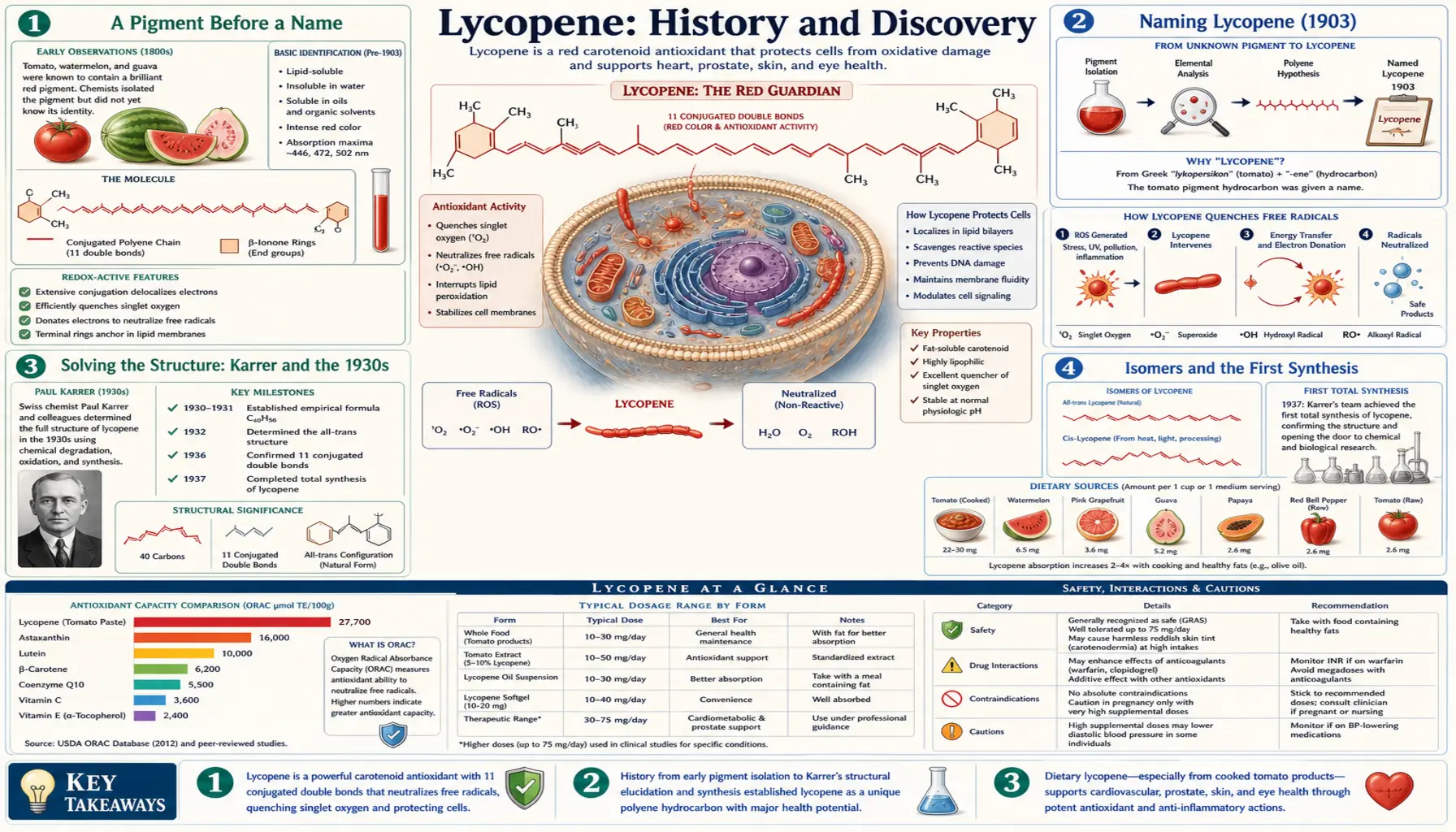
Lycopene's history is a chemist's story rather than a herbalist's. The bright-red pigment was pulled out of plants in the 1870s, given its tomato-derived name in 1903, had its long open-chain structure worked out in the early 1930s by the same Swiss laboratory that won a Nobel Prize for carotenoid chemistry, and was finally made in the laboratory from scratch around 1950. For most of that time it was treated simply as a colour. Only in 1989 was it shown to be the most powerful natural quencher of a damaging form of oxygen, and only in 1995 did a large study of tomatoes and prostate cancer turn lycopene into a household word. This page traces that documented record — who isolated it, who named it, who solved its structure — and is careful to flag the few points where the earliest attributions are reported only at second hand and cannot be stated as settled fact.
Table of Contents
- A Pigment Before a Name
- Naming Lycopene (1903)
- Solving the Structure: Karrer and the 1930s
- Isomers and the First Synthesis
- From Colour to Nutrient
- 1989: The Most Efficient Singlet-Oxygen Quencher
- 1995: Tomatoes, Prostate Cancer, and Fame
- The Modern, More Cautious Era
- Research Papers and References
- Connections
- Featured Videos
A Pigment Before a Name
Long before anyone called it "lycopene," the red pigment was being separated from plants by nineteenth-century chemists who were simply curious about what gave fruits their colour. The earliest documented isolation came not from the tomato at all but from black bryony (Tamus communis), a European climbing yam with red berries; according to the Encyclopædia Britannica, the pigment was isolated from black bryony in 1873. Some later reviews attribute that 1873 work to a chemist named Hartsen, but because that name appears mainly in secondary summaries rather than in the primary record we have been able to confirm, this page treats the year and source as documented while regarding the name of the chemist as not firmly established.
Within a few years the same red substance was obtained from the fruit it would eventually be named after. The pigment was first isolated from tomatoes in the mid-1870s — Britannica gives 1875, while several peer-reviewed reviews state that it was "first discovered in the tomato by Millardet in 1876." The man usually credited is Pierre-Marie-Alexis Millardet, a French botanist and chemist better remembered today for the Bordeaux mixture fungicide. The one-year discrepancy (1875 versus 1876) is exactly the kind of small inconsistency that creeps into a 150-year-old record; this page reports both dates rather than pretend to a precision the sources do not share. What is not in doubt is the essential point: by the late 1870s the red of tomatoes and the red of certain berries had been recognised as the same isolable plant pigment.
At this stage the substance had no settled identity. It was understood as a coloured plant extract related to the orange pigment carotene (itself first isolated by Heinrich Wackenroder back in 1831), but its distinctiveness had not yet been pinned down. That recognition — and the name we still use — arrived at the turn of the twentieth century.
Naming Lycopene (1903)
The name lycopene was given to the tomato pigment in 1903 by the chemist C. A. Schunck. Multiple reference sources agree on both the year and the person: Schunck studied the pigment and found that its light-absorption spectrum differed from that of carotene, the orange pigment of carrots — in other words, he showed that the red of tomatoes was a chemically distinct compound and not merely carotene in another guise. Having distinguished it, he needed a name for it, and he took that name straight from the tomato.
The etymology is therefore botanical, not Greek-philosophical: "lycopene" derives from Lycopersicum esculentum (also written Lycopersicon esculentum), the scientific name the tomato then carried. Lycopersicon is a former genus name for the tomato — the word itself blends Greek roots often glossed as "wolf peach" — and Schunck simply fashioned the pigment's name from it. The modern accepted botanical name for the tomato is Solanum lycopersicum, which preserves the same lycopersicum element, so the link between the pigment's name and the tomato remains visible to this day.
It is worth pausing on what naming achieved. Once the red tomato pigment had its own name and was known to be spectroscopically different from carotene, it became a defined object of study rather than an anonymous "colouring matter." The stage was set for the next, harder question: not what to call the molecule, but what shape it actually had.
Solving the Structure: Karrer and the 1930s
Working out the structure of a carotenoid in the early twentieth century was a formidable task. These are large molecules — lycopene's formula is C40H56 — and the tools chemists now take for granted (nuclear magnetic resonance, mass spectrometry) did not yet exist. The structure had to be deduced from painstaking degradation experiments, colour chemistry, and the relationship between a molecule's double bonds and the light it absorbs.
The breakthrough came from the laboratory of the Swiss chemist Paul Karrer at the University of Zürich. Reviews of carotenoid chemistry place the elucidation of the structures of β-carotene, lycopene, and related pigments at the hands of "the school of Karrer" in 1930–1932; the Wikipedia summary of lycopene puts it crisply, stating that "the structure of the molecule was determined by 1931." Important parallel work on carotenoid chemistry and on the cis/trans isomers came from the Hungarian-born chemist László Zechmeister and others, so the achievement is best credited to a small international community of pigment chemists rather than to one person alone.
The significance of this work reached far beyond lycopene. Karrer established the correct structural formula for β-carotene — the orange pigment that the body converts into vitamin A — which was the first time the structure of any vitamin or provitamin had been settled. For his work on the constitution of carotenoids and vitamins, Paul Karrer shared the 1937 Nobel Prize in Chemistry with the British chemist Sir Walter Norman Haworth. Lycopene, then, was decoded as part of one of the founding achievements of modern vitamin chemistry. The key fact that emerged for lycopene specifically was structural: it is an acyclic carotene — a long, straight, open chain — lacking the closed rings that β-carotene curls at each end, which is precisely why, unlike β-carotene, lycopene cannot be turned into vitamin A.
Isomers and the First Synthesis
Knowing a molecule's structure raises an immediate next question: can chemists build it from scratch? For the carotenoids, the answer arrived in mid-century, and it came packaged with another discovery that turned out to matter enormously for lycopene's nutrition story — the chemistry of its shape, or isomers.
Because lycopene's backbone is a chain of alternating double bonds, the chain can lie perfectly straight (the all-trans, or all-E, form) or kink at one of those bonds into a bent (cis, or Z) form. László Zechmeister's studies, from the late 1930s onward, established that carotenoids such as lycopene readily shift between these cis and trans shapes — an insight that would only be recognised as nutritionally crucial decades later, when researchers realised the bent cis-isomers produced by cooking tomatoes are absorbed more easily by the human gut than the straight form found in raw fruit.
The first total syntheses of carotenoids followed the post-war surge in vitamin chemistry. Isler and colleagues at Roche announced the first total synthesis of crystalline vitamin A in 1947, and the first total syntheses of β-carotene were reported around 1950 by several groups, including Karrer and Eugster, Inhoffen and co-workers, and Milas and colleagues. Synthetic routes to lycopene itself were developed in roughly the same era and refined over the following decades. The honest qualifier here is that, while 1950 is well documented as the year β-carotene was first synthesised, the precise "first" for lycopene specifically is reported less uniformly across sources, so this page presents the early 1950s as the period in which laboratory synthesis of lycopene became possible rather than fixing it to a single paper.
From Colour to Nutrient
For the first half of the twentieth century, lycopene was studied chiefly as a pigment and a piece of structural chemistry. Its place in the human diet was incidental: it was simply the thing that made tomatoes red. Tomatoes themselves had travelled a long road to get to the dinner table — native to the Andes of South America, domesticated in Mesoamerica, carried to Europe by Spanish explorers in the sixteenth century, and at first eyed with suspicion in parts of Europe partly because the plant belongs to the nightshade family. By the time lycopene chemistry matured, the tomato had become a staple of Mediterranean and then global cooking, which meant that, almost by accident, lycopene had become one of the most commonly consumed carotenoids in the Western diet.
The shift from "pigment" to "nutrient" was gradual. Through the middle decades of the century, as the carotenoids were sorted out, it became clear that lycopene was different from its better-known cousin β-carotene in a way that initially looked like a disadvantage: because it has no ring at the end of its chain, it has no provitamin-A activity and so could not be classed as a vitamin precursor. For a while that made it seem nutritionally inert — a colour with no obvious job. The reframing of lycopene as a valuable antioxidant in its own right, rather than a runner-up to β-carotene, did not really take hold until the closing decades of the century, and it hinged on a single striking laboratory finding.
1989: The Most Efficient Singlet-Oxygen Quencher
The pivotal moment in lycopene's rise from food colouring to studied antioxidant came in 1989. In a paper in the journal Archives of Biochemistry and Biophysics, the researchers Paolo Di Mascio, Sara Kaiser, and Helmut Sies reported that, among the dietary carotenoids they tested, lycopene was the most efficient quencher of singlet oxygen — a high-energy, reactive form of oxygen that damages lipids, proteins, and DNA. Lycopene out-performed β-carotene at this task by roughly a factor of two, and far surpassed the common form of vitamin E.
This finding mattered because it gave lycopene a clear, measurable biological role at last. It was no longer just "the red one"; it was the standout antioxidant of its chemical family, and its long chain of eleven conjugated double bonds — the very feature that makes it red — was shown to be the structural reason for that power. The Di Mascio paper became one of the most cited works in the entire carotenoid field and is widely treated as the starting gun for the modern era of lycopene health research. Almost everything written about lycopene as an antioxidant since traces back, directly or indirectly, to that 1989 result.
1995: Tomatoes, Prostate Cancer, and Fame
If 1989 made lycopene interesting to chemists, 1995 made it famous with the public. That year, Edward Giovannucci and colleagues at the Harvard School of Public Health published an analysis from the Health Professionals Follow-Up Study — a large prospective cohort of around 48,000 men — in the Journal of the National Cancer Institute. Examining the relationship between many fruits and vegetables and the risk of prostate cancer, they found that the strongest protective signal came from tomato-based foods, and that, of the carotenoids measured, lycopene was the one statistically associated with lower risk, especially of aggressive disease.
The result was widely reported and effectively launched the popular image of the tomato as a cancer-fighting food. It also triggered a wave of further research through the 2000s — observational studies, meta-analyses, and supplement trials — aimed at confirming and explaining the link. The 1995 study is a genuine landmark in the history of the molecule, the moment lycopene crossed from the chemistry literature into newspapers and supplement bottles.
But it is important to be clear about what kind of study it was. The Health Professionals Follow-Up Study was observational: it found an association, not proof of cause and effect. Men who ate more tomato sauce differed in many other ways too. That distinction is the hinge on which the next, more sober chapter of lycopene's history turns.
The Modern, More Cautious Era
The two decades after 1995 were, in effect, a long reality check. As researchers put the tomato-and-prostate hypothesis to stricter tests — randomised trials and high-dose supplement studies rather than dietary surveys — the picture grew more complicated. Some small trials of lycopene supplements hinted at benefit; others found nothing. In 2007 the U.S. Food and Drug Administration reviewed the evidence for a proposed health claim and concluded there was no credible evidence to support a relationship between lycopene intake and a reduced risk of prostate or several other cancers, and only very limited evidence even for whole tomatoes. A 2011 Cochrane systematic review of lycopene for prostate-cancer prevention likewise found the trial evidence insufficient to recommend it.
At the same time, the more mechanistically grounded benefits held up better. The strongest modern human evidence links lycopene-rich diets to reduced oxidation of LDL cholesterol and modestly improved cardiovascular markers, and controlled studies have shown that eating tomato paste with olive oil over several weeks measurably increases the skin's resistance to sunburn — a direct, real-world confirmation of the singlet-oxygen quenching first measured in 1989. Researchers also came to understand that lycopene works not only by mopping up radicals directly but by switching on the body's own antioxidant defences through signalling pathways such as Nrf2.
The arc of lycopene's history is therefore a useful lesson in how nutrition science matures: a pigment is isolated, named, and structurally decoded; a laboratory finding reveals a striking property; a single epidemiological study sparks public excitement and overreach; and finally a more careful body of evidence sorts the durable benefits from the oversold ones. The detailed, up-to-date account of what lycopene does and does not do — the chemistry, the dosing, the food sources, and the cautions — is covered on the main Lycopene page; this article has traced only how the molecule came to be known in the first place.
Research Papers and References
The references below combine the landmark peer-reviewed papers in lycopene's scientific history with authoritative reference sources and curated PubMed topic searches. The earliest discovery and naming events (the 1870s isolations and Schunck's 1903 naming) are documented in historical reference works rather than in modern indexed journals; where a specific person or year is reported only at second hand, the article above says so. Author names, titles, and journals are given as plain text; only the stable DOI, PMID, or archive link is hyperlinked, and each opens in a new tab.
- Di Mascio P, Kaiser S, Sies H. Lycopene as the most efficient biological carotenoid singlet oxygen quencher. Archives of Biochemistry and Biophysics. 1989;274(2):532–538. — doi:10.1016/0003-9861(89)90467-0
- Giovannucci E, Ascherio A, Rimm EB, Stampfer MJ, Colditz GA, Willett WC. Intake of carotenoids and retinol in relation to risk of prostate cancer. Journal of the National Cancer Institute. 1995;87(23):1767–1776. — doi:10.1093/jnci/87.23.1767
- Story EN, Kopec RE, Schwartz SJ, Harris GK. An update on the health effects of tomato lycopene. Annual Review of Food Science and Technology. 2010;1:189–210. — doi:10.1146/annurev.food.102308.124120
- Przybylska S. Lycopene – a bioactive carotenoid offering multiple health benefits: a review. International Journal of Food Science & Technology. 2020;55(1):11–32. — doi:10.1111/ijfs.14260
- Ilic D, Forbes KM, Hassed C. Lycopene for the prevention of prostate cancer. Cochrane Database of Systematic Reviews. 2011;(11):CD008007. — doi:10.1002/14651858.CD008007.pub2
- The Nobel Prize in Chemistry 1937 — Paul Karrer, for his investigations on carotenoids, flavins and vitamins A and B2 (shared with Walter Norman Haworth). The Nobel Foundation. — NobelPrize.org — Paul Karrer (Chemistry 1937)
- Lycopene (carotenoid pigment) — isolation history and properties. Encyclopædia Britannica. — Britannica: Lycopene
- Lycopene — history of discovery, naming, and research — PubMed: lycopene history and discovery
- Lycopene chemistry, isomers, and structure — PubMed: lycopene structure and cis/trans isomers
External Authoritative Resources
- Encyclopædia Britannica — Lycopene
- Linus Pauling Institute — Carotenoids Micronutrient Information Center
- PubMed — All research on lycopene