Quercetin for Cardiovascular Health
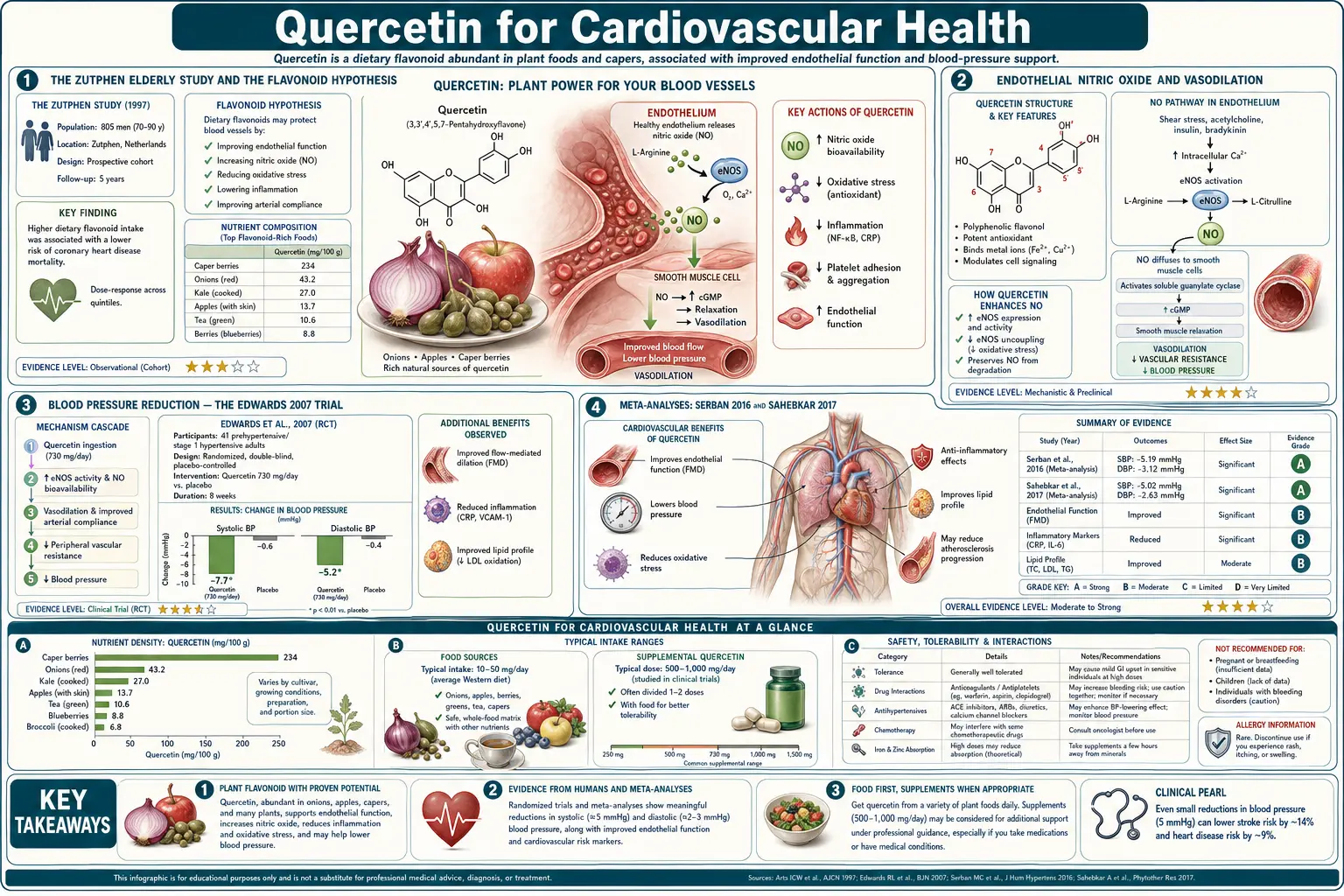
In 1993, Michael Hertog and Daan Kromhout at the National Institute for Public Health in the Netherlands published a five-year follow-up of 805 elderly men in Zutphen showing that those in the highest tertile of dietary flavonoid intake — mostly quercetin from apples, onions, and tea — had 68% lower coronary heart disease mortality than those in the lowest tertile. The Zutphen Elderly Study launched a generation of flavonoid-cardiovascular research that has subsequently produced randomized trial evidence for quercetin's effects on blood pressure (Edwards 2007: 7-mmHg systolic reduction at 730 mg/day in hypertensive subjects), endothelial nitric oxide bioavailability (Loke 2008), oxidized low-density lipoprotein (LDL) inhibition, and platelet aggregation. The 2016 Serban meta-analysis pooling seven randomized trials confirmed the blood-pressure effect, which was seen at doses of 500 mg/day or more. This page walks through each cardiovascular mechanism, the trial evidence, the practical dosing, and the realistic positioning of quercetin alongside standard cardiovascular pharmacology.
Table of Contents
- The Zutphen Elderly Study and the Flavonoid Hypothesis
- Endothelial Nitric Oxide and Vasodilation
- Blood Pressure Reduction — The Edwards 2007 Trial
- Meta-Analyses: Serban 2016 and Sahebkar 2017
- Oxidized Low-Density Lipoprotein and the Foam Cell Precursor
- Platelet Aggregation Inhibition
- Endothelial Dysfunction and Vascular Aging
- Dosing for Cardiovascular Indications
- Realistic Positioning Alongside Standard Cardiovascular Therapy
- Cautions and Drug Interactions
- Key Research Papers
- Connections
- Featured Videos
The Zutphen Elderly Study and the Flavonoid Hypothesis
The Zutphen Study began in 1960 as a Dutch cohort within the Seven Countries Study led by Ancel Keys, the landmark cross-country investigation of diet and cardiovascular disease that produced much of what is now standard population-health understanding of saturated fat, sodium, and dietary patterns. The original Zutphen cohort was 878 middle-aged Dutch men born between 1900 and 1919; the 1985 reactivation as the Zutphen Elderly Study followed 805 surviving men aged 65-84.
Hertog, Feskens, Hollman, Katan, and Kromhout published the 1993 Lancet paper following the surviving elderly men for five years after a detailed dietary assessment (a "cross-check dietary history") that included flavonoid intake estimation. The dominant flavonoid in the Dutch diet was quercetin; the main sources of flavonoid intake were tea (61%), onions (13%), and apples (10%). The investigators stratified the cohort into tertiles by flavonoid intake (low: less than 19 mg/day; medium: 19-30 mg/day; high: more than 30 mg/day) and followed them prospectively for coronary heart disease events and mortality.
The result — 68% lower coronary heart disease mortality in the highest tertile compared to the lowest, after adjustment for age, body mass index, smoking, blood pressure, cholesterol, energy intake, and antioxidant vitamins — was both larger than expected and statistically robust. The relative risk for the highest tertile was 0.42 before adjustment and 0.32 after adjustment (95% confidence interval 0.15-0.71), and the inverse relationship was dose-dependent across the tertiles.
The Zutphen result was subsequently replicated in the Seven Countries Study cohort, the Finnish Mobile Clinic Health Examination Survey, the Iowa Women's Health Study, and others. The pooled effect size in the meta-analyses is consistently in the 20-40% relative risk reduction range for the highest versus lowest flavonoid intake categories — smaller than the original Zutphen result but still clinically meaningful and dose-dependent.
Not every cohort agreed with Zutphen. In the Caerphilly Study (Hertog 1997), 1,900 Welsh men aged 45-59 were followed for 14 years. Their flavonol intake, mainly from tea to which milk is customarily added, was not related to heart-disease incidence (relative risk 1.0, highest versus lowest quarter of intake) and was weakly, non-significantly linked to more heart-disease deaths (relative risk 1.6, 95% confidence interval 0.9-2.9). The authors concluded that flavonol intake was not linked to lower heart-disease risk in the United Kingdom, and suggested that flavonols from tea taken with milk may not be absorbed.
The Zutphen result motivated the subsequent randomized trial work because epidemiologic associations alone cannot establish causation. Confounding by overall dietary pattern, socioeconomic status, and unmeasured health behaviors is always a concern. The randomized trials of quercetin supplementation in the following two decades have confirmed the blood-pressure and endothelial mechanisms in a controlled setting, lending strong mechanistic support to the cohort findings.
Endothelial Nitric Oxide and Vasodilation
The vascular endothelium — the single-cell-thick lining of blood vessels — is the largest endocrine organ in the body when total surface area is considered, and the dominant regulator of vascular tone, platelet function, leukocyte adhesion, and smooth muscle proliferation. Endothelial dysfunction is the earliest detectable abnormality in atherosclerosis, predating measurable plaque by years to decades.
The principal vasodilator produced by endothelium is nitric oxide (NO), synthesized from L-arginine by endothelial nitric oxide synthase (eNOS) in a reaction requiring tetrahydrobiopterin (BH4), reduced nicotinamide adenine dinucleotide phosphate (NADPH), and molecular oxygen. NO diffuses to vascular smooth muscle, activates soluble guanylyl cyclase, raises cyclic GMP, and produces smooth muscle relaxation and vasodilation. NO also inhibits platelet aggregation, leukocyte adhesion to the endothelium, smooth muscle proliferation, and oxidative stress — a constellation of effects that together make NO bioavailability one of the most important single biomarkers of vascular health.
Quercetin acts on the NO system at multiple points:
- eNOS expression and activity — quercetin upregulates eNOS expression at the transcriptional level and enhances eNOS activity through Akt-dependent phosphorylation. The result is increased baseline NO production.
- NO bioavailability via antioxidant effects — NO is highly reactive and is rapidly inactivated by superoxide to form peroxynitrite, which is both toxic and useless as a vasodilator. Quercetin scavenges superoxide before it can react with NO, prolonging NO half-life and increasing NO bioavailability without changing the rate of production.
- Reduced nicotinamide adenine dinucleotide phosphate oxidase inhibition — the dominant source of vascular superoxide is the reduced nicotinamide adenine dinucleotide phosphate oxidase (NOX) family. Quercetin inhibits NOX activity, reducing the rate of NO inactivation by superoxide.
- Endothelin-1 reduction — endothelin-1 is the principal endothelium-derived vasoconstrictor and a counter-regulator of NO. Loke et al. (2008) demonstrated that acute oral quercetin reduces plasma endothelin-1 in healthy men, shifting the vasodilator-vasoconstrictor balance toward vasodilation.
The Loke 2008 study is a particularly clean demonstration of the acute mechanism. In a randomized, placebo-controlled crossover trial, twelve healthy men received a single 200-mg oral dose of pure quercetin, (-)-epicatechin or epigallocatechin gallate, compared with water. Quercetin significantly raised plasma S-nitrosothiols, plasma nitrite and urinary nitrate (markers of NO production), but not plasma nitrate or urinary nitrite; it lowered both plasma and urinary endothelin-1; and it did not change F2-isoprostanes, a marker of oxidative stress. The effects occurred within the timeframe of peak plasma quercetin metabolite concentrations, supporting a direct pharmacological effect rather than longer-term gene-expression change.
Blood Pressure Reduction — The Edwards 2007 Trial
The 2007 Edwards study (Edwards, Lyon, Litwin, Rabovsky, Symons, Jalili at the University of Utah) is the foundational randomized trial of quercetin for hypertension and the one most commonly cited when the blood-pressure effect is discussed in clinical settings.
Design: 41 adults (19 prehypertensive, 22 stage 1 hypertensive) received either 730 mg/day quercetin or placebo for 28 days in a randomized, double-blind, placebo-controlled, crossover trial. Office and 24-hour ambulatory blood pressures were measured before and after each treatment period. Blood pressure at enrollment averaged 137/86 mmHg in the prehypertension group and 148/96 mmHg in the stage 1 hypertension group.
Results in the stage 1 hypertensive subjects (the population most likely to benefit clinically):
- Systolic blood pressure decreased by 7 mmHg compared to placebo
- Diastolic blood pressure decreased by 5 mmHg compared to placebo
- Mean arterial pressure decreased by 5 mmHg compared to placebo
- The reduction was statistically significant and clinically meaningful
- No effect was seen in the prehypertensive subjects, suggesting the mechanism requires elevated baseline pressure to demonstrate
- Markers of oxidative stress in blood and urine were not changed by quercetin ("indices of oxidant stress measured in the plasma and urine were not affected"), unlike in animal studies, so the trial did not support an antioxidant explanation for the blood-pressure drop in people
For context, a 7-mmHg systolic reduction is roughly comparable to the effect of a low-dose thiazide diuretic monotherapy and would be expected to reduce ten-year stroke risk by approximately 25% and ten-year coronary event risk by approximately 15% if sustained chronically. The dose (730 mg/day) is higher than typical supplemental quercetin intake but well within the range that has been studied for safety; practitioners commonly describe 500 mg of quercetin twice daily (1000 mg/day total) for people with high blood pressure.
The mechanism implied by the prehypertensive vs hypertensive divergence is that quercetin's effect is mediated through the NO and endothelin pathways and is larger when baseline endothelial function is impaired. People with normal blood pressure still show a reduction, but a smaller one: in a 2022 meta-analysis of 10 trials, systolic blood pressure fell by about 1.8 mmHg in the normotensive subgroup (Popiolek-Kalisz 2022).
Meta-Analyses: Serban 2016 and Sahebkar 2017
Two meta-analyses are the most-cited summary of the human randomized trial evidence for quercetin and cardiovascular biomarkers.
Serban MC, Sahebkar A, Zanchetti A, et al. (2016). Journal of the American Heart Association. This meta-analysis pooled seven randomized controlled trials of quercetin supplementation with blood pressure as the primary outcome. The pooled effect was a 3.04-mmHg reduction in systolic blood pressure (95% confidence interval (CI): 5.75 to 0.33, P = 0.028) and a 2.63-mmHg reduction in diastolic blood pressure (95% confidence interval: 3.26 to 2.01, P less than 0.001) compared to placebo. Subgroup analysis showed the effect was larger:
- At doses of 500 mg/day or more (4.45-mmHg systolic reduction; doses below 500 mg/day showed no significant effect, although a test comparing the dose groups directly did not find a significant difference)
- In trials of at least 8 weeks duration (3.57-mmHg systolic reduction, only marginally significant, P = 0.076)
The included trials were made up largely of people with normal or borderline-high blood pressure. Removing one trial (Zahedi 2013) made the overall systolic effect non-significant (1.78 mmHg, P = 0.129).
Sahebkar A (2017). Critical Reviews in Food Science and Nutrition. This meta-analysis examined effects on lipid profile across five randomized controlled trials (RCTs) with 442 subjects. Overall, quercetin did not significantly change low-density lipoprotein (LDL) cholesterol (+1.43 mg/dL), high-density lipoprotein (HDL) cholesterol (+0.26 mg/dL) or triglycerides (-9.42 mg/dL), and total cholesterol rose slightly (+3.13 mg/dL, borderline significant, P = 0.05). In trials using 500 mg/day or more for at least 4 weeks, triglycerides fell by 24.54 mg/dL and total cholesterol rose by 3.57 mg/dL, while LDL and HDL cholesterol did not change. The author concluded that the trials do "not suggest any clinically relevant effect of quercetin supplementation on plasma lipids, apart from a significant reduction of triglycerides". The lipid effect of quercetin is small at most — nowhere near the magnitude of statin therapy and not a primary indication for use.
Huang H, Liao D, Dong Y, Pu R (2020). Nutrition Reviews. This later analysis of 17 randomized trials (896 people) found that quercetin lowered systolic blood pressure by 3.09 mmHg and diastolic blood pressure by 2.86 mmHg, while cholesterol, triglycerides and blood sugar did not change significantly overall. Changes in HDL cholesterol and triglycerides appeared only in parallel-group trials in which people took quercetin for 8 weeks or more.
Popiolek-Kalisz J, Fornal E (2022). Current Problems in Cardiology. This meta-analysis of 10 randomized trials (841 people) found that quercetin lowered systolic blood pressure by 2.38 mmHg overall. Systolic pressure also fell by 1.82 mmHg in people with normal blood pressure, and diastolic pressure fell by 3.14 mmHg in people with high or borderline-high blood pressure.
The broader literature is consistent with these meta-analyses. Quercetin produces a small but reproducible blood pressure reduction in hypertensive subjects at doses of 500-1000 mg/day, with a smaller effect in normotensive subjects; no significant change in cholesterol overall, with lower triglycerides only at higher doses or with longer use; and indirect benefit through endothelial function and oxidized low-density lipoprotein reduction that may not be captured by standard lipid panels but is captured by harder outcome measures like flow-mediated dilation and oxidized low-density lipoprotein antibody titers.
Oxidized Low-Density Lipoprotein and the Foam Cell Precursor
The current understanding of atherosclerosis identifies oxidized low-density lipoprotein (oxLDL) as a critical step in plaque formation. Native low-density lipoprotein is not particularly inflammatory, and macrophages do not aggressively take it up. When low-density lipoprotein becomes oxidized (typically by reactive oxygen species generated by reduced nicotinamide adenine dinucleotide phosphate oxidase, lipoxygenase, or myeloperoxidase in the vessel wall), it becomes a ligand for scavenger receptors (CD36, SR-A1) on macrophages, which take it up without negative feedback and become foam cells — the cellular building block of atherosclerotic plaque.
Quercetin inhibits low-density lipoprotein oxidation through several mechanisms:
- Direct lipid peroxyl radical scavenging — quercetin donates hydrogen atoms to lipid peroxyl radicals before they can propagate the chain reaction that converts low-density lipoprotein phospholipids to lipid peroxides. This is the same general antioxidant mechanism shared by vitamin E and most polyphenols.
- Reduced nicotinamide adenine dinucleotide phosphate oxidase inhibition — reduces the rate of superoxide generation in the vessel wall that drives low-density lipoprotein oxidation.
- Myeloperoxidase inhibition — reduces hypochlorous acid generation by neutrophils and macrophages in the vessel wall.
- Sparing of vitamin E — quercetin regenerates oxidized vitamin E (alpha-tocopheryl radical) back to its active form, extending vitamin E's effective antioxidant activity in low-density lipoprotein.
The clinical correlate of these effects is reduced oxidized low-density lipoprotein in plasma, reduced antibody titers to oxidized low-density lipoprotein epitopes, and reduced 8-isoprostane (a stable end-product of arachidonic acid peroxidation). These biomarkers respond to chronic quercetin supplementation at 500-1000 mg/day with effect sizes of 10-20% reduction in oxLDL markers across multiple trials. Translation to harder outcomes (myocardial infarction, stroke) is supported by the epidemiologic data but not by direct trial-level evidence with quercetin as the intervention.
Platelet Aggregation Inhibition
Platelet aggregation is the rate-limiting step in arterial thrombosis — the acute event that converts a stable atherosclerotic plaque into a myocardial infarction or stroke when the plaque ruptures and the lipid-rich core is exposed to circulating platelets and clotting factors. Aspirin works by acetylating cyclooxygenase-1 in platelets, irreversibly blocking thromboxane A2 production and reducing platelet aggregation for the life of the platelet (7-10 days).
Quercetin has measurable antiplatelet effect through partially overlapping and partially distinct mechanisms:
- Cyclooxygenase inhibition — quercetin reversibly inhibits cyclooxygenase-1 (COX-1) and cyclooxygenase-2 (COX-2) in platelets, reducing thromboxane A2 production through the same target as aspirin but with reversible binding.
- Phospholipase A2 inhibition — reduces arachidonic acid liberation upstream of cyclooxygenase.
- Tyrosine kinase inhibition — quercetin inhibits Syk and other tyrosine kinases involved in platelet collagen-receptor signaling (GPVI pathway).
- Phosphodiesterase inhibition — raises platelet cyclic AMP and cyclic GMP, which inhibit platelet activation.
- Calcium signaling inhibition — the same calcium-influx-blocking mechanism that stabilizes mast cells also reduces platelet activation by interfering with the calcium pulse required for granule release and aggregation.
The clinical magnitude of the antiplatelet effect is smaller than aspirin and not generally considered a substitute for aspirin in patients with established coronary disease. The human evidence cited here is a small pilot study (Hubbard 2004): volunteers took 150 mg or 300 mg of quercetin-4'-O-beta-D-glucoside, plasma quercetin peaked 30 minutes later at about 4.7 and 9.7 micromoles per litre, and collagen-triggered platelet clumping was reduced at 30 and 120 minutes after both doses, along with reduced signalling through Syk and phospholipase C-gamma-2 (parts of the glycoprotein VI collagen-receptor pathway). The same antiplatelet effect is the basis of the bleeding-risk caution: practitioners commonly stop quercetin 7-10 days before planned surgery, and combining it with anticoagulants adds to their effect on bleeding.
Endothelial Dysfunction and Vascular Aging
Endothelial dysfunction — reduced NO bioavailability, increased adhesion molecule expression, increased inflammatory cytokine production by endothelial cells — is the unifying mechanism that links classic cardiovascular risk factors (hypertension, hypercholesterolemia, diabetes, smoking) to the development of atherosclerotic plaque. It is also the first detectable abnormality in the natural history of cardiovascular disease, predating measurable plaque by years to decades.
Quercetin's combined effects on NO bioavailability, oxidative stress, NF-kappaB signaling, and the SASP (senescence-associated secretory phenotype, see the Senolytic Activity page) collectively address endothelial dysfunction at multiple points. The harder-outcome translation (does this reduce myocardial infarction, stroke, cardiovascular mortality?) is supported by the epidemiologic data but lacks direct randomized trial evidence with hard endpoints — a trial that would require thousands of subjects followed for years and has not been funded.
For more on vascular aging biology and the broader senescent-cell-and-cardiovascular-disease connection, see our Cardiovascular Disease page and the Longevity Protocols page.
Dosing for Cardiovascular Indications
The doses studied for cardiovascular effects are concentrated in the 500-1000 mg/day range. The list below gives the trial doses and the doses practitioners describe:
- Stage 1 hypertension — the Edwards 2007 trial used 730 mg/day for 28 days, and in the Serban 2016 meta-analysis the blood-pressure effect was seen at 500 mg/day or more. Practitioners describe 730-1000 mg/day split into two doses (twice daily), taken with meals containing some fat for absorption, sometimes combined with bromelain or in a phospholipid-complex form.
- Endothelial function in people with metabolic syndrome — practitioners describe 500 mg twice daily.
- Primary cardiovascular prevention in people with elevated risk but no established disease — practitioners describe 500 mg/day, used alongside standard preventive measures (statin, blood pressure control, exercise, Mediterranean-style diet).
- People with established coronary artery disease (CAD) or stroke — quercetin is used as an adjunct, not a replacement for prescribed antiplatelet, statin, and blood-pressure therapies. In people taking aspirin or P2Y12 inhibitors (such as clopidogrel), quercetin's antiplatelet effect adds to that of the drug.
Dietary quercetin from apples, onions, capers, berries, tea, and red wine contributes 10-50 mg/day in typical Western diets — meaningful for population health (as the Zutphen Study demonstrated) but well below the supplemental doses studied for therapeutic effect.
Realistic Positioning Alongside Standard Cardiovascular Therapy
The honest framing for adult patients with cardiovascular concerns:
- Quercetin produces a real, reproducible, but small blood-pressure reduction in hypertensive subjects (3-7 mmHg systolic). This is comparable to a modest dose of a single antihypertensive medication. It does not substitute for standard antihypertensive therapy in patients with stage 2 hypertension or any patient with target-organ damage.
- In meta-analyses, quercetin did not significantly change cholesterol overall; triglycerides fell only at higher doses or with longer use (Sahebkar 2017; Huang 2020). It does not substitute for statin therapy in patients with established disease or high 10-year atherosclerotic cardiovascular disease (ASCVD) risk.
- Quercetin's endothelial-function and oxidized-LDL effects are mechanistically attractive and supported by good biomarker evidence; harder-outcome (myocardial infarction (MI), stroke, mortality) randomized trial evidence specifically with quercetin as the intervention does not exist.
- The trial evidence for quercetin's blood-pressure effect is strongest in stage 1 hypertension (Edwards 2007). Practitioners also describe its use in people with metabolic syndrome and elevated cardiovascular risk, and many people already take quercetin for other reasons (allergy, senolytic protocols, reported antiviral use), for whom the cardiovascular effects are a side benefit.
- Quercetin is one element of a broader cardiovascular-protective lifestyle that includes Mediterranean-style diet, regular exercise, sleep optimization, stress management, and where indicated standard pharmacological therapy.
Cautions and Drug Interactions
- Cyclosporine, tacrolimus, and cytochrome P450 3A4-metabolized drugs — quercetin inhibits cytochrome P450 3A4 in vitro and can raise plasma levels of multiple cardiovascular drugs metabolized by this enzyme (amlodipine, diltiazem, verapamil, simvastatin, atorvastatin, lovastatin). The concern applies to high-dose quercetin supplements, not to the amounts in food.
- Warfarin and direct oral anticoagulants — quercetin has antiplatelet effect and may modestly potentiate anticoagulation. In people taking warfarin, such a change shows up in the international normalized ratio (INR), the blood-clotting test used to adjust warfarin.
- Aspirin and clopidogrel — additive antiplatelet effect, which raises bleeding risk.
- Antihypertensive medications — additive blood-pressure-lowering effect. Practitioners use the added effect in people whose blood pressure is not fully controlled on standard therapy; in people whose blood pressure is already well controlled, it can cause low blood pressure with lightheadedness on standing (symptomatic hypotension).
- Surgery — because of the antiplatelet effect, practitioners commonly stop quercetin 7-10 days before planned surgery so platelet function can return to normal.
- Renal function — high-dose intravenous quercetin (used in oncology research) has been associated with renal toxicity; oral quercetin at typical doses has not; advanced chronic kidney disease is the setting in which this kidney concern is raised.
- Pregnancy — insufficient human data; dietary intake from fruits and vegetables is unaffected by this caution.
Key Research Papers
- Hertog MGL, Feskens EJM, Hollman PCH, Katan MB, Kromhout D (1993). Dietary antioxidant flavonoids and risk of coronary heart disease: the Zutphen Elderly Study. The Lancet. — PubMed PMID: 8105262
- Edwards RL, Lyon T, Litwin SE, Rabovsky A, Symons JD, Jalili T (2007). Quercetin reduces blood pressure in hypertensive subjects. Journal of Nutrition. — PubMed PMID: 17951477
- Serban MC, Sahebkar A, Zanchetti A, et al. (2016). Effects of quercetin on blood pressure: a systematic review and meta-analysis of randomized controlled trials. Journal of the American Heart Association. — PubMed PMID: 27405810
- Sahebkar A (2017). Effects of quercetin supplementation on lipid profile: a systematic review and meta-analysis of randomized controlled trials. Critical Reviews in Food Science and Nutrition. — PubMed PMID: 25897620
- Loke WM, Hodgson JM, Proudfoot JM, McKinley AJ, Puddey IB, Croft KD (2008). Pure dietary flavonoids quercetin and (-)-epicatechin augment nitric oxide products and reduce endothelin-1 acutely in healthy men. American Journal of Clinical Nutrition. — PubMed PMID: 18842789
- Larson AJ, Symons JD, Jalili T (2012). Therapeutic potential of quercetin to decrease blood pressure: review of efficacy and mechanisms. Advances in Nutrition. — PubMed
- Egert S, Bosy-Westphal A, Seiberl J, et al. (2009). Quercetin reduces systolic blood pressure and plasma oxidised low-density lipoprotein concentrations in overweight subjects with a high-cardiovascular disease risk phenotype: a double-blinded, placebo-controlled cross-over study. British Journal of Nutrition. — PubMed PMID: 19402938
- Knekt P, Kumpulainen J, Jarvinen R, et al. (2002). Flavonoid intake and risk of chronic diseases. American Journal of Clinical Nutrition. — PubMed
- Hubbard GP, Wolffram S, Lovegrove JA, Gibbins JM (2004). Ingestion of quercetin inhibits platelet aggregation and essential components of the collagen-stimulated platelet activation pathway in humans. Journal of Thrombosis and Haemostasis. — PubMed PMID: 15613018
- Mink PJ, Scrafford CG, Barraj LM, et al. (2007). Flavonoid intake and cardiovascular disease mortality: a prospective study in postmenopausal women. American Journal of Clinical Nutrition. — PubMed PMID: 17344514
- Perez-Vizcaino F, Duarte J (2010). Flavonols and cardiovascular disease. Molecular Aspects of Medicine. — PubMed PMID: 20837053
- Zahedi M, Ghiasvand R, Feizi A, Asgari G, Darvish L (2013). Does quercetin improve cardiovascular risk factors and inflammatory biomarkers in women with type 2 diabetes: a double-blind randomized controlled clinical trial. International Journal of Preventive Medicine. — PubMed PMID: 24049596
- Hertog MG, Sweetnam PM, Fehily AM, Elwood PC, Kromhout D (1997). Antioxidant flavonols and ischemic heart disease in a Welsh population of men: the Caerphilly Study. American Journal of Clinical Nutrition. — PubMed PMID: 9129481
- Huang H, Liao D, Dong Y, Pu R (2020). Effect of quercetin supplementation on plasma lipid profiles, blood pressure, and glucose levels: a systematic review and meta-analysis. Nutrition Reviews. — PubMed PMID: 31940027
- Popiolek-Kalisz J, Fornal E (2022). The effects of quercetin supplementation on blood pressure - meta-analysis. Current Problems in Cardiology. — PubMed PMID: 35948195
PubMed Topic Searches
Connections
- Quercetin Overview
- Quercetin Benefits Hub
- Quercetin for Allergy & Histamine
- Quercetin Senolytic Activity (D+Q)
- Quercetin Zinc Ionophore
- Cardiovascular Disease
- Hypertension
- Atherosclerosis
- Fisetin (Sister Flavonol)
- Vitamin C (Endothelial Co-Factor)
- Vitamin E (Low-Density Lipoprotein Antioxidant)
- Magnesium
- Omega-3 Fatty Acids
- Longevity Protocols
- Apples (Dietary Quercetin)
- Onions (Highest Dietary Quercetin)
- History