Coenzyme Q10: History and Discovery
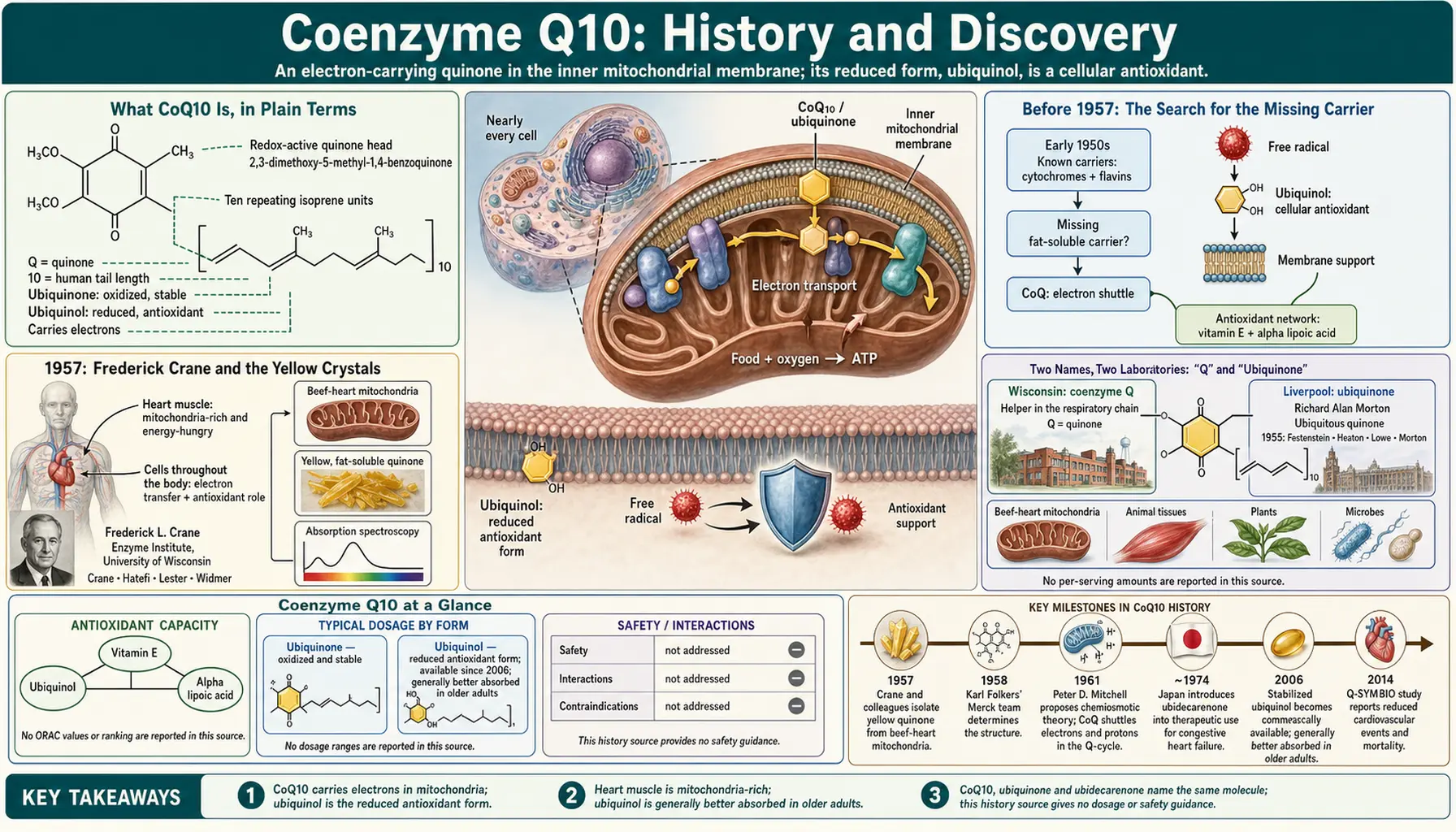
Coenzyme Q10 is a molecule your body makes in nearly every cell, where it ferries electrons through the tiny power plants called mitochondria. Unlike a herb with a long folk tradition, its story is a scientific one, and an unusually well-documented one: it was first pulled out of beef-heart mitochondria in 1957 by an American biochemist named Frederick Crane, its chemical structure was solved a year later by Karl Folkers and his team at Merck, and the British biochemist Richard Morton gave it the everyday name "ubiquinone" because it turned up almost everywhere life did. This page traces what the record actually supports — who isolated it and when, how its role in cellular energy was worked out (a line of research that helped earn a Nobel Prize), how Japan turned it into one of the first heart medicines made from the molecule, and how it became the familiar supplement sold today. Where a date or a name is firmly documented we say so; where the picture is shared among several researchers, we name them together rather than crown a single discoverer.
Interactive Visualization Free Radicals & Your Antioxidant Network Follow one superoxide radical down the whole relay — SOD, catalase, glutathione, vitamin E, vitamin C, NADPH — then release free iron and watch a membrane tear itself apart. Launch →
Table of Contents
- What CoQ10 Is, in Plain Terms
- Before 1957: The Search for the Missing Carrier
- 1957: Frederick Crane and the Yellow Crystals
- Two Names, Two Laboratories: "Q" and "Ubiquinone"
- 1958: Folkers, Merck, and the Molecule's Blueprint
- The Q-Cycle and a Nobel Prize
- From Bench to Bedside: Japan and the Heart
- Becoming a Supplement: Ubiquinol and Modern Trials
- Research Papers and References
- Connections
- Featured Videos
What CoQ10 Is, in Plain Terms
Before the history makes sense, it helps to know what was being discovered. Coenzyme Q10 is a small, fatty molecule that sits inside the inner membrane of the mitochondria — the structures in your cells that burn food and oxygen to make usable energy. Its job is to carry electrons from one stage of that energy-making assembly line to the next. Without it, the line stalls. Because it is found in nearly every cell of nearly every animal, plant, and microbe, it is one of the most widespread biological molecules there is, and that ubiquity is woven right into one of its names.
The "Q" in the name comes from quinone, the chemical family it belongs to. The "10" refers to the length of its tail: ten repeating isoprene units in the version humans make. Other species make slightly shorter-tailed cousins (Q6, Q8, Q9), which is why the early researchers, studying many organisms at once, kept finding the same kind of molecule in slightly different sizes. Keep that picture in mind — a quinone living in the mitochondria, carrying electrons, present almost everywhere — because every chapter of the history below is really the story of scientists slowly figuring out those few facts.
Before 1957: The Search for the Missing Carrier
By the early 1950s, biochemists knew that cells made energy by passing electrons down a chain of molecules inside the mitochondria, a process called the respiratory chain or electron transport chain. They had identified several of the links — proteins called cytochromes, and helpers such as the flavins. But something was missing. The known carriers did not fully explain how electrons travelled from the early steps of the chain to the later ones. There seemed to be a small, fat-soluble go-between that nobody had yet caught.
At the same time, a separate group of researchers was studying fat-soluble substances in animal tissues for entirely different reasons — chasing vitamins and related compounds. These two lines of work, one focused on how cells breathe and one focused on the fatty contents of tissue, were about to converge on the same molecule from opposite directions. That convergence is why CoQ10's discovery is often told as two near-simultaneous stories rather than one, and why it carries two different names to this day. The honest summary of the years before 1957 is that the molecule was strongly suspected but had not been isolated, named, or pinned to a structure.
1957: Frederick Crane and the Yellow Crystals
The clearest single milestone in the story belongs to Frederick L. Crane (1925–2016), a biochemist working at the Enzyme Institute of the University of Wisconsin under the direction of David E. Green. In 1957, while studying preparations made from beef-heart mitochondria — chosen because heart muscle is exceptionally rich in mitochondria — Crane and his colleagues isolated a yellow, fat-soluble compound. Examined by absorption spectroscopy, it behaved like a quinone. That was the surprise: quinones had been thought of largely as plant substances, and finding one tucked into the energy machinery of an animal cell was unexpected.
The finding was announced in a short, now-famous note: Crane, Hatefi, Lester, and Widmer, "Isolation of a quinone from beef heart mitochondria," published in Biochimica et Biophysica Acta in 1957. It was barely two pages long, but it is the paper usually cited as the discovery of coenzyme Q. Crane is therefore commonly and reasonably credited as the discoverer of CoQ10; it is worth noting, in fairness to the record, that the paper carried four authors (Crane, Youssef Hatefi, Robert Lester, and Conrad Widmer) and that the work grew out of Green's laboratory — this was a team effort, with Crane as its central figure.
What Crane had caught was the missing electron carrier the respiratory-chain researchers had been looking for. The molecule was a genuine, named, datable discovery made by named scientists — the kind of clean attribution that many older nutrients lack — and 1957 is the year almost every careful history fixes on.
Two Names, Two Laboratories: "Q" and "Ubiquinone"
The molecule ended up with two names because two groups arrived at it independently. Crane and Green's group in Wisconsin called it coenzyme Q — "coenzyme" for its helper role in the respiratory chain, and "Q" for quinone. That name, later sharpened to coenzyme Q10 once the ten-unit tail of the human form was understood, is the one that stuck in supplements and medicine.
Across the Atlantic, the British biochemist Richard Alan Morton, working at the University of Liverpool, had been studying fat-soluble compounds in animal tissue. His group described the same kind of substance and, struck by how it appeared in tissue after tissue and organism after organism, coined the name ubiquinone — the "ubiquitous quinone." The naming is usually traced to a 1955 paper by Festenstein, Heaton, Lowe, and Morton in the Biochemical Journal, and Morton is credited with proposing the term. So the molecule was, in effect, found from two directions: the energy-metabolism direction (which gave us "coenzyme Q") and the tissue-chemistry direction (which gave us "ubiquinone"). Both names are correct and both are still in use; modern labels often print them side by side, exactly as the main Coenzyme Q10 page on this site does.
There is a third, more technical name — ubidecarenone — used chiefly in pharmacology and drug regulation, where the "deca" again points to the ten-unit tail. For ordinary readers, the practical point is simple: coenzyme Q10, CoQ10, and ubiquinone are the same thing, named by different scientists for different reasons.
1958: Folkers, Merck, and the Molecule's Blueprint
Isolating a molecule is one thing; knowing its exact chemical structure is another. Crane had the substance, but not its blueprint. For that, he turned to the pharmaceutical company Merck, in Rahway, New Jersey, whose chemists were renowned for working out the structures of complicated natural products. The effort there was led by Karl August Folkers (1906–1997), a distinguished natural-products chemist.
In 1958, Folkers' team determined the structure of the molecule and identified the length of its isoprenoid tail. The structural work was published as Wolf, Hoffman, Trenner, Arison, Shunk, Linn, McPherson, and Folkers, "Coenzyme Q. I. Structure Studies on the Coenzyme Q Group," in the Journal of the American Chemical Society in 1958. The human form was shown to be a 2,3-dimethoxy-5-methyl-1,4-benzoquinone carrying a tail of ten isoprene units — in other words, coenzyme Q10. Folkers' group also worked out the related shorter-tailed forms found in other species, which is how the whole "Q" family was sorted out.
Two milestones therefore sit a year apart and belong to two different places: 1957, Crane in Wisconsin, the isolation; 1958, Folkers at Merck, the structure. Folkers went on to spend much of his career on coenzyme Q, including its possible roles in human health, and is one of the names most closely tied to the molecule's later medical study. Both men are essential to the story, and crediting one without the other would misrepresent how the molecule actually came to be understood.
The Q-Cycle and a Nobel Prize
Knowing what the molecule looked like still left the deepest question open: how did it work inside the mitochondrion? Answering that took two more decades and reshaped all of biology's understanding of how cells make energy. The central figure was the British biochemist Peter D. Mitchell, who in 1961 proposed the chemiosmotic theory — the idea that the respiratory chain pumps protons across the mitochondrial membrane, and that the resulting gradient, like water behind a dam, drives the manufacture of ATP, the cell's energy currency.
Coenzyme Q turned out to be a key player in this scheme. Mitchell worked out a mechanism, the Q-cycle, describing how ubiquinone shuttles both electrons and protons at a particular junction of the chain — precisely the go-between role that Crane's yellow crystals had been suspected of filling. The chemiosmotic idea was met with years of skepticism before the evidence won out. In 1978, Mitchell was awarded the Nobel Prize in Chemistry "for his contribution to the understanding of biological energy transfer through the formulation of the chemiosmotic theory." CoQ10 was no longer just a curious quinone from beef heart; it was understood as an indispensable cog in one of the most fundamental machines in living cells — and the molecule's role sat at the heart of Nobel-recognized science.
From Bench to Bedside: Japan and the Heart
The leap from laboratory molecule to medicine happened largely in Japan. Because the heart is one of the most mitochondria-dense and energy-hungry organs in the body — and because heart muscle has among the highest CoQ10 concentrations of any tissue — researchers reasoned that a failing heart might be short of it. Pioneering clinical work on CoQ10 in heart patients was carried out in Japan beginning in the 1960s, associated with the researcher Yamamura among others, and the country developed the industrial fermentation methods needed to make the molecule in usable quantities.
By the mid-1970s this had reached the clinic: CoQ10 (under the pharmacological name ubidecarenone) was introduced into therapeutic use in Japan around 1974, where it was used as a treatment for congestive heart failure. For a time it was among the more widely used cardiac medicines there. This is a meaningful historical episode in its own right — one of the relatively few instances of a naturally occurring, body-made molecule being developed into an approved heart drug — and it set the stage for the larger international trials that came later. It is worth being precise: early enthusiasm ran ahead of rigorous proof, and it took decades of controlled trials to sort out where CoQ10 genuinely helps. That sorting-out is the subject of the companion Benefits articles; here the point is simply that Japan is where CoQ10 first crossed from biochemistry into bedside medicine.
Becoming a Supplement: Ubiquinol and Modern Trials
Once fermentation could produce CoQ10 affordably, it moved beyond prescription use and into the worldwide dietary-supplement market, sold for heart health, energy, and general antioxidant support. For its first decades as a supplement, it was sold almost entirely as ubiquinone — the oxidized, more stable form. A notable later development came in 2006, when the reduced form, ubiquinol, became commercially available as a stabilized supplement; ubiquinol is the form the body actually uses as an antioxidant, and it is generally better absorbed in older adults. The arrival of a stable ubiquinol product is the most recent meaningful milestone in the molecule's commercial history.
The modern era also brought the large, rigorous trials that the early Japanese work had only hinted at. The most influential is the Q-SYMBIO trial, an international double-blind randomized study led by Svend Mortensen and colleagues and published in 2014, which reported reduced cardiovascular events and mortality when CoQ10 was added to standard heart-failure therapy. Earlier, the American biochemist Lester Packer — the University of California, Berkeley researcher who popularized the idea of an interlinked "antioxidant network" — and others had helped establish CoQ10's standing as a genuine cellular antioxidant, complementary to molecules such as alpha lipoic acid and vitamin E. The throughline from 1957 is unbroken: a yellow quinone caught in beef-heart mitochondria became a Nobel-linked piece of basic biology, then a Japanese heart drug, and finally one of the most widely taken supplements in the world. The detailed evidence for what it does — and does not — reliably treat is covered on the main Coenzyme Q10 page and its Benefits articles; this history is concerned only with how it came to be known in the first place.
Research Papers and References
The list below combines the key primary papers in CoQ10's discovery with curated PubMed topic-search links and authoritative resources. Author names, titles, and journals are given as plain text; only the stable DOI, PMID, or archive link is hyperlinked, and each opens in a new tab. Peter Mitchell's 1978 Nobel Prize in Chemistry is referenced through the official Nobel Foundation record.
- Crane FL, Hatefi Y, Lester RL, Widmer C. Isolation of a quinone from beef heart mitochondria. Biochimica et Biophysica Acta. 1957;25(1):220-221. — doi:10.1016/0006-3002(57)90457-2 · PMID: 13445756
- Wolf DE, Hoffman CH, Trenner NR, Arison BH, Shunk CH, Linn BO, McPherson JF, Folkers K. Coenzyme Q. I. Structure studies on the coenzyme Q group. Journal of the American Chemical Society. 1958;80(17):4752. — doi:10.1021/ja01550a096
- Festenstein GN, Heaton FW, Lowe JS, Morton RA. A constituent of the unsaponifiable portion of animal tissue lipids (lambda max. 272 m mu). Biochemical Journal. 1955;59(4):558-566. — doi:10.1042/bj0590558 · PMID: 14363147
- The Nobel Prize in Chemistry 1978 — Peter D. Mitchell, for the chemiosmotic theory of biological energy transfer. The Nobel Foundation. — nobelprize.org: Chemistry 1978
- Mortensen SA, Rosenfeldt F, Kumar A, et al; Q-SYMBIO Study Investigators. The effect of coenzyme Q10 on morbidity and mortality in chronic heart failure: results from Q-SYMBIO, a randomized double-blind trial. JACC: Heart Failure. 2014;2(6):641-649. — doi:10.1016/j.jchf.2014.06.008 · PMID: 25282031
- Crane FL. Discovery of ubiquinone (coenzyme Q) and an overview of function. Mitochondrion. 2007;7 Suppl:S2-S7. — doi:10.1016/j.mito.2007.02.011 · PMID: 17446142
- Coenzyme Q10 history and discovery — PubMed: coenzyme Q10 history and discovery
- Ubiquinone biochemistry and the respiratory chain — PubMed: ubiquinone and the electron transport chain
External Authoritative Resources
- Linus Pauling Institute — Coenzyme Q10 Micronutrient Information Center
- NCCIH — Coenzyme Q10
- MedlinePlus — Coenzyme Q10
- PubMed — All research on coenzyme Q10
Connections
- Free Radicals & Your Antioxidant Network — interactive animation
- Coenzyme Q10
- Coenzyme Q10 Benefits
- All Antioxidants
- Alpha Lipoic Acid
- NAD+ & NMN
- Methylene Blue
- Vitamin E
- Selenium