Carnosine: History and Discovery
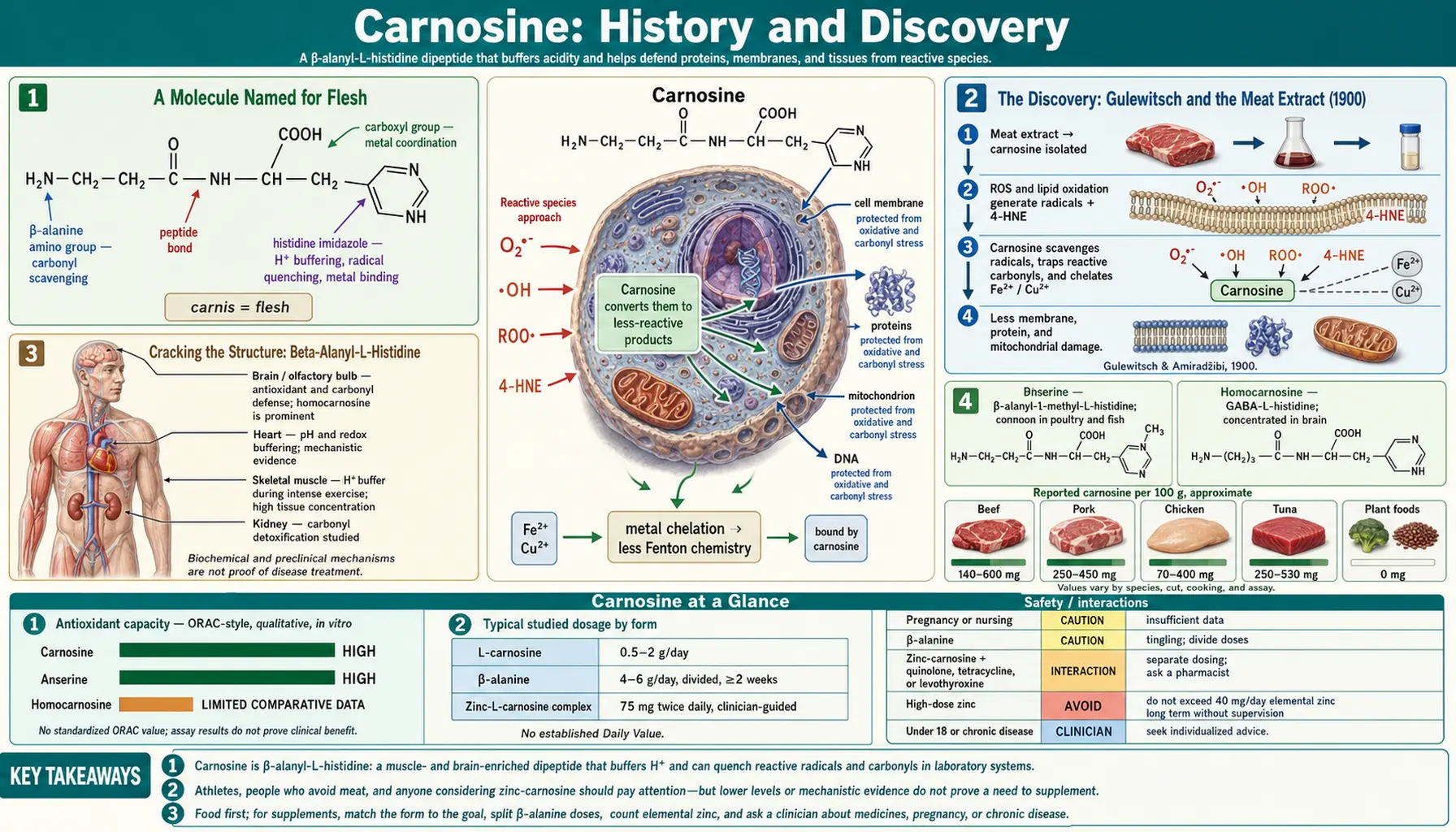
Carnosine has a history that is almost entirely a story of the laboratory. Unlike a herb passed down through folk tradition, this small molecule — the dipeptide beta-alanyl-L-histidine — was unknown until a chemist noticed that meat held more nitrogen than the proteins in it could account for. From that single observation in 1900 came more than a century of work: first to name and isolate the compound, then to crack its chemical structure, then to discover its close relatives, and finally — decade by decade — to understand what it actually does in living muscle and brain. This article follows that documented trail: who isolated carnosine and when, how its structure was settled, the surprising 1953 experiment that hinted at an anti-fatigue role, and the modern turn toward carnosine as an antioxidant, an anti-glycation agent, and a sports-nutrition target. Where a date, name, or "first" is firmly recorded we state it plainly; where the science is still developing we say so.
Table of Contents
- A Molecule Named for Flesh
- The Discovery: Gulewitsch and the Meat Extract (1900)
- Cracking the Structure: Beta-Alanyl-L-Histidine
- The Dipeptide Family: Anserine and Homocarnosine
- The pH-Buffer Era and Severin's Phenomenon
- From Buffer to Antioxidant: The Glycation Discoveries
- The Beta-Alanine Breakthrough
- Carnosine as Medicine: Eye Drops and Zinc-Carnosine
- A Compound of Meat: Dietary and Cultural Context
- Research Papers and References
- Connections
- Featured Videos
A Molecule Named for Flesh
The name carnosine tells you where it was found. It comes from the Latin caro, carnis, meaning "flesh" or "meat" — the same root that gives English words like carnivore and carnal. The name was chosen because the compound was first isolated from a meat extract, and meat is still where it is most abundant: carnosine reaches some of the highest concentrations of any small molecule in skeletal and heart muscle.
Chemically, carnosine is a dipeptide — two amino acids joined by a single bond. It is built from beta-alanine linked to the amino acid L-histidine. The histidine half carries an imidazole ring, and that ring is the part of the molecule responsible for much of carnosine's later-discovered chemistry, from pH buffering to antioxidant and anti-glycation activity. But in 1900 none of that was known. At the moment of discovery, carnosine was simply a puzzle: an unidentified nitrogen-containing substance that nobody had expected to find.
It is worth being clear at the outset that carnosine's history is a scientific history rather than a folk one. There is no ancient tradition of "taking carnosine," because no one knew the molecule existed before the twentieth century. What people did have, for as long as humans have eaten meat, was a diet that delivered carnosine without anyone naming it — a point the final section returns to.
The Discovery: Gulewitsch and the Meat Extract (1900)
Carnosine was isolated in 1900 by the Russian chemist Vladimir Sergeevich Gulewitsch (also transliterated Gulevich) together with his collaborator S. Amiradžibi, working at Kharkov University (in present-day Ukraine). They were studying the nitrogen-containing compounds of muscle, using the kind of concentrated meat extract that had been popularised commercially by the chemist Justus von Liebig. The discovery is documented in their paper "Ueber das Carnosin, eine neue organische Base des Fleischextractes" ("On carnosine, a new organic base of meat extract"), published in Berichte der Deutschen Chemischen Gesellschaft in 1900.
The route to the discovery was a careful piece of bookkeeping. Gulewitsch noticed that when he added up the nitrogen in muscle from all the proteins and other compounds known at the time, the total fell short of the nitrogen actually present in the tissue. Something nitrogen-rich was being missed. Pursuing that gap, he isolated and characterised several previously unknown substances, and one of them was the new base he named carnosine. In other words, carnosine was found not by looking for a useful drug but by chasing a discrepancy in a chemical ledger — a classic example of a discovery driven by accurate measurement.
This makes Gulewitsch the securely documented discoverer of carnosine, and 1900 the firmly established discovery date. Both are well attested across the modern review literature. What he had at that point was a pure, named compound of unknown structure and entirely unknown function; settling the first of those questions took most of the next two decades.
Cracking the Structure: Beta-Alanyl-L-Histidine
Isolating a compound and knowing what it is are two different achievements. After 1900, the open question was the chemical structure of carnosine — which atoms it contained and how they were arranged. Gulewitsch himself continued the work, and around 1911 he identified the two building blocks that carnosine breaks down into: the amino acid histidine and the unusual amino acid beta-alanine.
The full structure — carnosine as the dipeptide beta-alanyl-L-histidine — was established over the following years and is generally dated to around 1918, with confirming work by several investigators including Barger and Tutin and Baumann and Ingvaldsen. The key chemical insight was that carnosine uses beta-alanine, not the ordinary alpha-alanine found in body proteins. In beta-alanine the amino group sits on a different carbon atom, and that small difference has large consequences: carnosine cannot be built into ordinary proteins and resists the usual protein-digesting enzymes, so it accumulates inside cells as a free dipeptide rather than being broken down or locked into structures.
This structural fact, settled a full century ago, is the foundation for everything that followed. The imidazole ring contributed by histidine would later be recognised as carnosine's pH buffer and antioxidant centre, while the beta-alanine half explains both the molecule's stability and — much later — why beta-alanine turned out to be the practical key to raising carnosine in the body. The chemistry was known long before the biology made sense of it.
The Dipeptide Family: Anserine and Homocarnosine
Once chemists knew what to look for, they began finding carnosine's relatives. In 1929, D. Ackermann and colleagues (with N. Tolkatschevskaya) described a carnosine-like compound in the muscle of geese and named it anserine, after the goose's genus, Anser. Anserine is simply a methylated carnosine — the same beta-alanine and histidine, with a small methyl group added to the imidazole ring. It is the dominant histidine-dipeptide in the muscle of many birds and fish.
A third member of the family, homocarnosine — in which histidine is joined not to beta-alanine but to the neurotransmitter precursor GABA — was identified later, with its characterisation generally credited to work around 1961 (Pisano and colleagues). Unlike carnosine and anserine, which are mainly muscle compounds, homocarnosine is concentrated in the brain and nervous system. A fourth relative, balenine (also called ophidine), was found in the muscle of whales and some reptiles.
Together these compounds make up the "histidine-containing dipeptide" family, and recognising them as a group was an important step: it showed that nature had built several closely related molecules on the same chemical theme, distributed differently across tissues and species. That pattern — the same protective chemistry deployed in muscle, in heart, and in brain — later pointed researchers toward the idea that these dipeptides share a common protective job rather than being biochemical curiosities.
The pH-Buffer Era and Severin's Phenomenon
For the first few decades after its discovery, no one was sure what carnosine actually did. The first widely accepted physiological role emerged in 1938, when the British food scientist E. C. Bate-Smith studied the buffering of muscle and proposed that carnosine is a major intracellular pH buffer. His paper, "The buffering of muscle in rigor: protein, phosphate and carnosine," argued that carnosine could account for a large share of muscle's ability to resist becoming acidic — up to roughly a quarter of the buffering capacity in rigor and a substantial fraction in living muscle.
This made chemical sense. The imidazole ring of histidine has a pKa close to 6.8, which sits almost perfectly in the pH range that hard-working muscle passes through as it produces acid during intense effort. A buffer is most effective near its pKa, so carnosine, present at high concentrations, is unusually well suited to soaking up the hydrogen ions that build up during anaerobic exercise. For decades, pH buffering remained the textbook answer to "what is carnosine for?"
A second clue arrived in 1953, when the Russian biochemist Sergei Severin and co-workers reported a striking experiment: adding carnosine to the fluid surrounding a fatigued, isolated muscle restored its working capacity. This anti-fatigue effect became known as Severin's phenomenon, and it was later shown to hold for anserine as well. The result hinted that carnosine was doing more than passive buffering — that it was somehow protecting or restoring the contractile machinery — and it helped keep carnosine a subject of serious physiological research through the second half of the twentieth century.
From Buffer to Antioxidant: The Glycation Discoveries
From roughly the 1980s onward, the understanding of carnosine widened dramatically. Researchers found that the molecule was not only a buffer but a genuinely multifunctional protective agent. Its histidine ring could scavenge reactive oxygen species, making it an antioxidant; the same chemistry let it bind transition metals such as copper and zinc, making it a metal chelator that shuts down metal-driven free-radical production at the source.
The discovery that drove most of the modern interest, however, was carnosine's ability to block glycation — the slow reaction in which sugars latch onto proteins and eventually form damaging cross-links called advanced glycation end-products (AGEs). Carnosine acts in part as a sacrificial decoy, reacting with sugars and reactive carbonyls so that the body's structural proteins are spared, and it traps the aggressive dicarbonyl molecules (such as methylglyoxal) that do the worst glycation damage. Much of this anti-glycation and anti-carbonyl work was developed and synthesised by researchers including Alan Hipkiss and Giancarlo Aldini, whose reviews helped reframe carnosine as a defender of long-lived proteins against the chemical wear-and-tear of aging and high blood sugar.
This was a genuine shift in how the molecule was understood. A compound first valued for keeping muscle from going acidic was now seen as part of the body's broad cellular-defence network, working alongside antioxidants such as glutathione and CoQ10. It also placed carnosine squarely in aging research: laboratory studies, including widely cited cell-culture work reporting that carnosine extended the lifespan of cultured human cells and improved the appearance of aged cells, suggested a role in slowing the accumulation of damaged proteins. These are mechanistic and preclinical findings, and the strongest human evidence still lies in exercise performance and early metabolic endpoints rather than in lifespan itself — an honest distinction the research community continues to draw.
The Beta-Alanine Breakthrough
One of the most practically important chapters in carnosine's history is recent. For a long time it was assumed that to raise carnosine in the body you would simply take carnosine. The problem is that an enzyme called carnosinase, present in the blood and gut, rapidly cleaves ingested carnosine back into its parts before much of it reaches muscle. The structure worked out in 1918 had, in effect, predicted the loophole: muscle does not import whole carnosine well, but it readily takes up beta-alanine and rebuilds carnosine internally using the enzyme carnosine synthase.
The decisive demonstration came in 2006, when Roger Harris and colleagues published a study in the journal Amino Acids showing that orally supplied beta-alanine is absorbed and then drives a substantial increase in muscle carnosine in human volunteers. Because histidine is usually plentiful in muscle, beta-alanine is the rate-limiting ingredient, and supplying it directly bypasses the carnosinase problem. Follow-up work, much of it by Harris together with Craig Sale, Wim Derave, and others, established that several weeks of beta-alanine loading can raise muscle carnosine by roughly 40 to 80 percent and produce a small but consistent improvement in high-intensity exercise lasting a few minutes.
This finding turned carnosine biochemistry into a mainstream sports-nutrition tool and explained a paradox that still surprises people: the best way to raise carnosine is usually to supplement beta-alanine. It also clarified an old observation — that vegetarians, who eat little or no dietary carnosine or beta-alanine, carry measurably lower muscle carnosine than meat-eaters. The tingling skin sensation many people feel after a dose of beta-alanine (harmless paresthesia) became a familiar, if unexpected, footnote to a century-old molecule.
Carnosine as Medicine: Eye Drops and Zinc-Carnosine
Two specific medical applications gave carnosine a public profile beyond the research literature. The first is a stomach medicine. A chelated complex of zinc and carnosine — known as polaprezinc (zinc-L-carnosine, originally coded Z-103) — was developed in Japan and approved there in 1994 for the treatment of gastric ulcers and protection of the stomach lining. In this product the carnosine delivers zinc to inflamed tissue while contributing its own antioxidant and membrane-stabilising effects locally in the stomach, and it remains in clinical use in Japan.
The second, more controversial, application is in the eye. Because the lens is one of the body's most glycation-vulnerable tissues — its proteins are made early in life and essentially never replaced — carnosine's anti-glycation chemistry suggested a possible role in cataract. Plain carnosine penetrates the eye poorly, so a modified, cornea-penetrating prodrug, N-acetylcarnosine, was developed. From around the early 2000s the Russian researcher Mark Babizhayev published trials reporting that N-acetylcarnosine eye drops improved lens clarity and vision in age-related cataract, and these results led to commercial "non-surgical cataract" eye-drop products.
It is important to mark this part of the history honestly. Independent replication of the eye-drop results has been limited, and major ophthalmology bodies do not endorse N-acetylcarnosine drops as a proven treatment; surgery remains the only established cure for an actual cataract. The drops are best described as a mechanistically plausible, investigational option rather than a settled therapy — a reminder that an interesting molecular rationale is the beginning of a medical story, not the end of it.
A Compound of Meat: Dietary and Cultural Context
Carnosine has no folk tradition, but it has always had a dietary one. Because the compound is concentrated in animal muscle and absent from plants, humans have been consuming carnosine for as long as they have eaten meat — entirely unaware of it until 1900. Red meat such as beef and pork is among the richest sources, with poultry, fish, and organ meats also contributing carnosine and its relative anserine. The very name of the molecule encodes this: a substance of the flesh, named in Latin for the tissue it came from.
This dietary fact runs quietly through the whole scientific history. The discrepancy Gulewitsch chased in 1900 existed because meat is unusually rich in these dipeptides. The lower muscle carnosine measured in vegetarians, confirmed in the modern era, is the same fact seen from the other side. And the cultural observation that meat-eating populations take in carnosine without supplements — while plant-based eaters do not — is what gives the beta-alanine research its practical relevance for anyone choosing whether and how to maintain their tissue stores.
Seen as a whole, carnosine's history is a tidy illustration of how modern nutrition learns about itself: a compound hidden in an everyday food is isolated by chance, slowly understood, found to do several useful jobs at once, and finally connected back to the diets people were eating all along. The detailed chemistry, the evidence for each proposed benefit, dosing, and cautions are covered on the main Carnosine page; this history is concerned only with how the molecule came to be known.
Research Papers and References
The list below combines key peer-reviewed sources on carnosine's discovery, chemistry, and physiology with curated PubMed topic-search links into the historical and biochemical literature. Gulewitsch's original 1900 report and the early structural work are named in the article as historical primary sources. Author names, titles, and journals are given as plain text; only the stable DOI, PMID, or archive link is hyperlinked, and each opens in a new tab.
- Gulewitsch Wl, Amiradžibi S. Ueber das Carnosin, eine neue organische Base des Fleischextractes. Berichte der Deutschen Chemischen Gesellschaft. 1900;33(2):1902-1903. — doi:10.1002/cber.19000330275
- Bate-Smith EC. The buffering of muscle in rigor; protein, phosphate and carnosine. The Journal of Physiology. 1938;92(3):336-343. — doi:10.1113/jphysiol.1938.sp003605
- Boldyrev AA, Aldini G, Derave W. Physiology and pathophysiology of carnosine. Physiological Reviews. 2013;93(4):1803-1845. — doi:10.1152/physrev.00039.2012
- Harris RC, Tallon MJ, Dunnett M, et al. The absorption of orally supplied beta-alanine and its effect on muscle carnosine synthesis in human vastus lateralis. Amino Acids. 2006;30(3):279-289. — doi:10.1007/s00726-006-0299-9
- Hipkiss AR. Carnosine and its possible roles in nutrition and health. Advances in Food and Nutrition Research. 2009;57:87-154. — doi:10.1016/S1043-4526(09)57003-9
- Hipkiss AR. Glycation, ageing and carnosine: are carnivorous diets beneficial? Mechanisms of Ageing and Development. 2005;126(10):1034-1039. — doi:10.1016/j.mad.2005.05.002
- Babizhayev MA, Deyev AI, Yermakova VN, et al. Efficacy of N-acetylcarnosine in the treatment of cataracts. Drugs in R&D. 2002;3(2):87-103. — doi:10.2165/00126839-200203020-00004
- Carnosine history and biochemistry — PubMed: carnosine history and discovery
- Histidine-containing dipeptides — anserine, homocarnosine, carnosine — PubMed: histidine-containing dipeptides
External Authoritative Resources
Connections
- Carnosine
- All Antioxidants
- Histidine (Precursor)
- Creatine
- Glutathione
- Spermidine
- Beef (Richest Source)
- Beta-Alanine — carnosine's other building block, and the rate-limiting precursor for raising it.