Grape Seed Extract for Heart Health and Blood Pressure
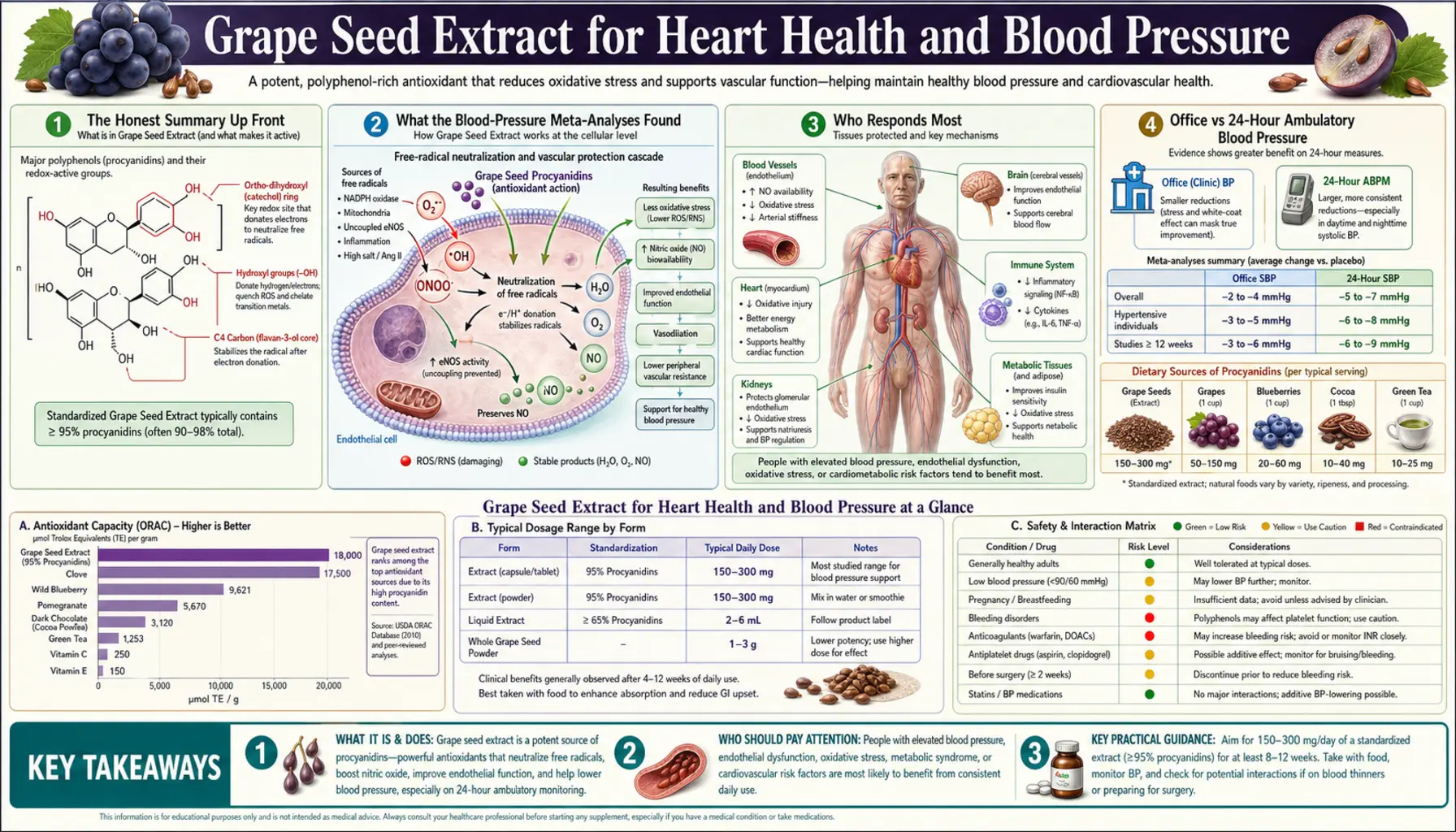
Grape seed extract lowers blood pressure — but the honest headline is that it does so modestly, and mainly in the people who have the most room to improve. Meta-analyses of randomized controlled trials find reductions in systolic blood pressure ranging from about 1.5 to 6 mmHg on average, with the largest effects in younger adults, people who are overweight or obese, and those with metabolic syndrome. Beyond blood pressure, human evidence on endothelial function is mixed, and small trials report lower markers of oxidized LDL with grape seed oligomeric proanthocyanidins (OPCs). This page walks through the actual effect sizes, who is most likely to respond, and where the hype outruns the data — the research describes a modest adjunct, not a replacement for blood-pressure medication.
Table of Contents
- The Honest Summary Up Front
- What the Blood-Pressure Meta-Analyses Found
- Who Responds Most
- Office vs Ambulatory Blood Pressure
- Endothelial Function and Flow-Mediated Dilation
- LDL Oxidation and Lipid Effects
- Type 2 Diabetes and Metabolic Syndrome
- Mechanisms: Nitric Oxide, Oxidation, Inflammation
- What Grape Seed Extract Is Not
- Key Research Papers
- Connections
- Featured Videos
The Honest Summary Up Front
It is worth stating the bottom line before the details, because grape seed extract is often oversold. Across randomized trials, grape seed extract produces a small but statistically real reduction in systolic (top-number) blood pressure, on the order of 1.5 to 6 millimeters of mercury on average depending on the meta-analysis, with a smaller and less consistent effect on diastolic (bottom-number) pressure. The average effect is not large enough to control diagnosed hypertension on its own. But in specific subgroups — younger people, those with obesity, and those with metabolic syndrome — the reductions are larger and more meaningful.
Read that way, the research describes grape seed extract as a low-risk adjunct for cardiovascular risk reduction, studied alongside diet, exercise, weight management, and (where indicated) prescribed medication. It is not a stand-alone antihypertensive, and hypertension guidelines continue to call for standard treatment of high blood pressure.
What the Blood-Pressure Meta-Analyses Found
Two pooled analyses anchor the blood-pressure evidence. Feringa and colleagues (2011) pooled 9 randomized controlled trials (390 participants) and found a significant reduction in systolic blood pressure of 1.54 mmHg and in heart rate of 1.42 beats per minute, with no significant change in diastolic blood pressure, lipids or C-reactive protein. A later, larger meta-analysis by Zhang and colleagues (2016) pooled 16 trials from 12 articles (810 participants) and found larger average reductions: 6.08 mmHg systolic and 2.80 mmHg diastolic compared with control. Zhang and colleagues noted that their sample size was small and called for a large, long-term trial in people with hypertension.
The consistent theme across these syntheses is direction: both found systolic blood pressure moving downward. The size of the pooled effect, however, differs roughly four-fold between the two analyses, and Zhang and colleagues described the individual trial results as often irreproducible. Their subgroup analyses and meta-regression suggest the effect depends on who is being treated.
Who Responds Most
In the subgroup analyses of the Zhang meta-analysis, larger systolic reductions were seen in:
- Younger adults — trials with a mean participant age under 50 (about 6.0 mmHg systolic, 3.1 mmHg diastolic)
- People with obesity — trials with a mean body mass index of 25 or above (about 4.5 mmHg systolic)
- People with metabolic syndrome — the cluster of central obesity, high blood pressure, high triglycerides, low HDL, and elevated blood sugar (about 8.5 mmHg systolic)
The metabolic-syndrome signal is illustrated by the trial of Sivaprakasapillai and colleagues (2009), who randomized people with metabolic syndrome to placebo, 150 mg or 300 mg of grape seed extract a day for 4 weeks and, using ambulatory monitoring, recorded lower systolic and diastolic blood pressure with grape seed extract than with placebo; serum lipids and blood glucose did not change significantly. One proposed explanation is that interventions acting on the endothelium and oxidative stress have more to work on when endothelial dysfunction and oxidative stress are already present, as in metabolic syndrome and obesity.
The trials summarized here enrolled people with prehypertension, hypertension, overweight or metabolic disorders; they say little about people with normal blood pressure and a normal metabolic profile.
Office vs Ambulatory Blood Pressure
A crucial nuance separates a good trial from a weak one: how blood pressure is measured. Office readings (a cuff in a clinic) are prone to variability. Ambulatory monitoring — a wearable cuff that records pressure repeatedly through a normal day — is generally regarded as the more rigorous method.
Ras and colleagues (2013) put grape seed extract to this test in 70 untreated, otherwise healthy people with pre- and stage I hypertension: 300 mg a day or placebo for 8 weeks, with daytime ambulatory blood pressure as the outcome. Systolic pressure fell by 3.0 mmHg and diastolic by 1.4 mmHg relative to placebo, but neither change was statistically significant, and markers such as nitric-oxide metabolites, endothelin-1 and platelet aggregation were not affected. The ambulatory evidence is therefore mixed: the Sivaprakasapillai trial in metabolic syndrome, which also used ambulatory monitoring, did record a reduction. A small 2025 crossover study in 10 men with elevated or stage 1 hypertension reported lower resting diastolic and mean arterial pressure after 7 days of grape seed extract, with no difference in systolic pressure or heart rate variability. Taken together, grape seed extract has lowered blood pressure in some trials, but the effect has not appeared in every well-controlled study.
Endothelial Function and Flow-Mediated Dilation
Blood pressure is downstream of endothelial function — the ability of the artery lining to release nitric oxide and relax. In laboratory studies, extracts of grape seeds and skins relax blood vessels only when the endothelium is intact, through nitric-oxide release and cyclic GMP; Fitzpatrick and colleagues isolated 16 individual procyanidins from grape seeds with this endothelium-dependent relaxing activity. In humans, Odai and colleagues (2019) ran a randomized, double-blind, placebo-controlled trial in 30 Japanese adults aged 40–64 with prehypertension, using 200 or 400 mg a day of grape seed proanthocyanidin extract for 12 weeks. Systolic blood pressure fell by 13 mmHg in the high-dose group, but flow-mediated dilation did not change; in an ad hoc analysis of the 21 non-smokers, measures of arterial stiffness and elasticity improved with the high dose.
Flow-mediated dilation (FMD) — ultrasound measurement of how much an artery widens after a brief blood-flow stimulus — is the standard non-invasive readout of endothelial health, and it is a predictor of long-term cardiovascular risk. Endothelial dysfunction is regarded as an early step on the road to atherosclerosis, which is why researchers measure it. For grape seed extract the human results are mixed so far: neither the Odai trial (flow-mediated dilation) nor the Kar trial in type 2 diabetes (photoplethysmography) found a significant change in endothelial function.
LDL Oxidation and Lipid Effects
Grape seed OPCs are potent antioxidants in the laboratory, and protection of LDL cholesterol from oxidation is one of the effects researchers have looked for in people. Oxidized LDL is the more atherogenic form — it is what macrophages engulf to become the foam cells of an early atherosclerotic plaque — so reducing LDL oxidation is a plausible route to slower plaque development. In a single-blind trial of 61 healthy adults with LDL cholesterol of 100–180 mg/dL, Sano and colleagues (2007) reported lower malondialdehyde-modified LDL, one form of oxidized LDL, after 6–12 weeks of 200 or 400 mg of grape seed proanthocyanidin a day, compared with baseline; the difference from placebo was significant only at week 6 in the 400 mg group. A randomized, placebo-controlled trial of 200 mg a day of red grape seed extract for 8 weeks in 70 people with mild-to-moderate hyperlipidemia reported increased serum paraoxonase activity (an enzyme carried on HDL that helps protect LDL from oxidation), along with higher HDL and apolipoprotein A-I and lower total cholesterol, triglycerides and LDL cholesterol.
Effects on the standard lipid panel (total, LDL, HDL cholesterol, triglycerides) are less consistent. A 2020 systematic review and dose-response meta-analysis of 11 randomized trials (536 participants) found small reductions in LDL cholesterol (0.17 mmol/L) and triglycerides (0.11 mmol/L), with no overall effect on total or HDL cholesterol; the earlier Feringa meta-analysis found no significant lipid effect. In short: the evidence does not show grape seed extract substituting for a statin or for dietary change where lipid lowering is needed, and the human evidence on LDL oxidation comes from small trials. Lipid management itself is covered on the Cholesterol Management page.
Type 2 Diabetes and Metabolic Syndrome
Because grape seed extract's benefits concentrate in dysmetabolic states, it has been tested in type 2 diabetes. Kar and colleagues (2009) ran a double-blind, randomized, placebo-controlled crossover trial in 32 people with type 2 diabetes at high cardiovascular risk, giving 600 mg a day of grape seed extract for 4 weeks. After grape seed extract (but not placebo), high-sensitivity C-reactive protein (an inflammation marker) and fructosamine (a glycaemia marker) fell, whole-blood reduced glutathione rose, and total cholesterol fell slightly. Endothelial function, insulin resistance (HOMA-IR) and total antioxidant status did not change significantly.
This sits alongside the metabolic syndrome subgroup findings, although the trial was short and small. The trial evidence places it as a supportive adjunct to standard diabetes care (glycemic control, blood-pressure and lipid management, lifestyle), not as a glucose-lowering treatment in its own right. Related: the Diabetes page.
Mechanisms: Nitric Oxide, Oxidation, Inflammation
Three interlocking mechanisms are proposed for grape seed extract's cardiovascular effects, based mainly on laboratory and animal work:
- Nitric oxide and vasodilation — procyanidins prompt the endothelium to release nitric oxide, relaxing arterial smooth muscle and lowering resistance, which is the proposed route to reduced blood pressure; in the Ras human trial, however, nitric-oxide metabolites in blood and urine did not change.
- Antioxidant protection — OPCs quench reactive oxygen species that would otherwise inactivate nitric oxide and oxidize LDL; by preserving nitric-oxide availability and reducing LDL oxidation, they support both vascular tone and slower plaque formation.
- Anti-inflammatory effects — grape seed polyphenols dampen inflammatory signaling in the vessel wall, and chronic low-grade vascular inflammation is a driver of endothelial dysfunction and atherosclerosis.
These mechanisms are the same ones that underlie the vein and capillary effects on the Circulation and Veins page — the endothelium is the common organ, whether the target vessel is a leg vein or a coronary artery.
What Grape Seed Extract Is Not
- Not a replacement for antihypertensive medication. The research does not support replacing prescribed blood-pressure drugs with a supplement: grape seed extract's average effect is too small to control established hypertension alone. Decisions about medicines and supplements belong with a clinician.
- Not a proven treatment for heart disease. There are no large outcome trials showing that grape seed extract prevents heart attacks, strokes, or cardiovascular death. The evidence is for surrogate markers (blood pressure, endothelial function, oxidation), not hard clinical endpoints.
- Not without interactions. Grape seed extract inhibited platelet aggregation in human blood in the test tube, and a grape seed plus grape skin combination did so in dogs, which raises a theoretical concern about additive bleeding risk with warfarin, direct oral anticoagulants and antiplatelet drugs — medications many cardiac patients take. In the Ras human trial, 300 mg a day for 8 weeks did not affect platelet aggregation. See the Safety and Standardization page.
- Not a substitute for the basics. Hypertension guidelines build blood-pressure management on diet, physical activity, sodium reduction, weight management and not smoking; grape seed extract is not part of guideline treatment.
Key Research Papers
- Feringa HH, Laskey DA, Dickson JE, Coleman CI (2011). The effect of grape seed extract on cardiovascular risk markers: a meta-analysis of randomized controlled trials. Journal of the American Dietetic Association — PubMed PMID: 21802563
- Zhang H et al. (2016). The impact of grape seed extract treatment on blood pressure changes: a meta-analysis of 16 randomized controlled trials. Medicine (Baltimore) — PubMed PMID: 27537554
- Sivaprakasapillai B et al. (2009). Effect of grape seed extract on blood pressure in subjects with the metabolic syndrome. Metabolism — PubMed PMID: 19608210
- Ras RT et al. (2013). Effect of polyphenol-rich grape seed extract on ambulatory blood pressure in subjects with pre- and stage I hypertension. British Journal of Nutrition — PubMed PMID: 23702253
- Odai T et al. (2019). Effects of grape seed proanthocyanidin extract on vascular endothelial function in participants with prehypertension. Nutrients — PubMed PMID: 31757033
- Kar P et al. (2009). Effects of grape seed extract in Type 2 diabetic subjects at high cardiovascular risk. Diabetic Medicine — PubMed PMID: 19646193
- Effects of grape seed extract on dyslipidaemia: a systematic review and dose-response meta-analysis of randomised controlled trials (2020). British Journal of Nutrition — PubMed PMID: 32138795
- The effect of red grape seed extract on serum paraoxonase activity in patients with mild to moderate hyperlipidemia (2016). Sao Paulo Medical Journal — PubMed PMID: 27191247
- Effect of 7-day dietary supplementation with grape seed extract on cardiac autonomic and hemodynamic responses in elevated and stage 1 hypertension (2025). Clinical Physiology and Functional Imaging — PubMed PMID: 40341867
- Fitzpatrick DF, Bing B, Maggi DA, Fleming RC, O'Malley RM (2002). Vasodilating procyanidins derived from grape seeds. Annals of the New York Academy of Sciences 957:78–89 — PubMed PMID: 12074963
- Sano A, Uchida R, Saito M, Shioya N, Komori Y, Tho Y, Hashizume N (2007). Beneficial effects of grape seed extract on malondialdehyde-modified LDL. Journal of Nutritional Science and Vitaminology 53(2):174–182 — PubMed PMID: 17616006
- Shanmuganayagam D, Beahm MR, Osman HE, Krueger CG, Reed JD, Folts JD (2002). Grape seed and grape skin extracts elicit a greater antiplatelet effect when used in combination than when used individually in dogs and humans. Journal of Nutrition 132(12):3592–3598 — PubMed PMID: 12468593
PubMed Topic Searches
- PubMed: Grape seed extract and blood pressure
- PubMed: OPCs and endothelial function
- PubMed: Grape seed extract and LDL oxidation
- PubMed: Grape seed extract and metabolic syndrome
- PubMed: Grape seed extract and type 2 diabetes