Beta-Carotene: History and Discovery
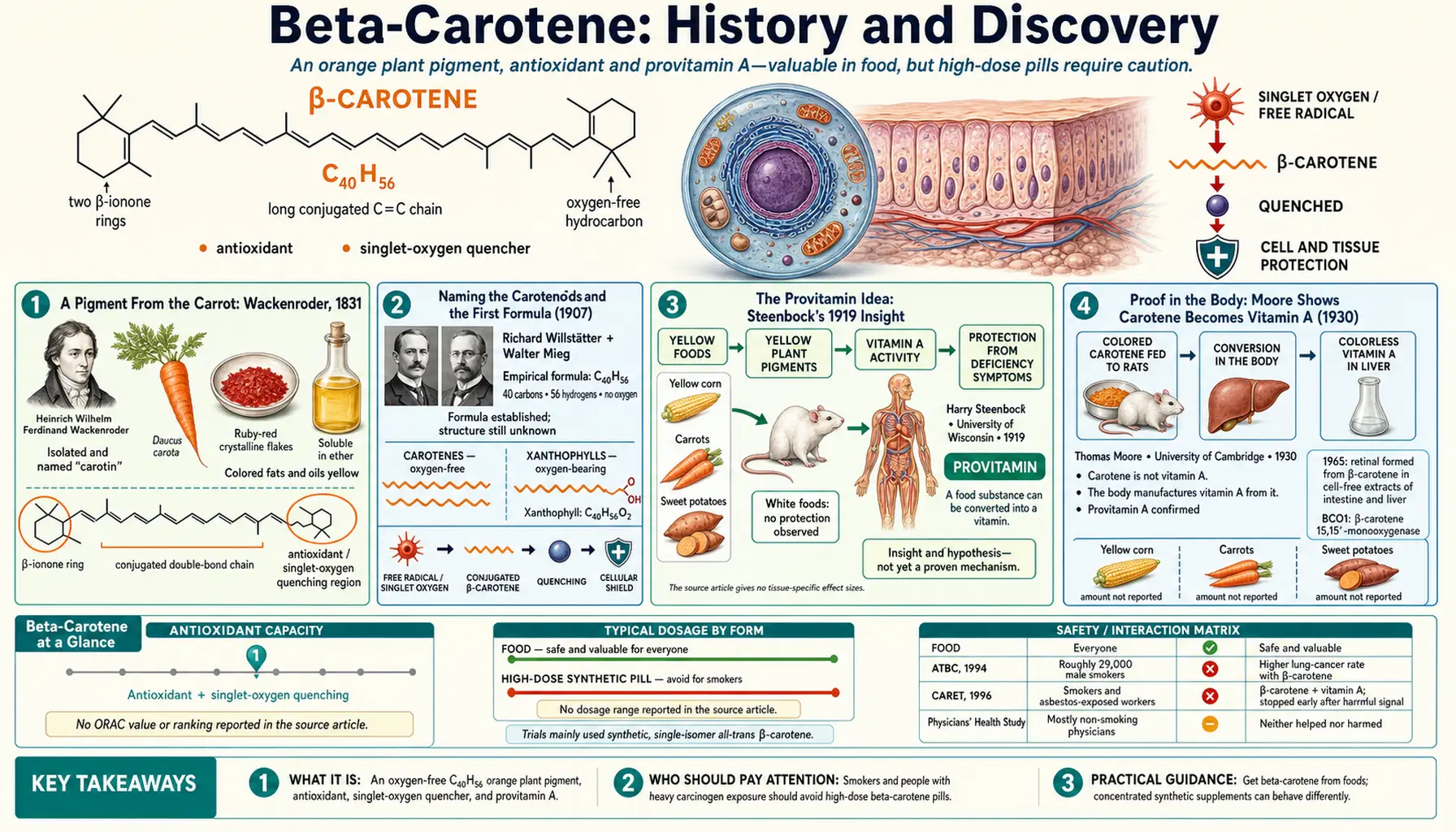
The story of beta-carotene is the story of how a humble orange pigment from a carrot became one of the most-studied molecules in the history of nutrition. It begins in 1831, when a German pharmacist drew a few ruby-red flakes out of carrot juice and named them after the vegetable; it runs through the first time anyone worked out the structure of a vitamin precursor; and it ends with a famous, sobering reversal in which the same pigment that protects plants from sunlight was found to harm one specific group of people when given as a high-dose pill. This page traces what the historical record actually supports — who isolated the pigment, who named it, who proved the body turns it into vitamin A, who solved its structure and won a Nobel Prize for it, and how it went from a hoped-for cancer shield to a cautionary tale. Where the record is firm we say so by name and date; where an attribution is shared or still discussed, we say that too.
Table of Contents
- A Pigment From the Carrot: Wackenroder, 1831
- Naming the Carotenoids and the First Formula (1907)
- The Provitamin Idea: Steenbock's 1919 Insight
- Proof in the Body: Moore Shows Carotene Becomes Vitamin A (1930)
- Solving the Structure: Karrer and a Scientific First
- Splitting the Isomers: Kuhn, Lederer, and Chromatography
- From Laboratory to Factory: Synthesis and Industry
- The Great Reversal: From Cancer Hope to the Smoker Trials
- Research Papers and References
- Connections
- Featured Videos
A Pigment From the Carrot: Wackenroder, 1831
Beta-carotene's recorded history opens with a name that is firmly documented: Heinrich Wilhelm Ferdinand Wackenroder (1798–1854), a German pharmacist and analytical chemist working in Jena. In 1831 Wackenroder isolated a yellow-orange pigment from the root of the common carrot, Daucus carota, and named it "carotin" after the carrot's Latin name — the root of the modern word carotene. The detail most sources stress is that he did not set out to find a pigment at all: he came across it while looking for an antihelminthic (a worm-expelling remedy) in carrots. He obtained the substance as small ruby-red crystalline flakes, soluble in ether, which gave fats and oils a beautiful yellow colour when dissolved in them.
It is worth being precise about what "discovery" means here. Carotene was not invented; it is a natural pigment that colours carrots, and people had eaten it for as long as they had eaten orange vegetables. What Wackenroder did, and what makes 1831 the genuine starting point, was to isolate and name the pure pigment as a distinct chemical substance — to lift it out of the carrot and recognise it as a thing in its own right. From that moment the pigment had an identity and a name, and the long scientific effort to understand it could begin.
Naming the Carotenoids and the First Formula (1907)
For most of the nineteenth century carotene remained a curiosity — a coloured extract whose chemical makeup was unknown. The first major step toward understanding it came from one of the giants of plant chemistry, Richard Willstätter (who would win the 1915 Nobel Prize in Chemistry largely for his work on chlorophyll). Working with Walter Mieg, Willstätter established in 1907 the empirical formula of carotene as C40H56 — a pure hydrocarbon of forty carbons and fifty-six hydrogens, containing no oxygen. In the same period he distinguished carotene from a closely related but oxygen-bearing yellow pigment, xanthophyll (C40H56O2). This split — oxygen-free carotenes versus oxygen-bearing xanthophylls — is still the basic division of the carotenoid family today.
Knowing the formula was not the same as knowing the structure. C40H56 told chemists how many atoms were in the molecule and that it was extraordinarily rich in carbon-carbon double bonds, but not how those atoms were arranged. That far harder problem — the actual shape of the molecule, with its long chain of conjugated double bonds capped by two rings — would not be solved for another two decades, and solving it would turn out to be a landmark in the whole of organic chemistry. Willstätter and Mieg supplied the molecule's headcount; the architecture came later.
The Provitamin Idea: Steenbock's 1919 Insight
While chemists were weighing carotene's atoms, a different line of work was about to connect the pigment to human health. In 1919 the American biochemist Harry Steenbock, at the University of Wisconsin, noticed something that would prove enormously important: animals fed yellow plant foods — yellow corn, carrots, sweet potatoes — were protected from the symptoms of what we now call vitamin A deficiency, while the same animals fed white foods (white corn, white vegetables) were not. Steenbock proposed that the yellow plant pigments were linked to vitamin A activity.
This was the birth of the provitamin concept — the entirely new idea that a substance in food might not be a vitamin itself, but could be turned into one by the body. It was a genuinely original notion with large consequences, both scientific and commercial, because it meant a plant pigment could serve as a source of an animal vitamin. Steenbock's observation was a hypothesis based on a striking pattern, not yet a proven mechanism; the proof that carotene actually becomes vitamin A inside the body was still eleven years away, and is the subject of the next section. But the insight pointed research in exactly the right direction.
Proof in the Body: Moore Shows Carotene Becomes Vitamin A (1930)
The decisive experiment came from the British biochemist Thomas Moore, working at the University of Cambridge. In a series of papers culminating in a now-classic 1930 report in the Biochemical Journal ("Vitamin A and carotene. VI. The conversion of carotene to vitamin A in vivo"), Moore showed that when rats were fed carotene — which is coloured — they accumulated the colourless form of vitamin A in their livers. In other words, the orange pigment going in was being transformed inside the animal into the pale vitamin found in liver. This was the direct experimental confirmation of Steenbock's idea: carotene is not vitamin A, but the body manufactures vitamin A from it.
Moore's demonstration settled the central biological fact about beta-carotene that everything else rests on — it is a provitamin A, the most important dietary precursor of the vitamin. The work was important enough that the Biochemical Journal paper was later reprinted as a "Nutrition Classic." A further chapter in this same story was written in 1965, when researchers (notably James Allen Olson and DeWitt Goodman, working independently) demonstrated the formation of retinal from beta-carotene in cell-free extracts of intestine and liver — pinning the conversion down to a specific enzymatic cleavage rather than a whole-animal black box. The enzyme responsible is today known as beta-carotene 15,15'-monooxygenase (BCO1), described in detail on the main Beta-Carotene page.
Solving the Structure: Karrer and a Scientific First
The molecule's architecture — the question Willstätter's formula had left open — was cracked at the start of the 1930s by the Swiss chemist Paul Karrer at the University of Zurich. In 1930–1931 Karrer determined the correct structure of beta-carotene: the long backbone of conjugated double bonds capped at each end by a ring (the beta-ionone ring). What made this far more than a niche achievement is its place in history: it was the first time the chemical structure of any vitamin or provitamin had been worked out. Karrer went on to show that vitamin A was structurally related to the carotenoids — effectively half of the carotene molecule — which explained at the molecular level exactly how one could give rise to the other.
Karrer's carotenoid and vitamin work earned him the Nobel Prize in Chemistry in 1937, which he shared with Walter Norman Haworth (recognised for his work on carbohydrates and vitamin C). Karrer's half of the prize was awarded, in the words of the official citation, "for his investigations on carotenoids, flavins and vitamins A and B2." With the structure known, beta-carotene was no longer a mysterious coloured extract but a fully defined molecule — a necessary step before anyone could hope to make it in a laboratory.
Splitting the Isomers: Kuhn, Lederer, and Chromatography
At almost the same moment, a second discovery revealed that "carotene" was not even a single substance. In 1931, the German-based chemist Richard Kuhn, working with Edgar Lederer, separated carotene into two distinct but very similar forms, which they named beta-carotene and alpha-carotene. The recognition that carotene is made of two optically distinct components is, by most historical accounts, a shared credit rather than Kuhn's alone: the official Nobel record notes that in 1931 Kuhn (in Heidelberg), Paul Karrer (in Zurich), and Sigmund Otto Rosenheim (in London) arrived at this finding "simultaneously and independently" — alpha-carotene being optically inactive while beta-carotene rotates polarised light. What is distinctively credited to Kuhn and Lederer is the chromatographic method that cleanly resolved the two and the naming of the isomers. About two years later (in 1933) Lederer identified a third form, gamma-carotene. The pigment Wackenroder had isolated a century earlier turned out to be mostly the beta form, but mixed with these close relatives — which differ in the placement of a double bond in one ring and, crucially, in how much vitamin A activity they can yield.
This separation is famous for a second reason: it helped revive a forgotten laboratory technique. The carotene isomers were too alike to separate by ordinary means, so Kuhn and Lederer turned to chromatography — passing the mixture through a column packed with an adsorbent so the components travelled at different rates and separated into bands. The method had been invented decades earlier by the botanist Mikhail Tswett but had fallen out of use; when impurities were frustrating Kuhn's work, Willstätter is reported to have sent him a German translation of Tswett's book, and the carotenoid chemists (Kuhn, Karrer, and László Zechmeister among them) became central to chromatography's rebirth as the indispensable tool it remains today. Kuhn was awarded the 1938 Nobel Prize in Chemistry "for his work on carotenoids and vitamins"; the political circumstances of the time meant he was unable to accept the award when it was granted and received the diploma and medal only after the Second World War.
From Laboratory to Factory: Synthesis and Industry
Knowing the structure raised an obvious next goal: building beta-carotene from scratch. This was a formidable target — a symmetrical forty-carbon molecule with a long, delicate chain of double bonds. The breakthrough came in 1950, when the first total syntheses of beta-carotene were reported in the same year by several groups working independently, including Paul Karrer with C. H. Eugster, Hans Inhoffen and colleagues, and Nicholas Milas and colleagues. Achieving the synthesis confirmed beyond doubt that the proposed structure was correct — you cannot build a molecule from a wrong blueprint — and it opened the door to making the pigment in quantity.
Industrial production followed quickly. Building on Inhoffen's approach, the Swiss firm Hoffmann-La Roche, with the chemist Otto Isler leading the effort, developed a manufacturing route and began commercial synthesis of beta-carotene in 1954; BASF later began its own production in 1972. Synthetic beta-carotene became widely used as a food colour (it gives the orange tint to margarine, butter, cheese, and soft drinks) and as a vitamin-A source and supplement. This is an important thread to keep in mind for the final section: the supplements that would later be tested in the great clinical trials were, for the most part, this synthetic, single-isomer all-trans beta-carotene — a purified industrial product quite unlike the mixed natural carotenoids found in food and in algae such as Dunaliella salina.
The Great Reversal: From Cancer Hope to the Smoker Trials
By the late twentieth century, beta-carotene's scientific reputation had reached its high-water mark. Decades of observational studies pointed the same way: people who ate more carotene-rich fruits and vegetables, and who had higher levels of beta-carotene in their blood, tended to have less cancer — especially lung cancer — and less heart disease. Combined with the molecule's known power as an antioxidant and singlet-oxygen quencher, this made an appealing hypothesis: perhaps giving beta-carotene as a supplement to people at high risk would protect them. In the 1980s and early 1990s, beta-carotene was widely regarded as one of the most promising candidates for cancer prevention.
Two large randomised trials set out to prove it, and both produced the opposite of what was expected. The Finnish ATBC (Alpha-Tocopherol, Beta-Carotene) trial, published in the New England Journal of Medicine in 1994, gave roughly 29,000 male smokers beta-carotene, vitamin E, both, or neither — and found that the men taking beta-carotene had a higher, not lower, rate of lung cancer. Two years later, the American CARET (Carotene and Retinol Efficacy Trial), also in the New England Journal of Medicine in 1996, tested beta-carotene plus vitamin A in smokers and asbestos-exposed workers; it was stopped early when the same harmful signal appeared. In a parallel population of mostly non-smoking physicians, the U.S. Physicians' Health Study found beta-carotene neither helped nor harmed — confirming that the danger was specific to smokers and heavy carcinogen exposure.
The reversal reshaped nutrition science. It became the textbook demonstration that an antioxidant which is beneficial in food can behave very differently — even harmfully — when stripped out, concentrated, and given as a high-dose pill, particularly in the oxygen-rich, smoke-damaged lung. The lesson rippled outward: when the Age-Related Eye Disease Study formula for macular degeneration was revised in 2013 (AREDS2), beta-carotene was removed and replaced with the macular xanthophylls lutein and zeaxanthin, partly for this very safety reason. The careful, modern verdict — that beta-carotene from food is safe and valuable for everyone, while high-dose synthetic supplements are best avoided by smokers — is the historical endpoint of a journey that began with a few red flakes drawn from a carrot in 1831. The full clinical detail, dosing, and mechanisms are covered on the main Beta-Carotene page; this history is concerned with how we came to know what we know.
Research Papers and References
The list below combines historical scholarship on the discovery of carotene with the landmark primary studies that define its modern story. Author names, titles, and journals are given as plain text; only stable DOI, PMID, or archive links are hyperlinked, and each opens in a new tab. Thomas Moore's original 1930 Biochemical Journal paper and Willstätter and Mieg's 1907 work are named in the article as historical primary sources; the citations below point to a peer-reviewed history of the field and to stable reprints and reviews that document these events.
- Sourkes TL. The discovery and early history of carotene. Bulletin for the History of Chemistry. 2009;34(1):32–38. — Stable archive: hdl.handle.net/2142/127735 (doi:10.70359/bhc2009v034p032)
- Moore T. Nutrition classics. The Biochemical Journal volume 24, 1930. Vitamin A and carotene. VI. The conversion of carotene to vitamin A in vivo (reprinted). Nutrition Reviews. 1982;40(9):275–278. — PMID: 6757804
- Lakshman MR. Alpha and omega of carotenoid cleavage. The Journal of Nutrition. 2004;134(1):241S–245S. — doi:10.1093/jn/134.1.241S Search PubMed
- von Lintig J. Provitamin A metabolism and functions in mammalian biology. American Journal of Clinical Nutrition. 2012;96(5):1234S–1244S. — doi:10.3945/ajcn.112.034629 · PMID: 23053549
- The Alpha-Tocopherol, Beta Carotene Cancer Prevention Study Group. The effect of vitamin E and beta carotene on the incidence of lung cancer and other cancers in male smokers (ATBC). New England Journal of Medicine. 1994;330(15):1029–1035. — doi:10.1056/NEJM199404143301501 · PMID: 8127329
- Omenn GS, Goodman GE, Thornquist MD, et al. Effects of a combination of beta carotene and vitamin A on lung cancer and cardiovascular disease (CARET). New England Journal of Medicine. 1996;334(18):1150–1155. — doi:10.1056/NEJM199605023341802 · PMID: 8602180
- Discovery and history of carotene and the carotenoids PubMed: carotene history and discovery
- Beta-carotene conversion to vitamin A — provitamin A metabolism PubMed: beta-carotene provitamin A conversion
External Authoritative Resources
- Linus Pauling Institute — Vitamin A & Carotenoids Micronutrient Information Center
- NIH Office of Dietary Supplements — Vitamin A & Carotenoids Fact Sheet
- NobelPrize.org — Paul Karrer, Nobel Prize in Chemistry 1937
- PubMed — All research on beta-carotene