⚠ Evidence warning: Clinical trials or other evidence do not support the claims that D-phenylalanine amplifies the body's own opioid pain relief without tolerance, dependence or respiratory depression, and that this is the only well-documented clinical mechanism of a D-amino acid in human therapeutics. This page keeps it as a report of what people, websites or other media say.
Phenylalanine — Benefits Deep Dive
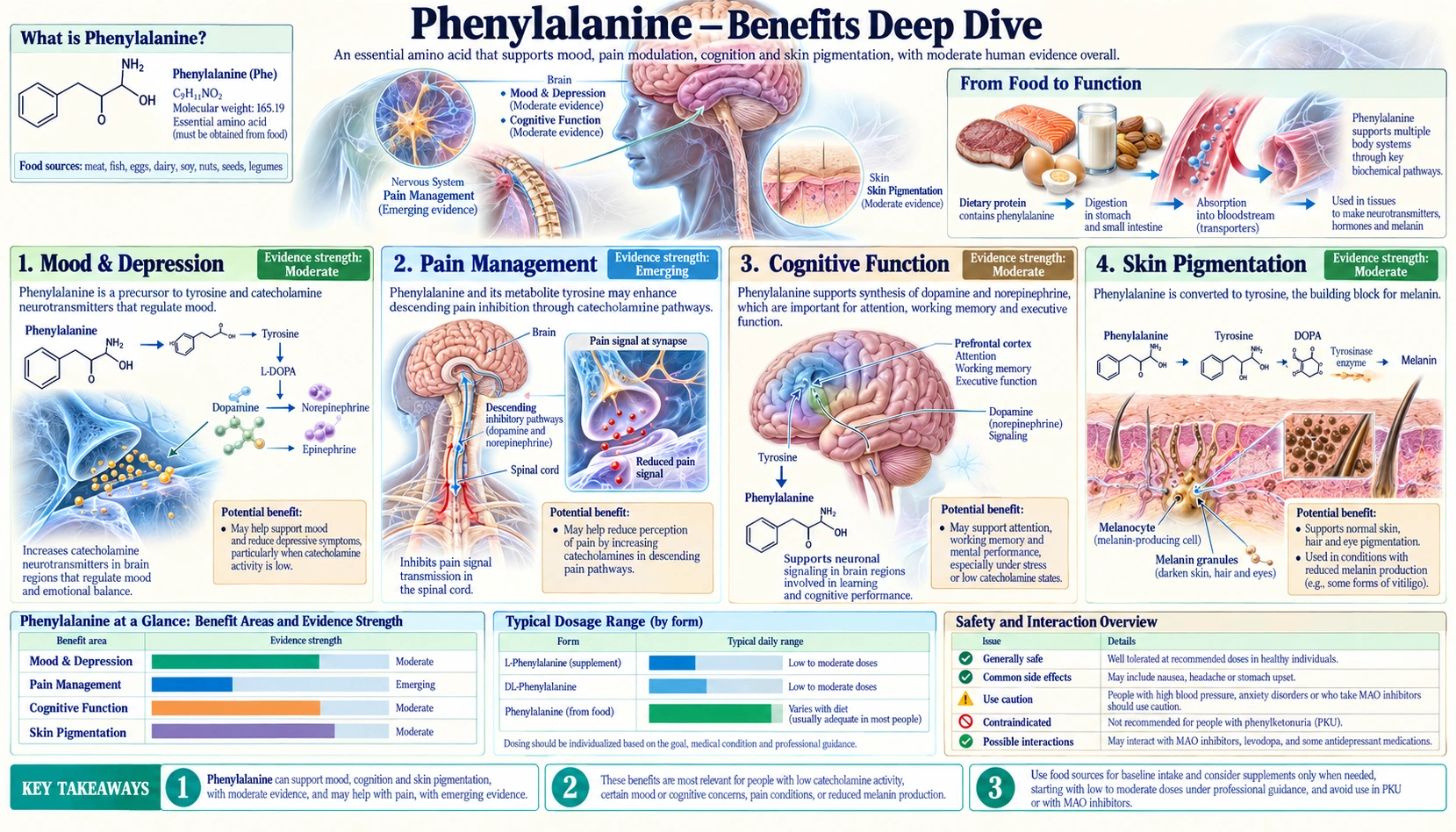
Phenylalanine is an essential aromatic amino acid; the precursor of tyrosine and the entire catecholamine cascade (dopamine, norepinephrine, epinephrine) plus thyroid hormone and melanin; the only amino acid with a clinically important D-form (D-phenylalanine) that prolongs endogenous opioid signaling at the enkephalin receptor by inhibiting enkephalinase; and the amino acid that people with phenylketonuria (PKU) cannot break down, so their diets restrict it severely. Four benefit pages below explore the areas where phenylalanine has been studied most — the catecholamine-precursor approach to depression and low mood, the unique enkephalinase-inhibition mechanism of D-phenylalanine for chronic pain, the catecholamine and thyroid contribution to cognitive function (with the rare opposite story of PKU phenylalanine toxicity), and the substrate-supply approach to vitiligo repigmentation that combines oral phenylalanine with ultraviolet A (UVA) light.
PKU WARNING
In anyone with phenylketonuria (PKU), all supplemental phenylalanine adds to the load the body cannot clear — including the L-, D-, and DL- forms discussed on these pages, and including the phenylalanine released from aspartame in diet sodas and sugar-free products. PKU patients lack functional phenylalanine hydroxylase and cannot metabolize the amino acid; accumulation in plasma and brain is neurotoxic. Every aspartame-containing product carries a regulatory warning ("Phenylketonurics: Contains phenylalanine") for this reason. The 2017 European PKU guidelines describe the cornerstone of treatment as a low-phenylalanine diet combined with phenylalanine-free amino acid supplements, which also supply tyrosine, with blood levels followed by a metabolic clinic.
Deep-Dive Articles
Mood & Depression
The phenylalanine → tyrosine → L-DOPA → dopamine cascade as the antidepressant precursor-loading approach. The differences among L-phenylalanine (catecholamine precursor), D-phenylalanine (enkephalinase inhibitor with emotional-pain effect), and DL-phenylalanine (DLPA, the combined-mechanism racemic mixture used in most depression trials). The Beckmann 1977 open trial (20 depressed patients, no placebo group), the Sabelli phenylethylamine trials of the 1980s and 1990s, the Beckmann 1979 double-blind comparison with the antidepressant imipramine (27 patients completed; no statistical difference between the groups, and no placebo arm), the comparison to tyrosine for depression, and how phenylalanine compares with its alternatives.
Read the deep dive →Pain Management
D-phenylalanine as the most distinctive nutritional approach to chronic pain. The proposed mechanism is blocking the enzymes that break down the body's own opioid peptides met-enkephalin and leu-enkephalin, which include enkephalinase (neutral endopeptidase) and aminopeptidase N (Roques and Noble 1995); the Walsh 1986 trial report states the hypothesis as D-phenylalanine blocking enkephalin breakdown by the enzyme carboxypeptidase A. Ehrenpreis proposed that protecting enkephalins this way strengthens the body's own pain relief; in animals D-phenylalanine raised the pain threshold, an effect reversed by the opioid blocker naloxone. By prolonging enkephalin half-life at the synapse, D-phenylalanine amplifies endogenous opioid analgesia without tolerance, dependence, or respiratory depression. Ehrenpreis's 1982 review of early patient reports, Russell and McCarty's 2000 hypothesis paper based on clinical experience, the Walsh 1986 double-blind, placebo-controlled crossover trial in 30 chronic-pain patients (25% had more relief on D-phenylalanine, 22% on placebo and 53% no difference; the authors found no significant pain-relieving effect compared with placebo), applications to low back pain, osteoarthritis, headache, fibromyalgia, the two-to-four-week titration window, and the comparison to alpha-lipoic acid for neuropathic pain.
Read the deep dive →Cognitive Function
Phenylalanine as the precursor of the four molecules that drive cognitive performance: dopamine (prefrontal working memory), norepinephrine (locus coeruleus attention), epinephrine (acute stress mobilization), and thyroid hormone (basal cognitive metabolism). Acute phenylalanine and tyrosine depletion studies, cognitive performance under stress (Banderet military research), attention-deficit/hyperactivity disorder (ADHD) and focus applications, aging cognition, the rare opposite story of PKU (phenylketonuria) phenylalanine toxicity as one of the most catastrophic causes of acquired intellectual disability before newborn screening and dietary management, and the unresolved aspartame controversy that connects normal cognitive function to PKU toxicity through the same molecule.
Read the deep dive →Skin Pigmentation
The phenylalanine → tyrosine → L-DOPA → melanin pathway, the dual role of tyrosinase (the copper-dependent enzyme that produces melanin), and the substrate-supply approach to vitiligo repigmentation. The Cormane 1985 clinical report (oral phenylalanine 50 mg per kg of body weight, then UVA light 30–45 minutes later when blood levels peak, with “reasonable repigmentation” after 4 months and 32 treatments; the abstract describes no control group), the Schulpis 1989 preliminary report in 13 children (3 fully repigmented, 6 improved by 50–90%, 4 did not respond), oral vs topical phenylalanine protocols, the characteristic perifollicular repigmentation pattern, response by body location (face/trunk best, hands/feet refractory), and the comparison to khellin (KUVA), narrowband ultraviolet B (UVB), topical tacrolimus, and the recently approved JAK inhibitors.
Read the deep dive →Table of Contents
- Deep-Dive Articles
- Why Phenylalanine Produces Effects Across Many Systems
- Research Papers: Mood and Depression
- Research Papers: Pain Management
- Research Papers: Cognitive Function and PKU
- Research Papers: Skin Pigmentation and Vitiligo
- Research Papers: Cross-Cutting (Metabolism, Forms, Safety)
- External Authoritative Resources
- Connections
- Featured Videos
Why Phenylalanine Produces Effects Across Many Systems
Phenylalanine occupies an unusual position in human biochemistry. It is one of only nine essential amino acids the body cannot synthesize, but unlike the other eight (which serve primarily as structural building blocks for protein synthesis), phenylalanine sits at the head of multiple regulatory cascades whose products govern mood, attention, motivation, energy metabolism, pain perception, and skin pigmentation. The four deep-dive pages above each explore one of these cascades. The unifying mechanism that makes all of them respond to the same molecule is summarized below.
- Catecholamine cascade (dopamine, norepinephrine, epinephrine) — phenylalanine is hydroxylated to tyrosine, then to L-DOPA, then decarboxylated to dopamine, then hydroxylated to norepinephrine, then methylated to epinephrine. This is the pathway behind phenylalanine's antidepressant precursor effect and behind much of its cognitive support effect. The rate-limiting step is tyrosine hydroxylase, which is approximately 75 percent saturated at normal physiologic tyrosine concentrations — meaning that substrate availability can drive measurable increases in catecholamine production when needed. The 2007 Fernstrom review reports that raising brain tyrosine increases catecholamine production in actively firing neurons, but that tyrosine is the enzyme's preferred substrate, so changes in phenylalanine do not affect catecholamine synthesis unless tyrosine levels are abnormally low.
- Thyroid hormone synthesis — tyrosine residues within thyroglobulin in the thyroid gland are iodinated by thyroid peroxidase and coupled to form T4 (thyroxine) and T3 (triiodothyronine), which regulate basal metabolic rate, brain energy supply, and cognitive function. Phenylalanine, as the tyrosine precursor, is therefore an upstream contributor to thyroid hormone production, although iodine deficiency is the more common limiting factor in most populations.
- Melanin synthesis — in melanocytes, tyrosine is oxidized by the copper-containing enzyme tyrosinase to L-DOPA and then dopaquinone, which polymerizes to eumelanin (brown-black) or pheomelanin (red-yellow). This is the pathway behind phenylalanine's role in skin pigmentation and the substrate-supply approach to vitiligo repigmentation that became the basis for the Cormane 1985 and Schulpis 1989 clinical reports.
- Endogenous opioid modulation (D-form only) — the synthetic D-enantiomer of phenylalanine (DPA) is proposed to block the enzymes that break down the body's own enkephalin pentapeptides (the Walsh 1986 report names carboxypeptidase A), prolonging their action; in animals it raised the pain threshold, an effect reversed by naloxone. This is the basis for DPA and DLPA (DL-phenylalanine) in chronic pain management, although the Walsh 1986 double-blind, placebo-controlled trial in 30 chronic-pain patients found no significant pain-relieving effect compared with placebo. This is the only well-documented clinical mechanism of a D-amino acid in human therapeutics.
- Phenylethylamine (PEA) trace amine — phenylalanine can be decarboxylated by aromatic L-amino acid decarboxylase to phenylethylamine, a trace amine with modest mood-elevating and catecholamine-releasing effects that the Sabelli group has long argued contributes to phenylalanine's antidepressant effect beyond what would be expected from catecholamine synthesis alone.
The therapeutic complication is that the same molecule can produce two distinct toxicity syndromes. The first is phenylketonuria (PKU), where loss-of-function mutations in phenylalanine hydroxylase prevent conversion to tyrosine, and dietary phenylalanine accumulates to neurotoxic levels in plasma and brain. Untreated PKU is one of the most catastrophic causes of acquired intellectual disability known to medicine. Newborn screening, lifelong dietary restriction, and strict avoidance of aspartame have largely eliminated this in developed countries. The second is the more familiar but milder pattern of catecholamine excess in patients with combined phenylalanine supplementation and monoamine oxidase inhibitor (MAOI) use, which can produce hypertensive crisis. Both show the same point: the effects of phenylalanine are bounded, and PKU and MAOI use are the two situations where it carries the clearest risks.
A newer oral PKU drug, sepiapterin, was tested in the phase 3 APHENITY trial (Muntau 2024), which enrolled 157 children and adults at 34 sites in 13 countries. In people whose blood phenylalanine fell by at least 30% during a 14-day test, six weeks of sepiapterin lowered blood phenylalanine by 63% on average, against 1% on placebo. Side effects were reported by 59% of people on sepiapterin and 33% on placebo; most were mild stomach and gut upsets (20% on sepiapterin, 19% on placebo) that cleared quickly, and there were no deaths and no serious or severe adverse events.
For the related amino acid one step closer to the active products, see our Tyrosine page. For the alternative serotonin-pathway approach to mood through the parallel essential amino acid, see Tryptophan.
Research Papers: Mood and Depression
- Beckmann H, Strauss MA, Ludolph E (1977). Dl-phenylalanine in depressed patients: an open study. J Neural Transm 41(2-3):123-34. — PubMed PMID: 335027
- Sabelli HC, Fawcett J, Gusovsky F, Javaid JI, Wynn P, Edwards J, Jeffriess H, Kravitz H (1986). Clinical studies on the phenylethylamine hypothesis of affective disorder: urine and blood phenylacetic acid and phenylalanine dietary supplements. J Clin Psychiatry 47(2):66-70. — PubMed PMID: 3944066
- Sabelli HC et al. (1996). Sustained antidepressant effect of PEA replacement — PubMed: Sabelli 1996
- Beckmann H, Athen D, Olteanu M, Zimmer R (1979). DL-phenylalanine versus imipramine: a double-blind controlled study. Arch Psychiatr Nervenkr 227(1):49-58. — PubMed PMID: 387000
- Mann J, Peselow ED, Snyderman S, Gershon S (1980). D-phenylalanine in endogenous depression. Am J Psychiatry 137(12):1611-2. — PubMed PMID: 7435725
- Fischer E, Heller B, Nachon M, Spatz H (1975). Therapy of depression by phenylalanine. Preliminary note. Arzneimittelforschung 25(1):132. — PubMed PMID: 1173765
- Gelenberg AJ, Wojcik JD, Falk WE, Baldessarini RJ, Zeisel SH, Schoenfeld D, Mok GS (1990). Tyrosine for depression: a double-blind trial. J Affect Disord 19(2):125-32. — PubMed PMID: 2142699
- Maes M (1993). Decreased availability of L-tryptophan and L-tyrosine in plasma of depressed patients — PubMed: Maes 1993
- Wood DR, Reimherr FW, Wender PH (1985). Treatment of attention deficit disorder with DL-phenylalanine. Psychiatry Res 16(1):21-6. — PubMed PMID: 3903813
- Birkmayer W, Riederer P, Linauer W, Knoll J (1984). L-deprenyl plus L-phenylalanine in the treatment of depression. J Neural Transm 59(1):81-7. — PubMed PMID: 6425455
Research Papers: Pain Management
- Ehrenpreis S (1982). D-phenylalanine and other enkephalinase inhibitors as pharmacological agents: implications for some important therapeutic application. Acupunct Electrother Res 7(2-3):157-72. — PubMed PMID: 6128872
- Russell AL, McCarty MF (2000). DL-phenylalanine markedly potentiates opiate analgesia - an example of nutrient/pharmaceutical up-regulation of the endogenous analgesia system. Med Hypotheses 55(4):283-8. — PubMed PMID: 10998643
- Walsh NE, Ramamurthy S, Schoenfeld L, Hoffman J (1986). Analgesic effectiveness of D-phenylalanine in chronic pain patients. Arch Phys Med Rehabil 67(7):436-9. — PubMed PMID: 3524509
- Balagot RC (1983). Analgesia in mice and humans by D-phenylalanine — PubMed: Balagot 1983
- Budd K (1983). D-phenylalanine in treatment of intractable pain — PubMed: Budd 1983
- Donzelle G, Bernard L, Deumier R, Lacome M, Barre M, Lanier M, Mourtada MB (1981). Curing trial of complicated oncologic pain by D-phenylalanine. Anesth Analg (Paris) 38(11-12):655-8. — PubMed PMID: 7114516
- Hyodo M (1983). D-Phenylalanine and acupuncture analgesia — PubMed: Hyodo 1983
- Roques BP, Noble F (1995). Dual inhibitors of enkephalin-degrading enzymes (neutral endopeptidase 24.11 and aminopeptidase N) as potential new medications in the management of pain and opioid addiction. NIDA Res Monogr 147:104-45. — PubMed PMID: 8742783
- Roques BP, Fournié-Zaluski MC, Soroca E, Lecomte JM, Malfroy B, Llorens C, Schwartz JC (1980). The enkephalinase inhibitor thiorphan shows antinociceptive activity in mice. Nature 288(5788):286-8. — PubMed PMID: 7001254
- Cheng RS, Pomeranz B (1979). Electroacupuncture analgesia could be mediated by at least two pain-relieving mechanisms; endorphin and non-endorphin systems. Life Sci 25(23):1957-62. — PubMed PMID: 160969
Research Papers: Cognitive Function and PKU
- Banderet LE, Lieberman HR (1989). Treatment with tyrosine, a neurotransmitter precursor, reduces environmental stress in humans. Brain Res Bull 22(4):759-62. — PubMed PMID: 2736402
- Jongkees BJ, Hommel B, Kühn S, Colzato LS (2015). Effect of tyrosine supplementation on clinical and healthy populations under stress or cognitive demands--A review. J Psychiatr Res 70:50-7. — PubMed PMID: 26424423
- McTavish SF, Cowen PJ, Sharp T (1999). Effect of a tyrosine-free amino acid mixture on regional brain catecholamine synthesis and release. Psychopharmacology (Berl) 141(2):182-8. — PubMed PMID: 9952043
- van Spronsen FJ, van Wegberg AM, Ahring K, Bélanger-Quintana A, Blau N, Bosch AM, Burlina A, Campistol J, Feillet F, Giżewska M, Huijbregts SC, Kearney S, Leuzzi V, Maillot F, Muntau AC, Trefz FK, van Rijn M, Walter JH, MacDonald A (2017). Key European guidelines for the diagnosis and management of patients with phenylketonuria. Lancet Diabetes Endocrinol 5(9):743-756. — PubMed PMID: 28082082
- Fernstrom JD, Fernstrom MH (2007). Tyrosine, phenylalanine, and catecholamine synthesis and function in the brain. J Nutr 137(6 Suppl 1):1539S-1547S. — PubMed PMID: 17513421
- Lieberman HR, Thompson LA, Caruso CM, Niro PJ, Mahoney CR, McClung JP, Caron GR (2015). The catecholamine neurotransmitter precursor tyrosine increases anger during exposure to severe psychological stress. Psychopharmacology (Berl) 232(5):943-51. — PubMed PMID: 25220844
- Magnuson BA, Burdock GA, Doull J, Kroes RM, Marsh GM, Pariza MW, Spencer PS, Waddell WJ, Walker R, Williams GM (2007). Aspartame: a safety evaluation based on current use levels, regulations, and toxicological and epidemiological studies. Crit Rev Toxicol 37(8):629-727. — PubMed PMID: 17828671
- Humphries P, Pretorius E, Naudé H (2008). Direct and indirect cellular effects of aspartame on the brain. Eur J Clin Nutr 62(4):451-62. — PubMed PMID: 17684524
Research Papers: Skin Pigmentation and Vitiligo
- Cormane RH, Siddiqui AH, Westerhof W, Schutgens RB (1985). Phenylalanine and UVA light for the treatment of vitiligo. Arch Dermatol Res 277(2):126-30. — PubMed PMID: 3885873
- Schulpis CH, Antoniou C, Michas T, Strarigos J (1989). Phenylalanine plus ultraviolet light: preliminary report of a promising treatment for childhood vitiligo. Pediatr Dermatol 6(4):332-5. — PubMed PMID: 2616391
- Siddiqui AH, Stolk LM, Bhaggoe R, Hu R, Schutgens RB, Westerhof W (1994). L-phenylalanine and UVA irradiation in the treatment of vitiligo. Dermatology 188(3):215-8. — PubMed PMID: 8186511
- Camacho F, Mazuecos J (1999). Treatment of vitiligo with oral and topical phenylalanine: 6 years of experience. Arch Dermatol 135(2):216-7. — PubMed PMID: 10052421
- Juhlin L, Olsson MJ (1997). Improvement of vitiligo after oral treatment with vitamin B12 and folic acid and the importance of sun exposure. Acta Derm Venereol 77(6):460-2. — PubMed PMID: 9394983
- Schallreuter KU, Chavan B, Rokos H, Hibberts N, Panske A, Wood JM (2005). Decreased phenylalanine uptake and turnover in patients with vitiligo. Mol Genet Metab 86 Suppl 1:S27-33. — PubMed PMID: 16143555
- Ezzedine K, Eleftheriadou V, Whitton M, van Geel N (2015). Vitiligo. Lancet 386(9988):74-84. — PubMed PMID: 25596811
- Picardo M, Dell'Anna ML, Ezzedine K, Hamzavi I, Harris JE, Parsad D, Taieb A (2015). Vitiligo. Nat Rev Dis Primers 1:15011. — PubMed PMID: 27189851
- Slominski A, Tobin DJ, Shibahara S, Wortsman J (2004). Melanin pigmentation in mammalian skin and its hormonal regulation. Physiol Rev 84(4):1155-228. — PubMed PMID: 15383650
Research Papers: Cross-Cutting (Metabolism, Forms, Safety)
- Phenylalanine hydroxylase enzyme kinetics and BH4 cofactor — PubMed: PAH and BH4
- LAT1 transporter and large neutral amino acid competition at the blood-brain barrier — PubMed: LAT1 transport
- Tyrosine hydroxylase as rate-limiting catecholamine biosynthetic enzyme — PubMed: Tyrosine hydroxylase
- Phenylethylamine (PEA) as endogenous trace amine and TAAR1 ligand — PubMed: PEA and TAAR1
- Phenylalanine ammonia lyase (PAL) and the PEGylated enzyme treatment for PKU — PubMed: Pegvaliase for PKU
- Sapropterin (BH4) treatment for responsive PKU — PubMed: Sapropterin PKU
- Phenylalanine and tyrosine combined dietary requirements (FAO/WHO/UNU) — PubMed: PT requirements
- Aromatic L-amino acid decarboxylase (AADC) and deficiency — PubMed: AADC deficiency
- Phenylalanine hydroxylation and the relationship to depression and mood disorders — PubMed: PAH and mood
- Aspartame metabolism and phenylalanine pharmacokinetics — PubMed: Aspartame pharmacokinetics
- van Wegberg AMJ, MacDonald A, Ahring K, Bélanger-Quintana A, Blau N, Bosch AM, Burlina A, Campistol J, Feillet F, Giżewska M, Huijbregts SC, Kearney S, Leuzzi V, Maillot F, Muntau AC, van Rijn M, Trefz F, Walter JH, van Spronsen FJ (2017). The complete European guidelines on phenylketonuria: diagnosis and treatment. Orphanet J Rare Dis 12(1):162. — PubMed PMID: 29025426
- Muntau AC, Longo N, Ezgu F, Schwartz IVD, Lah M, Bratkovic D, Margvelashvili L, Kiykim E, Zori R, Campistol Plana J, Bélanger-Quintana A, Lund A, Guilder L, Chakrapani A, Mungan HN, Guimas A, Cabrales Guerra IDC, MacDonald A, Ingalls K, Smith N, APHENITY study group (2024). Effects of oral sepiapterin on blood Phe concentration in a broad range of patients with phenylketonuria (APHENITY): results of an international, phase 3, randomised, double-blind, placebo-controlled trial. Lancet 404(10460):1333-1345. — PubMed PMID: 39368841
External Authoritative Resources
- National Academies — Dietary Reference Intakes: Protein and Amino Acids (2005), Chapter 10 — comprehensive scientific summary of amino acid biology
- MedlinePlus — Amino acids (short general overview of amino acids)
- MedlinePlus Genetics — Phenylketonuria (PKU patient and family resource)
- National PKU Alliance (US patient advocacy organization)
- Cleveland Clinic — Vitiligo (current dermatologic management overview)
- U.S. Food and Drug Administration (FDA) — Aspartame and Other Sweeteners in Food (regulatory and safety position)
- PubMed — All research on Phenylalanine (~75,000+ papers)
- PubMed — All research on Phenylketonuria (~25,000+ papers)
Connections
- All Amino Acids
- Phenylalanine (Main Page)
- Phenylalanine for Mood & Depression
- Phenylalanine for Pain Management
- Phenylalanine for Cognitive Function
- Phenylalanine for Skin Pigmentation
- Tyrosine (One Step Closer to Dopamine)
- Tryptophan (Serotonin Pathway)
- Methionine
- Histidine
- Depression
- Chronic Pain
- Vitiligo
- Hypothyroidism
- Vitamin B6 (PLP Cofactor)
- Vitamin C (DBH Cofactor)
- Iron (TH Cofactor)
- Copper (DBH and Tyrosinase Cofactor)
- Iodine (Thyroid Hormone)
- Aspartame (PKU Warning)
- Artificial Sweeteners
- History
- Sources