⚠ Evidence warning: Clinical trials or other evidence do not support the claim that the effect of vitamin C on iron absorption plateaus at about 100 to 200 mg per meal. This page keeps it as a report of what people, websites or other media say.
Vitamin C and Iron Absorption
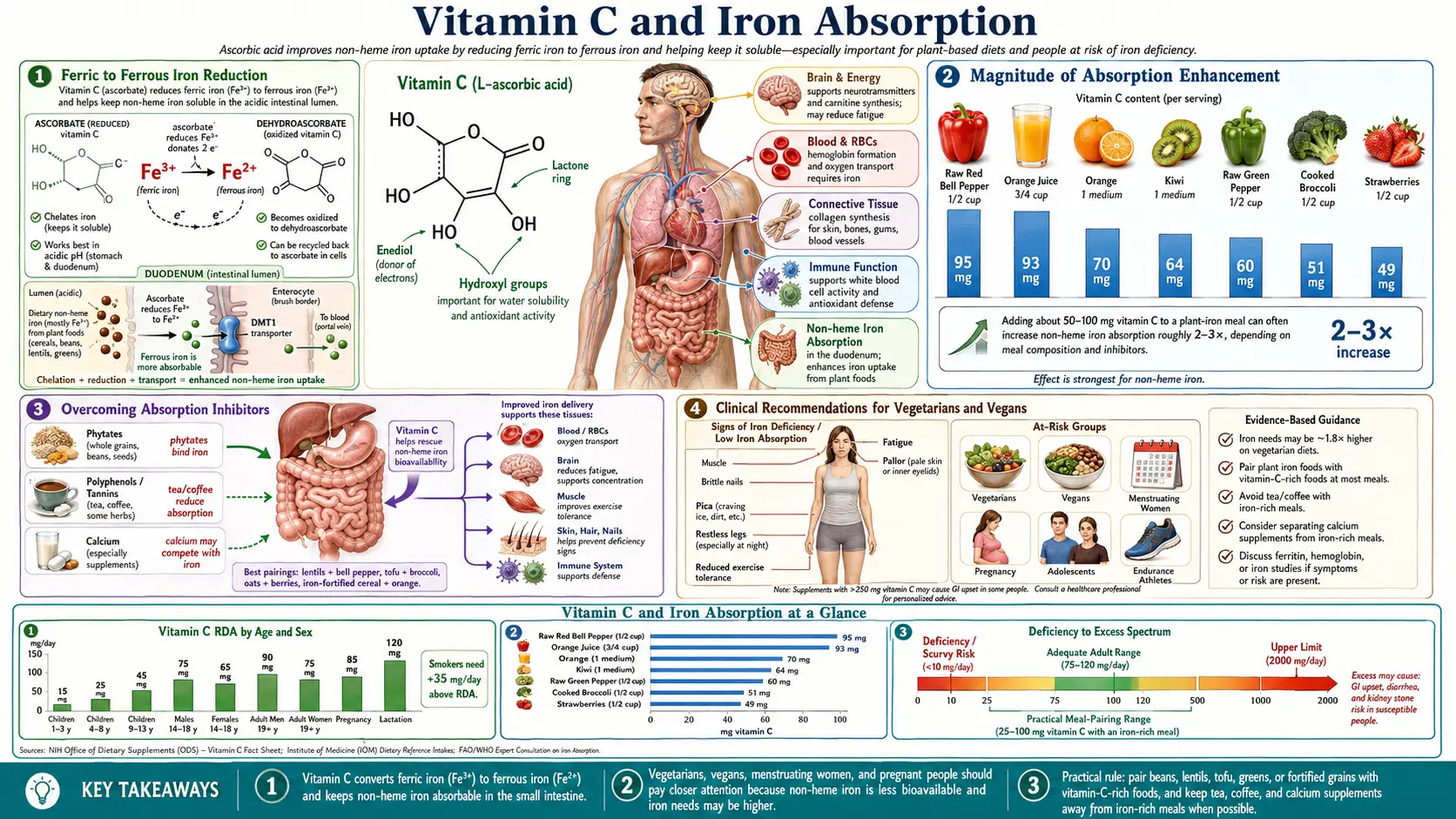
Iron deficiency is the most prevalent nutritional deficiency worldwide, affecting an estimated two billion people and causing significant morbidity through iron deficiency anemia (IDA). Vitamin C (ascorbic acid) is the most potent dietary enhancer of non-heme iron absorption, capable of increasing iron uptake from plant foods by three- to sixfold. Understanding this relationship is critical for preventing and treating iron deficiency, particularly in populations relying primarily on plant-based diets.
Interactive Visualization Vitamin C, Collagen & Why Sailors Fell Apart Zip three protein chains into the strongest rope in biology — then take the vitamin C away and watch the helix unravel, and old healed scars split back open. Launch →Table of Contents
- Ferric to Ferrous Iron Reduction
- Chelation Mechanism in the Gut
- DMT1 Transporter
- Magnitude of Absorption Enhancement
- Relevance for Plant-Based Diets
- Overcoming Absorption Inhibitors
- Single-Meal Studies Versus Actual Iron Status
- Iron Deficiency Anemia Prevention
- Meal Timing Strategies
- Iron and Vitamin C Evidence for Vegetarians and Vegans
- Key Research Papers
- Connections
- Featured Videos
Ferric to Ferrous Iron Reduction
The chemistry of iron absorption begins with understanding the two oxidation states of dietary iron.
- Ferric Iron (Fe3+) – Non-heme iron in plant foods, fortified foods, and iron supplements exists predominantly in the ferric (Fe3+) oxidation state. Ferric iron is poorly soluble at the near-neutral pH of the duodenum and upper jejunum, where the majority of iron absorption occurs. At pH above 3, ferric iron rapidly forms insoluble ferric hydroxide precipitates that cannot be absorbed.
- Ferrous Iron (Fe2+) – The ferrous form of iron is far more soluble at intestinal pH and is the form actively transported across the apical membrane of enterocytes. Conversion of ferric to ferrous iron is therefore a critical rate-limiting step in non-heme iron absorption.
- Ascorbate as a Reducing Agent – Vitamin C is an effective reducing agent with a reduction potential that thermodynamically favors the conversion of Fe3+ to Fe2+. In the acidic environment of the stomach, ascorbic acid donates an electron to ferric iron, reducing it to the absorbable ferrous form. This reaction occurs rapidly and efficiently at gastric pH.
- Duodenal Cytochrome b (Dcytb) – The brush border of duodenal enterocytes expresses Dcytb, a ferric reductase that also reduces Fe3+ to Fe2+ at the cell surface. Intracellular ascorbate serves as the electron donor for Dcytb, linking vitamin C status directly to the enzymatic reduction of iron at the absorption site. Individuals with low vitamin C status have reduced Dcytb activity.
Chelation Mechanism in the Gut
- Soluble Iron-Ascorbate Complex – Beyond its role as a reducing agent, vitamin C forms a soluble chelate complex with iron in the acidic gastric environment. This iron-ascorbate complex remains soluble as it passes into the alkaline duodenum, where unchelated ferric iron would otherwise precipitate as insoluble ferric hydroxide. The chelate effectively shields iron from the pH-dependent precipitation that is the major barrier to non-heme iron absorption.
- Molar Ratio – Studies indicate that a molar ratio of ascorbate to iron of approximately 2:1 to 4:1 provides optimal enhancement of absorption. In practical terms, 25 to 75 mg of vitamin C consumed with a meal containing 5 to 10 mg of non-heme iron provides a meaningful boost to absorption.
- Protection Through the gastrointestinal (GI) Tract – The iron-ascorbate chelate maintains iron in a soluble and bioavailable form throughout the transit from the stomach to the absorptive sites in the duodenum and proximal jejunum, a journey during which pH rises from 2 to approximately 6.5.
DMT1 Transporter
- Divalent Metal Transporter 1 (DMT1) – DMT1 (also known as SLC11A2 or NRAMP2) is the primary apical membrane transporter responsible for importing ferrous iron into duodenal enterocytes. DMT1 is a proton-coupled symporter that transports Fe2+ along with a hydrogen ion across the brush border membrane. It has high selectivity for divalent cations and does not transport ferric iron (Fe3+).
- Vitamin C and DMT1 Coupling – The absolute requirement of DMT1 for ferrous iron means that any factor increasing the proportion of Fe2+ at the brush border surface will enhance iron uptake. Vitamin C accomplishes this through both its direct chemical reducing action and its support of Dcytb enzymatic activity, making it the most important dietary factor enhancing DMT1-mediated iron transport.
- DMT1 Regulation – DMT1 expression is upregulated by iron deficiency through the iron-responsive element/iron regulatory protein (IRE/IRP) system. When iron stores are low, DMT1 mRNA is stabilized, increasing transporter density on the enterocyte surface. In this iron-deficient state, the enhancing effect of vitamin C becomes even more pronounced, as more transport capacity is available to handle the increased supply of ferrous iron.
- Intracellular Processing – Once inside the enterocyte, iron can be stored as ferritin or exported across the basolateral membrane by ferroportin. Hephaestin, a copper-dependent ferroxidase on the basolateral surface, oxidizes Fe2+ back to Fe3+ for loading onto plasma transferrin. Intracellular ascorbate may also play a role in maintaining the labile iron pool within enterocytes.
Magnitude of Absorption Enhancement
The enhancement of non-heme iron absorption by vitamin C has been quantified in numerous isotope absorption studies.
- Dose-Response Relationship – The enhancing effect of vitamin C on iron absorption follows a dose-response curve. In radioiron tests in 63 men, the increase in iron absorption from a semisynthetic meal was directly proportional to the amount of ascorbic acid added over a range of 25 to 1,000 mg: absorption was 1.65 times higher with 25 mg and 9.57 times higher with 1,000 mg than without it (Cook and Monsen 1977). The relative increase was substantially smaller when the test meal contained meat. The effect plateaus at approximately 100 to 200 mg per meal.
- Baseline Absorption Rates – Without enhancers, non-heme iron absorption from a mixed diet typically ranges from 2 to 10 percent. With adequate vitamin C, absorption can increase to 10 to 30 percent or more, depending on iron status and the presence of inhibitors.
- Comparison with Other Enhancers – Vitamin C is the most potent known dietary enhancer of non-heme iron absorption. Meat, fish, and poultry (the "MFP factor") also enhance non-heme iron absorption but are less effective milligram-for-milligram than ascorbic acid. Organic acids such as citric acid and malic acid have modest enhancing effects but are far weaker than ascorbate.
- Long-Term Impact — and this is the part that gets left out – The single-meal figures above come from radioisotope studies, and they do not survive the move to whole diets. Cook and Reddy measured iron absorption from complete diets across three dietary periods in which vitamin C intake was deliberately pushed from 51 to 247 mg/day, and found no significant difference in mean iron absorption between the periods. Their conclusion was that the facilitating effect "from a complete diet is far less pronounced than that from single meals," and that this "may explain why several prior studies did not show a significant effect on iron status of prolonged supplementation with vitamin C." See the section below.
Relevance for Plant-Based Diets
- Non-Heme Iron Predominance – Vegetarian and vegan diets provide iron exclusively in the non-heme form, which has inherently lower bioavailability (2 to 20 percent) compared to heme iron from animal sources (15 to 35 percent). This makes the enhancing effect of vitamin C particularly critical for individuals following plant-based eating patterns.
- Iron-Rich Plant Foods – Legumes (lentils, chickpeas, black beans, kidney beans), whole grains (brown rice, quinoa, oats, buckwheat, amaranth), pumpkin seeds, sesame seeds and tahini, cashews, dark leafy greens (kale, Swiss chard, collards), dried apricots, and blackstrap molasses. Most of these also carry phytate, which is why pairing them with a vitamin C source is the traditional advice — and why soaking, sprouting or souring grains and legumes, which degrades phytate directly, does more for iron availability than any pairing.
- Practical Pairing Examples – Lentil soup with tomatoes and bell peppers; kale salad with strawberries and a lemon dressing; black bean chili with tomato and lime; brown rice bowl with pumpkin seeds, broccoli and red pepper; oatmeal with berries and orange segments. These pair a vitamin C source with a non-heme iron source in the same meal, which is where the single-meal absorption data are strongest.
- Prevalence of Deficiency – While vegetarians and vegans typically consume as much or more total iron than omnivores, their iron stores (as measured by serum ferritin) tend to be lower, and iron deficiency anemia is more prevalent in these populations. Pairing vitamin C with meals is the intervention most often suggested, though the whole-diet and treatment studies below show a much smaller effect than single-meal studies.
Overcoming Absorption Inhibitors
Several dietary compounds inhibit non-heme iron absorption. Vitamin C can partially or fully overcome these inhibitory effects.
- Phytates (Inositol Hexaphosphate) – Phytic acid, found in whole grains, legumes, nuts, and seeds, is the most potent dietary inhibitor of iron absorption. Phytate binds ferric iron in insoluble complexes that resist digestion. Vitamin C can overcome phytate inhibition by reducing iron to the ferrous form before phytate binding occurs and by competing for iron binding through chelation. Studies show that 50 mg of ascorbic acid can counteract the inhibitory effect of moderate phytate loads.
- Tannins and Polyphenols – Tannins in tea, coffee, red wine, and certain fruits bind non-heme iron, reducing absorption by 50 to 90 percent. In radio-iron studies with a bread meal, black tea served with the meal reduced iron absorption by 79 to 94 percent (Hurrell 1999). Vitamin C partially counteracts this effect, though very high tannin loads may require proportionally larger amounts of ascorbate. Hurrell and colleagues noted that this matters for dietary advice on iron; the practice usually described is drinking tea and coffee between meals rather than with them, with vitamin C-rich foods when polyphenol-rich beverages accompany iron-containing meals.
- Calcium – Calcium inhibits both heme and non-heme iron absorption, likely through an intracellular mechanism in the enterocyte. In studies of 126 people, iron absorption was reduced by 50 to 60 percent at doses of 300 to 600 mg of calcium (typical of a glass of milk or calcium supplement), and 165 mg of calcium given as milk, cheese, or calcium chloride also reduced absorption by 50 to 60 percent (Hallberg 1991). Vitamin C can mitigate some of this inhibition; because the effect was measured with calcium in the same meal, separating calcium and iron intake in time is the approach commonly described.
- Soy Protein – Soy protein carries an inhibitory factor, thought to involve the storage protein conglycinin, that reduces iron absorption independently of its phytate content. This matters mainly as a caution: soy-based protein foods are a weaker iron source than their iron content on a label suggests.
- Oxalates – Oxalic acid in spinach, rhubarb, beet greens, and Swiss chard binds iron (and calcium) in insoluble complexes. While spinach is often cited as iron-rich, the bioavailability of its iron is very low due to high oxalate content. Vitamin C has a limited ability to overcome oxalate inhibition. Low-oxalate greens like kale, collards, or bok choy provide more bioavailable iron.
Single-Meal Studies Versus Actual Iron Status
Almost everything written about vitamin C and iron rests on a particular kind of experiment: give someone one meal containing radioactively labelled iron, with and without ascorbic acid, and measure how much of the label ends up in their red cells. Those studies are elegant, reproducible, and show large effects. They are also a poor guide to what happens when a person eats normally for months.
Two lines of evidence show where the gap is.
Whole-diet absorption
Cook and Reddy had 12 volunteers eat a labelled wheat roll with every meal for five days, across three separate dietary periods: freely chosen, then deliberately low in vitamin C, then deliberately high. Mean daily vitamin C ranged from 51 to 247 mg. Mean iron absorption did not differ significantly between the three periods. Regression across the pooled data did show a positive association with ascorbic acid, but the practical effect of nearly quintupling dietary vitamin C was not detectable.
Why the discrepancy? A single test meal is eaten in isolation, on an empty stomach, with one enhancer and no competing enhancers. A real diet contains meat, other organic acids, and multiple meals per day, and the body's own absorption is regulated by hepcidin according to how much iron you already have. Someone who is iron-replete absorbs less regardless of what they drink with dinner. The homeostatic system, in other words, largely closes the gap that the isotope study opens.
Treating actual anemia
The clearest test is a trial in people who really are iron deficient. Li and colleagues randomized 440 adults with iron deficiency anemia to oral iron alone or oral iron plus vitamin C:
- Hemoglobin at 2 weeks: rose 2.00 g/dL with vitamin C and 1.84 g/dL without — a between-group difference of 0.16 g/dL (95% confidence interval (CI) −0.03 to 0.35), meeting the pre-specified criteria for equivalence
- Ferritin at 8 weeks: 35.75 versus 34.48 ng/mL, difference 1.27 ng/mL (95% confidence interval −0.70 to 3.24, P = 0.21)
- Adverse events: 20.9% versus 20.5% no difference. Vitamin C did not make iron easier to tolerate.
The authors' conclusion: "on-demand vitamin C supplements are not essential to take along with oral iron supplements for patients with IDA."
What this means for the rest of the page
The chemistry in the earlier sections is real. Ascorbate does reduce ferric to ferrous iron, does chelate it into a soluble complex, and does present it to DMT1 more effectively. What is not established is that acting on this changes your blood count.
- For people taking an iron supplement for diagnosed iron deficiency, the best trial on this question found no added benefit from vitamin C and no reduction in side effects. What does have trial support is the dosing schedule: alternate-day single doses were absorbed better than consecutive-day dosing, because each dose raises hepcidin and blunts the next; splitting a daily dose in two raised hepcidin without a significant difference in absorption over three days.
- For people who eat little or no meat, pairing vitamin C-rich foods with iron-rich meals is where the single-meal data are strongest, since inhibitors like phytate are heaviest in those meals; the whole-diet data suggest the real-world effect is modest.
- Low ferritin is a medical finding in its own right. Squeezing lemon on lentils is not a substitute for iron replacement, and low ferritin has causes — heavy periods, occult gastrointestinal bleeding, coeliac disease — that clinicians look for.
Iron Deficiency Anemia Prevention
- Global Burden – Iron deficiency anemia affects approximately 1.2 billion people worldwide, with the highest prevalence in preschool children, women of reproductive age, and pregnant women in low- and middle-income countries. IDA reduces work capacity, impairs cognitive development in children, increases maternal mortality, and compromises immune function.
- Vitamin C in Public Health Interventions – Several public health strategies have successfully used vitamin C to enhance iron nutrition at the population level. Adding ascorbic acid to iron-fortified foods (flour, rice, condiments) improves the bioavailability of fortification iron. School meal programs that include vitamin C-rich fruits and vegetables alongside iron-rich foods have improved iron status in children.
- Supplementation Trials – An earlier version of this page stated that randomized trials show co-supplementation with vitamin C beats iron alone. The largest trial addressing exactly that question found the opposite: in 440 adults with iron deficiency anemia, adding vitamin C to oral iron was equivalent to iron alone on both hemoglobin and ferritin. Any remaining benefit is most plausible in populations with genuinely marginal vitamin C status, which is not the population most supplements are sold to.
- Iron Supplement Side Effects – Gastrointestinal side effects are the main reason people stop taking iron, so anything that reduced them would matter. Vitamin C does not appear to. In the trial above, adverse events occurred in 20.9% of the vitamin C group and 20.5% of the iron-only group. What is worth changing is the dosing schedule. In iron-depleted women, alternate-day dosing achieved higher cumulative iron absorption than consecutive-day dosing (21.8% versus 16.3%, P = 0.0013), because each dose raises serum hepcidin and blunts uptake of the next. In the same report, splitting a daily dose into two produced no significant difference in fractional or total iron absorption over three days, although it raised serum hepcidin. Fewer doses also means fewer opportunities for the nausea; whether alternate-day dosing suits a given case is a question for a clinician.
Meal Timing Strategies
- Simultaneous Consumption – The enhancing effect of vitamin C on iron absorption requires simultaneous presence of both nutrients in the duodenum. Taking vitamin C hours before or after an iron-containing meal provides little or no enhancement: in Cook and Monsen's study, a large dose of vitamin C taken with breakfast did not affect iron absorption from the noon or evening meal.
- Optimal Meal Composition – The ideal iron-enhancing meal minimizes inhibitors and maximizes enhancers. A meal built around iron-rich foods (legumes, fortified grains, dark greens) with generous vitamin C-rich additions (citrus, peppers, tomatoes, berries) and limited tea, coffee, and high-calcium items will maximize iron absorption.
- Cooking Considerations – Vitamin C is heat-sensitive and partially destroyed during cooking. Adding vitamin C-rich foods at the end of cooking, eating raw fruits and vegetables alongside cooked iron-rich dishes, or drinking a glass of citrus juice with the meal keeps more of it intact.
- Iron Supplement Timing – Taking an iron supplement with a glass of orange juice (approximately 70 mg of vitamin C) or a vitamin C tablet is routine practice, but in the largest trial on the question — 440 adults with iron deficiency anemia — oral iron plus 200 mg of vitamin C was equivalent to iron alone in improving hemoglobin recovery and iron absorption (Li 2020). Iron supplements are best absorbed on an empty stomach; taking them with a small amount of food is the usual compromise when gastrointestinal side effects occur.
Iron and Vitamin C Evidence for Vegetarians and Vegans
- Daily Iron Targets – The Institute of Medicine recommends that vegetarians consume 1.8 times the Recommended Dietary Allowance (RDA) for iron (14.4 mg for men and postmenopausal women; 32.4 mg for premenopausal women) to compensate for lower bioavailability of non-heme iron. Meeting these elevated targets requires deliberate dietary planning.
- Vitamin C Amounts – The smallest addition Cook and Monsen tested, 25 mg per meal, already raised absorption 1.65-fold, and 25 to 75 mg per iron-containing meal is easily reached through dietary sources: one medium orange (70 mg), one cup of strawberries (85 mg), half a cup of red bell pepper (95 mg), or one cup of broccoli (80 mg).
- Food Preparation Techniques – Soaking and sprouting legumes and grains reduces phytate content by 30 to 70 percent, improving iron bioavailability. Fermentation (as in sourdough bread or tempeh) also degrades phytates. Combining these preparation methods with vitamin C consumption at meals provides the highest non-heme iron bioavailability.
- Monitoring Iron Status – Iron status is assessed through serum ferritin testing. A ferritin level below 30 micrograms per liter suggests depleted stores, a point at which clinicians consider dietary change or supplementation. Women of reproductive age, athletes, and frequent blood donors on plant-based diets are at the highest risk.
- Cast Iron Cookware – Cooking acidic, vitamin C-rich foods (such as tomato sauce) in cast iron cookware can increase the iron content of the food by several milligrams per serving. The acidic environment and the reducing action of vitamin C leach small amounts of iron from the cooking surface in a bioavailable form.
- Competing Nutrients at Iron Meals – Calcium supplements and high-calcium foods, tea, and coffee all reduced iron absorption when they were part of the same meal (see Overcoming Absorption Inhibitors above); keeping them apart from primary iron meals, and drinking tea and coffee between meals, is the approach commonly described.
Key Research Papers
Key Research Papers
Verified citations for the specific claims on this page, each linking to a numeric PubMed record.
- Li N, Zhao G, Wu W, et al. The efficacy and safety of vitamin C for iron supplementation in adult patients with iron deficiency anemia: a randomized clinical trial. JAMA Network Open. 2020;3(11):e2023644. 440 patients; iron alone was equivalent to iron plus vitamin C on hemoglobin and ferritin. — PubMed PMID: 33136134
- Cook JD, Reddy MB. Effect of ascorbic acid intake on nonheme-iron absorption from a complete diet. American Journal of Clinical Nutrition. 2001;73(1):93-98. No significant absorption difference across dietary vitamin C intakes of 51 to 247 mg/day. — PubMed PMID: 11124756
- Stoffel NU, Cercamondi CI, Brittenham G, et al. Iron absorption from oral iron supplements given on consecutive versus alternate days and as single morning doses versus twice-daily split dosing in iron-depleted women: two open-label, randomised controlled trials. Lancet Haematology. 2017;4(11):e524-e533. Alternate-day dosing absorbed 21.8% versus 16.3% on consecutive days. — PubMed PMID: 29032957
- Cook JD, Monsen ER. Vitamin C, the common cold, and iron absorption. American Journal of Clinical Nutrition. 1977;30(2):235-241. Iron absorption rose in direct proportion to added ascorbic acid over 25 to 1,000 mg (1.65-fold to 9.57-fold). — PubMed PMID: 835510
- Hallberg L, Brune M, Erlandsson M, et al. Calcium: effect of different amounts on nonheme- and heme-iron absorption in humans. American Journal of Clinical Nutrition. 1991;53(1):112-119. Iron absorption fell 50 to 60% at 300 to 600 mg calcium. — PubMed PMID: 1984335
- Hurrell RF, Reddy M, Cook JD. Inhibition of non-haem iron absorption in man by polyphenolic-containing beverages. British Journal of Nutrition. 1999;81(4):289-295. Black tea inhibited iron absorption from a bread meal by 79 to 94%. — PubMed PMID: 10999016
PubMed Topic Searches
Live queries that stay current as new studies are indexed.
- PubMed: Vitamin C and iron absorption
- PubMed: Ascorbic acid and non-heme iron bioavailability
- PubMed: Phytate inhibition and vitamin C
- PubMed: Tannins and iron absorption
- PubMed: DMT1 and duodenal iron transport
- PubMed: Duodenal cytochrome b and ascorbate
- PubMed: Hepcidin and iron dosing intervals
- PubMed: Iron deficiency in vegetarian diets
- PubMed: Iron fortification with ascorbic acid
- PubMed: Soaking, sprouting and fermentation for phytate
- PubMed: Calcium-iron interaction
- PubMed: Pregnancy, iron deficiency and vitamin C