Sleep Hygiene — Sleep Tracking Tech
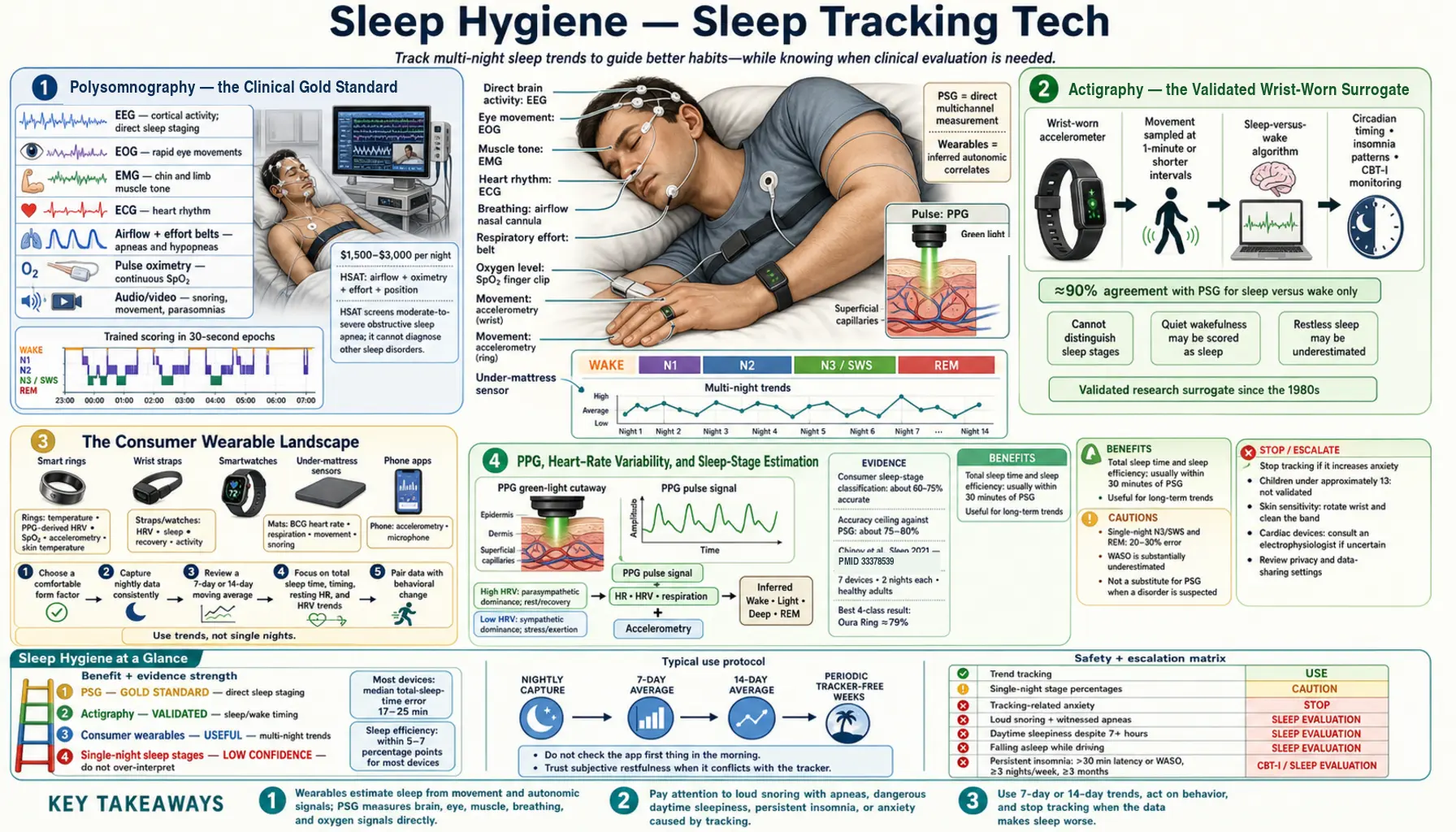
Consumer sleep trackers — sleep-tracking rings, screenless wrist straps, wrist-worn fitness bands, smartwatches and bedside devices — have been tested against overnight polysomnography (PSG), the laboratory reference method. Across the validation studies on this page the pattern is consistent: the devices detect sleep well (epoch-by-epoch sensitivity of 0.93 or higher) but detect wake poorly (specificity of about 0.18–0.61), and their sleep-stage estimates are mixed. The Chinoy et al. 2021 study in Sleep (PubMed PMID: 33378539) tested seven consumer devices side by side against PSG and research-grade actigraphy. This page covers polysomnography, actigraphy, the consumer device types, how stage estimates are made, what the validation studies found, "orthosomnia", and what clinical guidelines say about sleep testing.
Table of Contents
- Polysomnography — the Clinical Gold Standard
- Actigraphy — the Validated Wrist-Worn Surrogate
- The Consumer Wearable Landscape
- PPG, Heart-Rate Variability, and Sleep-Stage Estimation
- The Chinoy 2021 Validation Study
- Rings, Straps and Watches — How the Device Types Compare
- What Trackers Get Right (and Wrong)
- Orthosomnia — When Tracking Makes Sleep Worse
- Clinical Sleep Testing — What the Guidelines Say
- Cautions
- Key Research Papers
- Connections
- Featured Videos
Polysomnography — the Clinical Gold Standard
Polysomnography (PSG) is the overnight multichannel recording against which every sleep-tracking technology on this page was judged. Ancoli-Israel et al. (Sleep 2003, PubMed PMID: 12749557) describe PSG as comprising at least three distinct types of data — EEG (brain activity), EOG (eye movements) and EMG (muscle tone) — which jointly determine whether a person is asleep or awake. Sleep is scored by trained technologists under the American Academy of Sleep Medicine (AASM) scoring manual (the 2017 version 2.4 update is described by Berry et al., PubMed PMID: 28416048); the validation studies below compared devices with PSG in 30-second epochs.
For obstructive sleep apnea, the AASM 2017 diagnostic-testing guideline (Kapur et al., PubMed PMID: 28162150) calls polysomnography the standard diagnostic test. It recommends that either PSG or home sleep apnea testing (HSAT) with a technically adequate device be used in uncomplicated adults whose signs and symptoms indicate an increased risk of moderate-to-severe OSA; that PSG be performed if a single home test is negative, inconclusive or technically inadequate; and that PSG rather than a home test be used in people with significant cardiorespiratory disease, potential respiratory-muscle weakness from a neuromuscular condition, awake or suspected sleep-related hypoventilation, chronic opioid use, a history of stroke, or severe insomnia.
Actigraphy — the Validated Wrist-Worn Surrogate
Wrist actigraphy uses a wrist-worn movement sensor to infer sleep and wake. The 2003 review by Ancoli-Israel et al. (PubMed PMID: 12749557) concluded that actigraphy is more reliable than sleep logs, is one-dimensional where PSG is multi-signal, is not appropriate for diagnosing sleep-disordered breathing or periodic limb movements in sleep, and is reliable for evaluating sleep patterns in insomnia, for studying treatment effects, and for the diagnosis of circadian rhythm disorders (its recordings correlate well with melatonin and core-body-temperature rhythms).
Marino et al. (Sleep 2013, PubMed PMID: 24179309) compared actigraphy with simultaneous PSG in 77 young and older adults, including people with chronic primary insomnia and night workers sleeping by day, across 232,849 thirty-second epochs. Overall sensitivity (actigraphy scoring sleep when PSG showed sleep) was 0.965 and accuracy 0.863, but specificity (scoring wake when PSG showed wake) was low at 0.329. Mean wake after sleep onset (WASO) was 49.1 minutes per night by PSG and 36.8 minutes by actigraphy. The authors concluded that actigraphy is a useful and valid means of estimating total sleep time and WASO in field and workplace studies, with some limitations in specificity.
The AASM 2018 actigraphy guideline (Smith et al., PubMed PMID: 29991437), which applies only to FDA-approved devices, makes conditional suggestions for actigraphy in adult and pediatric insomnia disorder, in adult and pediatric circadian rhythm sleep-wake disorders, integrated with home sleep apnea test devices to estimate total sleep time, before a Multiple Sleep Latency Test in suspected central disorders of hypersomnolence, and in suspected insufficient sleep syndrome. Its one strong recommendation is against using actigraphy in place of electromyography to diagnose periodic limb movement disorder.
The Consumer Wearable Landscape
A 2019 review by de Zambotti et al. (Med Sci Sports Exerc, PubMed PMID: 30789439) describes consumer sleep trackers as relatively inexpensive multi-sensor devices that capture biosignals such as heart rate and its variability, skin conductance and temperature in addition to activity, around the clock. The device types tested in the studies on this page:
- Sleep-tracking rings: a multisensor ring worn on the finger, tested against PSG by de Zambotti et al. in 2019.
- Screenless wrist straps: a strap that estimates sleep from movement (actigraphy) and heart rate (photoplethysmography); in the Miller 2020 validation its sleeps were scored by the manufacturer using proprietary algorithms.
- Wrist-worn fitness bands: described in the 2018 de Zambotti study as a consumer multi-sensory wristband.
- Smartwatches and sports watches: Walch et al. (2019) collected raw acceleration and PPG heart-rate data from a smartwatch; Chinoy et al. (2021) included two wearables from one maker of sports watches.
- Non-wearable bedside devices: three of the seven devices in the Chinoy 2021 study were non-wearable devices placed by the bed rather than worn.
The 2019 review notes that little guidance exists for the use of these devices, and lists proprietary algorithms, device malfunction and firmware updates as factors to be considered before they are used in clinical and research protocols.
PPG, Heart-Rate Variability, and Sleep-Stage Estimation
Photoplethysmography (PPG) is the optical sensor on the underside of most current wearables; the devices in these studies combine it with a motion sensor to estimate sleep. Walch et al. (Sleep 2019, PubMed PMID: 31579900) note that the algorithms consumer devices use to score sleep are not open source and their raw sensor data is rarely accessible. Using their own app to collect raw acceleration and heart-rate data from a smartwatch worn during PSG, they built classifiers from motion, the local standard deviation of heart rate and a "clock proxy". Their method scored 90% of epochs correctly for sleep versus wake, with a sensitivity of 93% and a specificity of 59.6%; accuracy for separating wake, NREM sleep and REM sleep was approximately 72% with all features used.
The underlying limitation is the one Ancoli-Israel et al. describe for actigraphy: PSG defines sleep from EEG, EOG and EMG together, and a device that records none of these infers sleep state from other signals.
The Chinoy 2021 Validation Study
Chinoy et al. (Sleep 2021, PubMed PMID: 33378539) tested 34 healthy young adults (22 women; mean age 28.1) on three consecutive nights, including a disrupted-sleep condition, in a sleep laboratory with PSG, alongside research-grade actigraphy. Seven consumer devices were tested: four wearables (from three makers) and three non-wearable bedside devices. Findings reported in the abstract and full text:
- Sleep/wake performance: five of the seven devices performed as well as or better than actigraphy on sleep/wake measures; the two devices from one sports-watch maker performed worse.
- Epoch-by-epoch agreement: sensitivity for detecting sleep was high (all ≥0.93); specificity for detecting wake was low to medium (0.18–0.54). Five of the seven devices performed as well as or better than actigraphy on specificity.
- Summary biases: as with actigraphy, most devices tended to overestimate sleep (total sleep time, sleep efficiency) and underestimate wake (WASO), although for many devices these biases were smaller than actigraphy's.
- Disrupted nights: devices tended to perform worse on nights with poorer or disrupted sleep.
- Sleep stages: all devices differed significantly from PSG in total light sleep, mostly overestimating it; half the devices also differed in deep or REM sleep, overestimating deep sleep and underestimating REM. Most devices failed to correctly identify 30–50% of both deep sleep and REM sleep on average, and misclassified epochs were most often called light sleep.
The authors concluded that the devices showed high performance in detecting sleep, that most performed equivalent to (or better than) actigraphy in detecting wake, and that their sleep-stage assessments were inconsistent; they noted that only healthy people with no reported sleep problems and a fixed 8-hour time in bed were studied, and called for testing in other populations and settings.
Rings, Straps and Watches — How the Device Types Compare
- Sleep-tracking ring: de Zambotti et al. (Behav Sleep Med 2019, PubMed PMID: 28323455) compared one ring with PSG over a single laboratory night in 41 healthy adolescents and young adults (mean age 17.2). Sleep-onset latency, total sleep time and WASO did not differ from PSG; the ring underestimated N3 by about 20 minutes and overestimated REM by about 17 minutes. Sensitivity for sleep was 96% and specificity for wake 48%; agreement was 65% for light sleep, 51% for deep sleep and 61% for REM.
- Wrist-worn fitness band: de Zambotti et al. (Chronobiol Int 2018, PubMed PMID: 29235907) tested one wristband against single-night PSG in adults aged 19–61 (main group n = 35). It showed 0.96 sensitivity and 0.61 specificity, with accuracy of 0.81 for light sleep (N1+N2), 0.49 for deep sleep (N3) and 0.74 for REM. It overestimated total sleep time by 9 minutes and light sleep by 34 minutes and underestimated N3 by 24 minutes; WASO and REM time did not differ from PSG.
- Screenless wrist strap: Miller et al. (J Sports Sci 2020, PubMed PMID: 32713257) assessed 86 sleeps from 12 healthy adults in a 10-day laboratory protocol, with bedtimes entered by the researchers. The strap overestimated total sleep time by 8.2 ± 32.9 minutes (not significant). For sleep versus wake, agreement was 89%, sensitivity 95% and specificity 51%; for four-stage scoring, agreement was 64%. The authors judged it a reasonable method where PSG is impractical, particularly for sleep versus wake, if accurate bedtimes are entered manually.
- Smartwatch (research algorithm): in Walch et al. 2019 the accuracy figures (90% sleep/wake, about 72% for wake/NREM/REM) came from the researchers' own disclosed algorithm applied to the watch's raw data, not from the watch's built-in sleep scoring.
- Sports watches: in Chinoy et al. 2021 the two devices from one sports-watch maker performed worse than actigraphy on sleep/wake measures.
- Four earlier personal devices: Mantua et al. (Sensors 2016, PubMed PMID: 27164110) found no difference from PSG and strong correlation for total sleep time on every device, but sleep efficiency differed from PSG for all four consumer devices, light sleep time differed for all devices, and data loss was greatest for two of them.
What Trackers Get Right (and Wrong)
What the validation studies on this page report as relatively accurate:
- Detecting sleep. Epoch-by-epoch sensitivity for sleep was 0.93 or higher in every device in the Chinoy study, and 0.95–0.96 in the ring, wristband and strap studies.
- Total sleep time in healthy sleepers. Mantua 2016 found no difference from PSG for any device tested; the ring study found no difference; the wristband overestimated by 9 minutes and the strap by 8.2 minutes (not significant).
- Changes in resting heart rate during illness (one study). Mishra et al. (Nat Biomed Eng 2020, PubMed PMID: 33208926) analysed smartwatch data from 32 people with COVID-19 identified in a cohort of nearly 5,300; 26 (81%) had alterations in heart rate, daily steps or time asleep, and of 25 detected cases with symptom information, 22 were detected before or at symptom onset. In retrospective data, a two-tier warning based on extreme resting-heart-rate elevations could have detected 63% of cases before symptom onset.
What they report as less accurate:
- Detecting wake. Specificity ranged from 0.18 to 0.61 across these studies, so time awake in bed tends to be scored as sleep and WASO tends to be underestimated (Chinoy 2021).
- Sleep stages. Accuracy for N3 was 0.49 in the wristband study, and agreement for the ring's “deep sleep” category (N2+N3) was 51%; in Chinoy 2021 most devices missed 30–50% of deep and REM sleep on average.
- Poor or disrupted nights. Device performance worsened on nights with poorer sleep (Chinoy 2021).
- Sleep apnea. The AASM 2017 guideline recommends that clinical tools, questionnaires and prediction algorithms not be used to diagnose OSA in adults in the absence of polysomnography or home sleep apnea testing (Kapur et al., PubMed PMID: 28162150).
Orthosomnia — When Tracking Makes Sleep Worse
"Orthosomnia" is the term used by Baron, Abbott, Jao, Manalo and Mullen in a 2017 case report in the Journal of Clinical Sleep Medicine (PubMed PMID: 27855740). They describe a growing number of patients seeking treatment for self-diagnosed sleep disturbances, such as insufficient sleep duration and insomnia, because of periods of light or restless sleep shown in their sleep-tracker data. The patients' inferred link between the tracker data and their daytime fatigue, the authors write, may become a perfectionistic quest for ideal sleep in order to optimize daytime function, and the tracker data often feels more consistent with the patients' experience of sleep than validated techniques such as polysomnography or actigraphy.
The authors describe the clinician's challenge as balancing education about the validity of these devices with patients' enthusiasm for objective data, and write that incorporating sleep trackers into cognitive behavioral therapy for insomnia (CBT-I) will be important as use of the devices expands.
Clinical Sleep Testing — What the Guidelines Say
Consumer trackers are not diagnostic devices, and the guideline documents on this page describe how sleep disorders are tested for and first treated:
- Obstructive sleep apnea: the AASM 2017 guideline (Kapur et al., PubMed PMID: 28162150) states that diagnostic testing for OSA is performed in conjunction with a comprehensive sleep evaluation, with polysomnography as the standard test and home sleep apnea testing an option in uncomplicated adults at increased risk of moderate-to-severe OSA (details in the polysomnography section above).
- Insomnia and circadian rhythm disorders: the AASM 2018 guideline (Smith et al., PubMed PMID: 29991437) suggests clinical actigraphy with FDA-approved devices for insomnia disorder and circadian rhythm sleep-wake disorders, and recommends against it in place of EMG for periodic limb movement disorder.
- Chronic insomnia treatment: the American College of Physicians 2016 guideline (Qaseem et al., PubMed PMID: 27136449) recommends CBT-I as the initial treatment for chronic insomnia disorder in all adult patients (strong recommendation, moderate-quality evidence), with a shared decision on short-term medication when CBT-I alone has been unsuccessful (weak recommendation, low-quality evidence).
- Dream enactment (REM sleep behavior disorder): in a 24-centre cohort of 1,280 people with polysomnographically confirmed idiopathic REM sleep behavior disorder, Postuma et al. (Brain 2019, PubMed PMID: 30789229) found an overall conversion rate to an overt neurodegenerative syndrome (parkinsonism or dementia) of 6.3% per year, with 73.5% converting after 12 years of follow-up. The authors describe the disorder as a powerful early sign of Parkinson's disease, dementia with Lewy bodies and multiple system atrophy.
Cautions
- Who was studied: the Chinoy 2021, ring, wristband and strap studies enrolled healthy participants; Chinoy et al. studied only people with no reported sleep problems on a fixed 8-hour time in bed. The 2018 wristband study names adolescents, the elderly and patients with sleep disorders as populations still to be tested, and the 2018 review by Roomkham et al. (IEEE Rev Biomed Eng, PubMed PMID: 29993607) lists limitations in the populations studied and a lack of standard evaluation methods for consumer-grade devices.
- Algorithms change: consumer devices use proprietary, closed algorithms (Walch 2019), and the de Zambotti 2019 review lists firmware updates and device malfunction among the factors that affect results, so a validation result applies to the device and software version tested.
- Single nights: the ring and wristband studies each recorded one laboratory night per participant, and the Bland–Altman plots in Chinoy 2021 showed large night-to-night spread in sleep-stage estimates, with some devices matching PSG on average only because over- and underestimates cancelled out.
- Data loss: Mantua 2016 reported missing data from some devices, greatest for two of the four consumer devices.
Key Research Papers
- Chinoy ED et al., Performance of seven consumer sleep-tracking devices compared with polysomnography (Sleep 2021) — PubMed PMID: 33378539
- de Zambotti M et al., The sleep of the ring: comparison of the OURA sleep tracker against polysomnography (Behav Sleep Med 2019) — PubMed PMID: 28323455
- de Zambotti M et al., A validation study of Fitbit Charge 2 compared with polysomnography in adults (Chronobiol Int 2018) — PubMed PMID: 29235907
- Baron KG et al., Orthosomnia: are some patients taking the quantified self too far? (J Clin Sleep Med 2017) — PubMed PMID: 27855740
- Ancoli-Israel S et al., The role of actigraphy in the study of sleep and circadian rhythms (Sleep 2003) — PubMed PMID: 12749557
- Marino M et al., Measuring sleep: accuracy, sensitivity, and specificity of wrist actigraphy compared to polysomnography (Sleep 2013) — PubMed PMID: 24179309
- Berry RB et al., AASM scoring manual updates for 2017 (version 2.4) (J Clin Sleep Med 2017) — PubMed PMID: 28416048
- Mantua J et al., Reliability of sleep measures from four personal health monitoring devices compared to research-based actigraphy and polysomnography (Sensors 2016) — PubMed PMID: 27164110
- Roomkham S et al., Promises and challenges in the use of consumer-grade devices for sleep monitoring (IEEE Rev Biomed Eng 2018) — PubMed PMID: 29993607
- Miller DJ et al., A validation study of the WHOOP strap against polysomnography to assess sleep (J Sports Sci 2020) — PubMed PMID: 32713257
- Walch O et al., Sleep stage prediction with raw acceleration and photoplethysmography heart rate data derived from a consumer wearable device (Sleep 2019) — PubMed PMID: 31579900
- de Zambotti M et al., Wearable sleep technology in clinical and research settings (Med Sci Sports Exerc 2019) — PubMed PMID: 30789439
- Kapur VK et al., Clinical Practice Guideline for Diagnostic Testing for Adult Obstructive Sleep Apnea: AASM (J Clin Sleep Med 2017) — PubMed PMID: 28162150
- Smith MT et al., Use of actigraphy for the evaluation of sleep disorders and circadian rhythm sleep-wake disorders: an AASM clinical practice guideline (J Clin Sleep Med 2018) — PubMed PMID: 29991437
- Qaseem A et al., Management of chronic insomnia disorder in adults: a clinical practice guideline from the American College of Physicians (Ann Intern Med 2016) — PubMed PMID: 27136449
- Postuma RB et al., Risk and predictors of dementia and parkinsonism in idiopathic REM sleep behaviour disorder: a multicentre study (Brain 2019) — PubMed PMID: 30789229
- Mishra T et al., Pre-symptomatic detection of COVID-19 from smartwatch data (Nat Biomed Eng 2020) — PubMed PMID: 33208926