Natural Anxiety Relief — Benefits Deep Dive
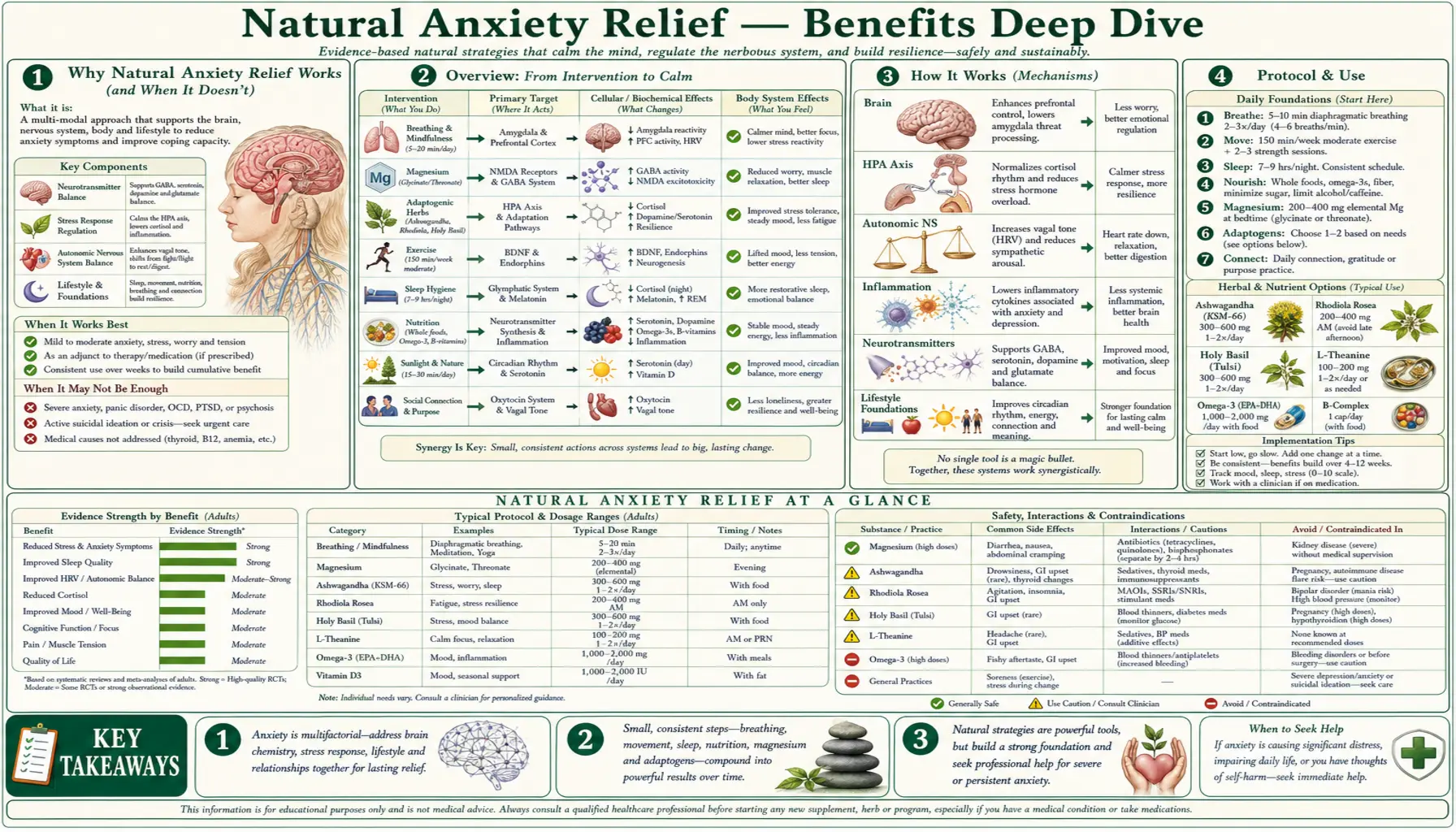
Anxiety disorders are the most common of all mental disorders: the World Health Organization estimates that 470 million people worldwide had an anxiety disorder in 2023, about 5.8% of the global population. Standard treatments are psychological therapies such as cognitive behavioral therapy (CBT) and medicines such as selective serotonin reuptake inhibitors (SSRIs); benzodiazepines are also prescribed. Conventional anxiety medicines have known drawbacks, including dependence with benzodiazepines and sexual side effects and discontinuation symptoms with SSRIs. The four deep-dive pages below summarize what trials and reviews report for four other approaches: L-theanine from tea, magnesium, adaptogenic herbs (ashwagandha, rhodiola, holy basil and lemon balm), and slow breathing and deliberate cold exposure. The evidence behind each differs widely in size and quality.
Deep-Dive Articles
L-Theanine & Green Tea
An amino acid found in the tea plant. Laboratory and animal studies describe effects on glutamate receptors and on GABA, and resting EEG studies in people report increased alpha-wave activity. A 2020 systematic review of nine randomized trials concluded that 200–400 mg a day may assist in reducing stress and anxiety in people exposed to stressful conditions; the one trial in diagnosed generalized anxiety disorder found no difference from placebo on anxiety. Its combination with caffeine is studied for attention and alertness.
Read the deep dive →Magnesium Glycinate
Magnesium blocks the channel of the NMDA glutamate receptor at resting membrane potential; effects on GABA receptors and on the HPA axis have been proposed, mainly from laboratory and animal research. A 2017 systematic review of 18 studies in groups vulnerable to anxiety found the evidence suggestive of a benefit but of poor quality. The page compares the magnesium forms (glycinate, citrate, oxide, L-threonate); no trial has established that one form works better than another for anxiety.
Read the deep dive →Adaptogenic Herbs
Ashwagandha (a 2024 meta-analysis of nine randomized trials with 558 patients found lower stress, anxiety and serum cortisol scores than with placebo), rhodiola rosea (long used in Russia and listed in the Russian pharmacopoeia), holy basil (tulsi) and lemon balm. The proposed mechanisms involve the HPA axis and stress-response mediators such as the chaperone protein HSP70, drawn mainly from animal and cell studies. The page covers the individual trials, the standardized extracts they used, and the reported liver-injury cases and other safety findings.
Read the deep dive →Breath & Cold Exposure
Slow breathing (under 10 breaths per minute) is associated in healthy people with higher heart rate variability, more EEG alpha power and fewer self-reported symptoms of arousal and anxiety, and heart rate variability biofeedback uses a breathing rate of about six breaths a minute. During 1-hour head-out immersion in 14 °C water, young men's plasma noradrenaline (norepinephrine) rose by 530% and dopamine by 250%, measured during the immersion; cold water on the face triggers the diving reflex, a fall in heart rate. The page also covers box breathing, the physiological sigh, the Wim Hof method and the hazards of cold water.
Read the deep dive →Table of Contents
- Deep-Dive Articles
- How These Approaches Are Studied and What the Evidence Shows
- Research Papers: L-Theanine & Green Tea
- Research Papers: Magnesium Glycinate
- Research Papers: Adaptogenic Herbs
- Research Papers: Breath & Cold Exposure
- Research Papers: Cross-Cutting (HPA Axis, GABA, Vagal Tone)
- External Authoritative Resources
- Connections
- Featured Videos
How These Approaches Are Studied and What the Evidence Shows
Researchers describe anxiety in terms of a threat-detection system: the amygdala, locus coeruleus, hypothalamic-pituitary-adrenal (HPA) axis, sympathetic nervous system and prefrontal cortex together evaluate incoming stimuli and mount a fight-or-flight response. Factors studied as contributors to anxiety disorders include acute stressors, early-life adversity, chronic illness, sleep loss, inflammation, nutritional deficiencies and genetic predisposition.
Medicines act at specific points in this system. A 2017 review of treatment guidelines and meta-analyses names cognitive behavioral therapy as the psychotherapy with the highest level of evidence and the selective serotonin reuptake inhibitors (SSRIs) and serotonin-norepinephrine reuptake inhibitors (SNRIs) as first-line drugs; benzodiazepines, which enhance GABA-A receptor signaling, are not recommended for routine use; and buspirone, a 5-HT1A partial agonist, is among the other options (Bandelow 2017).
The approaches covered in this Benefits hub are studied for effects on the same systems:
- Amino-acid and mineral supplements (L-theanine and magnesium glycinate). In healthy young adults resting with their eyes closed, 50 mg of L-theanine produced a greater increase in EEG alpha activity than placebo over the 45 to 105 minutes after ingestion (Nobre 2008). Magnesium blocks the NMDA receptor channel at resting membrane potential; effects on GABA receptors and on the HPA axis have been proposed, mainly from laboratory and animal research, and a 2017 systematic review judged the evidence for magnesium in anxiety suggestive of a benefit in anxiety-vulnerable groups but of poor quality (Boyle 2017).
- Adaptogenic herbs (ashwagandha, rhodiola, holy basil, lemon balm) are studied for effects on the HPA axis and the stress response. A 2024 meta-analysis of nine randomized trials of ashwagandha (558 patients) found lower Perceived Stress Scale scores (mean difference -4.72), Hamilton Anxiety Scale scores (-2.19) and serum cortisol (-2.58) than with placebo; four of the included studies reported mild to moderate adverse events, and the authors stated that more information is needed on safety with long-term use (Arumugam 2024).
- Body-based approaches (slow breathing and deliberate cold exposure) act on the autonomic nervous system. In healthy people, slow breathing (under 10 breaths per minute) is associated with higher heart rate variability, more EEG alpha power and fewer self-reported symptoms of arousal and anxiety (Zaccaro 2018); for heart rate variability biofeedback, the most supported proposed mechanism is a strengthening of baroreceptor reflex control (Lehrer 2014). Cold acts in two different ways. Cold water on the face while holding the breath triggers the diving reflex, a fall in heart rate (Caspers 2011). Whole-body cold immersion instead activates the sympathetic nervous system: during 1-hour head-out immersion in 14 °C water, young men's plasma noradrenaline (norepinephrine) rose by 530% and dopamine by 250%, with higher heart rate and blood pressure, while cortisol tended to decrease (Šrámek 2000). The study measured hormones during the immersion; its abstract does not report how long the rises lasted afterwards, and the study did not measure mood or anxiety.
Many of the trials cited on these pages were small and short and enrolled healthy, stressed or mildly anxious volunteers rather than people with diagnosed anxiety disorders, and several ashwagandha trials were funded by the makers of the extracts tested. The 2022 clinician guidelines of the World Federation of Societies of Biological Psychiatry (WFSBP) and the Canadian Network for Mood and Anxiety Treatments (CANMAT) taskforce rated ashwagandha (++) and lavender (++) as modestly supported for anxiety disorders, and found that no nutrient-based product (nutraceutical) other than N-acetylcysteine, for OCD-related disorders, had sufficient evidence in any anxiety-related disorder (Sarris 2022). Decisions about treatment belong with a clinician.
Research Papers: L-Theanine & Green Tea
- Nobre AC, Rao A, Owen GN (2008). L-theanine, a natural constituent in tea, and its effect on mental state. Asia Pacific Journal of Clinical Nutrition 17 Suppl 1:167-8. — PubMed PMID: 18296328
- Williams JL, Everett JM, D'Cunha NM et al. (2020). The Effects of Green Tea Amino Acid L-Theanine Consumption on the Ability to Manage Stress and Anxiety Levels: a Systematic Review. Plant Foods for Human Nutrition 75:12-23. — PubMed PMID: 31758301
- Hidese S, Ogawa S, Ota M et al. (2019). Effects of L-Theanine Administration on Stress-Related Symptoms and Cognitive Functions in Healthy Adults: A Randomized Controlled Trial. Nutrients 11:2362. — PubMed PMID: 31623400
- Kimura K, Ozeki M, Juneja LR et al. (2007). L-Theanine reduces psychological and physiological stress responses. Biological Psychology 74:39-45. — PubMed PMID: 16930802
- Lardner AL (2014). Neurobiological effects of the green tea constituent theanine and its potential role in the treatment of psychiatric and neurodegenerative disorders. Nutritional Neuroscience 17:145-55. — PubMed PMID: 23883567
- Owen GN, Parnell H, De Bruin EA et al. (2008). The combined effects of L-theanine and caffeine on cognitive performance and mood. Nutritional Neuroscience 11:193-8. — PubMed PMID: 18681988
- Yoto A, Motoki M, Murao S et al. (2012). Effects of L-theanine or caffeine intake on changes in blood pressure under physical and psychological stresses. Journal of Physiological Anthropology 31:28. — PubMed PMID: 23107346
- Sarris J, Byrne GJ, Cribb L et al. (2019). L-theanine in the adjunctive treatment of generalized anxiety disorder: A double-blind, randomised, placebo-controlled trial. Journal of Psychiatric Research 110:31-37. — PubMed PMID: 30580081
- Lu K, Gray MA, Oliver C et al. (2004). The acute effects of L-theanine in comparison with alprazolam on anticipatory anxiety in humans. Human Psychopharmacology 19:457-65. — PubMed PMID: 15378679
- Higashiyama A, Htay HH, Ozeki M et al. (2011). Effects of l-theanine on attention and reaction time response. Journal of Functional Foods 3:171-178. — doi:10.1016/j.jff.2011.03.009
Research Papers: Magnesium Glycinate
- Boyle NB, Lawton C, Dye L (2017). The Effects of Magnesium Supplementation on Subjective Anxiety and Stress-A Systematic Review. Nutrients 9:429. — PubMed PMID: 28445426
- Pickering G, Mazur A, Trousselard M et al. (2020). Magnesium Status and Stress: The Vicious Circle Concept Revisited. Nutrients 12:3672. — PubMed PMID: 33260549
- Sartori SB, Whittle N, Hetzenauer A et al. (2012). Magnesium deficiency induces anxiety and HPA axis dysregulation: modulation by therapeutic drug treatment. Neuropharmacology 62:304-12. — PubMed PMID: 21835188
- Eby GA, Eby KL (2010). Magnesium for treatment-resistant depression: a review and hypothesis. Medical Hypotheses 74:649-60. — PubMed PMID: 19944540
- de Baaij JH, Hoenderop JG, Bindels RJ (2015). Magnesium in man: implications for health and disease. Physiological Reviews 95:1-46. — PubMed PMID: 25540137
- Tarleton EK, Littenberg B, MacLean CD et al. (2017). Role of magnesium supplementation in the treatment of depression: A randomized clinical trial. PLoS ONE 12:e0180067. — PubMed PMID: 28654669
- Jacka FN, Overland S, Stewart R et al. (2009). Association between magnesium intake and depression and anxiety in community-dwelling adults: the Hordaland Health Study. Australian and New Zealand Journal of Psychiatry 43:45-52. — PubMed PMID: 19085527
- Cuciureanu MD, Vink R (2011). Magnesium and stress. In: Vink R, Nechifor M (eds), Magnesium in the Central Nervous System. University of Adelaide Press. — PubMed PMID: 29920004
- Slutsky I, Abumaria N, Wu LJ et al. (2010). Enhancement of learning and memory by elevating brain magnesium. Neuron 65:165-77. — PubMed PMID: 20152124
- Walker AF, Marakis G, Christie S et al. (2003). Mg citrate found more bioavailable than other Mg preparations in a randomised, double-blind study. Magnesium Research 16:183-91. — PubMed PMID: 14596323
Research Papers: Adaptogenic Herbs
- Chandrasekhar K, Kapoor J, Anishetty S (2012). A prospective, randomized double-blind, placebo-controlled study of safety and efficacy of a high-concentration full-spectrum extract of ashwagandha root in reducing stress and anxiety in adults. Indian Journal of Psychological Medicine 34:255-62. — PubMed PMID: 23439798
- Lopresti AL, Smith SJ, Malvi H et al. (2019). An investigation into the stress-relieving and pharmacological actions of an ashwagandha (Withania somnifera) extract: A randomized, double-blind, placebo-controlled study. Medicine (Baltimore) 98:e17186. — PubMed PMID: 31517876
- Salve J, Pate S, Debnath K et al. (2019). Adaptogenic and Anxiolytic Effects of Ashwagandha Root Extract in Healthy Adults: A Double-blind, Randomized, Placebo-controlled Clinical Study. Cureus 11:e6466. — PubMed PMID: 32021735
- Panossian A, Wikman G (2010). Effects of Adaptogens on the Central Nervous System and the Molecular Mechanisms Associated with Their Stress-Protective Activity. Pharmaceuticals (Basel) 3:188-224. — PubMed PMID: 27713248
- Cropley M, Banks AP, Boyle J (2015). The Effects of Rhodiola rosea L. Extract on Anxiety, Stress, Cognition and Other Mood Symptoms. Phytotherapy Research 29:1934-9. — PubMed PMID: 26502953
- Bystritsky A, Kerwin L, Feusner JD (2008). A pilot study of Rhodiola rosea (Rhodax) for generalized anxiety disorder (GAD). Journal of Alternative and Complementary Medicine 14:175-80. — PubMed PMID: 18307390
- Saxena RC, Singh R, Kumar P et al. (2012). Efficacy of an Extract of Ocimum tenuiflorum (OciBest) in the Management of General Stress: A Double-Blind, Placebo-Controlled Study. Evidence-Based Complementary and Alternative Medicine 2012:894509. — PubMed PMID: 21977056
- Cohen MM (2014). Tulsi - Ocimum sanctum: A herb for all reasons. Journal of Ayurveda and Integrative Medicine 5:251-9. — PubMed PMID: 25624701
- Kennedy DO, Little W, Haskell CF et al. (2006). Anxiolytic effects of a combination of Melissa officinalis and Valeriana officinalis during laboratory induced stress. Phytotherapy Research 20:96-102. — PubMed PMID: 16444660
- Speers AB, Cabey KA, Soumyanath A et al. (2021). Effects of Withania somnifera (Ashwagandha) on Stress and the Stress- Related Neuropsychiatric Disorders Anxiety, Depression, and Insomnia. Current Neuropharmacology 19:1468-1495. — PubMed PMID: 34254920
- Arumugam V, Vijayakumar V, Balakrishnan A et al. (2024). Effects of Ashwagandha (Withania Somnifera) on stress and anxiety: A systematic review and meta-analysis. Explore (NY) 20:103062. — PubMed PMID: 39348746
Research Papers: Breath & Cold Exposure
- Zaccaro A, Piarulli A, Laurino M et al. (2018). How Breath-Control Can Change Your Life: A Systematic Review on Psycho-Physiological Correlates of Slow Breathing. Frontiers in Human Neuroscience 12:353. — PubMed PMID: 30245619
- Balban MY, Neri E, Kogon MM et al. (2023). Brief structured respiration practices enhance mood and reduce physiological arousal. Cell Reports Medicine 4:100895. — PubMed PMID: 36630953
- Lehrer PM, Gevirtz R (2014). Heart rate variability biofeedback: how and why does it work? Frontiers in Psychology 5:756. — PubMed PMID: 25101026
- Russo MA, Santarelli DM, O'Rourke D (2017). The physiological effects of slow breathing in the healthy human. Breathe (Sheffield) 13:298-309. — PubMed PMID: 29209423
- Kox M, van Eijk LT, Zwaag J et al. (2014). Voluntary activation of the sympathetic nervous system and attenuation of the innate immune response in humans. Proceedings of the National Academy of Sciences of the USA 111:7379-84. — PubMed PMID: 24799686
- Buijze GA, Sierevelt IN, van der Heijden BC et al. (2016). The Effect of Cold Showering on Health and Work: A Randomized Controlled Trial. PLoS ONE 11:e0161749. — PubMed PMID: 27631616
- Srámek P, Simecková M, Janský L et al. (2000). Human physiological responses to immersion into water of different temperatures. European Journal of Applied Physiology 81:436-42. — PubMed PMID: 10751106
- Brown RP, Gerbarg PL (2005). Sudarshan Kriya Yogic breathing in the treatment of stress, anxiety, and depression. Part II--clinical applications and guidelines. Journal of Alternative and Complementary Medicine 11:711-7. — PubMed PMID: 16131297
- Bordoni B, Purgol S, Bizzarri A et al. (2018). The Influence of Breathing on the Central Nervous System. Cureus 10:e2724. — PubMed PMID: 30083485
- Tipton MJ, Collier N, Massey H et al. (2017). Cold water immersion: kill or cure? Experimental Physiology 102:1335-1355. — PubMed PMID: 28833689
- Caspers C, Cleveland S, Schipke JD (2011). Diving reflex: can the time course of heart rate reduction be quantified? Scandinavian Journal of Medicine & Science in Sports 21:18-31. — PubMed PMID: 21083770
Research Papers: Cross-Cutting (HPA Axis, GABA, Vagal Tone)
- Bandelow B, Michaelis S, Wedekind D (2017). Treatment of anxiety disorders. Dialogues in Clinical Neuroscience 19:93-107. — PubMed PMID: 28867934
- Lydiard RB (2003). The role of GABA in anxiety disorders. Journal of Clinical Psychiatry 64 Suppl 3:21-7. — PubMed PMID: 12662130
- Stein MB, Sareen J (2015). Generalized anxiety disorder. New England Journal of Medicine 373:2059-68. — PubMed PMID: 26580998
- Heim C, Nemeroff CB (2001). The role of childhood trauma in the neurobiology of mood and anxiety disorders: preclinical and clinical studies. Biological Psychiatry 49:1023-39. — PubMed PMID: 11430844
- Porges SW (2007). The polyvagal perspective. Biological Psychology 74:116-43. — PubMed PMID: 17049418
- Sarris J, O'Neil A, Coulson CE et al. (2014). Lifestyle medicine for depression. BMC Psychiatry 14:107. — PubMed PMID: 24721040
- Inflammation and anxiety (PubMed topic search). Note: a paper listed here earlier as “Chaudhary R et al. (2019), Inflammation and anxiety, Journal of Neuroinflammation” could not be found in PubMed or Crossref, so this entry is a topic search only. — PubMed: Inflammation and anxiety
- George MS, Sackeim HA, Rush AJ et al. (2000). Vagus nerve stimulation: a new tool for brain research and therapy. Biological Psychiatry 47:287-95. — PubMed PMID: 10686263
- Foster JA, McVey Neufeld KA (2013). Gut-brain axis: how the microbiome influences anxiety and depression. Trends in Neurosciences 36:305-12. — PubMed PMID: 23384445
- Ravindran AV, Balneaves LG, Faulkner G et al. (2016). Canadian Network for Mood and Anxiety Treatments (CANMAT) 2016 Clinical Guidelines for the Management of Adults with Major Depressive Disorder: Section 5. Complementary and Alternative Medicine Treatments. Canadian Journal of Psychiatry 61:576-87. — PubMed PMID: 27486153
- Sarris J, Ravindran A, Yatham LN et al. (2022). Clinician guidelines for the treatment of psychiatric disorders with nutraceuticals and phytoceuticals: The World Federation of Societies of Biological Psychiatry (WFSBP) and Canadian Network for Mood and Anxiety Treatments (CANMAT) Taskforce. World Journal of Biological Psychiatry 23:424-455. — PubMed PMID: 35311615
External Authoritative Resources
- NIH National Center for Complementary and Integrative Health — Anxiety at a Glance
- NIH Office of Dietary Supplements — Magnesium Fact Sheet (Health Professionals)
- Linus Pauling Institute — Magnesium Micronutrient Information Center
- NCBI Bookshelf — Ashwagandha (Withania somnifera) (LiverTox monograph)
- PubMed — All research on natural anxiety treatment supplements