Pharmaceutical Methylene Blue vs Industrial Dye: USP Grade, Contaminants, and Quality
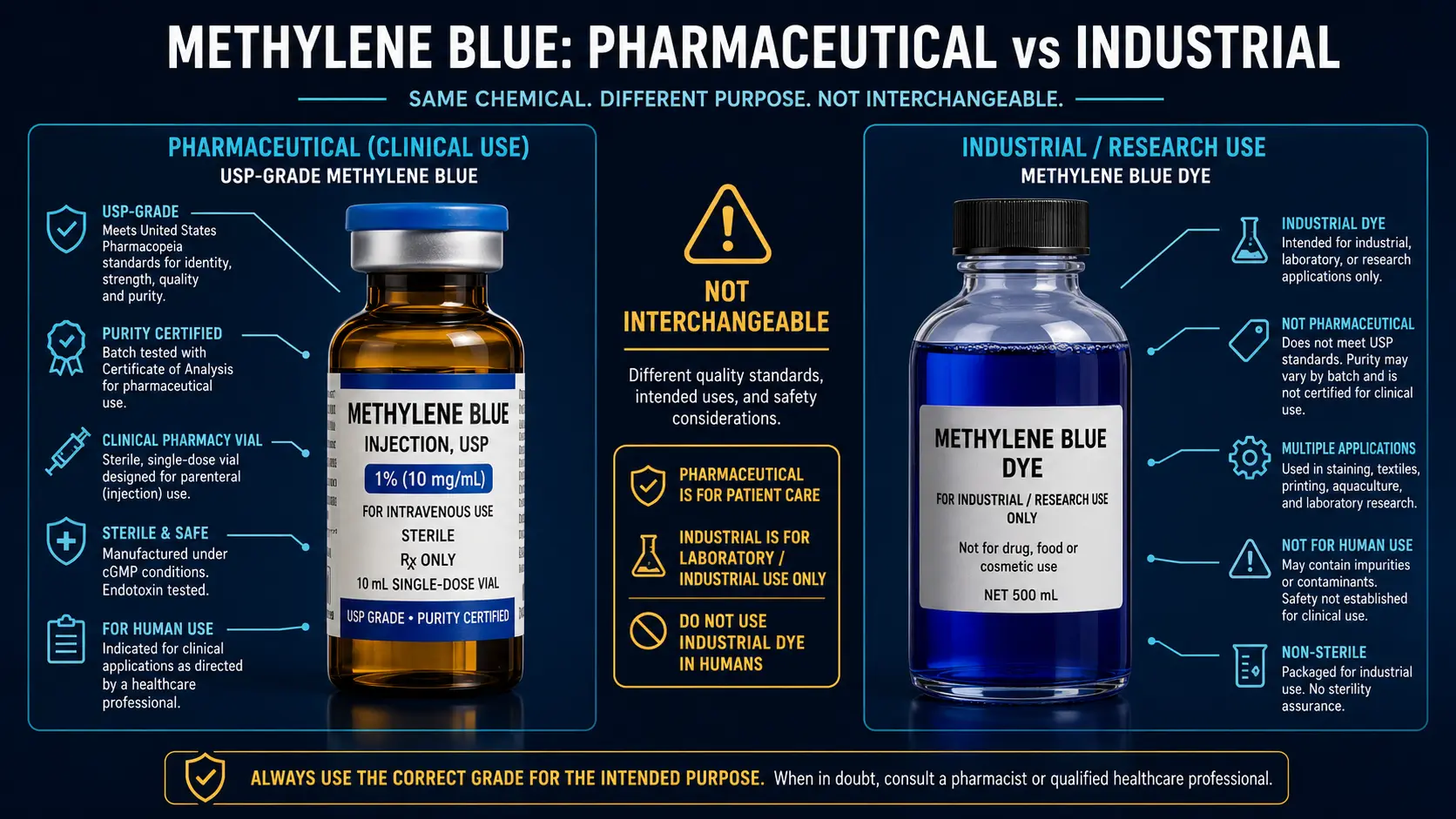
Methylene blue is one of those substances where the chemical name is identical, but the products with that name vary enormously in purity. The compound on a pharmacist's shelf as "USP-grade methylene blue injection" has been certified for human use; the methylene blue powder sold by laboratory chemistry suppliers is intended for industrial staining and may contain heavy metal residues, organic byproducts of synthesis, and analytical impurities at levels never tested for human safety. The "save money by buying lab grade" approach is the single most preventable cause of harm from off-label methylene blue use.
This page explains the grades, the actual differences in contamination, what to look for in a quality supplement, and the 2024–2025 FDA enforcement actions that have cleaned up some (not all) of the grey market.
Table of Contents
- The Grades of Methylene Blue
- USP-Grade Pharmaceutical
- ChemDye / Lab Grade
- Aquarium / Veterinary Grade
- Common Contaminants
- Supplement Quality Signals
- FDA Enforcement Actions
- Blue Tongue, Urine, and Stool
- Sourcing Options
- Research Papers and References
- Connections
The Grades of Methylene Blue
Methylene blue is sold in several distinct grades, each with different intended uses and purity standards:
- USP / Ph. Eur. Grade (Pharmaceutical) — meets United States Pharmacopeia or European Pharmacopeia standards for human use; tested for heavy metals, residual solvents, microbial contaminants, and dye impurities
- ACS Reagent Grade — meets American Chemical Society standards for analytical chemistry; cleaner than industrial but not certified for human use
- ChemDye / Histology Grade — for laboratory staining; lower purity standards; may contain visible blue impurities like Azure A and Azure B (themselves bioactive compounds)
- Aquarium / Veterinary Grade — for fish-tank and animal applications; not tested for human consumption; sometimes contains other antibiotics or antifungals
- Industrial Grade — for textile and biological dyeing; may contain heavy metals, aromatic amines, and significant byproduct contamination
Only the first category — USP or Ph. Eur. grade pharmaceutical methylene blue — has been certified safe for human ingestion or injection.
USP-Grade Pharmaceutical
USP-grade methylene blue meets the following published specifications (United States Pharmacopeia 43–NF 38):
- Methylthioninium chloride content: 95.0–101.0% (anhydrous basis)
- Heavy metals (Pb, As, Cd, Hg combined): ≤ 20 ppm (often < 5 ppm in modern manufacturing)
- Specific impurities: Azure B ≤ 6%, sum of related substances ≤ 8%
- Loss on drying: ≤ 22% (the powder is hydrated)
- Residue on ignition: ≤ 2.0%
- Total organic carbon (purified water): ≤ 0.5 mg/L
- Microbial limits: ≤ 100 CFU/g aerobic bacteria, ≤ 10 CFU/g molds, no Salmonella, E. coli, Pseudomonas
USP grade in the US is most commonly available as 1% aqueous injection (10 mg/mL, in 1 mL or 10 mL vials), 0.5% troche or capsule (compounded), or USP-certified 1% solution sold by compounding pharmacies and pharmaceutical suppliers. Brand examples: ProvayBlue (FDA-approved injectable methylene blue for methemoglobinemia), various compounded oral solutions from licensed compounding pharmacies.
ChemDye / Lab Grade
ChemDye, biological stain, and histology-grade methylene blue is sold by chemistry suppliers (Sigma-Aldrich, Fisher, VWR) for laboratory use only. The purity is typically 80–90%, with the balance consisting of the methyl-violet-related dyes Azure A, Azure B, and Azure C produced during synthesis. These azures themselves have biological activity — they are also redox-active and can affect mitochondrial function, but their long-term safety in repeated human consumption has not been studied.
Lab-grade methylene blue is what's typically being sold by grey-market wellness supplement sellers under labels like "high-quality methylene blue" or "professional grade." It is NOT pharmaceutical grade despite often being marketed in similar packaging.
Aquarium / Veterinary Grade
Aquarium methylene blue is sold for treating fungal and parasitic infections in fish. It is intended for water dosing, not consumption, and the purity standards are lower than pharmaceutical grade. Aquarium products often contain additional ingredients (acriflavine, malachite green, formalin) that are toxic to humans. Never substitute aquarium methylene blue for human-grade product.
Veterinary methylene blue (used in livestock and pets for nitrate poisoning, parasite control) is closer to pharmaceutical grade but is typically more concentrated and lacks the formulation controls (preservatives, isotonicity, pH) of human pharmaceutical preparations.
Common Contaminants
Methylene blue synthesis can leave behind several classes of impurities:
- Azure A, Azure B, Azure C — demethylated derivatives of methylene blue; biologically active redox dyes; allowed in low concentrations in USP grade
- Heavy metals — particularly chromium, copper, and lead from synthesis catalysts; significant in industrial grade, controlled in USP grade
- Aromatic amines — aniline, dimethylaniline; some are carcinogenic; controlled in USP grade
- Residual solvents — benzene, methanol, ethanol; controlled per ICH Q3C guidelines in USP grade
- Microbial contamination — uncontrolled in non-pharmaceutical grades
- Inorganic salts — sulfates, chlorides; not toxic but affect dose calculation
For someone taking 100–200 mg of methylene blue daily for months, the cumulative dose of impurities matters. A 5% heavy-metal contamination in a 100 mg daily dose is 5 mg/day of heavy metal — an unacceptable load, especially for cumulative-toxicity metals like cadmium and lead.
Supplement Quality Signals
Practical signals to look for when sourcing methylene blue:
- USP or Ph. Eur. designation on the label; not just "high purity" or "pharmaceutical-grade"
- Certificate of Analysis (CoA) showing actual purity, heavy metals, and microbial test results
- Compounding pharmacy preparation from a state-licensed pharmacy (US 503A or 503B compounders)
- Third-party testing — USP verified, NSF, ConsumerLab, Informed Sport
- Manufacturer transparency — willing to provide source, synthesis route, and full impurity profile
- Sealed, properly-labeled packaging with lot numbers and expiration dates
- Reasonable but not suspiciously low pricing — pharmaceutical-grade is meaningfully more expensive than industrial
Red flags:
- Unrealistically low pricing (a 1000-fold price difference vs pharmacy-compounded)
- "Cancer cure," "miracle drug," or "health authorities don't want you to know" marketing
- No clear manufacturer or country of origin
- Sold on social media or general e-commerce without medical or compounding-pharmacy involvement
- No CoA available on request
- Generic chemistry-supplier packaging
FDA Enforcement Actions
The FDA has issued multiple warning letters and enforcement actions in 2023–2024 against grey-market methylene blue sellers. Common violations cited:
- Marketing unapproved drugs (selling injectable methylene blue or oral methylene blue with disease-treatment claims)
- Misbranded labeling (not disclosing it's industrial-grade)
- Contamination findings on FDA inspection
- Disease-treatment claims (cancer, autism, "all chronic disease")
The enforcement environment has cleaned up some sellers but new ones appear constantly. The presence of FDA enforcement does not guarantee market clean-up; consumer due-diligence remains essential.
Blue Tongue, Urine, and Stool
Methylene blue's color is its most visible biomarker. Expected color effects from any therapeutic or nootropic dose:
- Blue urine — reliably appears within 1–2 hours of an oral dose; persists 24–36 hours; intensity proportional to dose
- Blue tongue — with sublingual administration; persists 1–3 hours
- Blue-green stools — possible at higher doses; reflects unabsorbed leuco-MB
- Faintly blue sweat — rare, dose-dependent
- Bluish skin tinge — cosmetic only; reverses on discontinuation
None of these is harmful. The blue urine, in fact, is one of the easier ways to verify that a product actually contains methylene blue at the labeled concentration — an obvious starter sanity check on a new bottle.
Alarming color signs that warrant medical attention: brown or chocolate-colored blood (suggests methemoglobinemia), dark cola-colored urine (suggests hemoglobinuria from hemolysis — see G6PD page), or persistent mucosal blueness with shortness of breath (suggests cyanosis).
Sourcing Options
- Compounding pharmacies — state-licensed, US 503A pharmacies can dispense compounded methylene blue with a prescription. Both oral solutions and capsules. Most reliable source for therapeutic doses.
- Pharmacist-formulated supplements from reputable manufacturers — explicitly labeled USP grade, with CoA available
- Hospital/clinic IV preparations — only for FDA-approved indications
- International pharmacies — can be reliable but importation laws and quality vary
- Veterinary suppliers — not appropriate for human use
- Chemistry suppliers — not appropriate for human use
- Aquarium/pet stores — not appropriate for human use
Research Papers and References
- MB impurity profile and pharmacopoeia — PubMed search
- USP grade contamination standards — PubMed search
- Industrial dye contamination — PubMed search
- ProvayBlue (FDA-approved MB) — PubMed search
External Authoritative Resources
Connections
- Methylene Blue Deep-Dive Articles:
- Methylene Blue Overview
- Dosing Guide
- Drug Interactions
- G6PD Deficiency
- Toxins
- Heavy Metals in Food
- Lead
- Mercury
- Cadmium