Elderberry and Antiviral Activity
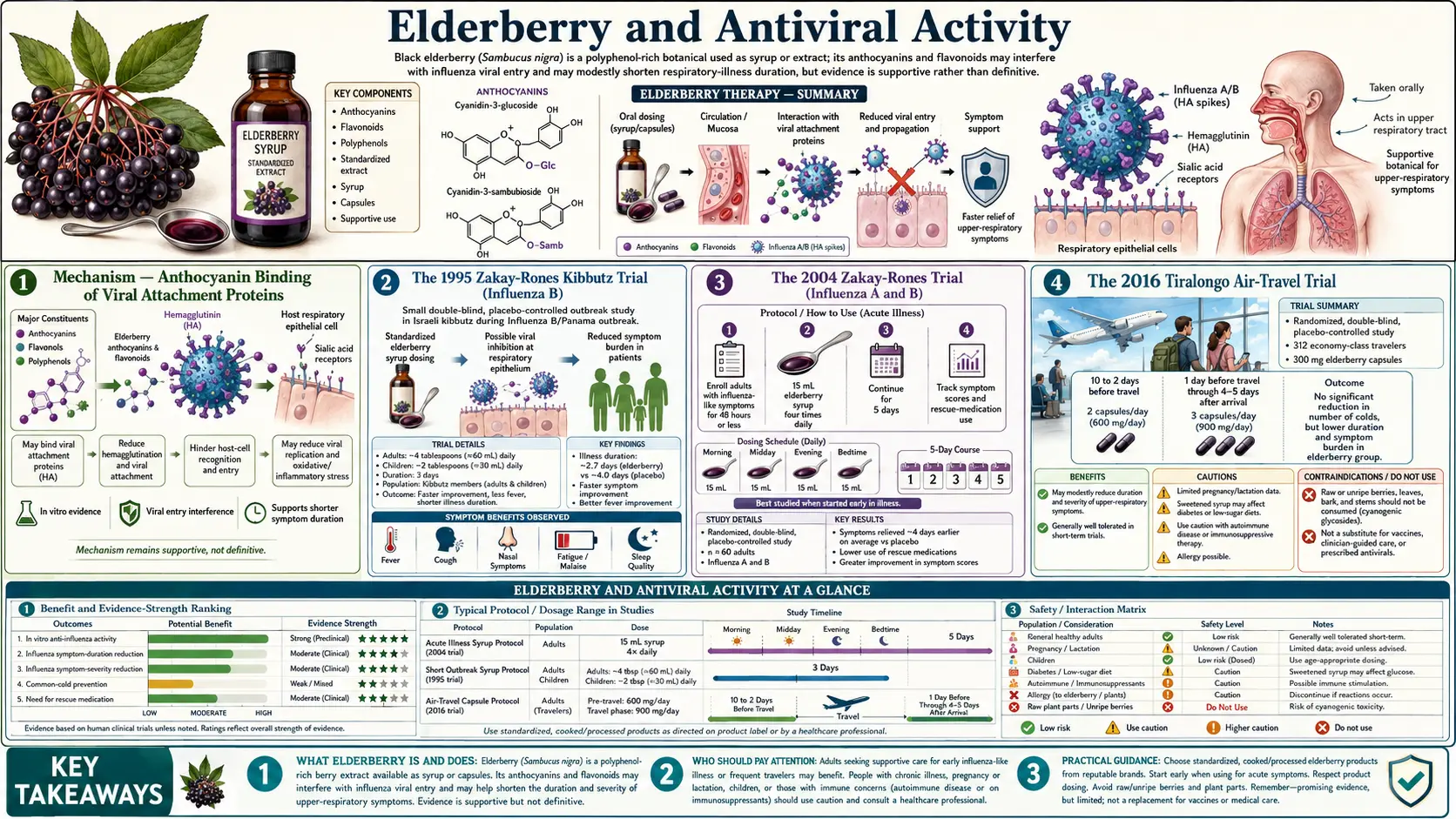
Elderberry (Sambucus nigra) is the natural-medicine cold-and-flu intervention with the longest written tradition (Hippocrates called it his "medicine chest") and a small but consistent modern randomized-trial base. The 1995 Zakay-Rones trial in an Israeli kibbutz during an influenza B Panama outbreak, the 2004 Zakay-Rones follow-up trial in influenza A and B, and the 2016 Tiralongo trial in long-haul air travelers all show that standardized elderberry extract compresses respiratory-infection symptom duration by approximately two to four days relative to placebo when started early. The mechanism is anthocyanin-driven: elderberry anthocyanins (cyanidin-3-glucoside, cyanidin-3-sambubioside) bind to the hemagglutinin protein on influenza virus and to non-influenza viral attachment proteins, blocking host-cell entry. This page covers the mechanism, the three randomized trials in detail, dosing, the "cytokine storm" concern that has driven internet caution, and the standardized products that match the trial formulations.
Table of Contents
- Mechanism — Anthocyanin Binding of Viral Attachment Proteins
- The 1995 Zakay-Rones Kibbutz Trial (Influenza B)
- The 2004 Zakay-Rones Trial (Influenza A and B)
- The 2016 Tiralongo Air-Travel Trial
- Hawkins 2019 Meta-Analysis
- The 2020 Emergency-Room Influenza Trial Found No Benefit
- Standardized Extracts Used in the Trials
- Practical Dosing
- The "Cytokine Storm" Concern — Theoretical vs Observed
- Raw Elderberry Cyanogenic Glycoside Warning
- Cautions and Drug Interactions
- Key Research Papers
- Connections
- Featured Videos
Mechanism — Anthocyanin Binding of Viral Attachment Proteins
Elderberries are unusually rich in anthocyanins, the deep-purple flavonoid pigments that give the fruit its color. The two principal anthocyanins in Sambucus nigra are cyanidin-3-glucoside and cyanidin-3-sambubioside, with smaller amounts of cyanidin-3,5-diglucoside. These compounds are the basis of the standardized extract's antiviral activity.
The proposed mechanism — supported by in vitro and computational work — is direct binding of anthocyanins to the viral attachment proteins of respiratory viruses. For influenza A and B, the target is the hemagglutinin (HA) glycoprotein on the viral surface, which normally binds sialic acid residues on host respiratory epithelial cells to initiate viral entry. Roschek et al. (2009) reported in a Phytochemistry paper that flavonoids from an elderberry extract bind to H1N1 influenza virus particles in vitro and, when bound, block the viruses from infecting host cells. Two of these compounds, made synthetically in the laboratory, blocked H1N1 infection in vitro with IC50 values (the concentration that blocks half of infections) of 0.13 µg/mL (0.36 µM) and 2.8 µg/mL (8.7 µM), which the authors compared favorably with 0.32 µM for oseltamivir; the whole elderberry extract had an IC50 of 252 µg/mL.
Krawitz et al. (2011) tested a standardized elderberry liquid extract in cell culture against an H5N1 influenza A strain taken from a patient and an influenza B strain, and found that it slowed the spread of both viruses, plus inhibition of clinically relevant respiratory bacteria (Streptococcus pyogenes, group C and G streptococci, Branhamella catarrhalis), supporting the "broad respiratory pathogen" use rather than a strictly anti-influenza claim.
The mechanism is conceptually similar to monoclonal-antibody antivirals that target viral surface glycoproteins: prevent attachment, prevent infection. Oseltamivir works differently: its FDA label describes it as an inhibitor of the influenza virus neuraminidase enzyme, which affects the release of new virus particles from infected cells.
The 1995 Zakay-Rones Kibbutz Trial (Influenza B)
The first randomized controlled trial of standardized elderberry extract was conducted by Zakay-Rones and colleagues at Hebrew University and the Hadassah-Hebrew University Medical Center during a 1993 outbreak of influenza B (Panama strain) in an Israeli kibbutz. Twenty-seven people with influenza symptoms, children and adults aged 5 to 56, were randomized to a standardized elderberry syrup or placebo syrup for three days — one tablespoon twice a day for children and four times a day for adults, as summarised in the 2021 Wieland systematic review.
Results.
- Symptom improvement, including fever: seen in 93.3% of the elderberry group within 2 days, while 91.7% of the placebo group improved within 6 days (p < 0.001).
- Complete cure: within 2 to 3 days in nearly 90% of the elderberry group, and within at least 6 days in the placebo group (p < 0.001).
- No adverse effects attributable to elderberry.
The trial was small and conducted in a closed kibbutz population, which limits external validity, but the effect size (roughly halving recovery time) was large enough to attract follow-up investigation. The trial used a standardized elderberry preparation manufactured to consistent anthocyanin content — the same commercial syrup later used in the 2004 trial. The 2021 Wieland review rated the trial at unclear risk of bias for how people were randomized, because the randomization process was not described.
The 2004 Zakay-Rones Trial (Influenza A and B)
The 2004 trial, published in the Journal of International Medical Research, was a larger randomized double-blind placebo-controlled trial. Sixty patients (ages 18–54) with symptoms consistent with influenza A or B for less than 48 hours were enrolled during the 1999–2000 influenza season in Norway. Participants received 15 mL of the standardized elderberry syrup or placebo syrup four times daily for five days.
Results.
- Mean time to symptom resolution: 3.1 days in the elderberry arm vs 7.1 days in the placebo arm (p<0.001). A four-day reduction in symptom duration.
- Use of rescue medication (paracetamol, decongestants): substantially lower in the elderberry arm.
- Both influenza A and B cases responded, consistent with the mechanism-independent-of-viral-strain hypothesis.
- No serious adverse events.
The 2004 trial is the strongest single study supporting elderberry for influenza. It is double-blind and placebo-controlled, the population was outpatient adults, the dose and formulation are commercially available, and the effect size is clinically meaningful (cutting the typical influenza illness in half).
Limitations: sample size is moderate. The authors wrote that the findings need to be confirmed in a larger study.
The 2016 Tiralongo Air-Travel Trial
Long-haul air travel is a well-documented setting for elevated respiratory-infection risk — recycled cabin air, dry mucosa from low humidity, confined seating, and cross-time-zone immune disruption. Tiralongo, Wee, and Lea published a 2016 randomized double-blind placebo-controlled trial in Nutrients enrolling 312 economy-class travelers on long-haul flights from Australia. Participants took capsules of a standardized, membrane-filtered elderberry extract (300 mg each) or placebo capsules: two capsules a day (600 mg) starting 10 days before travel, and three capsules a day (900 mg) while travelling and for 4–5 days after arrival.
Results.
- Cold episodes: 12 in the elderberry group vs 17 in the placebo group among the 312 travellers, a difference that was not statistically significant (p = 0.4).
- Total cold-episode days: 57 in the elderberry group vs 117 in the placebo group (p = 0.02).
- Average symptom score over those cold days: 247 in the elderberry group vs 583 in the placebo group (p = 0.05).
- Five participants reported adverse events; the authors found that none could be directly attributed to elderberry.
The Tiralongo trial is methodologically important because (a) it was run by a different research group with a different elderberry extract, (b) it used capsules rather than syrup (different delivery route, same active compounds), and (c) it tested a non-influenza-specific real-world cold-prone setting. The consistency of direction (reduced symptom duration with elderberry, even in a setting where prevention was not achieved) reinforces the "shortens duration once infection occurs" interpretation.
Hawkins 2019 Meta-Analysis
Hawkins et al. published a 2019 meta-analysis in Complementary Therapies in Medicine that looked only at elderberry as a treatment for upper respiratory symptoms. It included a total of 180 participants and reported that elderberry “was found to substantially reduce upper respiratory symptoms”, with “a large mean effect size”. The 2021 Wieland review notes that Hawkins included a 2009 lozenge trial (Kong 2009) in 64 adults aged 20 to 59.
Subsequent systematic reviews (Wieland et al. 2021 BMC Complement Med Ther) have been more cautious, noting that the underlying trial base is small and not all studies show statistically significant benefit, but consistently note no safety signals and a direction-of-effect favorable to elderberry. Wieland and colleagues included five randomized trials and concluded that elderberry “may not reduce the risk of developing the common cold; it may reduce the duration and severity of colds, but the evidence is uncertain”, and that it “may reduce the duration of influenza but the evidence is uncertain”.
A 2026 overview by Aghajafari and colleagues in Phytotherapy Research gathered 18 systematic reviews covering 16 herbal medicines for acute respiratory infections. It listed black elderberry among the herbs, with ginseng, ivy leaf extract, echinacea and eucalyptus, whose reviews “showed some benefits”. It also found that the evidence “remains limited by methodological flaws in the primary studies” and that adverse events were likely under-reported.
The honest summary is: elderberry has a small but real evidence base supporting symptom-duration reduction in influenza and the common cold, mechanistically plausible from anthocyanin-driven viral attachment inhibition, with no documented safety concerns in standardized extracts at trial doses. The trials tested elderberry for shortening an illness, not for preventing infection (the travel trial found no significant difference in the number of colds), and they enrolled outpatients, not people in hospital. The 2020 emergency-room trial described in the next section found no benefit in laboratory-confirmed influenza.
The 2020 Emergency-Room Influenza Trial Found No Benefit
Macknin and colleagues ran a randomized, double-blind, placebo-controlled trial from January 2018 to April 2019 in three emergency rooms (two suburban, one urban) of a US Midwestern health system, published in the Journal of General Internal Medicine in 2020. It enrolled 87 people over age four who had had at least two moderate-severity influenza symptoms for less than 48 hours and a positive influenza test by polymerase chain reaction (PCR). Children aged 5 to 12 took 15 mL of elderberry extract or placebo twice a day for 5 days; people over 12 took 15 mL four times a day for 5 days. Participants could also choose to take the standard dose of oseltamivir.
Results.
- Days until all symptoms were none or mild: 4.9 with placebo (44 people) and 5.3 with elderberry (43 people) (p = 0.57).
- Days to complete recovery: 8.7 with placebo and 8.6 with elderberry (p = 0.87).
- A post hoc analysis suggested that, among people who did not take oseltamivir, the main outcomes were 2 days worse with elderberry alone than with placebo alone.
The authors “found no evidence that elderberry benefits the duration or severity of influenza” and wrote that their results contradict the earlier studies. The trial was small, but it was designed with more than 90% power to detect a 2-day benefit.
Standardized Extracts Used in the Trials
The Zakay-Rones trials used one commercial standardized black elderberry syrup, an Israeli extract formulated to consistent anthocyanin content; the 2021 Wieland review describes the 2004 trial syrup as containing 38% proprietary elderberry extract. The Tiralongo travel trial used capsules of a different, membrane-filtered elderberry extract standardized to polyphenols.
Other product types sold include:
- Drugstore elderberry capsules and syrups standardized to a stated anthocyanin percentage per serving.
- Standardized elderberry syrups with organic certification.
- Organic elderberry syrups with less added sugar than the trial syrup.
Product types with little or no stated extract content:
- Unstandardized "elderberry gummies" with no anthocyanin content listed. These are typically far below the doses used in the trials.
- Elderberry concentrates made by tincture extraction in ethanol — anthocyanins are water-extractable, so ethanol tinctures may not contain the bulk of the active compounds.
- "Elderberry-flavored" cough drops or juices that contain trivial amounts of actual fruit extract.
The supplement-facts panel lists the standardized extract content per serving. The trials used 15 mL of syrup four times a day (Zakay-Rones 2004) and capsules at 600 mg a day before travel and 900 mg a day while travelling (Tiralongo 2016).
Practical Dosing
Acute symptom-onset dosing (Zakay-Rones 2004 protocol)
- The trial enrolled people within 48 hours of their first influenza-like symptoms.
- Standardized elderberry syrup: 15 mL (one tablespoon) four times daily for adults. 7.5 mL four times daily for children ages 4–12 (per the manufacturer's label).
- The trial course lasted 5 days.
- The trials tested short courses, not indefinite use.
Travel prophylaxis (Tiralongo 2016 protocol)
- Capsules were started 10 days before long-haul air travel.
- Standardized extract capsule: 300 mg twice daily (600 mg/day total) for 10 days before travel.
- 300 mg three times daily (900 mg/day) during travel and for 4–5 days after arrival.
- The capsules stopped after that period; the trial did not test a maintenance dose.
The trial data cover acute symptom-driven use and short-term travel use, not daily year-round or indefinite chronic use.
The "Cytokine Storm" Concern — Theoretical vs Observed
A recurring internet caution against elderberry is the theoretical concern that elderberry may amplify the production of inflammatory cytokines (tumor necrosis factor-alpha, interleukin-6, interleukin-1-beta), which could worsen outcomes in autoimmune disease or in severe viral infection driven by a "cytokine storm" (the excessive innate-immune response implicated in severe pneumonia from various viral causes).
The empirical basis for this concern is thin.
- The cytokine-induction observation comes from in vitro studies adding elderberry extract directly to cultured human monocytes — a setting that does not reproduce the gut absorption, hepatic first-pass metabolism, or systemic distribution of orally consumed elderberry. The 2021 Wieland review also found three small studies, with 51 people in total, that measured cytokine production in blood samples taken after people had taken elderberry products (ex vivo studies); it found “evidence that elderberry has some effect on inflammatory markers, although this effect may decline with ongoing supplementation”, and it did not find any studies linking elderberry to clinical inflammatory outcomes.
- The Zakay-Rones, Tiralongo, and other clinical trials — involving hundreds of participants over decades — have not documented increased inflammatory complications.
- Influenza recovery in the trials was faster, not slower, in the elderberry arms, which is incompatible with a meaningful cytokine-amplification effect at the clinical level.
In short: the cytokine-storm concern is theoretical and unconfirmed clinically. The 2021 Wieland review concluded that elderberry “may be a safe option for treating viral respiratory illness, and there is no evidence that it overstimulates the immune system”, while adding that “the evidence on both benefits and harms is uncertain”. The review noted that judging the clinical meaning of elderberry's effect on inflammation would need trials in patients with inflammatory conditions, so there is no direct evidence either way for people with active autoimmune disease, people on immune-suppressing therapy, or people in hospital with severe respiratory illness.
Raw Elderberry Cyanogenic Glycoside Warning
An important safety distinction: raw uncooked elderberries (and elderberry leaves, bark, and unripe berries) contain cyanogenic glycosides — primarily sambunigrin — that release hydrogen cyanide on digestion. Consumption of raw or unripe elderberries can cause nausea, vomiting, abdominal cramping, and (in significant quantity) more serious cyanide toxicity. Documented outbreaks of elderberry poisoning have occurred from consumption of unheated juice and from making "natural" smoothies with raw berries.
Standardized commercial elderberry extracts and properly prepared elderberry syrups (boiled or pressure-extracted under heat) have the cyanogenic glycosides destroyed by cooking and are safe. Commercial standardized syrups and extracts are made with controlled heat extraction.
Traditional home preparation of foraged elderberries cooks them thoroughly — boiling for at least 15–20 minutes — before they are eaten. The berries are stripped from their stems (stems are higher in glycosides), unripe green berries are discarded, and leaves and bark are not eaten.
Heat-processed commercial products do not carry the raw-berry risk, because the glycosides are destroyed during manufacture.
Cautions and Drug Interactions
- Autoimmune disease (multiple sclerosis, rheumatoid arthritis, lupus, type 1 diabetes): theoretical concern from cytokine-induction in vitro work. The 2021 Wieland review found no studies linking elderberry to clinical inflammatory outcomes, so there is no direct evidence either way.
- Immunosuppressive therapy (post-transplant, biologics for autoimmune disease): as above.
- Diuretics: elderberry has mild diuretic activity in some preparations; co-administration may enhance fluid loss, a concern raised mainly for older people.
- Pregnancy and breastfeeding: insufficient data on standardized extracts at trial doses; there is no good safety data for pregnancy or breastfeeding.
- Diabetes medications: some animal data suggest elderberry may modestly lower blood glucose; the concern raised is for people taking insulin or sulfonylureas, medicines that themselves lower blood glucose.
- Children under age 4: safety not formally established. Lower-dose children's formulations are sold; the 1995 and 2020 trials included children from age 5.
- Severe illness requiring medical care: high fever, shortness of breath (dyspnea), chest pain, coughing up blood (hemoptysis) and confusion (mental-status change) are signs that hospitals treat as urgent; the elderberry trials enrolled outpatients.
Key Research Papers
- Zakay-Rones Z, Varsano N, Zlotnik M, et al. Inhibition of several strains of influenza virus in vitro and reduction of symptoms by an elderberry extract (Sambucus nigra L.) during an outbreak of influenza B Panama. J Altern Complement Med 1995. — PubMed PMID: 9395631
- Zakay-Rones Z, Thom E, Wollan T, Wadstein J. Randomized study of the efficacy and safety of oral elderberry extract in the treatment of influenza A and B virus infections. J Int Med Res 2004. — PubMed PMID: 15080016
- Tiralongo E, Wee SS, Lea RA. Elderberry supplementation reduces cold duration and symptoms in air-travellers: a randomized, double-blind placebo-controlled clinical trial. Nutrients 2016. — PubMed PMID: 27023596
- Hawkins J, Baker C, Cherry L, Dunne E. Black elderberry (Sambucus nigra) supplementation effectively treats upper respiratory symptoms: a meta-analysis of randomized, controlled clinical trials. Complement Ther Med 2019. — PubMed PMID: 30670267
- Krawitz C, Mraheil MA, Stein M, et al. Inhibitory activity of a standardized elderberry liquid extract against clinically-relevant human respiratory bacterial pathogens and influenza A and B viruses. BMC Complement Altern Med 2011. — PubMed PMID: 21352539
- Roschek B Jr, Fink RC, McMichael MD, et al. Elderberry flavonoids bind to and prevent H1N1 infection in vitro. Phytochemistry 2009. — PubMed PMID: 19682714
- Mocanu ML, Amariei S. Elderberries-A source of bioactive compounds with antiviral action. Plants (Basel) 2022. — PubMed PMID: 35336621
- Macknin M, Wolski K, Negrey J, Mace S. Elderberry Extract Outpatient Influenza Treatment for Emergency Room Patients Ages 5 and Above: a Randomized, Double-Blind, Placebo-Controlled Trial. J Gen Intern Med 2020. — PubMed PMID: 32929634
- Vlachojannis JE, Cameron M, Chrubasik S. A systematic review on the sambuci fructus effect and efficacy profiles. Phytother Res 2010. — PubMed PMID: 19548290
- Wieland LS, Piechotta V, Feinberg T, et al. Elderberry for prevention and treatment of viral respiratory illnesses: a systematic review. BMC Complement Med Ther 2021. — PubMed PMID: 33827515
- Aghajafari F, Choi B, Bhatt D, et al. Benefits and Harms of Herbal Medicines for Preventing and Treating Acute Respiratory Infections: An Overview of Systematic Reviews. Phytother Res 2026. — PubMed PMID: 42839197
- Porter RS, Bode RF. A review of the antiviral properties of black elder (Sambucus nigra L.) products. Phytother Res 2017. — PubMed PMID: 28198157
- Senica M, Stampar F, Veberic R, Mikulic-Petkovsek M. The higher the better? Differences in phenolics and cyanogenic glycosides in Sambucus nigra leaves, flowers and berries from different altitudes. J Sci Food Agric 2017. — PubMed PMID: 27734518
Connections
- All Remedies
- Benefits Hub
- Cold and Flu Treatments (Main Page)
- Zinc Acetate Lozenges
- Vitamin D Status and Respiratory Infection
- Steam and Saline Rinses
- Elderberry (Main Page)
- Echinacea
- Andrographis
- Vitamin C
- Vitamin D3
- Zinc
- Immune Boosting
- Pulmonology
- Influenza — the infection the Zakay-Rones and Hawkins elderberry trials were run against.