Cold and Flu Natural Treatments — Benefits Deep Dive
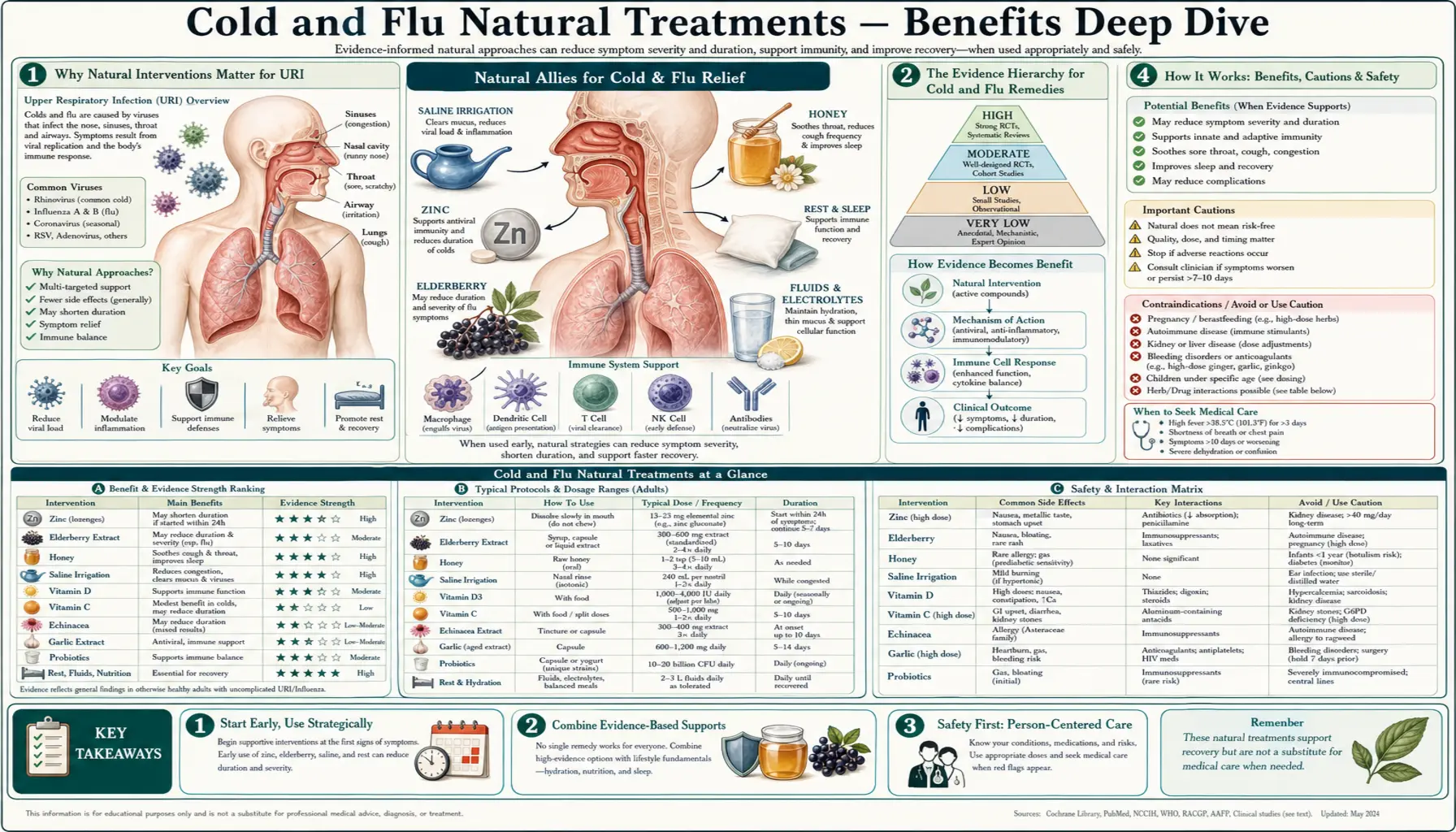
Acute upper respiratory infection (URI) is the single most common reason American adults miss work and children miss school. Roughly 200 distinct virus serotypes (rhinoviruses, influenza A/B, respiratory syncytial virus (RSV), parainfluenza, adenoviruses, and seasonal endemic coronaviruses) cycle through the population each year, and the typical adult experiences two to four episodes annually. For influenza, the U.S. Centers for Disease Control and Prevention (CDC) lists four recommended prescription antivirals (oseltamivir, zanamivir, peramivir and baloxavir marboxil), recommended as early as possible for people with confirmed or suspected influenza who are in hospital, severely ill or at higher risk of complications; for the common cold there is no specific antiviral therapy at all. That treatment gap is what creates the demand for the four natural interventions explored in the deep-dive pages below — zinc acetate lozenges, which shortened colds by about 33% in a 2017 meta-analysis while the 2024 Cochrane review rates the evidence for shorter colds as low-certainty; Vitamin D, which in a 2017 analysis cut acute respiratory infection risk by about 12% overall and by about 70% in people with very low starting levels taking it daily or weekly, while a larger 2021 analysis found a small overall effect (odds ratio 0.92) and no difference by starting level; elderberry extract, where small early trials reported shorter influenza but the 2020 double-blind emergency-room trial found no benefit; and the mechanical interventions (steam inhalation, hypertonic saline rinses, neti-pot irrigation) that physically clear viral particles and reduce sinus burden.
Deep-Dive Articles
Zinc Acetate Lozenges
The Hemila meta-analyses, the 80–92 mg/day elemental zinc dosing window, why acetate or gluconate (not citrate or oxide), the 24-hour symptom-onset rule, why ionic free Zn2+ in the oropharynx matters more than systemic zinc status, the rhinovirus ICAM-1 docking mechanism, palatability tradeoffs, the meta-analyses finding that lozenges shorten the common cold by roughly one-third, and the 2024 Cochrane review that rates the evidence for shorter colds as low-certainty.
Read the deep dive →Vitamin D Status and Respiratory Infection
The Martineau individual participant data (IPD) meta-analysis (25 trials, 11,321 participants aged 0 to 95) showing Vitamin D reduces acute respiratory infection risk by approximately 12% overall and roughly 70% in profoundly deficient participants taking it daily or weekly, the larger 2021 meta-analysis (46 trials) that found a smaller overall effect, the cathelicidin LL-37 antimicrobial peptide mechanism, the 25-hydroxyvitamin D target of 40–60 ng/mL, daily/weekly dosing superior to monthly boluses, and the seasonal latitude pattern that drives the winter respiratory-infection peak.
Read the deep dive →Elderberry and Antiviral Activity
The Sambucus nigra randomized trials (Zakay-Rones 1995 Israel, Zakay-Rones 2004, Tiralongo 2016 air travel), the anthocyanin-driven hemagglutinin inhibition mechanism, the standardized elderberry syrup and lozenge dosing, why the autoimmune-cytokine concern is theoretical rather than observed, the early trials' reports of shorter influenza and the 2020 emergency-room trial (Macknin) that found no benefit, and how to distinguish standardized extracts from low-anthocyanin commodity products.
Read the deep dive →Steam Inhalation and Saline Rinses
The mechanical removal of viral particles, antigens, and inflammatory mediators from the nasal mucosa by hypertonic saline irrigation, the ELVIS pilot trial (open-label, 68 adults) reporting reduced symptom duration and onward transmission, neti-pot vs squeeze-bottle vs powered irrigation, the water-safety record (a 2012 report linked two deaths from amoebic brain infection to sinus rinsing with household tap water containing the ameba Naegleria fowleri, and names distilled, boiled or filtered water as appropriate for rinsing), Eucalyptus / Tea Tree adjuncts, steam-tent technique, humidifier hygiene, and where the evidence for menthol decongestion stands.
Read the deep dive →Table of Contents
- Deep-Dive Articles
- Why Natural Interventions Matter for URI
- The Evidence Hierarchy for Cold and Flu Remedies
- Research Papers: Zinc Lozenges
- Research Papers: Vitamin D and Respiratory Infection
- Research Papers: Elderberry and Antiviral Activity
- Research Papers: Steam, Saline, and Mechanical Interventions
- Research Papers: Cross-Cutting (Cold/Flu Epidemiology, Adjunct Nutrients)
- External Authoritative Resources
- Connections
- Featured Videos
Why Natural Interventions Matter for URI
Acute upper respiratory infection is an illness for which conventional medicine offers little specific treatment, which is why natural interventions draw so much interest. Four points explain that interest.
- The conventional toolkit is thin. The CDC's guidance for clinicians (updated March 2026) lists four recommended prescription influenza antivirals — oseltamivir, zanamivir, peramivir and baloxavir marboxil. It recommends starting treatment as early as possible for people with confirmed or suspected influenza who are in hospital, have severe, complicated or progressive illness, or are at higher risk of complications; it states that “decisions about starting antiviral treatment should not wait for laboratory confirmation of influenza”; and for people in hospital it notes that treatment might still help even if started more than 48 hours after illness onset. These drugs act on influenza only, and many people with "flu-like illness" have one of dozens of circulating respiratory viruses (rhinovirus, respiratory syncytial virus, parainfluenza, seasonal endemic coronavirus, metapneumovirus). For the common cold (overwhelmingly rhinovirus), there is no approved specific antiviral therapy at all in 2026.
- The pathophysiology is favorable for nutritional intervention. URI symptoms arise less from direct viral cytopathic effect and more from the host inflammatory response — cytokine release, mucus hypersecretion, vasodilation. Interventions that modulate barrier function (Vitamin D, mucosal immunoglobulin A (IgA) via Vitamin A), reduce viral attachment (zinc binding to rhinovirus ICAM-1), or directly inhibit viral entry (elderberry anthocyanins blocking hemagglutinin) all operate on this pathophysiology rather than requiring strain-specific antiviral activity.
- The risk profile is excellent. Zinc lozenges, Vitamin D repletion, elderberry syrup, and saline nasal irrigation all have established safety profiles spanning decades of use. The narrowest therapeutic windows are zinc (chronic intake >40 mg/day depletes copper) and Vitamin D (intake >10,000 international units (IU)/day for months risks hypercalcemia), but neither is approached by typical cold/flu dosing.
- Cost and accessibility draw people to self-care. A bottle of zinc acetate lozenges, a bottle of standardized elderberry syrup, a Vitamin D blood test plus a year of D3 capsules, and a neti pot together cost less than a single urgent-care copay in the United States.
The four deep-dive pages below each explore one intervention in detail: the mechanism, the randomized-trial evidence, the dosing window that worked in trials, the populations who benefited most, and the cautions.
The Evidence Hierarchy for Cold and Flu Remedies
Not all "natural cold remedies" have the same evidence base. A useful three-tier hierarchy:
Tier 1 — Multiple randomized trials and meta-analyses
- Zinc acetate / gluconate lozenges (Hemila, JRSM Open 2017 meta-analysis of seven trials, 575 participants): roughly 33% reduction in common-cold duration when started within 24 hours of symptom onset at 80–92 mg/day elemental zinc divided across the day. The newest Cochrane review (Nault et al. 2024; 34 trials, 8,526 participants) rates the evidence lower: zinc may make little or no difference to the risk of catching a cold (risk ratio 0.93, low-certainty evidence), may shorten a cold that has already started by about 2.37 days (low-certainty evidence), and probably causes more non-serious side effects when used as treatment (risk ratio 1.34).
- Vitamin D supplementation (Martineau et al. individual-patient-data meta-analysis 2017, BMJ; 25 trials, 11,321 participants aged 0 to 95): approximately 12% overall reduction in acute respiratory infection risk, rising to ~70% in profoundly deficient participants (starting 25-hydroxyvitamin D below 25 nmol/L) receiving daily or weekly vitamin D. A larger 2021 meta-analysis by the same research group (Jolliffe et al., Lancet Diabetes Endocrinol; 46 trials, 75,541 participants) found a smaller overall effect (odds ratio 0.92) and no significant effect in any subgroup defined by starting vitamin D level; protection was seen with daily dosing, with daily doses of 400–1000 IU, with trials lasting 12 months or less, and in children aged 1 to 15 at enrolment.
Tier 2 — Small randomized trials with mixed or uncertain results
- Hypertonic saline nasal irrigation (Ramalingam et al. ELVIS pilot trial 2019, Scientific Reports): in a pilot, open-label (unblinded) randomized trial of 68 adults whose main aim was to test recruitment, illness was 1.9 days shorter and household transmission 35% lower in the saline group. The 2015 Cochrane review of saline nasal irrigation (King et al.) found the trials generally too small and at high risk of bias. A 2024 pragmatic trial of the same rinse-and-gargle method in 576 people with suspected or confirmed COVID-19 in Pakistan, started within five days of symptoms, found no benefit (symptom resolution 3.6% vs 3.7% in a group washing the nose and gargling with tap water); its authors state that rinsing started within 48 hours of illness onset still needs testing.
- Heated, humidified air (steam): the 2017 Cochrane review (6 trials, 387 participants) found it uncertain whether heated, humidified air relieves cold symptoms. A 2021 randomized trial in New Zealand (170 adults) of humidified air heated to 41 °C for 2 hours a day for 5 days found no difference from a sham treatment in symptom severity or in time to recovery (5.96 vs 6.42 days).
- Elderberry extract (Zakay-Rones 1995, 2004; Tiralongo 2016; Macknin 2020): the small early trials reported shorter symptoms, but the 2020 double-blind, placebo-controlled trial in 87 emergency-room patients with laboratory-confirmed influenza found no benefit (4.9 days to mild symptoms on placebo vs 5.3 days on elderberry, p = 0.57), and its authors wrote that their results contradict previous studies. The 2021 Wieland systematic review concluded that elderberry “may reduce the duration of influenza but the evidence is uncertain.” Mechanistic plausibility comes from anthocyanin hemagglutinin inhibition in laboratory studies.
- Echinacea purpurea (Karsch-Volk Cochrane 2014): heterogeneous trials, some positive for prevention but small effect sizes; species and preparation matter (E. purpurea aerial parts vs E. angustifolia root).
- Andrographis paniculata: several small trials showing symptom reduction in URI.
- Pelargonium sidoides (a standardized root extract): meta-analyses suggesting modest benefit in acute bronchitis.
Tier 3 — Mechanism plus historical use, sparse modern trial data
- Garlic (allicin), ginger, oregano oil, propolis, Vitamin A repletion for measles or low-status populations, larch arabinogalactan, beta-glucans.
The four deep-dive pages on this site cover zinc and Vitamin D from Tier 1 and saline irrigation and elderberry from Tier 2. Other interventions are discussed on their own topic pages but are not given dedicated benefits deep-dives.
Research Papers: Zinc Lozenges
- Hemila H, Petrus EJ, Fitzgerald JT, Prasad A. Zinc acetate lozenges for treating the common cold: an individual patient data meta-analysis. Br J Clin Pharmacol 2016. — PubMed PMID: 27378206
- Hemila H. Zinc lozenges and the common cold: a meta-analysis comparing zinc acetate and zinc gluconate, and the role of zinc dosage. JRSM Open 2017. — PubMed PMID: 28515951
- Nault D, Machingo TA, Shipper AG, et al. Zinc for prevention and treatment of the common cold. Cochrane Database Syst Rev 2024. — PubMed PMID: 38719213
- Prasad AS, Beck FW, Bao B, et al. Duration and severity of symptoms and levels of plasma interleukin-1 receptor antagonist, soluble tumor necrosis factor receptor, and adhesion molecules in patients with common cold treated with zinc acetate. J Infect Dis 2008. — PubMed PMID: 18279051
- Eby GA, Davis DR, Halcomb WW. Reduction in duration of common colds by zinc gluconate lozenges in a double-blind study. Antimicrob Agents Chemother 1984. — PubMed PMID: 6367635
- Mossad SB, Macknin ML, Medendorp SV, Mason P. Zinc gluconate lozenges for treating the common cold. A randomized, double-blind, placebo-controlled study. Ann Intern Med 1996. — PubMed PMID: 8678384
- Novick SG, Godfrey JC, Godfrey NJ, Wilder HR. How does zinc modify the common cold? Clinical observations and implications regarding mechanisms of action. Med Hypotheses 1996. — Search PubMed
- Hulisz D. Efficacy of zinc against common cold viruses: an overview. J Am Pharm Assoc 2004. — Search PubMed
- Wang MX, Win SS, Pang J. Zinc supplementation reduces common cold duration among healthy adults: a systematic review and meta-analysis. Am J Trop Med Hyg 2020. — PubMed PMID: 32342851
- Science M, Johnstone J, Roth DE, et al. Zinc for the treatment of the common cold: a systematic review and meta-analysis of randomized controlled trials. CMAJ 2012. — PubMed PMID: 22566526
Research Papers: Vitamin D and Respiratory Infection
- Martineau AR, Jolliffe DA, Hooper RL, et al. Vitamin D supplementation to prevent acute respiratory tract infections: systematic review and meta-analysis of individual participant data. BMJ 2017. — PubMed PMID: 28202713
- Jolliffe DA, Camargo CA Jr, Sluyter JD, et al. Vitamin D supplementation to prevent acute respiratory infections: a systematic review and meta-analysis of aggregate data from randomised controlled trials. Lancet Diabetes Endocrinol 2021. — PubMed PMID: 33798465
- Urashima M, Segawa T, Okazaki M, et al. Randomized trial of vitamin D supplementation to prevent seasonal influenza A in schoolchildren. Am J Clin Nutr 2010. — PubMed PMID: 20219962
- Liu PT, Stenger S, Li H, et al. Toll-like receptor triggering of a vitamin D-mediated human antimicrobial response. Science 2006. — PubMed PMID: 16497887
- Cannell JJ, Vieth R, Umhau JC, et al. Epidemic influenza and vitamin D. Epidemiol Infect 2006. — PubMed PMID: 16959053
- Bergman P, Lindh AU, Bjorkhem-Bergman L, Lindh JD. Vitamin D and respiratory tract infections: a systematic review and meta-analysis of randomized controlled trials. PLoS One 2013. — PubMed PMID: 23840373
- Charan J, Goyal JP, Saxena D, Yadav P. Vitamin D for prevention of respiratory tract infections: a systematic review and meta-analysis. J Pharmacol Pharmacother 2012. — PubMed PMID: 23326099
- Camargo CA Jr, Ganmaa D, Frazier AL, et al. Randomized trial of vitamin D supplementation and risk of acute respiratory infection in Mongolia. Pediatrics 2012. — PubMed PMID: 22908115
- Ginde AA, Mansbach JM, Camargo CA Jr. Association between serum 25-hydroxyvitamin D level and upper respiratory tract infection in the Third National Health and Nutrition Examination Survey. Arch Intern Med 2009. — PubMed PMID: 19237723
- Hewison M. Antibacterial effects of vitamin D. Nat Rev Endocrinol 2011. — PubMed PMID: 21263449
Research Papers: Elderberry and Antiviral Activity
- Zakay-Rones Z, Varsano N, Zlotnik M, et al. Inhibition of several strains of influenza virus in vitro and reduction of symptoms by an elderberry extract (Sambucus nigra L.) during an outbreak of influenza B Panama. J Altern Complement Med 1995. — PubMed PMID: 9395631
- Zakay-Rones Z, Thom E, Wollan T, Wadstein J. Randomized study of the efficacy and safety of oral elderberry extract in the treatment of influenza A and B virus infections. J Int Med Res 2004. — PubMed PMID: 15080016
- Tiralongo E, Wee SS, Lea RA. Elderberry supplementation reduces cold duration and symptoms in air-travellers: a randomized, double-blind placebo-controlled clinical trial. Nutrients 2016. — PubMed PMID: 27023596
- Hawkins J, Baker C, Cherry L, Dunne E. Black elderberry (Sambucus nigra) supplementation effectively treats upper respiratory symptoms: a meta-analysis of randomized, controlled clinical trials. Complement Ther Med 2019. — PubMed PMID: 30670267
- Krawitz C, Mraheil MA, Stein M, et al. Inhibitory activity of a standardized elderberry liquid extract against clinically-relevant human respiratory bacterial pathogens and influenza A and B viruses. BMC Complement Altern Med 2011. — PubMed PMID: 21352539
- Roschek B Jr, Fink RC, McMichael MD, et al. Elderberry flavonoids bind to and prevent H1N1 infection in vitro. Phytochemistry 2009. — PubMed PMID: 19682714
- Mocanu ML, Amariei S. Elderberries-A source of bioactive compounds with antiviral action. Plants (Basel) 2022. — PubMed PMID: 35336621
- Macknin M, Wolski K, Negrey J, Mace S. Elderberry Extract Outpatient Influenza Treatment for Emergency Room Patients Ages 5 and Above: a Randomized, Double-Blind, Placebo-Controlled Trial. J Gen Intern Med 2020. — PubMed PMID: 32929634
- Vlachojannis JE, Cameron M, Chrubasik S. A systematic review on the sambuci fructus effect and efficacy profiles. Phytother Res 2010. — PubMed PMID: 19548290
- Wieland LS, Piechotta V, Feinberg T, et al. Elderberry for prevention and treatment of viral respiratory illnesses: a systematic review. BMC Complement Med Ther 2021. — PubMed PMID: 33827515
Research Papers: Steam, Saline, and Mechanical Interventions
- Ramalingam S, Graham C, Dove J, Morrice L, Sheikh A. A pilot, open labelled, randomised controlled trial of hypertonic saline nasal irrigation and gargling for the common cold. Sci Rep 2019. — PubMed PMID: 30705369
- King D, Mitchell B, Williams CP, Spurling GK. Saline nasal irrigation for acute upper respiratory tract infections. Cochrane Database Syst Rev 2015. — PubMed PMID: 25892369
- Slapak I, Skoupa J, Strnad P, Hornik P. Efficacy of isotonic nasal wash (seawater) in the treatment and prevention of rhinitis in children. Arch Otolaryngol Head Neck Surg 2008. — Search PubMed
- Singh M, Singh M, Jaiswal N, Chauhan A. Heated, humidified air for the common cold. Cochrane Database Syst Rev 2017. — PubMed PMID: 28849871
- Ramalingam S, Cai B, Wong J, et al. Antiviral innate immune response in non-myeloid cells is augmented by chloride ions via an increase in intracellular hypochlorous acid levels. Sci Rep 2018. — PubMed PMID: 30206371
- Adam P, Stiffman M, Blake RL Jr. A clinical trial of hypertonic saline nasal spray in subjects with the common cold or rhinosinusitis. Arch Fam Med 1998. — Search PubMed
- Rabago D, Zgierska A. Saline nasal irrigation for upper respiratory conditions. Am Fam Physician 2009. — PubMed PMID: 19904896
- Tyrrell D, Barrow I, Arthur J. Local hyperthermia benefits natural and experimental common colds. BMJ 1989. — PubMed PMID: 2500196
- Kassel JC, King D, Spurling GK. Saline nasal irrigation for acute upper respiratory tract infections. Cochrane Database Syst Rev 2010. — PubMed PMID: 20238351
- Yoder JS, Straif-Bourgeois S, Roy SL, et al. Primary amebic meningoencephalitis deaths associated with sinus irrigation using contaminated tap water. Clin Infect Dis 2012. — PubMed PMID: 22919000
- Yusuf OM, Ramalingam S, Norrie J, et al. Hypertonic saline nasal irrigation and gargling for suspected or confirmed COVID-19: Pragmatic randomised controlled trial (ELVIS COVID-19). J Glob Health 2024. — PubMed PMID: 39666578
- Bird G, Braithwaite I, Harper J, et al. Rhinothermy delivered by nasal high flow therapy in the treatment of the common cold: a randomised controlled trial. BMJ Open 2021. — PubMed PMID: 34848508
Research Papers: Cross-Cutting (Cold/Flu Epidemiology, Adjunct Nutrients)
- Heikkinen T, Jarvinen A. The common cold. Lancet 2003. — PubMed PMID: 12517470
- Eccles R. Understanding the symptoms of the common cold and influenza. Lancet Infect Dis 2005. — PubMed PMID: 16253889
- Hemila H, Chalker E. Vitamin C for preventing and treating the common cold. Cochrane Database Syst Rev 2013. — PubMed PMID: 23440782
- Karsch-Volk M, Barrett B, Kiefer D, et al. Echinacea for preventing and treating the common cold. Cochrane Database Syst Rev 2014. — PubMed PMID: 24554461
- Lissiman E, Bhasale AL, Cohen M. Garlic for the common cold. Cochrane Database Syst Rev 2014. — PubMed PMID: 25386977
- Maggini S, Pierre A, Calder PC. Immune function and micronutrient requirements change over the life course. Nutrients 2018. — PubMed PMID: 30336639
- Mousa HA. Prevention and treatment of influenza, influenza-like illness, and common cold by herbal, complementary, and natural therapies. J Evid Based Complementary Altern Med 2017. — PubMed PMID: 27055821
- Schapowal A, Klein P, Johnston SL. Echinacea reduces the risk of recurrent respiratory tract infections and complications: a meta-analysis of randomized controlled trials. Adv Ther 2015. — PubMed PMID: 25784510
- Allan GM, Arroll B. Prevention and treatment of the common cold: making sense of the evidence. CMAJ 2014. — PubMed PMID: 24468694
- Hao Q, Dong BR, Wu T. Probiotics for preventing acute upper respiratory tract infections. Cochrane Database Syst Rev 2015. — PubMed PMID: 25927096
External Authoritative Resources
- U.S. Centers for Disease Control and Prevention (CDC) — Seasonal Influenza — vaccination guidance, antiviral recommendations, surveillance data
- U.S. Centers for Disease Control and Prevention — Common Cold (general public information)
- Linus Pauling Institute — Immunity in Depth
- U.S. National Institutes of Health (NIH) ODS — Zinc Fact Sheet (Health Professionals)
- U.S. National Institutes of Health ODS — Vitamin D Fact Sheet (Health Professionals)
- WHO — Seasonal Influenza Fact Sheet
- PubMed — Common cold treatment randomized trials
Connections
- All Remedies
- Cold and Flu Natural Treatments (Main Page)
- Zinc Acetate Lozenges
- Vitamin D Status and Respiratory Infection
- Elderberry and Antiviral Activity
- Steam Inhalation and Saline Rinses
- Zinc
- Vitamin D3
- Vitamin A
- Vitamin C
- Elderberry
- Echinacea
- Andrographis
- Immune Boosting
- Pulmonology (Respiratory Diseases)