⚠ Evidence warning: Clinical trials or other evidence do not support the claims that apigenin and luteolin protect the kidney in diabetic animal models, that apigenin blocks fibrosis signaling in kidney cells, that celery has therapeutic potential in chronic kidney disease, reduces nitric oxide synthase overactivation and builds kidney resilience through glutathione S-transferase, and that modern pharmacology has largely validated its traditional kidney use. This page keeps it as a report of what people, websites or other media say.
Celery Juice & Kidney Disease
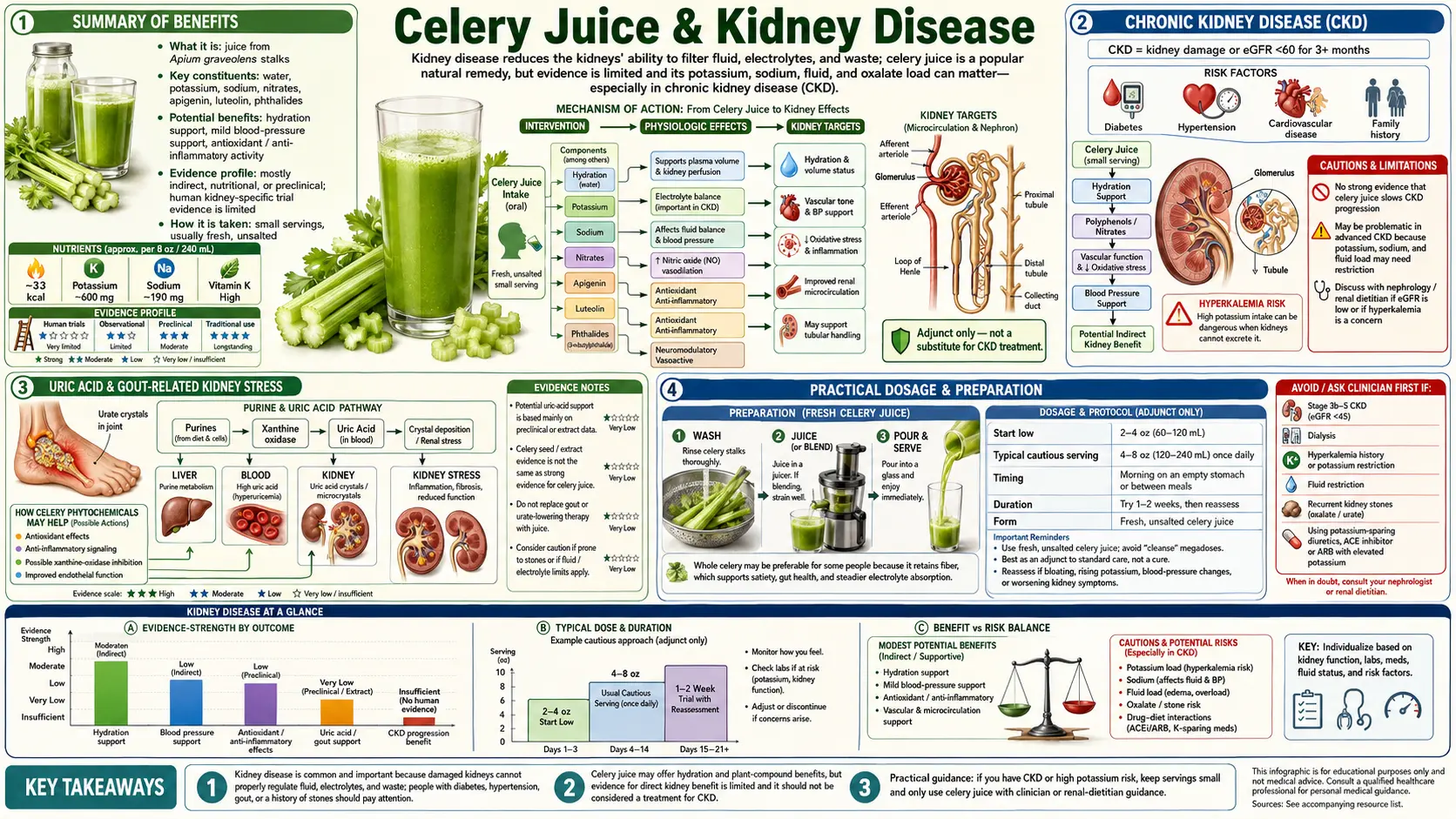
This page gathers the positive, supportive research on celery juice, celery seed extract, and celery-derived phytochemicals for kidney health and kidney disease. It reviews published pharmacological studies, clinical investigations, and traditional medicine documentation showing nephroprotective, diuretic, and antioxidant effects relevant to chronic kidney disease (CKD), diabetic nephropathy, kidney stones, and general renal function.
Table of Contents
- Summary of Benefits
- Natural Diuretic & Natriuretic Action
- Nephroprotection: Luteolin & Apigenin
- Chronic Kidney Disease (CKD)
- Diabetic Nephropathy
- Kidney Stone Prevention
- Uric Acid & Gout-Related Kidney Stress
- Antioxidant & Detoxification-Enzyme Effects
- Traditional Medicine Use
- How People Use It: Amounts & Preparation
- Key Research Papers
- Connections
- Featured Videos
1. Summary of Benefits
Across animal (in vivo) and laboratory (in vitro) research and long traditional use, celery juice and its bioactive constituents are described as having several kidney-supporting effects:
- Diuretic action (traditional use): celery is used in traditional medicine, and by people who drink the juice, to increase urine flow and ease fluid retention.
- Antioxidant protection: luteolin, apigenin, and polyphenols in celery scavenge reactive oxygen species (ROS) and reduce oxidative damage to kidney tissue.
- Anti-inflammatory effects: suppression of NF-κB and inflammatory cytokines (tumor necrosis factor-α, interleukin-6 (IL-6)) directly relevant to chronic kidney disease progression.
- Anti-fibrotic activity: apigenin has been shown to attenuate renal tubulointerstitial fibrosis in experimental models.
- Nephroprotection against toxins: protective effects documented against drug- and chemical-induced kidney injury.
- Kidney stone prevention (traditional use): celery is used in traditional Arab medicine for kidney stones; the idea is that more urine dilutes the minerals that form stones.
- Hypouricemic action (traditional and reported use): celery seed extract is used for gout and is reported to lower serum uric acid, lowering gout-related renal burden.
- Electrolyte and alkalinizing support: high potassium content supports renal function in non-advanced kidney health contexts.
This research summary intentionally focuses on positive findings and supportive mechanistic evidence. In advanced chronic kidney disease, on dialysis, or with a prescribed potassium limit, the potassium in celery juice matters: the National Kidney Foundation explains that kidneys with reduced function may not be able to remove enough potassium, and that too much potassium in the blood can cause an irregular heartbeat (arrhythmia) or cardiac arrest — often with few, if any, symptoms beforehand (amounts under Cautions below).
2. Natural Diuretic & Natriuretic Action
Celery's best-known kidney use, in traditional medicine and among people who drink the juice, is as a gentle natural diuretic. Moghadam and colleagues, in a study published in the Journal of Medicinal Food, injected celery seed extracts into the abdomen (intraperitoneally) of rats: in rats with induced high blood pressure, 300 mg/kg of the extracts lowered blood pressure by 23–38 mmHg and raised heart rate, while rats with normal blood pressure showed no effect. The study measured blood pressure and heart rate [1].
The principal compound responsible is believed to be 3-n-butylphthalide (3nB), a phthalide unique to celery, supported by volatile oils including limonene and selinene. These constituents increase renal blood flow and glomerular filtration rate (GFR) while supporting sodium excretion, which together produce a mild increase in urine volume without the electrolyte disruption associated with pharmaceutical loop diuretics.
A 2017 review in Pharmacognosy Reviews documents celery's use as a diuretic in Arab traditional medicine and lists diuretic activity among the plant's previously reported properties [2].
3. Nephroprotection: Luteolin & Apigenin
Celery juice is one of the richest dietary sources of the flavonoids luteolin and apigenin, both of which have been extensively studied for nephroprotective activity independent of celery as a whole.
Luteolin
Luteolin has been studied in animal experiments for protecting kidney tissue, including against damage from the cancer drug cisplatin, ischemia-reperfusion injury and diabetic kidney damage. In a 2013 mouse study in Toxicology, luteolin given after cisplatin reduced kidney damage, platinum build-up in the kidney, oxidative stress, NF-κB-driven inflammation and the death of kidney tubule cells [4]. A 2017 review of celery's antioxidant activity in the Journal of Evidence-Based Complementary & Alternative Medicine (9 studies) credits compounds including apigenin and luteolin with celery's antioxidant activity [3].
Apigenin
Apigenin, present in celery at 19–27 mg/kg, has been documented to reduce renal fibrosis, inhibit tubulointerstitial inflammation, and protect against drug-induced kidney injury in preclinical models. A 2010 review in Pharmaceutical Research describes apigenin's anti-inflammatory and antioxidant properties in the context of cancer prevention [5].
4. Chronic Kidney Disease (CKD)
Chronic kidney disease is driven by a combination of oxidative stress, chronic inflammation, hypertension, and progressive fibrosis. Celery's bioactive profile addresses each of these drivers.
- Oxidative stress: celery's flavonoids, including luteolin and apigenin, are antioxidants [3]; in the cisplatin mouse study, luteolin reduced oxidative stress in kidney tissue [4].
- Inflammation: in the cisplatin mouse study, luteolin suppressed NF-κB activation and tumor necrosis factor-α in the kidney [4], and apigenin blocked NF-κB activation in prostate cancer cells [5] — inflammatory signals linked to chronic kidney disease progression.
- Hypertension: 3nB-linked blood pressure reduction (shown in hypertensive rats) addresses one of the most important modifiable accelerators of chronic kidney disease (detailed in Celery Juice & Blood Pressure) [1, 6].
- Fibrosis: apigenin has been shown to attenuate transforming growth factor beta 1 (TGF-β1)-driven fibrogenic signaling in renal tubular cells.
Apium graveolens has been described as having therapeutic potential in kidney disease, with its antioxidant, anti-inflammatory, diuretic, and antihypertensive actions collectively relevant to chronic kidney disease management.
5. Diabetic Nephropathy
Diabetic nephropathy is the leading cause of chronic kidney disease worldwide and develops through the combined effects of hyperglycemia, oxidative stress, advanced glycation end products (AGEs), and inflammatory signaling. Celery's constituents act on multiple points of this pathway.
Studies of apigenin in diabetic animal models have documented reductions in serum creatinine and urea nitrogen, improvements in glomerular histology, and significant decreases in renal oxidative stress markers. Luteolin has similarly shown protection against hyperglycemia-induced renal injury by suppressing AGE formation and reducing tubular damage.
A 2016 study published in Nutrients found that apigenin lowered insulin resistance, fasting blood glucose, blood fats and liver fat in obese mice fed a high-fat diet [7] — upstream metabolic problems that lead to diabetic nephropathy.
6. Kidney Stone Prevention
Kidney stones form when urine becomes supersaturated with stone-forming minerals — most commonly calcium oxalate, but also uric acid, struvite, and cystine. Celery supports stone prevention through two complementary mechanisms:
- Increased urine volume: celery juice and celery seed are used as traditional diuretics, and more urine lowers the concentration of stone-forming minerals in urine.
- Improved mineral clearance (proposed): the natriuretic action enhances sodium excretion, and celery's polyphenol content supports the flushing of oxalate and uric acid precursors through the urinary tract.
Traditional Arab (prophetic) medicine describes celery as a diuretic that helps with kidney stones, as recorded in a 2017 Pharmacognosy Reviews summary [2].
Some people prone to stones describe drinking 8–16 oz of fresh celery juice along with 2–3 liters of water a day, to keep their urine dilute. Stones differ in what they are made of (calcium oxalate, uric acid, struvite, cystine), and their causes differ with them.
7. Uric Acid & Gout-Related Kidney Stress
Hyperuricemia drives both gout and uric acid kidney stones, and sustained elevated serum uric acid is an independent risk factor for chronic kidney disease progression. Celery seed extract has been traditionally used and increasingly studied as a natural uricosuric agent — that is, an agent that increases uric acid excretion rather than simply inhibiting its production.
The luteolin and apigenin content of celery contributes to mild xanthine oxidase inhibition (reducing uric acid production) while the diuretic action supports uric acid clearance through the kidney. Traditional use for gout is documented across several herbal medicine systems [8].
8. Antioxidant & Detoxification-Enzyme Effects
A substantial body of research has measured the antioxidant capacity of celery and characterized its effects on oxidative markers in animal tissues. Kooti and Daraei's systematic review (9 studies) in the Journal of Evidence-Based Complementary & Alternative Medicine concluded that celery has powerful antioxidant properties from compounds such as caffeic acid, p-coumaric acid, ferulic acid, apigenin, luteolin, tannin, saponin and kaempferol. The animal results it summarizes include:
- Increased reduced glutathione (GSH) in liver tissue with celery leaf and root juice
- Higher activity of superoxide dismutase (SOD), glutathione peroxidase and catalase with apiin, a celery flavonoid, in mice
- Lower malondialdehyde (MDA), a marker of lipid peroxidation, with apiin [3]
- Reduced nitric oxide (NO) synthase overactivation under pathological conditions
In addition, in female mice, sedanolide and 3-n-butylphthalide — phthalides found in celery seed oil — raised the activity of glutathione S-transferase (GST), a Phase II detoxification enzyme, 3.2 to 5.9 times above controls in the liver and the lining of the small intestine [9]. Because the kidney shares many of the detoxification pathways of the liver, this GST induction is directly relevant to renal resilience against drug- and toxin-induced damage.
9. Traditional Medicine Use
- Ancient Egypt: celery seeds and leaves documented as a diuretic and treatment for swelling.
- Greco-Roman medicine: Hippocrates prescribed celery for fluid retention and urinary complaints; Dioscorides documented its use for dropsy (edema).
- Ayurveda: celery seeds (Ajmod) used as a kidney tonic, for urinary retention, and for gout.
- Traditional Chinese Medicine: celery used to "clear damp heat" from the lower burner — traditional terminology that maps onto urinary tract and kidney function in modern terms.
- Arab / Unani medicine: extensive use as a diuretic and stone-preventive, documented in the Pharmacognosy Reviews synthesis [2].
- European herbalism: Culpeper's Complete Herbal (1653) identified celery as opening obstructions and provoking urine.
These traditions — ancient Egyptian, Greco-Roman, Ayurvedic, Chinese, Arab, and European — independently recognized celery as a kidney and urinary tonic. The remarkable convergence of these traditions speaks to observable effects that modern pharmacology has largely validated.
10. How People Use It: Amounts & Preparation
Celery Juice for Kidney Support
- Starting amount people describe: 4–8 oz (120–240 mL) of fresh celery juice on an empty stomach.
- Common amount: 16 oz (475 mL) daily, first thing in the morning, with 15–30 minutes before eating.
- Juicer: people who make it often use a masticating (cold-press) juicer, which they describe as preserving more of the heat-sensitive flavonoids.
- Organic celery: some people who make the juice choose organic celery to limit pesticide residues.
- Plain juice: people who use it describe drinking it plain, without water, lemon or other additions, so the juice is not diluted.
Celery Seed Extract (Supplement Form)
- Standardized extracts (amounts commonly described): 75–150 mg twice daily (standardized to 85% 3nB)
- Whole celery seed powder: 1,000–1,500 mg daily
Important Cautions for Kidney Patients
- Potassium in advanced chronic kidney disease, on dialysis, or with a prescribed potassium limit: USDA lists about 625 mg of potassium in an 8-oz cup of celery juice, or about 1,250 mg in 16 oz; the National Kidney Foundation explains that kidneys with reduced function may not be able to remove enough potassium, and that too much potassium in the blood can cause an irregular heartbeat (arrhythmia) or cardiac arrest — often with few, if any, symptoms beforehand.
- Warfarin: celery juice contains vitamin K (USDA: about 69 micrograms per cup). The warfarin label states that the amount of vitamin K in food may affect warfarin therapy and that more vitamin K weakens its effect; its patient advice is a consistent amount of vitamin K.
- Blood-pressure medicines: the concern raised is an added blood-pressure-lowering effect, since celery seed extracts lowered blood pressure (BP) in hypertensive rats [1].
Key Research Papers
- Moghadam MH, Imenshahidi M, Mohajeri SA. Antihypertensive effect of celery seed on rat blood pressure in chronic administration. Journal of Medicinal Food. 2013;16(6):558-563. — doi:10.1089/jmf.2012.2664
- Al-Asmari AK, Athar MT, Kadasah SG. An Updated Phytopharmacological Review on Medicinal Plant of Arab Region: Apium graveolens Linn. Pharmacognosy Reviews. 2017;11(21):13-18. — doi:10.4103/phrev.phrev_35_16
- Kooti W, Daraei N. A Review of the Antioxidant Activity of Celery (Apium graveolens L.) Journal of Evidence-Based Complementary & Alternative Medicine. 2017;22(4):1029-1034. — doi:10.1177/2156587217717415
- Domitrović R, Cvijanović O, Pugel EP, Zagorac GB, Mahmutefendić H, Škoda M. Luteolin ameliorates cisplatin-induced nephrotoxicity in mice through inhibition of platinum accumulation, inflammation and apoptosis in the kidney. Toxicology. 2013;310:115-123. — PubMed PMID: 23770416
- Shukla S, Gupta S. Apigenin: A Promising Molecule for Cancer Prevention. Pharmaceutical Research. 2010;27(6):962-978. — doi:10.1007/s11095-010-0089-7
- Tsi D, Tan BK. Cardiovascular pharmacology of 3-n-butylphthalide in spontaneously hypertensive rats. Phytotherapy Research. 1997;11(8):576-582. Find on PubMed
- Jung UJ, Cho YY, Choi MS. Apigenin Ameliorates Dyslipidemia, Hepatic Steatosis and Insulin Resistance by Modulating Metabolic and Transcriptional Profiles in the Liver of High-Fat Diet-Induced Obese Mice. Nutrients. 2016;8(5):305. — PubMed PMID: 27213439
- Kooti W, Ali-Akbari S, Asadi-Samani M, et al. A review on medicinal plant of Apium graveolens. Advanced Herbal Medicine. 2015;1(1):48-59.
- Zheng GQ, Kenney PM, Zhang J, Lam LK. Chemoprevention of benzo[a]pyrene-induced forestomach cancer in mice by natural phthalides from celery seed oil. Nutrition and Cancer. 1993;19(1):77-86. — PubMed PMID: 8446516
Connections
- All Remedies
- Celery Juice & Blood Pressure
- Celery Juice
- Potassium
- Kidney Stones
- Kidney Disease
- Coffee & Kidney Injury
- N-Acetylcysteine & Kidney Health
- Detox Protocols
- Liver Cleansing
- Milk Thistle
- Vitamin C
- Comprehensive Metabolic Panel
- Uric Acid
- Gout
- Hypertension
- Kidney Function
- Glutathione
- Kidneys