Celery Juice: History and Origins
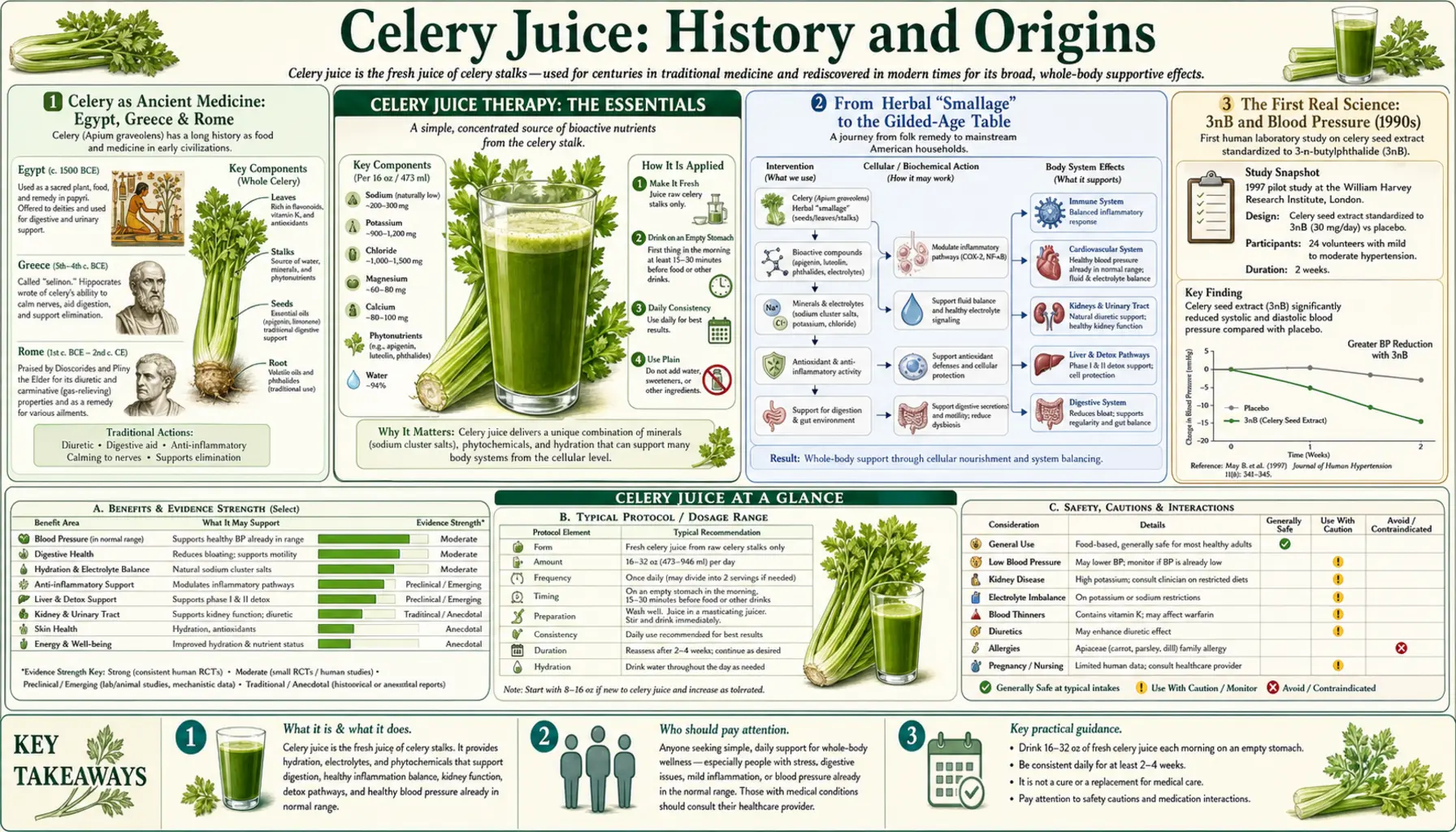
Celery juice has two histories. One is old: celery (Apium graveolens) was first domesticated in the Mediterranean region, where leaf celery (smallage) is the most ancient cultivated type, was described as a medicine in early-modern herbals, and in the 1990s became the subject of laboratory research into a blood-pressure-lowering compound in its oil. The other is recent: the modern "morning celery juice" practice — straight celery juice first thing in the morning — is credited to Anthony William, an author who writes that his health information comes from a source he calls "Spirit." This page traces both threads and sets out what published research does and does not show about the claims made for the juice.
Table of Contents
- Celery as Ancient Medicine: Egypt, Greece & Rome
- From Herbal "Smallage" to the Salad Stalk
- The First Real Science: 3nB and Blood Pressure (1990s)
- Anthony William and the Modern Trend
- The Claimed Source and the Books
- How the Morning Celery Juice Practice Spread
- Evidence & Reception: What Published Research Shows
- Two Histories, One Glass: A Summary
- Key Research Papers
- Connections
- Featured Videos
Celery as Ancient Medicine: Egypt, Greece & Rome
Celery's documented story begins long before anyone juiced it. A 2025 genomic study of 177 celery accessions found that smallage (leaf celery) from the Mediterranean region represents the most ancient type of cultivated celery, and that later selection for solid stalks and enlarged roots produced common celery and celeriac. The species carries the formal name Apium graveolens L., the "L." marking Carl Linnaeus as the botanist who named it.
Popular histories of the plant describe wild celery among the plant remains found in ancient Egyptian burials, including the garlands of Tutankhamun's tomb; celery (Greek selinon) in Greek victory wreaths and funeral customs; and Greek and Roman medical writers, Dioscorides among them, listing celery-family plants as remedies for digestive complaints and fluid retention. No peer-reviewed source confirming these specific details was found for this page, so they are reported here as the traditional account rather than as established findings. What such accounts describe is that celery was regarded as a medicinal plant in the ancient Mediterranean world, not that it cured the conditions it was used for.
From Herbal "Smallage" to the Salad Stalk
In the early-modern period celery appears in herbals mainly as a medicinal plant under the name smallage. The English herbalist Nicholas Culpeper, in his Complete Herbal, wrote that smallage "much more opens obstructions of the liver and spleen, rarefies thick phlegm, and cleanses it and the blood withal. It provokes urine…" That description — celery as a cleansing, diuretic, liver-related herb — is close to the language later used for celery juice.
The change from leafy medicinal herb to the mild salad stalk came through selection: the 2025 genomic study traces common celery's solid stalk to artificial selection on the petiole after the plant's initial domestication in the Mediterranean region, and found that the hollow-versus-solid stalk trait correlates with the presence or absence of a NAC gene.
Celery was also sold as a drink well before the juice trend. A bottled celery-flavored soda was, according to its maker, first produced in Brooklyn, New York, in 1868 and served in New York delicatessens from 1869; it was so popular in New York City's Jewish community in the 1930s that it was nicknamed "Jewish Champagne." The Food and Drug Administration objected to the product being called a "tonic," and its name was changed in the 1900s.
The First Real Science: 3nB and Blood Pressure (1990s)
The first laboratory chapter in celery's story came from the University of Chicago. In May 1992 a United Press International report described findings presented at the American Federation of Clinical Research meeting by Dr. William J. Elliott and medical student Quang T. Le. According to that report, the work began about five years earlier, when Le's father ate about a quarter pound of celery a day for a week for mild high blood pressure and reported a sustained drop in his readings.
Elliott and Le focused on 3-n-butylphthalide (often abbreviated 3nB or NBP), one of the more than 30 chemical compounds in celery oil. In rats, a small daily dose — described as the equivalent of about four celery stalks for a person — lowered blood pressure by 12 to 14 percent and cholesterol by about 7 percent. The researchers described the compound as allowing arteries to dilate while reducing levels of stress hormones that constrict them. These were animal results reported at a meeting and in the press; no peer-reviewed paper from this work was found in PubMed. Elliott was also quoted as saying celery itself was not being recommended for blood pressure because of its salt content.
Later research has continued this thread. A randomized, triple-blind, placebo-controlled crossover trial in Iran (52 patients with hypertension, 2022) gave celery seed extract capsules (1.34 g per day) or placebo for 4 weeks; on 24-hour ambulatory monitoring, systolic pressure with celery extract fell from 141.2 to 130.0 mmHg and diastolic from 92.2 to 84.2 mmHg, with no significant change on placebo and no significant side effects reported. A 2024 narrative review of animal and human studies concluded that celery and its extracts act as hypotensive agents, naming 3-n-butylphthalide and apigenin as key compounds, while noting that studies differ in doses, extracts, celery species and forms. A synthetic racemic form of the compound, dl-3-n-butylphthalide — based on l-3-n-butylphthalide isolated from Apium graveolens seeds — was approved by China's Food and Drug Administration for the treatment of ischemic stroke in 2002. These findings concern seed extracts and an isolated compound; they are distinct from the much broader claims later made for celery juice.
Anthony William and the Modern Trend
The modern celery juice practice is credited to Anthony William, an author who writes under the name "Medical Medium"; the Wikipedia article on him describes him as "the originator of the celery juice diet." William has described first receiving his expertise through a connection to "Spirit" at the age of four, and says he correctly identified lung cancer in his grandmother. According to the legal disclaimers on his own site, as summarized in that article, he holds no certifications of scientific or medical training; his health guidance is presented as coming from that spiritual source rather than from clinical training or research.
William has published eight books and has appeared on the New York Times Best Seller list, according to the same article. His articles have also appeared on a celebrity wellness website.
The Claimed Source and the Books
William writes that his connection to "Spirit" presents itself as a voice next to his right ear, and that it gives him the ability to identify infections, blockages and past health problems. Because the information is attributed to a spiritual source, it is not the kind of claim that controlled experiments, peer review and replication can test; this page reports what he writes without treating it as evidence.
The celery juice practice developed through his book series. His first book (2015) set out his thesis that the Epstein-Barr virus lies behind a wide range of chronic conditions, and in 2019 he published a book devoted to celery juice. In his celery juice writing he attributes the juice's effects to what he calls "sodium cluster salts," which he describes as removing toxins, killing pathogens and restoring stomach acid, and he has been quoted as saying that "the science behind the healing powers of celery juice is just yet to be discovered." A PubMed search found no study describing compounds of that name.
How the Morning Celery Juice Practice Spread
What William added was not the use of celery but a fixed routine. As summarized on Wikipedia, he describes drinking straight celery juice "first thing in the morning," starting at 4 to 16 ounces, and he calls it "a miracle juice" and "one of the greatest healing tonics of all time," saying it can improve energy levels, reduce bloating and increase "clarity of mind." The specific, repeatable form of the routine — one ingredient, one time of day — made it easy to share, and it spread widely on social media.
Evidence & Reception: What Published Research Shows
The central therapeutic claims made for celery juice in William's books have not been tested in published trials. What the record shows, claim by claim:
- "Cluster salts." A PubMed search for the term returns no studies; no compound class of that name appears in the indexed chemistry or food-science literature.
- Epstein-Barr virus. William attributes many cancers to EBV and, by his account, "over 95% of thyroid issues"; Wikipedia notes that no current scientific evidence supports this view. According to Wikipedia, the U.S. Centers for Disease Control and Prevention found no peer-reviewed scientific evidence for his claim that EBV causes lung cancer. A separate, much-cited 2022 study in Science (Bjornevik and colleagues), in a cohort of more than 10 million young adults in the U.S. military of whom 955 developed multiple sclerosis, found that MS risk rose 32-fold after EBV infection and concluded that EBV is the leading cause of MS. That finding concerns MS only; no study was found testing celery or celery juice against EBV.
- Celery juice in people. A PubMed search found no randomized trial of celery juice. The only human report found is a single 2021 case report of a 74-year-old man with hypertension whose blood pressure went from 150/80 to 118/82 mmHg over 6 months of daily celery juice combined with chiropractic care; a single uncontrolled case cannot separate the juice from other factors. A dietitian quoted in coverage of the trend said: "There's no scientific or research-based evidence to support this."
The vegetable itself does contain measured bioactive compounds. Celery contains the flavones apigenin, luteolin and chrysoeriol, including glycosides such as apigenin 7-O-apiosylglucoside; a U.S. retail survey measured mean nitrate levels of 1,496 mg/kg fresh weight in conventional celery and 912 mg/kg in organic-labeled celery; and its oil and seeds contain 3-n-butylphthalide, the compound behind the blood-pressure research described above.
Celery also carries a documented skin hazard. It contains psoralens (furocoumarins), which make skin react to ultraviolet A light (phytophotodermatitis). A 1987 occupational investigation of two Oregon grocery stores found 19 cases among workers at one store that had held a celery sale; tanning-salon use and outdoor sun exposure were risk factors, and two of three celery samples from that store had elevated psoralen levels. A 1994 outbreak among 11 celery-harvest workers in southern Israel was linked to celery containing 84 micrograms of total psoralens per gram, against 35 micrograms per gram in celery from the north of the country at the same time. A 2025 review states that the amount of furocoumarins in celery eaten as part of a typical diet generally is insufficient to cause this reaction, while people who handle celery regularly, eat fungus-infected produce or use tanning beds are at increased risk.
No trial was found showing that celery juice treats autoimmune thyroid disease, multiple sclerosis, type 1 diabetes or inflammatory bowel disease; decisions about treating these conditions belong with a clinician. These issues are explored in depth on the companion Evidence and Skepticism article.
Two Histories, One Glass: A Summary
The history of celery juice is two stories that meet in one morning glass. The first is the long history of celery as a plant and a remedy — domesticated from Mediterranean smallage, described as a liver and urine-provoking herb in Culpeper's herbal, sold as a celery soda in nineteenth-century New York, and studied for its blood-pressure-lowering compound 3-n-butylphthalide from the 1990s onward, work that now includes a small seed-extract trial and a stroke drug approved in China.
The second is the modern practice credited to Anthony William — a daily morning juice routine, framed by a theory of disease that he attributes to a spiritual source and spread widely through social media. Its specific therapeutic claims have not been tested in published trials. The fuller evidence picture and safety findings are covered on the main Celery Juice hub and its Benefits articles; this page is concerned with how the remedy — and the practice around it — came to be.
Key Research Papers
The list below combines peer-reviewed sources on celery's pharmacology, chemistry and skin hazards with reference material on the history of celery and of the modern celery juice practice, plus PubMed topic searches. Author names, titles, and journals are given as plain text; only stable DOI, PMID, or archival links are hyperlinked, and each opens in a new tab. The claims made for celery juice by its popularizer are self-reported and are described in the article as his own statements, not as scientific citations.
- Shayani Rad M, Moohebati M, Mohajeri SA. Effect of celery (Apium graveolens) seed extract on hypertension: a randomized, triple-blind, placebo-controlled, cross-over, clinical trial. Phytotherapy Research. 2022;36(7):2889-2907. — doi:10.1002/ptr.7469 ( PubMed PMID: 35624525)
- Alobaidi S, Saleh E. Antihypertensive property of celery: a narrative review on current knowledge. International Journal of Food Science. 2024;2024:9792556. — doi:10.1155/2024/9792556 ( PubMed PMID: 38505582)
- Bjornevik K, Cortese M, Healy BC, et al. Longitudinal analysis reveals high prevalence of Epstein-Barr virus associated with multiple sclerosis. Science. 2022;375(6578):296-301. — doi:10.1126/science.abj8222 ( PubMed PMID: 35025605)
- Celery compound lowers blood pressure (Elliott WJ and Le QT, University of Chicago; 3-n-butylphthalide research). United Press International archive. May 1, 1992. — UPI Archives, 1992
- Anthony William — biography and claims. Wikipedia. — en.wikipedia.org/wiki/Anthony_William
- History of a nineteenth-century bottled celery soda (Brooklyn, 1868). Wikipedia. — Wikipedia: celery soda article
- Culpeper N. The Complete Herbal, entry "Smallage." Project Gutenberg eBook #49513. — gutenberg.org/ebooks/49513
- Lai E, Guo S, Wu P, et al. Genome of root celery and population genomic analysis reveal the complex breeding history of celery. Plant Biotechnology Journal. 2025;23(3):946-959. — PubMed PMID: 39707837
- Wang S, Ma F, Huang L, et al. Dl-3-n-Butylphthalide (NBP): a promising therapeutic agent for ischemic stroke. CNS & Neurological Disorders Drug Targets. 2018;17(5):338-347. — PubMed PMID: 29895257
- Illes JD. Blood pressure change after celery juice ingestion in a hypertensive elderly male. Journal of Chiropractic Medicine. 2021;20(2):90-94. — PubMed PMID: 34987326
- Hostetler GL, Riedl KM, Schwartz SJ. Effects of food formulation and thermal processing on flavones in celery and chamomile. Food Chemistry. 2013;141(2):1406-1411. — PubMed PMID: 23790931
- Nuñez de González MT, Osburn WN, Hardin MD, et al. A survey of nitrate and nitrite concentrations in conventional and organic-labeled raw vegetables at retail. Journal of Food Science. 2015;80(5):C942-C949. — PubMed PMID: 25850811
- Seligman PJ, Mathias CG, O'Malley MA, et al. Phytophotodermatitis from celery among grocery store workers. Archives of Dermatology. 1987;123(11):1478-1482. — PubMed PMID: 2960270
- Finkelstein E, Afek U, Gross E, et al. An outbreak of phytophotodermatitis due to celery. International Journal of Dermatology. 1994;33(2):116-118. — PubMed PMID: 8157392
- Pate HF, Hill K, McGovern TW. Not as bland as you may think: celery (Apium graveolens) commonly induces phytophotodermatitis. Cutis. 2025;115(3):E28-E30. — PubMed PMID: 40315466
PubMed Topic Searches
- Apium graveolens (celery) pharmacology and health — PubMed PMID: 40656623
- Celery seed extract and blood pressure — clinical evidence — PubMed PMID: 36334223