Anthony William and the Origin of the Celery Juice Movement
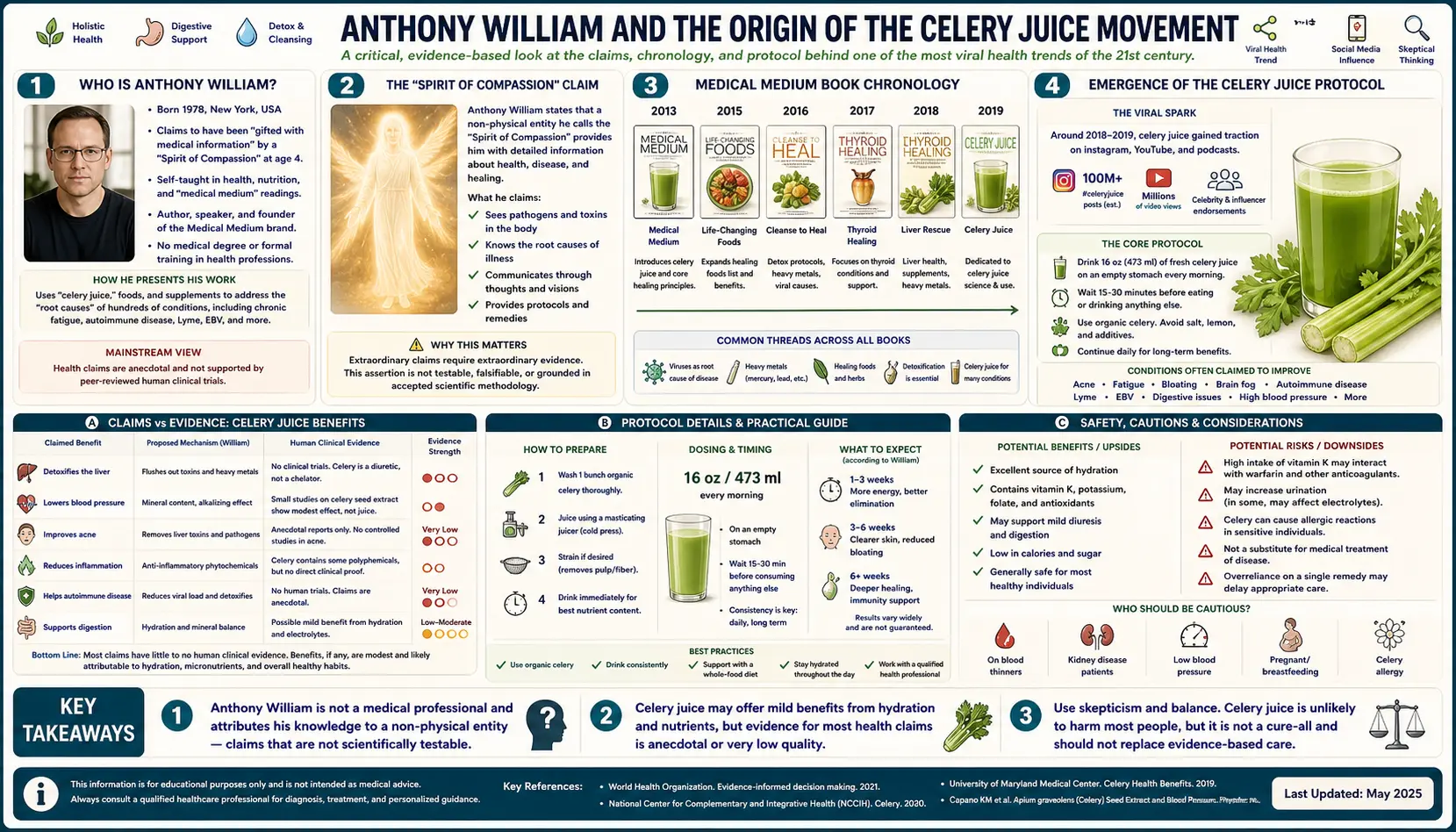
The "Medical Medium" celery juice protocol — 16 ounces of straight, pulp-free, cold-pressed celery juice on an empty stomach, first thing every morning, waiting 15-30 minutes before consuming anything else — was popularized starting around 2015 by Anthony William, an author whose publisher describes him as born with the ability to converse with a spirit that provides him with health information; his books call it "Spirit of Compassion." The practice spread widely on social media in 2018 and 2019. This page is a neutral chronology of how a humble Apiaceae garden vegetable became the centerpiece of a wellness movement, alongside what clinicians and researchers have said in response.
Table of Contents
- Anthony William: Background
- The "Spirit of Compassion" Claim
- The Medical Medium Book Chronology
- The Emergence of the Celery Juice Protocol
- Instagram Virality and #CeleryJuice
- Celebrity and Influencer Attention
- What Clinicians and Researchers Have Said
- Federal Trade Commission Rules on Health Claims
- Why the Protocol Spread So Effectively
- Key Research Papers
- Connections
- Featured Videos
Anthony William: Background
Anthony William, who writes under the brand name "Medical Medium," is the author of eight books on health and chronic illness, published by Hay House between 2015 and 2022 (listed below). His website's disclaimer states that he "is not a licensed medical doctor, chiropractor, osteopathic physician, naturopathic doctor, nutritionist, pharmacist, psychologist, psychotherapist, or other formally licensed healthcare professional, practitioner or provider of any kind." His publisher's biography states that he "was born with the unique ability to converse with a high-level spirit who provides him with extraordinarily accurate health information"; his books call this spirit "Spirit of Compassion."
The spiritual source is not hidden — it is the explicit foundation of the brand. The "Medical Medium" name itself joins "medical" (the subject matter) and "medium" (the spiritualist tradition of people who say they receive messages from spirits). His publisher's biography states that at age four he announced that his grandmother, who had no symptoms, had lung cancer, and that medical testing soon confirmed it; since then, it says, he has used this ability to "read" people's conditions.
The "Spirit of Compassion" Claim
"Spirit of Compassion" is the name William gives to the entity he says provides him with medical information. He describes the spirit as an angelic or transcendent being, not a human ghost, and not associated with any specific religious tradition. The spirit reportedly speaks in plain language about pathophysiology, supplement protocols, dietary changes, and the underlying causes of chronic disease.
William's books credit Spirit of Compassion explicitly in their forewords and acknowledgments. The "voice" is presented not as metaphor but as the literal source of all the diagnostic and therapeutic claims that follow. This positions the books in a long Western tradition that includes Edgar Cayce's "sleeping prophet" health readings of the 1930s and 1940s, the channeled medical guidance of the 19th-century Spiritualist movement, and various other "intuitive medicine" traditions.
The Medical Medium Book Chronology
The Medical Medium book series, published by Hay House (a major spirituality and self-help publisher founded by Louise Hay):
- 2015 — Medical Medium: Secrets Behind Chronic and Mystery Illness and How to Finally Heal. The foundational book. Introduces the Epstein-Barr Virus chronic-infection thesis as the proposed root cause of dozens of conditions including Hashimoto's thyroiditis, fibromyalgia, multiple sclerosis, chronic fatigue syndrome, lupus, and tinnitus.
- 2016 — Medical Medium Life-Changing Foods. Catalog of fruits, vegetables, herbs, and spices with assigned therapeutic properties for various conditions. Introduces the language of "Holy Four" foods (fruits, leafy greens, herbs/spices, wild foods).
- 2017 — Thyroid Healing: The Truth Behind Hashimoto's, Graves', Insomnia, Hypothyroidism, Thyroid Nodules & Epstein-Barr. Extends the Epstein-Barr virus (EBV) thesis to all thyroid disease.
- 2018 — Liver Rescue. Frames the liver as the central organ in chronic illness, with Epstein-Barr virus and "viral byproducts" depositing in liver tissue and causing systemic disease.
- 2019 — Medical Medium Celery Juice: The Most Powerful Medicine of Our Time. The dedicated celery juice book. By this point celery juice had already become a viral Instagram movement, and the book consolidated the protocol, introduced the "undiscovered cluster salts" terminology, and expanded the list of conditions celery juice was claimed to address.
- 2020 — Cleanse to Heal. Comprehensive cleansing and dietary protocols organized by condition.
- 2022 — Brain Saver series (Brain Saver and Brain Saver Protocols, Cleanses & Recipes). Extends the framework to neurological and psychiatric conditions.
The Emergence of the Celery Juice Protocol
The specific 16-ounce-on-empty-stomach celery juice protocol crystallized in William's public communications around 2015-2016, on his website, in his podcasts, and in social media. The framing — that celery juice acts as a "powerful medicine" through the action of "undiscovered cluster salts" that mobilize toxins, kill pathogens, and restore stomach hydrochloric acid — was his own. The vegetable itself is ancient: celery (Apium graveolens) was used as a medicinal plant in classical Greek and Roman pharmacology (the "smallage" of Hippocrates and Dioscorides), in traditional Chinese medicine, and in Ayurveda.
What was new in 2015 was the specific protocol stack: (1) 16 fluid ounces, (2) straight celery only, no other ingredients, (3) strained pulp-free, (4) consumed first thing in the morning, (5) on a completely empty stomach, (6) with a 15-30 minute wait before consuming anything else, (7) every day, (8) for an indefinite period (described as therapeutic for months or years).
Instagram Virality and #CeleryJuice
The celery juice movement spread largely through Instagram. The visual format (a 16-oz glass of bright green juice, photographed in morning light against a kitchen counter) suited the platform, and posts gathered under hashtags such as #CeleryJuice, #CeleryJuiceHealing and #MedicalMedium.
The pattern was archetypal social-media wellness virality:
- Visual format readily shareable (the green-juice photo).
- Low barrier to entry (celery is universally available and inexpensive).
- Promised dramatic benefits across a wide range of complaints, allowing identification by users with diverse conditions.
- Strong community formation around the practice (online groups, hashtag-based identity).
- Posts by celebrities and influencers reaching large audiences.
- Easily attributable subjective benefits (feeling better in the morning is a common before-coffee comparison).
Many users adopted celery juice in 2018-2019 having never read the Medical Medium books, having only encountered the practice through Instagram or word-of-mouth.
Celebrity and Influencer Attention
Celebrities, influencers and lifestyle websites wrote and posted about celery juice and featured William's work, which carried the practice to audiences well beyond the readers of his books.
What Clinicians and Researchers Have Said
As the trend grew, clinicians and researchers responded to the specific claims:
- A 2024 Cleveland Clinic health article, written with registered dietitian Amber Sommer, states that "celery juice isn't unhealthy" but that it is not a cure-all; it notes that juicing strips away much of the fiber found in whole celery, and that the liver is the body's own detoxification system.
- The books describe the "cluster salts" they credit for celery juice's effects as "undiscovered"; no published laboratory analysis has identified or measured them.
- Epstein-Barr virus infects most people and persists for life, held in check by B-cell latency and the immune system's T cells, natural killer (NK) cells and antibodies, as a 2026 review describes (Cao 2026). In a study of more than 10 million young adults in the U.S. military, the risk of multiple sclerosis rose 32-fold after Epstein-Barr virus infection (Bjornevik 2022).
- Hashimoto's thyroiditis is an autoimmune thyroid disease with known human leukocyte antigen (HLA) gene associations; Epstein-Barr virus is one of several proposed triggers under study, and standard care uses thyroid-stimulating hormone (TSH) monitoring and levothyroxine where thyroid hormone is low.
The concerns raised center on the therapeutic claims rather than on the juice itself, and on the possibility of celery juice being used in place of established treatment.
Federal Trade Commission Rules on Health Claims
In the United States, the Federal Trade Commission (FTC) requires health claims in advertising to be backed by "competent and reliable scientific evidence." Its Health Products Compliance Guidance, which updates its 1998 advertising guide for dietary supplements, defines this as "tests, analyses, research, or studies that (1) have been conducted and evaluated in an objective manner by experts in the relevant disease, condition, or function to which the representation relates; and (2) are generally accepted in the profession to yield accurate and reliable results."
The Medical Medium website carries a disclaimer stating that its information "is for informational purposes only and should not be considered to be healthcare advice or medical diagnosis, treatment or prescribing."
Other sellers, including multi-level marketing (MLM) operators, began selling celery juice powders and "celery juice cleanses" with specific cure claims for cancer, diabetes, and autoimmune disease. A 2018 analysis of multi-level marketing of nutrition supplements concluded that the business model is legal but argued that it is unethical, pointing to products of unproven efficacy and possible harm from excess nutrients and toxicity (Cardenas 2018).
Why the Protocol Spread So Effectively
Several structural reasons the celery juice protocol achieved such broad adoption:
- Mainstream medicine's gap in chronic illness. Conditions like chronic fatigue, fibromyalgia, irritable bowel syndrome (IBS), eczema, autoimmune flares, and unexplained inflammation are notoriously poorly served by conventional medicine. Patients with these conditions are pre-conditioned to seek alternatives. The Medical Medium framework offers a comprehensive model that explains all of them through a single cause (Epstein-Barr virus and "toxins") and a coherent protocol (celery juice + heavy-metal-detox smoothie + dietary changes). Whether the model is correct is one question; the unmet patient need that drove its adoption is entirely real.
- Subjective experience is overwhelming. The user who feels measurably better on the protocol is unlikely to be persuaded by epistemological objections about the source of the recommendations. "It works for me" trumps "there is no mechanism" in lived experience.
- The intervention is low-risk for most people. Dietitians describe celery juice as not unhealthy, so trying 16 oz a day felt like a low-stakes experiment.
- Strong community formation. The Medical Medium Facebook groups, Instagram communities, and conferences provide a social structure that conventional dietary advice does not. Belonging matters.
- Algorithmic amplification. Instagram and Facebook's engagement-optimizing algorithms reward visually striking, emotionally resonant before-and-after content. The celery juice format was optimized for that environment.
These drivers help explain why thoughtful, intelligent people adopt the practice. The companion Evidence and Skepticism page covers the substantive scientific objections to the specific claims.
Key Research Papers
- Cao Y, Liang Y, Zhao C, Zhou Z, Yu S, Yang Q, Shao L. Lifelong Epstein-Barr virus persistence as a stress test of ageing immune surveillance: From infectious mononucleosis to chronic active EBV disease and virus-associated malignancy. Ageing Res Rev. 2026;123:103387. PubMed PMID: 42815585
- Bjornevik K, Cortese M, Healy BC, Kuhle J, Mina MJ, Leng Y, Elledge SJ, Niebuhr DW, Scher AI, Munger KL, Ascherio A. Longitudinal analysis reveals high prevalence of Epstein-Barr virus associated with multiple sclerosis. Science. 2022;375(6578):296-301. PubMed PMID: 35025605
- Cardenas D, Fuchs-Tarlovsky V. Is multi-level marketing of nutrition supplements a legal and an ethical practice? Clin Nutr ESPEN. 2018;25:133-138. PubMed PMID: 29779808
PubMed Topic Searches
- PubMed: Apium graveolens (celery)
- PubMed: EBV and Hashimoto's
- PubMed: EBV and autoimmune disease
- PubMed: Alternative medicine chronic illness
- PubMed: Placebo in dietary trials
- PubMed: Social media and diet
- PubMed: Social media health trend
- PubMed: Celebrity health endorsement
- PubMed: Wellness celebrity endorsement
- PubMed: Wellness culture sociology
- PubMed: Health info seeking
- PubMed: Channeled medicine history
Connections
- All Remedies
- Celery Juice Benefits Hub
- Celery Bioactive Compounds
- Claimed Detox Benefits
- Evidence and Skepticism
- Celery Juice (Hub)
- Celery Juice for Blood Pressure
- Celery Juice and Kidney Disease
- Celery (Whole Food)
- Hashimoto's Thyroiditis
- Multiple Sclerosis
- Fibromyalgia
- Chronic Fatigue Syndrome
- Morley Robbins Mineral Protocol
- Gerson Therapy