Celery Juice Claimed Detox Benefits — Proponent Claims Presented Neutrally
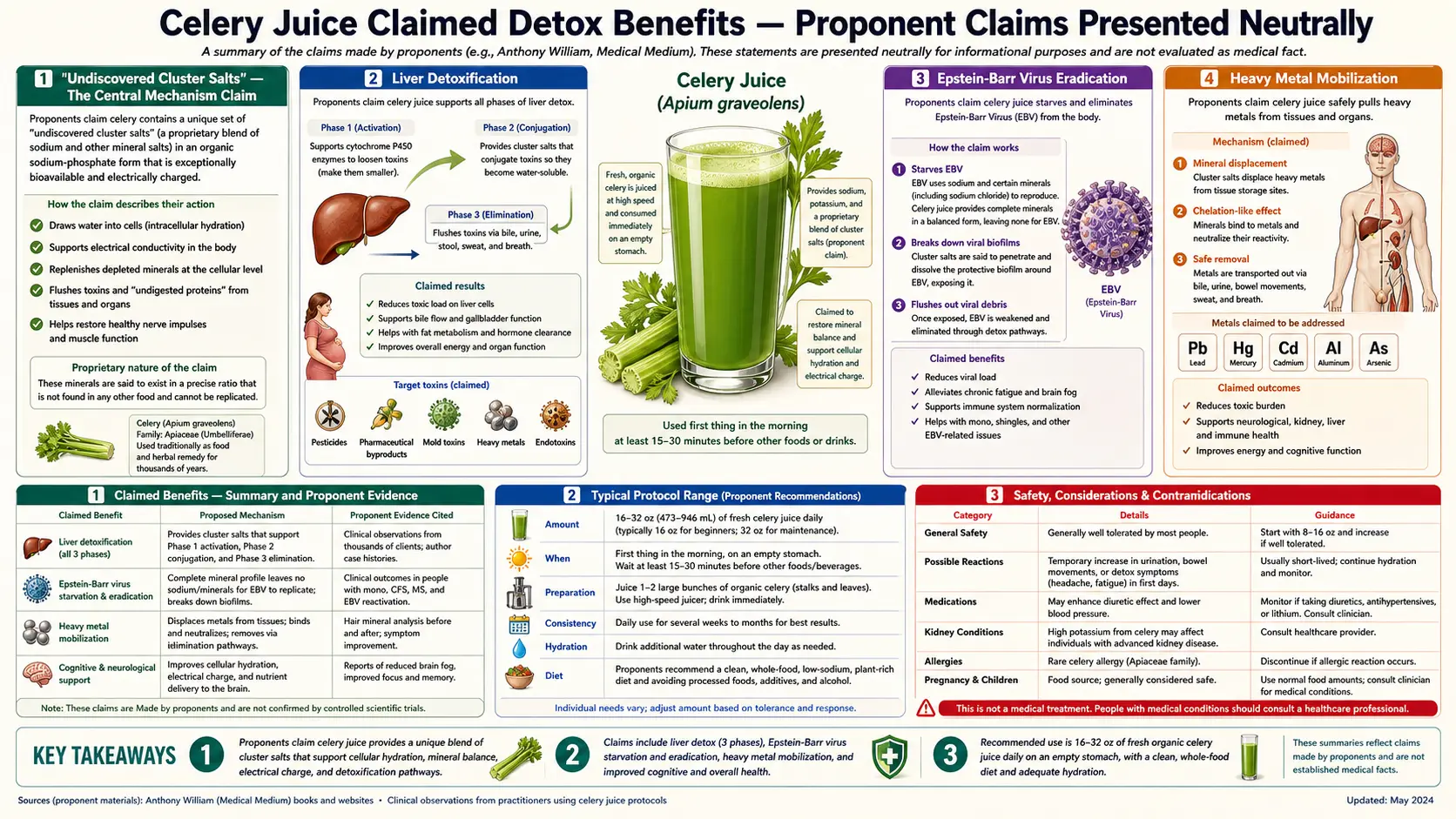
This page sets out the "detox" claims made for the celery juice practice in the framing used by its originator, the author Anthony William, and by his followers. The claims are reported as theirs, not as findings, and each section ends with what a PubMed search found. A PubMed search found no randomized trial of celery juice; the only human report of the juice found is a single 2021 case report. The companion Evidence and Skepticism page places each of these claims next to what the peer-reviewed evidence does or does not show, and covers the criticism the practice has drawn.
Table of Contents
- "Undiscovered Cluster Salts" — The Central Mechanism Claim
- Liver Detoxification
- Epstein-Barr Virus Eradication
- Heavy Metal Mobilization
- Restored Stomach Hydrochloric Acid
- Bloating, SIBO, and Digestion
- Autoimmune Conditions
- Skin Conditions (Acne, Eczema, Psoriasis)
- Energy, Adrenal Fatigue, and Chronic Fatigue
- Protocol Specifics and Why Each Detail Matters (Per Proponents)
- Key Research Papers
- Connections
- Featured Videos
"Undiscovered Cluster Salts" — The Central Mechanism Claim
The proposed central mechanism in Anthony William's framework is the action of what he calls "undiscovered cluster salts" or "celery juice cluster salts." Per his books and online materials, these are described as a unique form of sodium that is bound up in clusters with other mineral compounds and trace elements in a configuration that has not been identified by conventional analytical chemistry. The cluster salts are said to be the specific therapeutic agent in celery juice, and to be present only in fresh, straight, unblended celery juice on an empty stomach — not in whole celery, not in blended celery, not in celery juice mixed with other ingredients.
The functions attributed to cluster salts include:
- Breaking apart and neutralizing viral and bacterial pathogens (especially Epstein-Barr Virus and shingles virus) by stripping their protective outer membranes
- Mobilizing heavy metals (especially mercury, aluminum, copper, lead) from deep tissue stores so they can be eliminated
- Replenishing the hydrochloric acid in the stomach by providing the specific sodium ions needed for HCl synthesis
- Restoring the bile production and bile composition of a damaged liver
- Strengthening the central nervous system by repairing neurotransmitter pathways
- Healing the gut lining by binding to and neutralizing the byproducts of pathogenic bacteria
The claim is that cluster salts exist only in plant cell water at the moment fresh celery is juiced and consumed; they are said to degrade within minutes after juicing (which is why proponents emphasize drinking the juice immediately after pressing) and to be inactivated by the presence of any other ingredient (which is why the protocol specifies straight, unmixed juice).
What PubMed shows. A PubMed search for "cluster salts" together with celery returns no studies, and no compound class of that name was found in the indexed chemistry or food-science literature. A PubMed search also found no randomized trial of celery juice itself. The randomized trials of celery found for this page used celery seed extract, not juice — for example a 2022 triple-blind, placebo-controlled crossover trial of celery seed extract capsules in 52 people with hypertension (PubMed PMID: 35624525). The only human report of celery juice found is a 2021 case report of one man with hypertension who drank it daily alongside chiropractic care (PubMed PMID: 34987326). The companion skepticism page covers the academic response in detail.
Liver Detoxification
In William's framework, the liver is the central organ in chronic illness. Proponents describe a "sluggish" or "stagnant" liver as the underlying cause of dozens of conditions including weight resistance, eczema, acne, dark circles under the eyes, fatigue, hot flashes, mood disturbance, and food sensitivities. The proposed mechanism is accumulation of pathogenic byproducts (especially EBV "viral debris"), heavy metals, pesticides, plastics, and "troublemaker foods" (eggs, dairy, gluten, corn, canola oil) in liver tissue, where they congest the lobules and impair the liver's normal detoxification functions.
Celery juice is said to address this by:
- Providing cluster salts that mobilize accumulated toxins from liver tissue so they can be excreted via bile
- Supporting bile production and bile composition so that the gallbladder can effectively eliminate the mobilized toxins
- Reducing the population of liver-resident pathogens (EBV, shingles, streptococcus per the framework)
- Reducing inflammation in the hepatic sinusoids so that nutrient delivery and waste clearance improve
The pattern proponents describe is a several-week to several-month gradual improvement in liver-attributed symptoms: clearer skin, more stable energy, less morning stiffness, reduced food sensitivities, and improved digestion of fats. These are anecdotal reports.
What PubMed shows. No human study was found testing celery juice for liver function, bile flow, or the removal of toxins from the liver. The studies found are in animals. In rats, methanolic extracts of celery seeds showed significant protection of the liver against damage from a single large dose of paracetamol or from thioacetamide (1995; PubMed PMID: 8824736). In mice, celery juice given two hours beforehand was followed by a significant decrease of cytochrome P450 (a family of drug-metabolizing liver enzymes) in liver tissue, and by longer-lasting effects of paracetamol and aminopyrine (2002; PubMed PMID: 12365194). These are animal results with extracts or juice at experimental doses; they have not been tested in people.
Epstein-Barr Virus Eradication
William's framework places Epstein-Barr Virus (EBV) at the center of dozens of chronic conditions, with a specific model of "stages" of EBV infection that progresses over years or decades from initial mononucleosis to chronic latent infection in liver tissue, to mutation into more aggressive viral strains, to eventual triggering of autoimmune disease (particularly Hashimoto's thyroiditis, multiple sclerosis, lupus, rheumatoid arthritis, and fibromyalgia).
Celery juice is said to address EBV through the cluster-salt mechanism described above. Specifically:
- Cluster salts are said to strip the lipid envelope and outer protein coat of EBV virions, exposing the viral DNA to immune destruction
- The progressive reduction of EBV viral load is said to gradually reverse autoimmune flares and chronic-fatigue symptoms
- Combined with William's broader "anti-EBV" protocol (which includes zinc, vitamin B12 as methylcobalamin and adenosylcobalamin, vitamin C, L-lysine, licorice root, lemon balm, cat's claw, and a strict avoidance of "EBV-feeding" foods including eggs, dairy, gluten, corn, canola oil, soy, and pork), celery juice is said to accelerate the eradication of chronic EBV infection
The duration of protocol adherence required for full effect is described in the books as months to years, depending on the stage of the infection at the start.
What PubMed shows. No study was found testing celery or celery juice against EBV, in people or in the laboratory, and no study was found describing a celery compound that strips the virus's envelope. Celery contains the flavone apigenin (PubMed PMID: 23790931). In a 2017 cell-culture study, isolated apigenin inhibited EBV reactivation (the virus's lytic cycle) in epithelial cells and B cells and reduced the production of virus particles (PubMed PMID: 28056971); that is a laboratory result with the purified compound, not a finding about drinking celery juice.
Heavy Metal Mobilization
Heavy metal toxicity is the second pillar of William's framework (alongside chronic EBV). The metals specifically named are mercury (from dental amalgams, vaccines, fish, environmental exposure), aluminum (from antiperspirants, vaccines, cookware, food packaging), copper (which the framework classes as a "heavy metal"; in standard nutrition science copper is an essential trace mineral), lead, nickel, cadmium, and arsenic.
Celery juice is said to address heavy metal toxicity through:
- Cluster salts that loosen heavy metals from their tissue binding sites (especially in the brain and liver)
- Combined use with the "Heavy Metal Detox Smoothie" (a specific recipe with wild blueberries, cilantro, barley grass juice powder, spirulina, and Atlantic dulse) that is said to bind the mobilized metals so they can be excreted rather than redepositing in other tissues
- Long-term adherence allowing progressive depletion of accumulated metal stores in deep tissue
On copper, William's view is the opposite of that of Morley Robbins, who describes bioavailable copper (from beef liver, oysters, raw dairy, bee pollen, and other whole-food sources) as therapeutic for many of the same conditions that William's framework treats as evidence of copper toxicity. Robbins's approach is covered on the Morley Robbins page.
What PubMed shows. No study was found measuring whether celery juice, alone or with the smoothie, increases the removal of mercury, aluminum, lead, or other metals from the body in people. In one 2024 rat study of lead poisoning, a celery extract given at 300 mg/kg body weight per day changed blood IL-6 and liver caspase-3 levels compared with untreated lead-exposed rats (PubMed PMID: 38516746); the abstract does not report lead levels or lead excretion.
Restored Stomach Hydrochloric Acid
Low stomach acid (hypochlorhydria) is identified in William's framework as a near-universal feature of modern chronic illness, said to be the result of accumulated stress, viral infection, ammonia produced by intestinal bacteria, and consumption of "troublemaker foods." Low stomach acid is described as the root cause of bloating, SIBO, food sensitivities, B12 deficiency, mineral deficiency, and the perception of heartburn (which is described as paradoxically caused by insufficient rather than excessive stomach acid in this framework).
Celery juice is said to restore stomach acid by:
- Providing the cluster-salt sodium that is the building block of hydrochloric acid (HCl) synthesis in the gastric parietal cells
- Reducing the population of ammonia-producing pathogenic bacteria in the upper GI tract
- Strengthening the central nervous system signaling (vagal tone) that drives gastric acid secretion
- Healing the parietal cells themselves, which are described as damaged in many people with low stomach acid
The empty-stomach, first-thing-in-the-morning timing is said to be essential because cluster salts must directly contact the gastric mucosa without being diluted or buffered by food.
What PubMed shows. In standard physiology the stomach is acidified by parietal cells, which insert proton pumps into their membranes when stimulated and secrete acid into the stomach (2019 review; PubMed PMID: 30831083). Hydrochloric acid contains no sodium. No study was found showing that celery juice, or the sodium it contains, raises stomach acid, and a PubMed search found no study of celery juice in people with low stomach acid or heartburn.
Bloating, SIBO, and Digestion
Reduced bloating is among the benefits celery juice users describe. William's framework explains this as the combined effect of:
- Restored stomach acid (so food is properly digested in the stomach rather than fermenting in the small intestine)
- Cluster-salt reduction of populations of pathogenic gut bacteria, including the streptococcus strains the framework identifies as the primary cause of SIBO
- Improved bile flow (so dietary fats are properly emulsified rather than passing undigested into the colon)
- Anti-inflammatory action on the gut lining itself, reducing the visceral distension that is perceived as bloating
Users describe bloating reduction within days to weeks of starting the protocol, and proponents attribute it specifically to the cluster-salt and pathogen-reducing mechanism. What PubMed shows: no controlled study of celery juice for bloating or SIBO was found, so these reports cannot separate an effect of the juice from expectation, placebo, the added fluid, or other changes in morning habits.
Autoimmune Conditions
William's framework holds that virtually all autoimmune conditions are misclassified — that the body is not, in fact, attacking itself, but is instead attacking chronic viral, bacterial, and toxic invaders in tissue. The visible "autoimmune" disease pattern (anti-thyroid antibodies, anti-myelin antibodies, anti-joint antibodies) is reinterpreted as the immune system correctly attacking pathogens that have taken up residence in the relevant tissues.
By this framework, celery juice addresses autoimmune disease by reducing the pathogen load (EBV, shingles, streptococcus per the model) and heavy metal load that are said to be the actual triggers, after which the immune system stops needing to attack the affected tissue. Conditions specifically targeted include:
- Hashimoto's Thyroiditis — reframed as EBV in thyroid tissue
- Graves' disease — also EBV-attributed
- Multiple Sclerosis — described as EBV plus heavy metals in the central nervous system
- Rheumatoid arthritis — described as streptococcus and EBV in joint tissue
- Lupus — EBV plus heavy metal accumulation
- Fibromyalgia — described as inflamed nerve sheaths from EBV neurotoxins
- Inflammatory bowel disease (Crohn's, ulcerative colitis) — streptococcus and EBV in intestinal tissue
Proponents report gradual reduction of flares, antibody titers, and symptom severity over months to years of protocol adherence. These reports are anecdotal rather than from controlled trials.
What PubMed shows. A separate 2022 study in Science, in a cohort of more than 10 million young adults in the U.S. military of whom 955 developed multiple sclerosis, found that MS risk rose 32-fold after EBV infection and was not increased after infection with other viruses (PubMed PMID: 35025605). That finding concerns EBV and MS only; it did not test celery juice or heavy metals. No trial was found showing that celery juice treats autoimmune thyroid disease, multiple sclerosis, rheumatoid arthritis, lupus, fibromyalgia, or inflammatory bowel disease; decisions about treating these conditions belong with a clinician.
Skin Conditions (Acne, Eczema, Psoriasis)
Skin conditions are another benefit area claimed for celery juice. Proponents describe acne, eczema, psoriasis, rosacea, perioral dermatitis, and chronic urticaria as outward expressions of internal liver toxicity and pathogen load. Celery juice is said to address these by:
- Reducing the liver burden so that skin no longer serves as a secondary elimination pathway for toxins
- Reducing systemic inflammation
- Reducing the pathogen load (streptococcus per the framework) that is said to drive much of acne and rosacea
- Replenishing electrolytes and hydration in skin cells
The timeline proponents describe is several weeks to a few months for visible improvement, often with an initial "purge" period of worsening before improvement (the framework calls this "die-off" of pathogens and "mobilization" of toxins from skin tissue).
What PubMed shows. No study was found testing celery juice for acne, eczema, psoriasis, rosacea, or urticaria, or measuring inflammation in people after drinking it. Celery is itself a documented skin hazard: it contains psoralens (furocoumarins), which make skin react to ultraviolet A light (phytophotodermatitis). A 1987 investigation of two grocery stores found 19 cases among workers at one store that had held a celery sale, with tanning-salon use and outdoor sun exposure as risk factors (PubMed PMID: 2960270); a 1994 outbreak among 11 celery-harvest workers was linked to celery containing 84 micrograms of total psoralens per gram (PubMed PMID: 8157392). A 2025 review states that the amount of furocoumarins in celery eaten as part of a typical diet generally is insufficient to cause this reaction, while people who handle celery regularly, eat fungus-infected produce, or use tanning beds are at increased risk (PubMed PMID: 40315466).
Energy, Adrenal Fatigue, and Chronic Fatigue
Improved energy is one of the benefits described in the celery juice community. The framework attributes this to:
- Restored adrenal function (the framework describes "adrenal fatigue" as resulting from chronic viral-induced cortisol depletion, addressed by cluster salts that strengthen adrenal glands and reduce viral load)
- Better mineral status (potassium, magnesium, sodium ratio) leading to improved cellular energy production
- Reduced liver toxic load freeing up metabolic resources
- Direct cluster-salt action on the central nervous system that proponents describe as "neurotransmitter restoration"
Chronic Fatigue Syndrome (CFS/ME) is described in the framework as advanced-stage chronic EBV, and is one of the conditions for which proponents report the most dramatic results with full protocol adherence (often over a year or longer). A PubMed search found no controlled trial of celery juice for CFS.
"Adrenal fatigue" has not been recognized by any endocrinology society, and a 2016 systematic review of 58 studies concluded that there is no substantiation that it is an actual medical condition (PubMed PMID: 27557747). Conventional adrenal testing is covered on the Cortisol page.
Protocol Specifics and Why Each Detail Matters (Per Proponents)
The "16 oz of pure celery juice on an empty stomach first thing in the morning" specification is highly prescriptive. Per William's books, each detail matters:
- Quantity: 16 oz as the standard daily amount, up to 32 oz. As his instructions are summarized in a published profile, William describes starting with 4 to 16 ounces and working up to 32 ounces; larger amounts are associated in his writing with serious chronic illness, and the amount is linked to the cluster salts reaching effective concentrations.
- Straight celery only. Adding lemon, ginger, cucumber, apple, or anything else is said to deactivate the cluster salts. Mixed green juices are said not to provide the same benefit.
- Strained pulp-free. Pulp is said to slow the absorption of cluster salts and reduce their tissue effect. Blended celery in a smoothie is said not to work in this framework; juicing is described as essential.
- Empty stomach. Food in the stomach is said to dilute and buffer the cluster salts, preventing their direct contact with the gastric mucosa.
- A wait before consuming anything else. The published summary of his instructions gives at least 15–20 minutes. The cluster salts are said to need that window to do their absorption and tissue-uptake work undiluted.
- First thing in the morning. The body is said to be most receptive to detoxification in the early hours after the overnight fast.
- Fresh-pressed, consumed within minutes. Cluster salts are said to degrade rapidly in the open air after juicing; bottled juice or juice that has sat overnight is said to be substantially less effective.
- Organic preferred. Proponents prefer organic celery because of pesticide residues on conventionally grown produce, describing it as avoiding added pesticide load during what is intended to be a detoxification practice.
What PubMed shows. No controlled study was found that tested any of these details — amount, timing, straining, freshness, or the waiting period — against an alternative, and no study was found showing that a compound in celery juice degrades within minutes of juicing or is inactivated by other ingredients.
The detailed counter-analysis is on the Evidence and Skepticism page.
Key Research Papers
The four books are the proponent's own works: they are the source of the claims described on this page, not scientific evidence for them. The peer-reviewed papers are cited for what each section reports PubMed as showing.
- William A. Medical Medium Celery Juice: The Most Powerful Medicine of Our Time. 2019. (Source of the cluster-salt claims and the protocol as he describes it.)
- William A. Liver Rescue. 2018. (Source of the liver-centric framework.)
- William A. Thyroid Healing. 2017. (Source of the EBV–Hashimoto's thesis.)
- William A. Medical Medium: Secrets Behind Chronic and Mystery Illness. 2015.
- Anthony William — biography, claims, and published summary of his celery juice instructions. Wikipedia. — en.wikipedia.org/wiki/Anthony_William
- Bjornevik K, Cortese M, Healy BC, et al. Longitudinal analysis reveals high prevalence of Epstein-Barr virus associated with multiple sclerosis. Science. 2022;375(6578):296-301. — PubMed PMID: 35025605
- Shayani Rad M, Moohebati M, Mohajeri SA. Effect of celery (Apium graveolens) seed extract on hypertension: a randomized, triple-blind, placebo-controlled, cross-over, clinical trial. Phytotherapy Research. 2022;36(7):2889-2907. — PubMed PMID: 35624525
- Illes JD. Blood pressure change after celery juice ingestion in a hypertensive elderly male. Journal of Chiropractic Medicine. 2021;20(2):90-94. — PubMed PMID: 34987326
- Singh A, Handa SS. Hepatoprotective activity of Apium graveolens and Hygrophila auriculata against paracetamol and thioacetamide intoxication in rats. Journal of Ethnopharmacology. 1995;49(3):119-126. — PubMed PMID: 8824736
- Jakovljevic V, Raskovic A, Popovic M, Sabo J. The effect of celery and parsley juices on pharmacodynamic activity of drugs involving cytochrome P450 in their metabolism. European Journal of Drug Metabolism and Pharmacokinetics. 2002;27(3):153-156. — PubMed PMID: 12365194
- Hostetler GL, Riedl KM, Schwartz SJ. Effects of food formulation and thermal processing on flavones in celery and chamomile. Food Chemistry. 2013;141(2):1406-1411. — PubMed PMID: 23790931
- Wu CC, Fang CY, Cheng YJ, et al. Inhibition of Epstein-Barr virus reactivation by the flavonoid apigenin. Journal of Biomedical Science. 2017;24(1):2. — PubMed PMID: 28056971
- Razaqtania R, Pertiwi D, Trisnadi S, et al. Ameliorating effect of Apium graveolens (celery) extracts on IL-6 plasma level and expression of caspase 3 on liver in animal model of lead intoxication. Pakistan Journal of Biological Sciences. 2024;27(2):52-58. — PubMed PMID: 38516746
- Yao X, Smolka AJ. Gastric parietal cell physiology and Helicobacter pylori-induced disease. Gastroenterology. 2019;156(8):2158-2173. — PubMed PMID: 30831083
- Cadegiani FA, Kater CE. Adrenal fatigue does not exist: a systematic review. BMC Endocrine Disorders. 2016;16(1):48. — PubMed PMID: 27557747
- Seligman PJ, Mathias CG, O'Malley MA, et al. Phytophotodermatitis from celery among grocery store workers. Archives of Dermatology. 1987;123(11):1478-1482. — PubMed PMID: 2960270
- Finkelstein E, Afek U, Gross E, et al. An outbreak of phytophotodermatitis due to celery. International Journal of Dermatology. 1994;33(2):116-118. — PubMed PMID: 8157392
- Pate HF, Hill K, McGovern TW. Not as bland as you may think: celery (Apium graveolens) commonly induces phytophotodermatitis. Cutis. 2025;115(3):E28-E30. — PubMed PMID: 40315466
PubMed Topic Searches
- EBV and autoimmune disease — PubMed: EBV and autoimmune
- Bjornevik EBV and multiple sclerosis (2022) — Search PubMed
- EBV and Hashimoto's thyroiditis — PubMed: EBV-Hashimoto's
- Hypochlorhydria and chronic illness — PubMed: Hypochlorhydria
- Heavy metal body burden in adults — PubMed: Heavy metal body burden
- Chelation therapy — PubMed: Chelation evidence
- Dietary intervention for autoimmune thyroid disease — PubMed: Dietary intervention thyroid
- Autoimmune protocol (AIP) diet — PubMed PMID: 42559207
- PubMed: Celery and detoxification
- PubMed: EBV and chronic disease
- PubMed: Dietary heavy metal detox
- PubMed: Liver detoxification biochemistry
- PubMed: Alternative medicine chronic illness
Connections
- All Remedies
- Celery Juice Benefits Hub
- Anthony William Origin Story
- Bioactive Compounds
- Evidence and Skepticism
- Celery Juice (Hub)
- Celery Juice and Blood Pressure
- Celery Juice and Kidney Disease
- Morley Robbins Mineral Protocol
- Gerson Therapy
- Hashimoto's Thyroiditis
- Multiple Sclerosis
- Fibromyalgia
- Chronic Fatigue Syndrome
- SIBO