Bowen Therapy
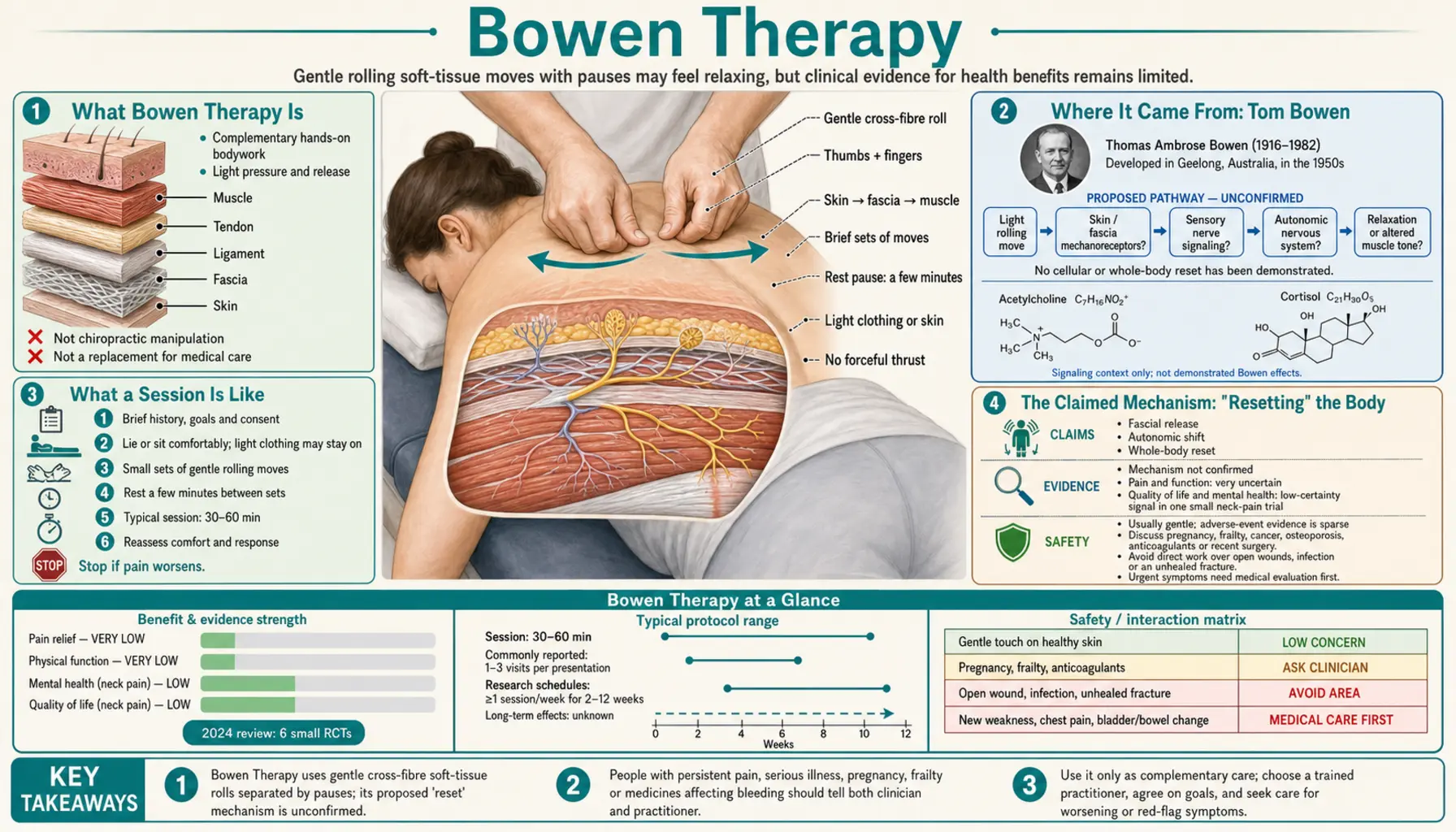
Bowen Therapy — also called the Bowen Technique, and taught in one popular form under the trademark Bowtech — is a very gentle, hands-on bodywork method. Instead of the deep kneading of a firm massage or the sharp thrusts of a chiropractic adjustment, a Bowen practitioner uses light, rolling moves with the thumbs and fingers over muscles, tendons, and the connective tissue called fascia, usually through your light clothing. What makes it distinctive is what happens between the moves: the therapist does a small set, then stops and waits, often leaving the room for a couple of minutes before returning to do the next set. This page tries to be fair and honest about what that is and what it can do. The short version is that a Bowen session is genuinely gentle, calming, and low-risk — a pleasant, restful hour that many people enjoy — but the broad healing claims made for it are not backed by good evidence. Below we walk through what Bowen Therapy is, where it came from, what a session feels like, the mechanism it claims, what the research actually shows, why people often feel better anyway, who might reasonably try it, and how to keep it in its proper place: a soothing complement to medical care, never a replacement for it.
Table of Contents
- What Bowen Therapy Is
- Where It Came From: Tom Bowen
- What a Session Is Like
- The Claimed Mechanism: "Resetting" the Body
- What the Evidence Actually Shows
- Why People Often Feel Better
- Who Might Try It
- What to Expect and What It Costs
- Is It Safe?
- The Honest Bottom Line
- Research Papers
- Connections
- Featured Videos
What Bowen Therapy Is
Bowen Therapy is a light-touch bodywork technique. You usually stay dressed in loose, thin clothing and lie face-down or face-up on a padded table (some moves can even be done seated). The practitioner works through a sequence of small, precise actions called moves. A Bowen move is not a rub or a press: the therapist gently draws the slack of the skin over a muscle, tendon, or band of fascia, then rolls the thumb or fingers across that tissue with light pressure and lets the skin return. Each move takes a second or two.
The moves are grouped into short sets — often just two or three moves at a time — and here is the part that surprises first-timers: after each set, the practitioner stops and waits. These deliberate pauses typically last around two minutes, and the therapist will often step away or leave the room entirely, letting you rest undisturbed before returning for the next set. A whole session may involve only a modest number of moves. The guiding philosophy is "less is more": practitioners believe that doing very little, gently, and then giving the body time, is the whole point.
It helps to separate two very different claims that tend to get bundled together whenever a gentle hands-on therapy is described:
- The experience claim — that lying still, warm, and undisturbed while someone makes slow, light contact with your body feels calming and pleasant. This part is real and not in dispute.
- The therapeutic claim — that the specific pattern of Bowen moves "resets" the nervous system or fascia and thereby treats a wide range of conditions. This is the testable, load-bearing claim, and, as we will see, the evidence for it is thin.
Keeping those two apart is the key to thinking clearly about Bowen Therapy. You can accept that it feels good without accepting that it does what its broader marketing promises.
Where It Came From: Tom Bowen
Bowen Therapy is named for Thomas Ambrose "Tom" Bowen (1916–1982), an Australian who worked in Geelong, in the state of Victoria. Bowen had no formal training as a doctor, physiotherapist, or osteopath. He was essentially self-taught, developing his gentle hands-on approach through observation and practice from around the 1950s onward, and building a busy local reputation for helping people with pain and stiffness.
Bowen left almost no written record of exactly what he did or why he thought it worked. He did not run a school, publish a manual, or set out a formal theory. Much of what is taught today as "the Bowen Technique" was reconstructed after his death by a handful of practitioners who had watched him work. The best-known of these, Oswald and Elaine Rentsch, codified a version of his method and, in the 1980s, founded the teaching organization that trademarked the name Bowtech (the Bowen Therapy Academy of Australia). Because the technique was pieced together from observation rather than handed down as a documented system, several somewhat different "lineages" of Bowen work now exist.
You will sometimes read striking figures — for instance, that a 1970s Australian government inquiry recorded Bowen seeing many thousands of patients a year with a very high success rate. It is worth being honest about numbers like these: they trace back to self-reported claims, not to controlled study, and a busy practice with satisfied clients tells us about popularity and goodwill, not about whether a treatment outperforms rest, attention, and time. Bowen's story is a genuine and interesting piece of twentieth-century Australian folk medicine. But a technique's history — however charming — is not evidence that it works, and Bowen Therapy is best judged on what careful testing finds, which is the subject of the sections below.
What a Session Is Like
Knowing what to expect makes a first visit far more comfortable, because a Bowen session can feel unusually quiet and sparse compared with a massage.
- You stay clothed. Bowen work is done through light, thin clothing, so you keep your clothes on (loose garments are best). There is no oil, and nothing is forcefully manipulated — no cracks, thrusts, or deep digging.
- Gentle moves in small sets. Lying on a padded table, you feel the practitioner make a few soft, rolling moves over particular spots — the lower back, along the spine, the shoulders, the legs. The pressure is light.
- The pauses are the point. After each little set, the therapist stops and often leaves the room for a couple of minutes. This can feel strange the first time — you may wonder if they have forgotten you — but the waiting is intentional, meant to give your body time to "respond" before the next set.
- It is short and calm. Many sessions run roughly 30 to 60 minutes, and a fair amount of that is you simply resting. Practitioners often suggest a small number of sessions spaced a week or so apart rather than frequent visits.
- Afterward. People commonly feel deeply relaxed, loose, warm, or sleepy, and are usually advised to drink water, move gently, and avoid other vigorous bodywork for a day or two.
Stripped of any theory, the honest description of a Bowen session is: a warm, quiet room; light, unhurried touch; and long stretches of undisturbed rest. That combination is calming by its very nature, which will matter when we ask why people feel better.
The Claimed Mechanism: "Resetting" the Body
To be fair to Bowen Therapy, it is worth stating its proposed mechanism carefully, in its own terms, before weighing it.
Practitioners generally explain the method in the language of the nervous system and fascia. The gentle moves, they say, act as light "inputs" or signals to the body — touching sensory receptors in muscles, tendons, and the fascial web — and the deliberate pauses give the nervous system time to "process" those signals. The claim is that this prompts the body to reset tension patterns, rebalance the autonomic nervous system (shifting it out of "fight or flight" and toward "rest and digest"), and switch on its own self-healing. In this picture the practitioner is not fixing anything directly; they are simply nudging the body with a few well-placed cues and then getting out of the way so the body can correct itself.
It is an appealing story, and told well it is persuasive. But it is important to be clear-eyed: these mechanisms are speculative, not established. Terms like "resetting the nervous system," "rebalancing," and "prompting self-healing" are used loosely and are hard to pin down or measure. We do know that gentle touch and deep rest genuinely calm the nervous system — that part is real physiology. What has not been shown is that Bowen's particular moves and pauses do anything beyond what any gentle, restful, hands-on session would do. The proposed mechanism, in other words, may be describing the ordinary calming effect of touch and rest in fancier clothing. Whether it does more than that is exactly the question that clinical studies are supposed to answer — so let us look at them.
What the Evidence Actually Shows
Here is the honest picture, and it is important not to oversell it in either direction.
The research base for Bowen Therapy is small and mostly low in quality. It consists of a handful of little trials, pilot studies, and case reports rather than the large, rigorous, repeatedly replicated trials that would let anyone confidently say "this works." A systematic review by Hansen and Taylor-Piliae (2011) — the most careful attempt to gather and grade the evidence — found only a few studies, generally of weak design, and concluded that the evidence was sparse and preliminary, not sufficient to establish that Bowen work is effective for any specific condition. That verdict still describes the field well.
Looking at the individual studies helps show why the reviewers were cautious:
- Frozen shoulder. Some of the most-cited Bowen research comes from Bernie Carter's small pilot studies around 2001–2002, which explored the technique for frozen shoulder and gathered patients' own accounts of their treatment. These were modest, early-stage studies without the controls needed to separate the technique from natural recovery and attention — useful for generating ideas, not for proving benefit. (Frozen shoulder is also a condition that often improves on its own over time, which makes uncontrolled results especially hard to interpret.)
- Flexibility. A randomized trial by Marr and colleagues (2011) found that a single Bowen treatment increased hamstring flexibility, with the effect measurable for several days. This is a real, measurable finding — but increased flexibility after hands-on work is not surprising and does not, by itself, show that Bowen treats disease.
- Pain. Small studies have looked at short-term effects on pain and pressure-pain thresholds, and a double-blind trial by Lee and Lewis (2020) reported short-term relief of multisite chronic pain. More recently, a small randomized trial (2025) tested Bowen Therapy for fibromyalgia. These are worth noting, but the effects tend to be modest and short-lived, the studies are small, and pain is highly susceptible to expectation and relaxation effects.
- Other conditions. Beyond these, the literature is largely case reports and pilots (for example, a small pilot in children with a developmental coordination difficulty). Individual reports can be genuinely encouraging to read, but a case report cannot tell us whether the therapy, rather than time, attention, or chance, produced the change.
There is a recurring pattern here that is worth naming. When a gentle hands-on therapy is compared only against doing nothing, it often looks helpful. When it is compared against a convincing "sham" — the same quiet session and light touch, minus the supposedly special technique — the specific advantage tends to shrink. That is the fingerprint of a treatment whose benefit comes largely from touch, rest, attention, and expectation rather than from the particular method. Bowen Therapy has simply not been tested often enough, or rigorously enough, to escape that concern. The fair summary: there is not enough good evidence to conclude that Bowen Therapy works for any specific medical condition. Where the evidence is thin, the honest thing is to say so — and the live PubMed searches in the Research section below let you check the current literature for yourself.
Why People Often Feel Better
If the evidence is so thin, why do so many people walk out of a Bowen session feeling genuinely better? Because a great deal of what happens in that room is real — just not for the reason the theory claims.
Consider what a Bowen session actually delivers, stripped of any explanation: you lie down in a warm, quiet space; you are still and safe for the better part of an hour; someone makes slow, gentle, attentive contact with your body; and you spend long, undisturbed minutes simply resting. That combination reliably shifts the nervous system toward its "rest and digest" (parasympathetic) state — breathing slows, muscles let go, and a busy mind quiets. Gentle, unhurried human touch is a well-studied comfort in its own right. Add the undivided attention of a caring practitioner and a strong, hopeful expectation that you will feel better, and you have a genuine recipe for relaxation and relief.
These are the same ingredients that make a nap, a warm bath, a good massage, or a quiet meditation feel restorative. They also make up a large part of what researchers call the placebo and context effect — not "fake" improvement, but real changes in how you feel that flow from the setting, the ritual, and your expectations rather than from a specific active technique. Understanding this lets you value Bowen Therapy for what it honestly provides — a calming, restful hour and a break from a stressed body and mind — without needing to believe that its moves reset some hidden system.
Who Might Try It
Bowen Therapy can be a reasonable choice for a fairly specific kind of person and purpose:
- People who want a very gentle, non-forceful hands-on session. If firm massage feels like too much, or if the cracking of chiropractic makes you uneasy, Bowen's feather-light touch may suit you.
- People seeking relaxation and stress relief. As a quiet, restful ritual, it can be a pleasant way to unwind and calm an overactive nervous system.
- People who find comfort in calm, attentive touch and enjoy an unhurried hour of being cared for.
It is worth thinking twice, on the other hand, if:
- You have a specific medical problem that needs diagnosis or proven treatment. Bowen Therapy is not a substitute for seeing a doctor, physiotherapist, or other qualified clinician about a treatable condition.
- You are being told it can cure serious illness or replace your regular care — that is a reason to be skeptical, not reassured (see Safety, below).
- Money is tight, since the value here is relaxation, which you can also get in less expensive ways.
The most useful frame is this: try Bowen Therapy the way you might try a massage or a restful spa hour — as something pleasant and calming that you keep alongside proper medical care — not as a treatment you are counting on to fix a health problem.
What to Expect and What It Costs
Setting honest expectations up front helps you decide whether Bowen Therapy is worth it to you.
- What it can reasonably offer: deep relaxation, a sense of calm, a gentle break for a tense body, and possibly some short-term easing of how much muscular tightness or minor pain bothers you.
- What it should not be expected to do: cure disease, replace medication or physiotherapy, or reliably fix a specific diagnosed condition. Be wary of any practitioner who promises those things.
- Length and number of sessions. Sessions usually run about 30 to 60 minutes. Practitioners often suggest a short course of a few sessions rather than ongoing frequent visits; if several sessions bring no benefit you value, there is no reason to keep paying.
- Cost. In the United States a session commonly runs roughly $60 to $120, varying by region and practitioner. Bowen Therapy is generally not covered by health insurance, so it is usually an out-of-pocket expense.
- Regulation. Bowen practitioners are not medical providers, and training and credentials vary. A good practitioner is warm, honest about what the therapy can and cannot do, and supportive of your regular medical care.
If a practitioner claims to diagnose disease, promises to cure a serious condition, or urges you to stop or delay conventional treatment, treat that as a clear red flag.
Is It Safe?
For most people, Bowen Therapy is very gentle and low-risk. The touch is so light and the moves so mild that direct physical harm is unlikely, and serious adverse events are rare. In that narrow sense it is one of the safer hands-on therapies you can choose.
The most important risk is not physical but indirect: the danger of relying on Bowen Therapy instead of proven care for a problem that can actually be treated. Delaying a real diagnosis, skipping effective treatment, or coming off prescribed medication because a gentle therapy is meant to "handle it" can cause genuine harm — and that harm comes not from the therapy itself but from what it displaces. Enjoy Bowen work alongside your regular medical care, never as a replacement for it.
A few sensible, common-sense cautions apply as well:
- If you are pregnant, recovering from surgery or injury, or living with a serious medical condition, let the practitioner know and check with your doctor first.
- Tell the practitioner about any area that is acutely injured, inflamed, or painful so it can be avoided.
- Keep taking any prescribed medication and keep your medical appointments; a relaxing session is a complement to that care, not a reason to change it.
Held to those simple rules, Bowen Therapy is a low-risk thing to try. The caution is less about the hands on your back and more about the ideas that sometimes come with them.
The Honest Bottom Line
Bowen Therapy is best understood as a gentle, low-risk, relaxing hands-on experience — not a proven medical treatment. If you find a quiet hour of light touch and undisturbed rest soothing, that is a real and worthwhile thing, and there is nothing wrong with enjoying it on those honest terms. The calm, the stillness, the caring attention, and the soft contact are genuine comforts that can ease stress and muscular tension and change how pain feels, most likely through the well-understood effects of touch, rest, and expectation.
What the evidence does not support is the bigger story built around the technique. The idea that Bowen's moves and pauses "reset" the nervous system or fascia and switch on self-healing is speculative, not established; the research base is small, mostly low-quality, and judged by careful reviewers to be sparse and preliminary; and there is not enough good evidence to say that Bowen Therapy treats any specific condition. So the guidance is warm and practical at once: have the session, let yourself relax, and take the real comfort it offers — but keep it as a complement, not a replacement, for medical care, be skeptical of anyone promising cures, and never let it stand between you and the treatment a real problem deserves. Valued for what it actually is, Bowen Therapy is a pleasant, calming thing to do for a tired, stressed body — no more, and no less.
Research Papers
- Hansen C, Taylor-Piliae RE. What is Bowenwork? A systematic review. The Journal of Alternative and Complementary Medicine. 2011;17(11):1001–1006. doi:10.1089/acm.2010.0023 — The key review of the field: found only a few, mostly weak studies and concluded the evidence was sparse and preliminary.
- Carter B. A pilot study to evaluate the effectiveness of Bowen Technique in the management of clients with frozen shoulder. Complementary Therapies in Medicine. 2001;9(4):208–215. doi:10.1054/ctim.2001.0481 — A small, early pilot exploring Bowen work for frozen shoulder, without the controls needed to prove benefit.
- Carter B. Clients' experiences of frozen shoulder and its treatment with Bowen technique. Complementary Therapies in Nursing and Midwifery. 2002;8(4):204–210. doi:10.1054/ctnm.2002.0645 — A qualitative follow-up capturing patients' own accounts; describes experience, not proven efficacy.
- Marr M, Baker J, Lambon N, Perry J. The effects of the Bowen technique on hamstring flexibility over time: a randomised controlled trial. Journal of Bodywork and Movement Therapies. 2011;15(3):281–290. doi:10.1016/j.jbmt.2010.07.008 — Found a single Bowen treatment increased hamstring flexibility for several days — a measurable effect, but not proof of treating disease.
- Félix GJS, Black L, Rodrigues M, Silva AG. The acute effect of Bowen therapy on pressure pain thresholds and postural sway in healthy subjects. Journal of Bodywork and Movement Therapies. 2017;21(4):804–809. doi:10.1016/j.jbmt.2016.12.008 — A small study of immediate effects on pain thresholds and balance in healthy volunteers.
- Lee K, Lewis GN. Short-term relief of multisite chronic pain with Bowen therapy: a double-blind, randomized controlled trial. Journal of Bodywork and Movement Therapies. 2020;24(4):271–279. doi:10.1016/j.jbmt.2020.06.025 — A double-blind trial reporting short-term pain relief; effects were modest and short-lived.
- Morgan-Jones M, Knott F, Wilcox H, Ashwin C. A pilot study of fascia Bowen therapy for 8–11 year-old boys with developmental coordination disorder. Journal of Bodywork and Movement Therapies. 2019;23(3):568–574. doi:10.1016/j.jbmt.2019.02.022 — A small pilot in children; exploratory and not able to establish efficacy on its own.
- Chen PY, Chu NP, Cheuk YLA, Kam HWA, Yau DKW. Effectiveness of Bowen therapy for fibromyalgia: a randomized controlled trial. International Journal of Therapeutic Massage & Bodywork. 2025;18(4):51–62. doi:10.3822/ijtmb.v18i4.1149 — A recent small randomized trial testing Bowen therapy for fibromyalgia symptoms.
- Walker-McPhail D. Implementing Bowen therapy on SCI patients with limb discrepancy. Journal of Bodywork and Movement Therapies. 2015;19(4):675–676. doi:10.1016/j.jbmt.2015.07.017 — A brief case report; illustrates that much of the Bowen literature is small reports rather than controlled trials.
- Live PubMed search — overview of the Bowen Technique clinical literature: pubmed.ncbi.nlm.nih.gov/?term=Bowen technique OR Bowenwork therapy — because the evidence base is small and evolving, check the current studies for yourself.
- Live PubMed search — Bowen therapy for pain and relaxation: pubmed.ncbi.nlm.nih.gov/?term=Bowen technique pain OR relaxation — where high-quality evidence is thin, these live results show what is (and is not) yet established.
Connections
- All Remedies
- Massage
- Craniosacral Therapy
- Reflexology
- Osteopathy
- Chiropractic
- Reiki
- Acupuncture
- Meditation
- Stress Management
- Breathwork