Modified Gerson Therapy for Noncancer Diseases
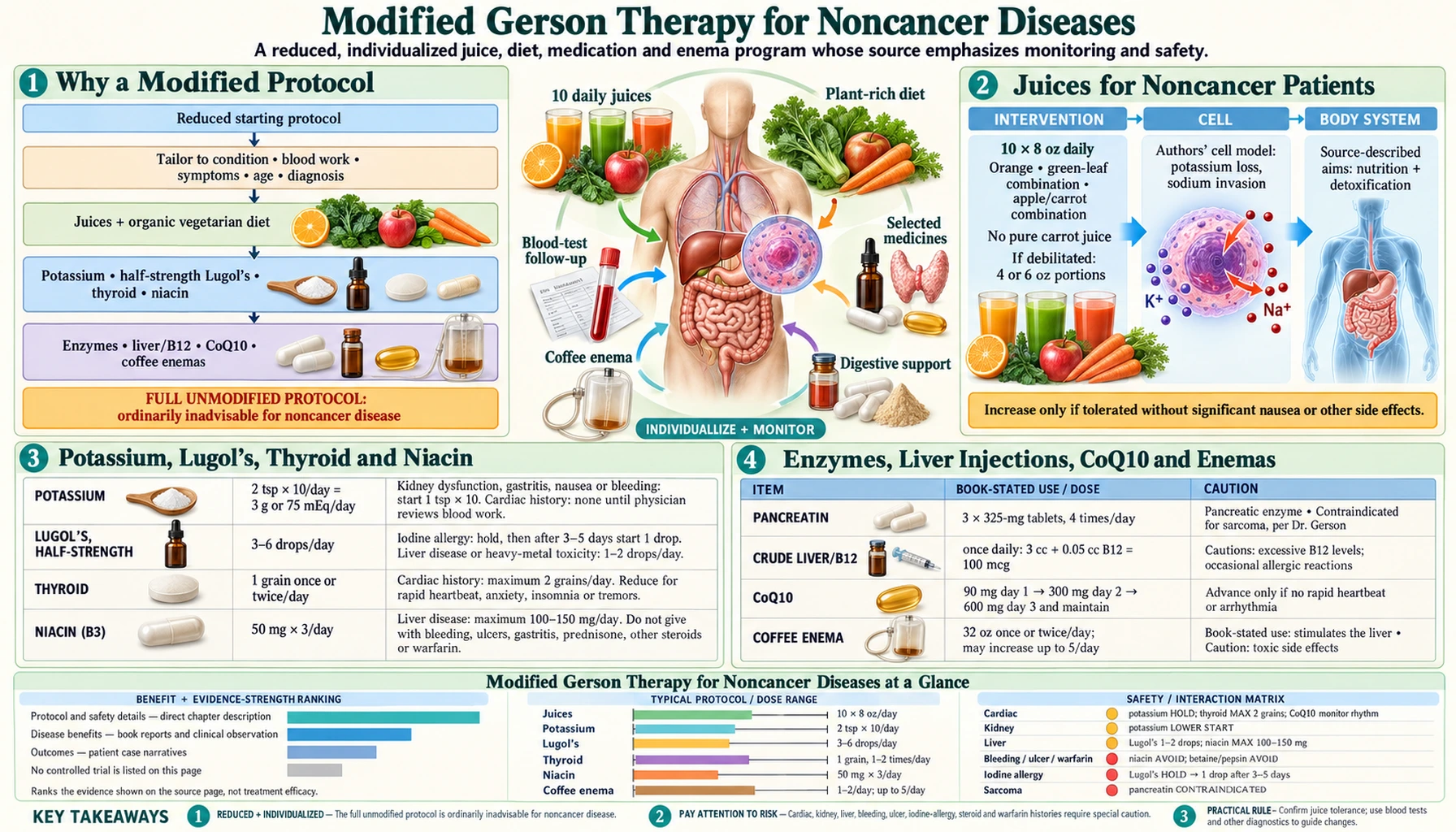
Chapter Seventeen of The Gerson Therapy (Charlotte Gerson and Morton Walker, D.P.M.) turns from cancer to the many other chronic and acute illnesses that the authors say respond to Dr. Max Gerson’s program. The book states plainly that no single diet-and-medication protocol exists for these illnesses, “simply because each disease shows diverse dietary origins and variable treatment needs.” Instead, the chapter offers a reduced standard protocol as a starting point, and then lists the modifications Gerson-trained practitioners make for particular diseases.
This page walks through that reduced protocol — juices, potassium, Lugol’s solution, thyroid, niacin, enzymes, liver injections and enemas — along with the cautions the book attaches to each, and then summarizes the chapter’s disease-by-disease notes: addictions, heart and artery disease, chronic fatigue, colostomy, diabetes, hepatitis, kidney disease, metal toxicity, multiple sclerosis, arthritis, osteoporosis, steroid-treated patients, collagen diseases and ulcerative colitis. For the patient stories told elsewhere in the book, see the companion page Success With Other Diseases.
Table of Contents
- Why a Modified Protocol
- Juices for Noncancer Patients
- Potassium, Lugol’s, Thyroid and Niacin
- Enzymes, Liver Injections, CoQ10 and Enemas
- First-Year Follow-Up
- Addictions
- Atherosclerosis, Heart and Vascular Disease
- Chronic Fatigue Syndrome
- Reversible Colostomy
- Diabetes, Types 1 and 2
- Hepatitis, Kidney Disease and Metal Toxicity
- Multiple Sclerosis
- Osteoarthritis
- Osteoporosis
- Steroid Treatment, Lupus, RA and Scleroderma
- Ulcerative Colitis, Genetic Disorders and Emphysema
- Key Research Papers
- Connections
- Featured Videos
1. Why a Modified Protocol
The chapter opens with the story of Pamela P., a woman in her thirties who in 1995 developed a large gray spot blocking the center of vision in her left eye. A second eye specialist diagnosed ocular histoplasmosis — a fungal infection of the eye — and urged surgery. The book reports that her job exposed her to spray glues and toxic art materials, deadline pressure and severe stress, and that she regularly sprayed her apartment with pesticides. On a friend’s suggestion she followed the Gerson Therapy at home from the end of June to July 31, 1995, including two coffee enemas a day and juices carried to work in thermos bottles. On August 1 the surgeon found the spot had shrunk until it was almost invisible, with no sign of bleeding. The book states that she needed no antifungal medication and no operation, and that she now sees “just fine.”
The authors say the standard protocol “does work, although there are variables,” and they name them: the patient’s overall condition, laboratory blood work, symptoms, age, medical diagnosis and other factors. They hold that “virtually all types of health problems respond to the Gerson Therapy.”
The book’s central safety point comes next, in its own words: “The use of a full, unmodified protocol of the Gerson Therapy for noncancerous diseases ordinarily remains inadvisable.” It warns that there are “considerable risks to using the intensive protocol in the presence of some illnesses,” and that patients who are not told why the reduced protocol is used will sometimes self-medicate with the more aggressive version “at the expense of their safety and long-term recovery outlook.”
2. Juices for Noncancer Patients

Where cancer patients drink thirteen glasses a day, the book says the regimen for a noncancerous illness can begin with ten 8-ounce glasses of juice daily, eliminating pure carrot juice. A patient in good physical condition should manage full 8-ounce portions; anyone showing debilitation starts with smaller glasses of 4 or 6 ounces.
The juice schedule for “a rather ill but noncancerous individual” draws on three types:
- Orange juice
- Green-leaf combination juice
- Apple/carrot combination juice
The book repeats a rule that runs through the whole therapy: be sure the patient tolerates all juices “without significant nausea or other side effects” before any increase in quantity is considered.
3. Potassium, Lugol’s, Thyroid and Niacin
Potassium compound solution
The suggested starting dose is 2 teaspoons ten times a day — about 1 gram (25 mEq) each of potassium acetate, gluconate and monobasic phosphate, a total of 3 grams or 75 mEq of potassium daily. The book notes that most noncancer patients do not need the full 40 teaspoons a cancer patient would take.
Cautions in the book: patients with a history of kidney insufficiency or dysfunction, gastritis, nausea or any sign of bleeding problems start at 1 teaspoon ten times a day, increasing slowly while effects are observed. Anyone with a history of cardiac insufficiency, heart attack or congestive heart failure should receive no potassium until a physician has analyzed blood work and agrees it would be beneficial.
Lugol’s solution (half-strength)
Three to six drops a day. With a history of iodine allergy, Lugol’s is not given at first, but can be cautiously added after three to five days, starting with one drop and increasing as tolerated. Patients with liver insufficiency, hepatitis or cirrhosis start on one to two drops a day “to avoid bleeding or a decrease in blood platelets,” and those with heavy metal toxicity also start at one to two drops.
Thyroid hormone
One grain once or twice a day. The book says noncancer patients typically have a less serious thyroid deficiency than cancer patients; in some cases Gerson-trained practitioners have started patients on up to 5 grains for only three to five days, rather than the fourteen days common in cancer cases. Watch for signs of an overactive thyroid — rapid heartbeat, anxiety, insomnia, tremors — and reduce the dose if they appear. The book adds that a passing rapid heartbeat on its own often signals a toxic or flare-up reaction. Patients with a cardiac history start at a maximum of 2 grains daily.
Niacin (vitamin B3)
50 mg three times a day. Patients with liver insufficiency, hepatitis or cirrhosis take a maximum of 100 to 150 mg daily. Those with a history of bleeding, ulcers or gastritis, and those taking prednisone, other steroids or the blood thinner warfarin, should not receive niacin.
4. Enzymes, Liver Injections, CoQ10 and Enemas
- Pancreatin (pancreatic enzyme from the pig): three 325-mg tablets four times a day. According to Dr. Gerson, it is contraindicated for sarcoma patients.
- Crude liver/B12 injection: once daily, 3 cc of crude liver extract with 0.05 cc of vitamin B12 added in the same syringe, for a 100-mcg dose. The book knows of no contraindication other than excessive B12 levels and occasional allergic reactions.
- Betaine hydrochloride and pepsin (a digestive aid): two capsules three times a day with meals. Not given with gastric ulcers, gastritis, severe nausea, intestinal bleeding, esophageal problems, or to patients taking warfarin.
- Coenzyme Q10: 90 mg once a day to start; if no rapid heartbeat or arrhythmia appears, 300 mg on the second day and 600 mg on the third, remaining at that dose.
- Proteolytic enzyme blends: indicated mainly for severe, excessive gas; the book notes some reports that they may help reduce tumor masses.
- Laetrile (amygdalin): not indicated for conditions other than cancer.
- Brewer’s yeast: not recommended in most cases, because of the risk of yeast syndrome (candidiasis) developing or worsening, and reports of extreme bloating and gas.
- Castor oil treatment: if used at all, once or twice a week and “with great caution,” because it is a powerful detoxifier that can release long-buried toxins and produce severe healing reactions.
- Coffee enemas: a 32-ounce enema once or twice a day, which may be increased up to five a day. The book reminds readers that enemas stimulate the liver and can cause toxic side effects as long-retained residues are eliminated.
5. First-Year Follow-Up
The book says medications change during the first year. About one month after discharge from inpatient care — roughly six to nine weeks after starting therapy — thyroid, potassium and Lugol’s are adjusted downward if laboratory values are normal; other supplements generally stay at their initial levels. Adjustments are guided by blood tests and other diagnostics.
The authors note that this differs from the schedule in Dr. Gerson’s own book A Cancer Therapy: Results of Fifty Cases. Today, they write, patients must be kept on higher doses of the three main medications for longer, because when medications are reduced too quickly “patients often experience difficulties and go through a slowing of recovery or a recurrence of disease.”
The chapter then lists eighteen conditions it says respond to the modified approach: addictions, atherosclerosis, chronic fatigue syndrome, reversible colostomy, diabetes types 1 and 2, genetic disorders, emphysema, heart and vascular disease, hepatitis A, B and C, kidney disease, heavy metal toxicity, multiple sclerosis, osteoarthritis, osteoporosis, steroid treatment, lupus, rheumatoid arthritis and ulcerative colitis. The book also recalls that at its beginning it cites at least fifty-two diseases that respond to the program.
6. Addictions
Codeine, morphine, amphetamines, sedatives and hypnotics
The book says these patients should be regarded “as types of chemotherapy patients,” and the addictive drug must be curtailed over a three- to ten-day period. If treatment is too aggressive, very heavy reactions such as diarrhea and an inability to eat and drink may result, along with possible electrolyte imbalance. Where the drug was first prescribed for pain, placebos may be needed early on.
Heroin and cocaine
Based on a limited number of patients, the authors report that withdrawal symptoms were almost absent on the full, intensive program with no modifications. They add that the risk of severe reactions cannot be ruled out, especially with multiple-drug use, so these patients must be watched carefully and supervising health professionals must intervene when needed.
Alcohol
The therapy has not often been used for chronic alcoholism, but the book believes alcoholics could be treated with the narcotic/sedative protocol above, with liver function watched carefully and the liver-insufficiency cautions applied.
Nicotine
No special modification is required. Some smokers may temporarily want something to hold or put in the mouth. Niacin, if not contraindicated, is suggested as an adjunct; some patients report it has a similar effect to nicotine, and the book notes niacin’s chemical name is nicotinic acid. In most cases, it says, nicotine addiction may be eliminated without withdrawal symptoms.
The Gerson view of addiction
The authors believe many addictions, including alcohol and cigarettes, “stem from a basic deficiency” — the person craves something, often nutrients. When a patient drinks thirteen glasses of fresh juice, they write, “his basic craving is satisfied with optimum nutrition, and to his own surprise, he no longer craves the drug.” When withdrawal sets in as stored drugs leave the tissues, a coffee enema clears the toxicity. Nights are the hard part for the first few days: patients often have heavy nightmares and wake around 1:00 or 2:00 AM; the book advises swallowing some fruit or juice and taking an enema, and says the nighttime problem clears in less than a week. It describes a young man in his thirties, addicted to cocaine and a heavy smoker, who was off drugs and cigarettes within a week.
The book also notes that the Gerson diet is intentionally free of foods that commonly cause allergies, and that the organic vegetarian diet, free of pesticides and additives, aims to overcome allergic reactions.
7. Atherosclerosis, Heart and Vascular Disease
Hardening of the arteries, the book says, “usually responds exceedingly well,” through the nutrition in whole vegetarian foods and the detoxification of the standard protocol. It states that in Gerson patients arterial plaque is reversible.
High blood pressure “responds exceptionally well.” The improvement is so marked that companions eating the diet should also be screened, because the authors have seen low blood pressure in both patients and companions on the diet alone. Blood-pressure drugs should be slowly decreased starting on the third to fifth day of treatment; malignant high blood pressure can take longer to respond.
A modified case: Frank W.
The book describes a 46-year-old man (given a pseudonym) admitted in October 1990 at 303 pounds, with heart damage from a heart attack at 38, high blood pressure, gout and diabetes with blood sugar of 240–400 mg/dL despite medication and insulin. His therapy was modified: grapefruit juice instead of orange, fewer apples in his juices, more green juice in place of some carrot juice, and a plate of raw vegetables to nibble instead of the usual fruit plate. He received 2 teaspoons of potassium compound in each glass, a little thyroid, Lugol’s, digestive enzymes, coffee enemas, the daily liver injection and — exceptionally, as this is not given to nondiabetics — 200 mcg of chromium picolinate three times daily. The book reports he was off gout medication from the first day without another attack, his blood-pressure medication was lowered, and within five weeks he had lost 35 pounds with blood sugar at a normal 105 without medication or insulin. He continued losing about a pound a day to 205 pounds.
The book stresses the coffee enema in such cases: as fat dissolves during rapid weight loss, toxins stored in it enter the blood, and the enemas “help to open the bile ducts in the liver and allow the toxins to be eliminated through the bowel.”
Thyroid, flaxseed oil and potassium
For heart disease, the book names thyroid medication to raise metabolism and use up fats and cholesterol — started low “in order not to overtax the damaged heart” — flaxseed oil to help dissolve fat and cholesterol deposits, and potassium to aid enzyme function and keep blood from clotting excessively. It recalls Dr. Gerson’s view that chronic disease begins with the loss of potassium from the cell and the invasion of sodium, and notes that the Mexican cardiologist Professor Demetrio Sodi-Pallares independently reached a similar low-sodium, high-potassium approach to heart disease.
8. Chronic Fatigue Syndrome
People with chronic fatigue syndrome (CFS, or CFIDS) “get along just fine on the Gerson program,” the book says, with significant improvement after a short time and recovery after about nine months. They may take the full thirteen glasses of juice daily if desired.
The cautions: CFS patients often feel worse after enemas early on as toxins leave the cells. Two enemas a day are normally suggested at first, working up to four; too many can trigger strong adverse reactions. The book adds that these patients tend to have very strong emotional responses, such as depression and crying, during and between reaction periods.
9. Reversible Colostomy
Patients with reversible colostomies typically receive two enemas a day through an irrigation kit, with instructions from Gerson personnel. The coffee can be mixed 50/50 with chamomile tea to reduce cramping and spasms. Juice volume, especially green juice, is often lowered to just 4 ounces, because green juices are not well absorbed and pass through quickly.
10. Diabetes, Types 1 and 2

The book explains type 1 diabetes as an absence or deficiency of insulin from damaged islet cells of the pancreas, and type 2 as the body’s inability to use the insulin it makes. It offers a theory it says is supported by clinical observation of the therapy: that insulin receptors on cells can become obstructed by cholesterol. Because the Gerson diet is very low in fat and contains no cholesterol, the authors hold it can quickly reverse this “clogging,” and Gerson personnel report patients reducing insulin dependence almost immediately.
What the book expects
- Type 2 is “far more easily corrected”; patients are often able to eliminate the need for insulin over time.
- Type 1 patients often notice a large reduction in insulin needs, but many remain permanently insulin-dependent: destroyed islet cells cannot regenerate, though damaged ones may recover. Kidney and retinal damage can stabilize or reverse, and type 1 patients need to stay on a menu very close to the Gerson diet indefinitely.
- High blood pressure is often eliminated. Blood glucose “does require careful monitoring,” and insulin needs may rise temporarily during healing reactions.
- When kidney function is at or below about 20 percent of normal, or the patient is on or near dialysis or has had a kidney transplant, the book says the program is no longer effective.
Diet and juice changes
- Apple juice is eliminated; grapefruit juice replaces orange.
- Apple/carrot juice is partly replaced with green juice, depending on insulin intake.
- Raw vegetables replace fruit for snacking; honey, maple syrup, brown sugar and other sweeteners are eliminated.
- If glucose stabilizes, one or two pieces of fruit a day may be added — melons preferred. After several weeks some type 2 patients return to the full protocol, including full apple/carrot juices.
Medication changes
Thyroid is reduced to 1 or 1½ grains a day and Lugol’s to three drops daily. Potassium is limited to 1 teaspoon per glass, except with severe edema, when it may go to 2 teaspoons per glass.
11. Hepatitis, Kidney Disease and Metal Toxicity
Hepatitis A, B and C: the authors report apparent full remission and restoration of liver function. Treatment is “identical to that of almost any cancer chemotherapy patient,” and liver enzymes should be carefully watched.
Kidney disease: because the diet is low in protein, the book says kidney disease can be controlled and remaining function of not less than 15 percent maximized. Patients already on dialysis cannot be accepted, and since kidneys are not fully restored in most cases, kidney patients must remain on the therapy for life.
Metal toxicity: Lugol’s is reduced to one or two drops a day, and “the detoxification process should be allowed to occur slowly.” The modified regimen used for chemotherapy patients in fair physical condition is normally applied.
12. Multiple Sclerosis
The book reports excellent results in MS. With proper nutrition and detoxification, it says, the body clears damaged myelin sheaths — the insulation on nerves — and this clearing may cause a temporary worsening of symptoms that can frighten the patient. If the patient persists, the authors write, the body restores and heals the sheaths.
The book’s warning: after treatment with immune-suppressing drugs, including cancer chemotherapy, the Gerson Therapy is “not easily effective,” and long periods on prednisone also hold back recovery.
13. Osteoarthritis
The book describes osteoarthritis as a slow, non-inflammatory deterioration of the joints, often seen as hard bony lumps on finger and toe joints before reaching larger joints. It attributes both osteo- and rheumatoid arthritis to excess animal protein the body cannot assimilate and the kidneys cannot excrete, possibly reflecting an inherited weakness of the pancreas — and notes that families also pass down the same eating habits, illustrated by a grandmother, daughter and five-year-old granddaughter all showing signs of arthritis.
Two patients are described. An 82-year-old physician with severe hip pain, who had been urged to have a hip replacement, saw his cholesterol drop by over 100 points in one week; by the third week his hearing had improved, his blood pressure stayed normal without medication and his hip pain was gone. The book adds a lesson from his case: when he took an extra dose of blood-pressure medication during a stressful moment, he fainted because his pressure was already too low — a reminder of why these drugs must be reduced as the diet works. A 61-year-old librarian, Marion S., arrived with badly deformed fingers held in a leather brace; after about two years on the therapy at home her hands became almost normal and she never needed the brace again.
The book is candid that osteoarthritis involves “long-term, deep damage” and takes a good deal of time and ongoing adherence to this “demanding and rather restrictive” therapy.
14. Osteoporosis
The authors argue that drinking more milk is the wrong answer to bone loss: they hold that excess protein, as in milk, contributes to the disease, and cite Pottenger’s cat studies on heat-damaged milk. They also say calcium tablets are poorly assimilated. Instead, calcium should enter the body together with live enzymes and the full range of minerals — magnesium, manganese, zinc, copper, potassium, iodine and more — found in carrot juice, green-leaf juice and plenty of fresh lettuce. In this way, the book says, the therapy “allows one’s body to actually rebuild bone,” and it has been observed to improve bone calcification.
15. Steroid Treatment, Lupus, RA and Scleroderma
Patients on steroids
For patients on cortisone-type drugs — for lupus, rheumatoid arthritis, gastrointestinal disorders, brain tumors and other conditions — the book is firm: the medication “must not be discontinued suddenly and the Gerson Therapy substituted in its place.” With appropriate monitoring, the patient is weaned off slowly. Because these patients are prone to stomach irritation, betaine hydrochloride/pepsin and niacin are withheld until five days after steroids have cleared, and potassium is reduced to 10 or 20 teaspoons a day.
Collagen diseases
Once steroids are eliminated, the book says lupus (SLE), rheumatoid arthritis and scleroderma “respond exceptionally well.” Healing is poor, however, when steroids have been taken for more than two years or after chemotherapy. For SLE and RA, enemas are limited to two to three a day; reactions can be severe, and patients must be monitored carefully during reaction periods.
16. Ulcerative Colitis, Genetic Disorders and Emphysema
Ulcerative colitis: even with bleeding, patients “may respond surprisingly well,” and the authors report several long-term remissions. Chamomile replaces coffee in the enemas at the outset, and certain raw foods are avoided for a short period. The book says Crohn’s disease, irritable bowel syndrome, leaky gut and other intestinal problems also respond positively.
Genetic disorders generally do not respond, the book says, though symptoms of genetic weakness can improve; it mentions one case of cystic fibrosis that improved significantly.
Emphysema: positive responses have been seen in patients who adhered faithfully; lung capacity can increase and related symptoms be controlled.
Key Research Papers
- Gerson C, Walker M. The Gerson Therapy: The Proven Nutritional Program for Cancer and Other Illnesses. Chapter Seventeen, “Modified Therapy for Noncancer Patients.” New York: Kensington. — primary source for every protocol detail, dose and case on this page.
- Gerson M. A Cancer Therapy: Results of Fifty Cases. — the original protocol and follow-up schedule the chapter compares itself against.
- Bishop B. A Time to Heal: Triumph over Cancer. 1985. — cited in the chapter on smokers and alcoholics.
- Pottenger F. Pottenger’s Cats: A Study in Nutrition. 1983. — cited in the chapter’s osteoporosis section.