The Gerson Therapy for Other Diseases
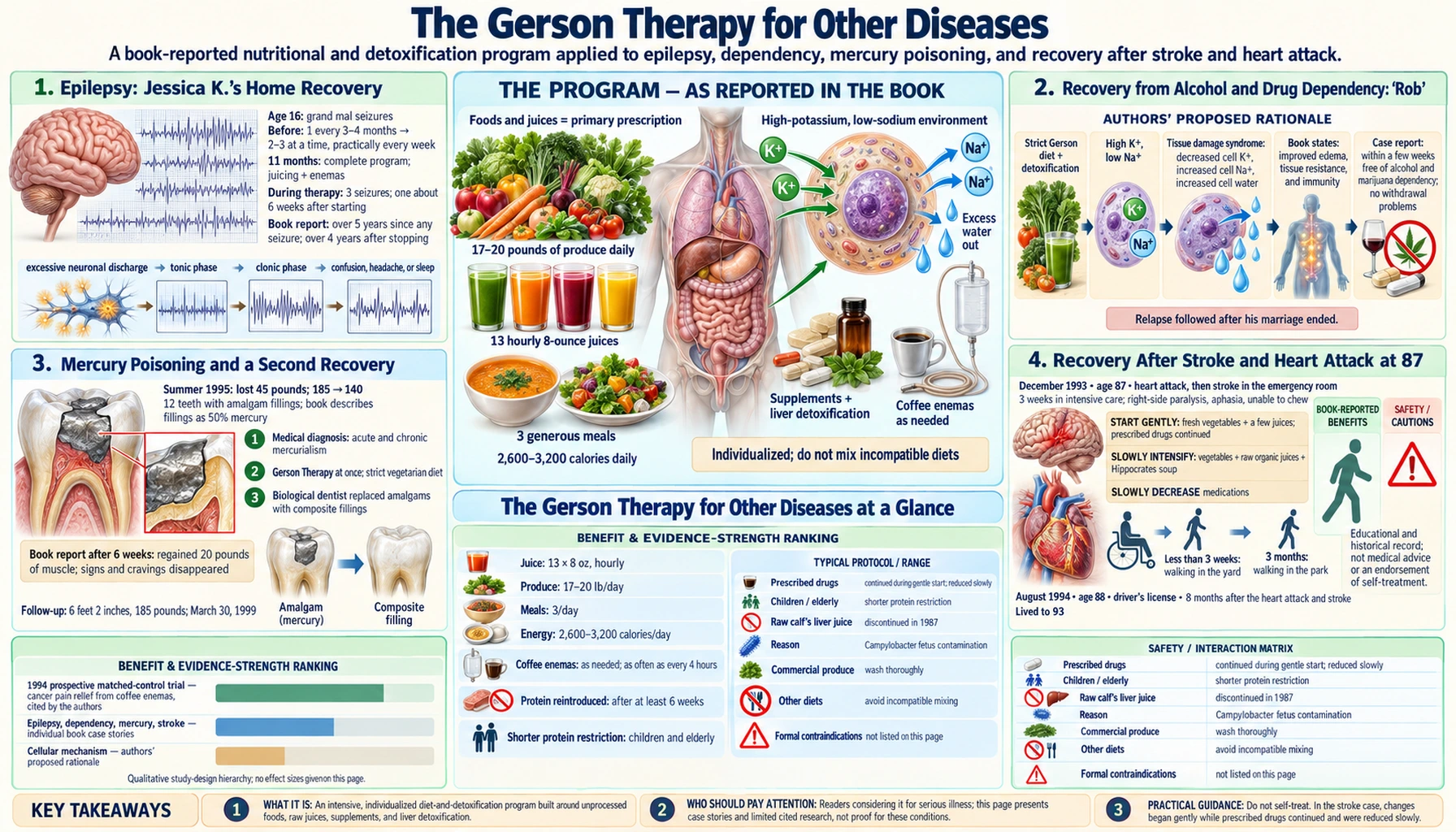
Most people know the Gerson Therapy as a nutritional approach to cancer. In Chapter Seven of The Gerson Therapy, “Success with Other Diseases,” Charlotte Gerson and Morton Walker, D.P.M., describe patients who used the same program for conditions that were not cancer: epilepsy, alcohol and drug dependency, mercury poisoning, and paralysis after a heart attack and stroke.
The chapter then steps back to explain the thinking behind the diet — why Dr. Max Gerson made food the foundation of treatment, the potassium–sodium “tissue damage syndrome” he worked to correct, how much food the program involves, why the authors say it should not be mixed with other diets, and which adjuncts came out of his work at the University of Munich. Everything below is reported as the book states it.
Table of Contents
- Epilepsy: Jessica K.’s Home Recovery
- Recovery from Alcohol and Drug Dependency: “Rob”
- Mercury Poisoning and a Second Recovery
- Recovery After Stroke and Heart Attack at 87
- “Diet Must Be the Basis of All Medical Therapy”
- The Science Behind the Anti-Degenerative-Disease Diet
- How Much Food: Calories, Weight and Calorie Restriction
- What Makes the Gerson Diet Different
- Adjuncts Developed in Munich
- Cautions in This Chapter
- Key Research Papers
- Connections
- Featured Videos
1. Epilepsy: Jessica K.’s Home Recovery
The chapter opens with the story of Jessica K., a Dallas, Texas, schoolgirl who began having grand mal seizures at sixteen. The book describes epilepsy as a chronic disorder of paroxysmal brain dysfunction caused by excessive neuronal discharge, usually with some alteration of consciousness. In a grand mal seizure the person falls unconscious with muscles in spasm (the “tonic” phase), the skin and lips may turn bluish (cyanosis), and convulsive movements follow (the “clonic” phase), sometimes with a bitten tongue or loss of bladder control, before the person wakes confused, with a headache, or falls asleep.
In her own account, Jessica writes that her seizures at first came once every three to four months, but soon worsened until she was having two or three at a time, practically every week. Her father had had a mild seizure disorder for twenty years, so she believed hers was inherited. Neurology consultations and EEGs (electroencephalograms) did not find a cause, and she was offered anti-convulsive drugs. After trying several alternative therapies, her family chose the Gerson program, having seen it help friends who had been affected by cancer.
Jessica followed the program completely for eleven months, adjusting her school day so she could do all of the juicing and the enemas. Her mother spoke to Charlotte Gerson by telephone a couple of times, but the family otherwise did the therapy “by the book,” using Dr. Max Gerson’s original book, which Jessica says she memorized. During those eleven months she had only three seizures, and she reports that they coincided with her expected healing crises, such as one about six weeks after starting.
At the time she wrote, it had been over four years since she stopped the treatment and over five years since any seizure. The book reports that she was graduating from college and planned a career in the health sciences, and adds that the general nutrition information she used as her road map is usable by anyone for overcoming illness or for prevention.
2. Recovery from Alcohol and Drug Dependency: “Rob”
The second story concerns a young man the book calls Rob (a pseudonym), whose mother’s recovery from breast cancer is told in a later chapter. As a teenager Rob used alcohol and marijuana heavily and left high school early in his junior year. His mother says he was never really a “healthy” child: at age five he had Legg-Calvé-Perthes disease, a disorder of the rounded head of the thigh bone where it turns in the hip. An X-ray examination, which his mother asked for, confirmed the diagnosis. Rob wore a full leg cast from below the knee to the groin for months, and during that time his mother discovered nutritional therapy, massage and reflexology while shopping in a health-food store. The book credits these alternatives, including dietary changes, with helping the boy discard the cast and recover permanently.
Remembering that experience, Rob, newly married and thinking about starting a family, chose to clean up his body with diet and detoxification. Having watched his mother go through the Gerson Therapy, he enrolled at a hospital facility in Tijuana, Mexico, that then used the program. The book reports that within a few weeks he was completely free of his dependency on alcohol and marijuana, “with no withdrawal problems of any kind.”
After his marriage ended suddenly, Rob could not cope with the emotional and financial shock and fell back into his old habits.
3. Mercury Poisoning and a Second Recovery
In the summer of 1995, the book says, Rob lost 45 pounds, dropping from 185 to 140, and lay on the floor of his empty apartment too weak to move. At thirty-two he realized he was dying. His symptoms were later diagnosed as acute and chronic mercurialism (mercury poisoning): fingers that swelled at night to twice their normal size and turned blue, repeated vomiting, severe abdominal pain, bloody diarrhea, inability to produce urine, mouth ulcers, loose teeth, loss of appetite and ringing in the ears. The book attributes the mercury to dental amalgam fillings, which it describes as 50 percent mercury, in twelve of his teeth, leaching into his body and brain.
Rob made his way to his mother’s home in the San Diego area, where a physician at the University of California confirmed how close he was to death, and his mother put him on the Gerson Therapy at once. The book reports that in just six weeks he regained 20 pounds of muscle without exercising, lost his cravings, went through no agonizing withdrawal, and developed excellent muscle tone on a strict vegetarian diet, while his signs of mercury poisoning disappeared along with his addictions.
Alongside the therapy, Rob went to a dentist who practices mercury-free, biological dentistry, and had his amalgams replaced with composite fillings. At 6 feet 2 inches he was back to his normal 185 pounds and, at the last report on March 30, 1999, was active and successful in his profession and a keen advocate of the Gerson Therapy.
4. Recovery After Stroke and Heart Attack at 87

Rob’s maternal grandfather suffered a heart attack (myocardial infarction) at home in December 1993, at age eighty-seven. While waiting in the hospital emergency room he had a stroke that paralyzed the whole right side of his body; he could not move, speak (aphasia) or chew. The book explains a myocardial infarction as the death of a segment of heart muscle after its blood supply is interrupted, usually in the left ventricle, with ventricular fibrillation as the main danger; and a stroke as sudden one-sided weakness caused by an interruption of blood flow to the brain, ranging from a passing tingling to profound paralysis, coma and death.
He spent three weeks in intensive care near his Sacramento, California, home, receiving many drugs. On discharge, his wife was advised to place him in a nursing home, but his daughter (Rob’s mother) took over his care. She found him slumped in a wheelchair, paralyzed, incontinent, unable to speak, head drooping and drooling.
She began the Gerson Therapy gently: fresh vegetables and only a few juices at first, while he still took his prescribed drugs. She then increased the intensity of the diet slowly and steadily — vegetables, fresh raw organic juices and Hippocrates soup served as Dr. Gerson recommended — and slowly decreased his medications. The book reports that in less than three weeks he was out of the wheelchair and walking around the yard; in three months he was walking in a park across the street; and in August 1994, at eighty-eight, eight months after the heart attack and stroke, he applied for and received a driver’s license from the California Department of Motor Vehicles. He lived to ninety-three, when complications of an accidental fall took him to hospital, where he died.
5. “Diet Must Be the Basis of All Medical Therapy”
Dr. Gerson admired the Swiss physician and chemist Paracelsus (1493–1541) and quoted his teaching that diet must be the basis of all medical therapy, yet diet should not be a treatment in itself. Accordingly, the book explains, the Gerson diet is the foundation of the healing effect, but other measures are added: coffee enemas, castor oil packs, ozone therapy, clay poultices, hydrotherapy, hyperthermia tub baths, live cell therapy, rectal ozone insufflation, specific nutrient supplements and other items.
For prevention, Dr. Gerson allowed for social life, holidays, family feasts, culture and cost: three-quarters of all food should be chosen to protect the essential organs — liver, kidneys, brain, heart and so on — while one-quarter could be “at choice.” The authors believe this is now too liberal. Because of today’s highly processed foods, prescription and over-the-counter drugs, pesticides, herbicides, fungicides and food-processing chemicals, they urge that both people newly recovered from illness and healthy people who want to stay that way eat 90 percent “defensive,” highly nutritious foods and allow perhaps only 10 percent “at choice.”
Dr. Gerson stressed that his general dietary outline was “written to prevent sickness, not to cure it”; a cure takes a great deal more effort, including supplementation and liver detoxification. In his words, “It’s safer to use foods in the most natural form, combined and mixed by nature and raised, if possible, by an organic gardening process, thus obeying the laws of nature.”
6. The Science Behind the Anti-Degenerative-Disease Diet
The book reports that the diet Dr. Gerson developed in the 1930s was first officially recorded as a treatment program at the University of Munich, with laboratory support funded by the Bavarian and Prussian governments. He worked with foods of dietary purity — unprocessed and totally natural — and with medications to remove tissue edema in conditions such as tuberculosis, arthritis, cardiovascular disease and cancer.
That edema, the authors explain, involves salt and water changes in the tissues that were named in 1977 the “tissue damage syndrome”: decreased cell potassium (K+), increased cell sodium (Na+), and increased cell water (cell swelling). Nutritional treatment that gives cells a high-potassium, low-sodium environment, the book states, improves edema and strengthens tissue resistance and immunity, bringing better healing outcomes — first shown in tuberculosis patients. The authors trace this rationale through all of Dr. Gerson’s later work on degenerative disease, particularly cancer.
The diet is individualized but has uniform features. For most patients it is restricted in salt, fat and protein and supplies large amounts of nutrients, enzymes and phytochemicals that act like nutraceuticals. Each day brings thirteen hourly 8-ounce glasses of raw vegetable and fruit juices, which the authors describe as the ultimate boost to the immune system.
The book also records that raw calf’s liver juice was once part of the program but had to be discontinued in 1987 after repeated bacterial contamination with Campylobacter fetus; the authors report that comparisons across time periods showed better overall survival among patients who had received uncontaminated liver juice.
7. How Much Food: Calories, Weight and Calorie Restriction

Served in three generous meals, the diet provides 2,600 to 3,200 calories a day and requires about 17 to 20 pounds of vegetables and fruits daily, counting both the produce for the thirteen juices and the solid meals. Even so, the book notes, there is some natural calorie restriction because of the purity of the foods.
The authors say the menu is patterned after the antitumor effect of calorie restriction first shown in Germany in 1909 and again in the United States in 1914. Although designed mainly for malignancies, they describe it as a form of orthomolecular medicine that works to improve physical, mental and emotional health in anyone whose well-being is declining, and report that it restores body weight to normal — weight loss in the obese and weight gain in the underweight.
The book cites Linus Pauling’s definition of orthomolecular medicine: a therapeutic approach designed to provide the optimum molecular environment for body functions, using the best concentrations of substances normally present in the body. The authors describe it as the use of natural remedies — vitamins, minerals, herbs, enzymes, nutraceuticals — without synthetic drugs, in contrast to what they call the “toximolecular” medicine of drug treatment.
8. What Makes the Gerson Diet Different
The authors contrast the Gerson diet with other healing diets: one well-known approach uses cooked foods almost exclusively and is high in sodium — the opposite of the Gerson basis; another recommends large amounts of nuts and seeds; another stresses pH balance in foods; and a strict raw-food approach excludes all cooked food and favors many nuts and sprouts. All have their supporters and have helped some patients.
Their advice: the approach you choose is your own decision, but choose one and stick with it, adding elements of other methods only when they are known to be compatible. The Gerson Therapy, they say, is usually not effective when its guidelines are mixed with those of other treatments, because its rules activate specific biochemical processes in a unique way. The foods and juices are its “primary prescription,” comparable to a drug, and significant deviation can be as serious as a diabetic missing an insulin shot.
At the same time, the book is realistic. You will not fail to heal because you miss one glass of juice a couple of times a month, or must occasionally use commercial produce instead of organic — washed thoroughly to remove pesticide and other coatings, though it remains lower in nutrients. Rare, mild deviation does not seem to affect outcomes much; cutting too many corners reduces the chances of success, and how many is too many differs for every patient and diagnosis. Many people, the authors note, have healed by following Dr. Gerson’s original book A Cancer Therapy: Results of Fifty Cases on their own, but the therapy is not “paint by numbers” and sometimes calls for ingenuity.
9. Adjuncts Developed in Munich
The book describes several additions to the diet that came out of the Munich work:
- Iodine and thyroid. Dr. Gerson found that natural thyroid hormone from animal sources, plus Lugol’s iodine solution and mild exercise, used together, markedly improved the healing person’s metabolism.
- Energy-supporting nutrients. Niacin, potassium salts (acetate, gluconate and monophosphate), and crude liver extract with injectable vitamin B12 were given to support cellular energy, and the book says these are still used as Gerson supplements.
- Temporary protein restriction. Dr. Gerson found that restricting protein for a time helped the body absorb edema and improved overall health. Protein is typically reintroduced after at least six weeks with nonfat, enzyme-predigested dairy such as yogurt or unsalted nonfat cottage cheese. Shorter periods of protein restriction are recommended for children and elderly patients.
- Castor oil. Described as a cathartic with no known adverse clinical side effects, given every other day for many weeks to people with acute or chronic damage, especially cancer patients (covered in the book’s chapter 11).
- Coffee enemas. Taken as needed, as often as every four hours through the day, for pain relief, detoxification and better nutritional condition, with occasional nighttime enemas in special cases (chapter 12).
The authors write that coffee enemas work exceedingly well against the inflammatory aches and pains of arthritis, cancer and other degenerative conditions. They cite a 1994 prospective matched-control trial by Dr. Peter Lechner at the Municipal Hospital of Graz, Austria, which they report found statistically significant relief of cancer pain. The proposed mechanism is a dialysis across the gut wall of tumor breakdown products such as polyamines, toxic bound nitrogen and ammonia. They also report that cancer patients using coffee enemas, large amounts of vitamin C and other parts of the therapy tolerate aggressive cytotoxic treatments better.
10. Cautions in This Chapter
The chapter’s own case stories and guidance carry several practical cautions, gathered here:
- In the stroke case, the therapy was introduced gradually — vegetables and a few juices first — while prescribed drugs continued, and medications were reduced only slowly as the diet intensified.
- Jessica’s seizures during treatment coincided with expected healing crises (see Remission and Healing Reactions).
- Protein restriction should be shorter for children and the elderly.
- Raw liver juice was discontinued in 1987 because of bacterial contamination.
- Commercial produce, if used, must be washed thoroughly; mixing Gerson guidelines with incompatible diets is discouraged.
- The prevention diet is not a cure; the authors say a full cure needs the complete program, including supplementation and liver detoxification, described in later chapters.
Key Research Papers
- Gerson C, Walker M. The Gerson Therapy. Chapter Seven, “Success with Other Diseases.” — primary source for this page.
- Gerson M. The cure of advanced cancer by diet therapy: a summary of 30 years of clinical experimentation. Physiol Chem Phys. 1978;10:449–464. — PubMed PMID: 751079