The Biological Basis of the Gerson Therapy
Chapter Three of The Gerson Therapy by Charlotte Gerson and Morton Walker, D.P.M., sets out why Dr. Max Gerson’s program is built the way it is. The authors state that the therapy is so firmly founded on the physiology of nutrition that, after a span of almost seventy years, it remains just as clinically valid as in its first decade, and that it has not been superseded by later treatments.
The chapter explains how the therapy manages the body’s potassium, sodium (salt), protein and water, why animal protein and fat are restricted, why thyroid hormone and iodine are added, and how coffee enemas are said to help the liver clear toxins. Everything below is reported as the book states it, attributed to Dr. Gerson and his co-authors.
Table of Contents
- 1. The Biological Concept in Brief
- 2. Physiological Universality
- 3. How It Aligns with Conventional Treatments
- 4. Long-Term Survival and Side Effects
- 5. Managing Potassium, Salt and Water
- 6. The Cell Scientists: Ling, Cope, Sodi-Pallares, Damadian
- 7. Protein and Calorie Restriction
- 8. Metabolism: Anabolism and Catabolism
- 9. Metabolic Speedup and the Tumor Penumbra
- 10. The Biological Basis for Coffee Enemas
- 11. Hyperalimentation
- Key Research Papers
- Connections
- Featured Videos
1. The Biological Concept in Brief
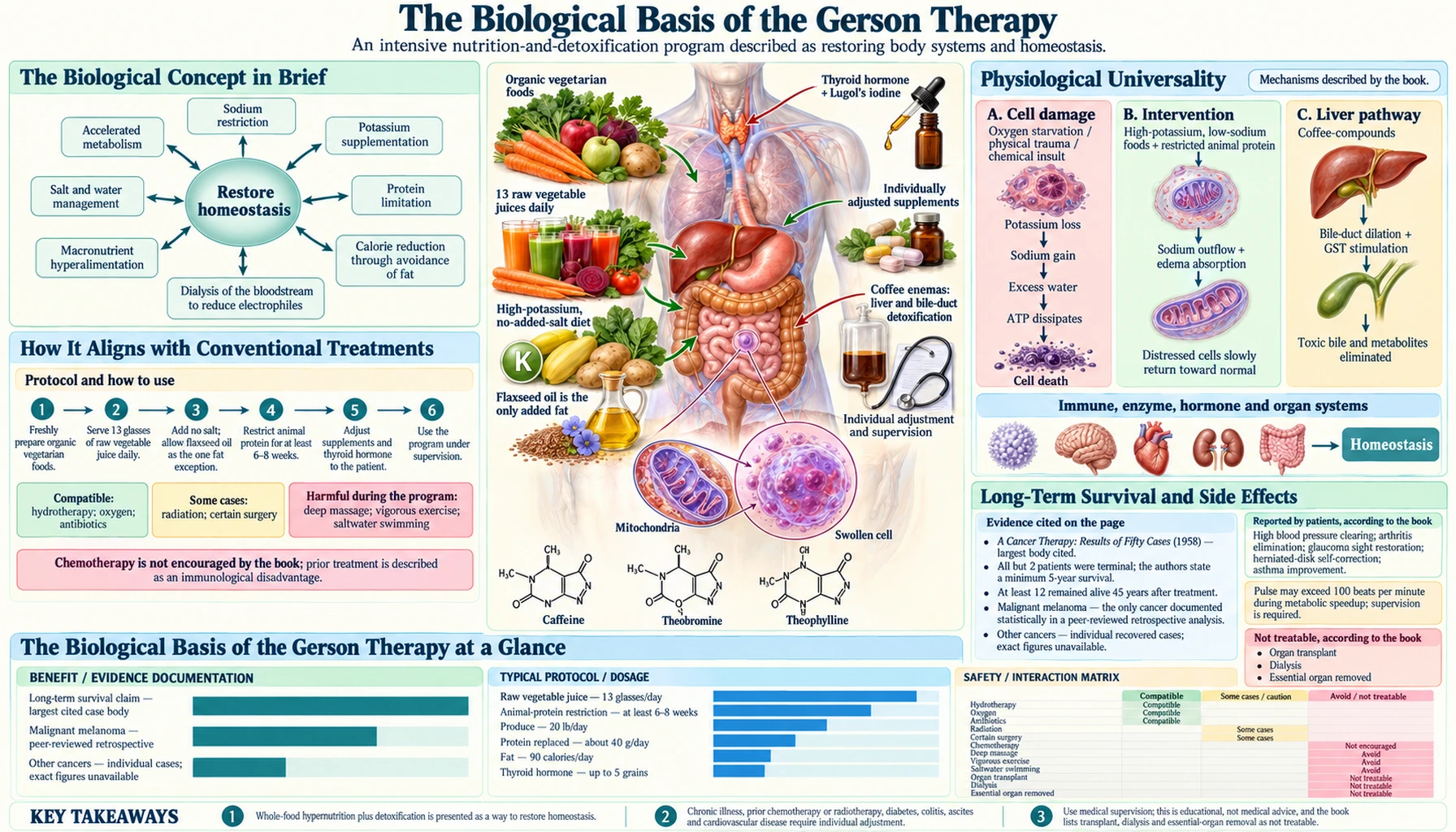
The book describes the Gerson Therapy as an intensive, nutrition-based treatment designed to restore and reactivate all the body’s systems. It is said to strengthen the immune, enzyme and hormone systems in particular, to correct the functioning of the essential organs, and to bring the body back into homeostasis.
Dr. Gerson learned during the 1930s, the authors write, that in chronic degenerative disease most organ systems become damaged and function poorly, to the point of shutting down. He concluded that the body’s innate healing mechanism eventually becomes inactive, so a debilitated body loses its ability to fight the disease and heal.
What the program requires
- Organic vegetarian foods, all freshly prepared.
- Thirteen glasses of raw vegetable juices a day, for their enzymatic effects.
- No added salt and no fats, with one exception: flaxseed oil (high in linoleic and linolenic acids).
- Foods high in potassium, which Dr. Gerson found lacking in long-time ill persons.
The damaged organ systems are thus “flooded with living nutrients,” easily absorbed and able to enter deficient tissues. When active minerals and enzymes are restored, the book says, the tissues release the excess sodium and toxins accumulated over years of faulty nutrition. It then becomes imperative to help the body — the liver in particular — filter out and eliminate those released toxins. Dr. Gerson found that caffeine given rectally assists the liver and its bile ducts to release accumulated poisons into the intestinal tract for elimination.
The chapter also describes ozone: given by rectal insufflation, it is said to increase blood oxygenation, energy and organ function. Most patients in a Gerson-certified facility also breathe air from an ozone generator in their rooms, which the authors say improves oxygenation and overcomes odors; a similar generator may be installed at home.
2. Physiological Universality
The basic philosophy — hypernutrition from whole foods plus detoxification — is described as universal for good body functioning. That universality includes eliminating, as far as possible, toxic materials from additives, perfumes, cosmetics, flavorings, dyes, herbicides, fluoride, chloride, metallic poisons, pesticide residues, cleaning agents and other environmental pollutants.
Individual adjustment
The book stresses that the program has to be adjusted for particular conditions, including candidiasis, diabetes, colitis, ascites in terminal cancer patients, cardiovascular disease, and patients who have had high doses of chemotherapy, radiotherapy, prednisone and other common drugs. Infections, low-grade fevers, lack of appetite, pain and other complications — some of them subclinical — are addressed individually and collectively during the program.
The limited supplement list
Alongside nutrition and detoxification, a small number of supplements are used to overcome deficiencies. The chapter lists:
- A potassium compound
- Digestive enzymes
- Thyroid hormone
- Iodine (Lugol’s solution)
- Vitamin B3 (niacin)
- Vitamin B12 (cobalamin)
- Injectable crude liver extract and/or liver powder or tablets
These “medications,” the authors note, are also adjusted to each patient’s needs.
3. How It Aligns with Conventional Treatments
According to the book, several conventional treatments are compatible with the Gerson Therapy: hydrotherapy, oxygen, antibiotics, radiation in some cases, and certain surgical operations, such as those for gastrointestinal blockage or the debulking of tumors.
Some physical therapies, perhaps surprisingly, are described as harmful during the program: deep massage, vigorous exercise and saltwater swimming.
The authors write that chemotherapy is not encouraged, describing it as highly toxic and suppressive of the immune system, and saying that someone treated with chemotherapy before starting the Gerson program begins at an immunological disadvantage. Even so, they report that many chemotherapy-pretreated patients can still respond positively, especially those with ovarian cancer, lymphomas, kidney cancer, and some glandular cancers such as breast and prostate cancer.
For pancreatic cancer, the book reports that the Gerson Institute has seen a number of long-term, total recoveries with the therapy, but that poor responses are likely if chemotherapy was applied first, because the organ becomes too damaged.
4. Long-Term Survival and Side Effects
The book names Dr. Gerson’s own text, A Cancer Therapy: Results of Fifty Cases, first published in 1958, as the largest body of evidence for the therapy. Almost all of those patients had been biopsied beforehand at accredited medical institutions around the United States. All but two were in terminal condition; the authors state they survived a minimum of five years, and at least a dozen remained alive forty-five years after beginning treatment.
The chapter says that the only cancer documented statistically in a peer-reviewed, published retrospective analysis is malignant melanoma (covered in the book’s chapter 6). For other cancers, the Gerson Institute records many individual recovered cases with prior biopsies and long-term survival, but exact figures are not available because recovered patients tend to stop communicating and get on with their lives. A Patient Support Network now connects those undertaking the treatment with fellow patients.
Side effects and who cannot be treated
The authors state that the therapy’s fresh organic foods, juices and cleansing enemas consist only of normal body substances and cause no bodily damage. They are clear, however, that certain patients are not treatable:
- Patients with organ transplants
- Patients on dialysis
- Patients who have had essential organs removed
Patients, the book says, jokingly refer to beneficial “side effects”: the clearing of high blood pressure, elimination of arthritis, sight restoration in glaucoma, self-correction of herniated disks and pulmonary improvement in asthma.
The “double fact”
- It is often impossible to heal a specific disease such as cancer while the body continues to suffer from diabetes, arthritis, heart disease and most other chronic disturbances.
- Eventually all the other afflictions also disappear when the Gerson Therapy is used for healing cancer.
5. Managing Potassium, Salt and Water
The central physiological idea of the chapter: around every tumor or arthritic joint, in most chronic viral conditions such as genital herpes, and in other long-standing diseases, the tissues lose potassium, gain sodium and swell with too much water.
Dr. Gerson saw the same thing when he studied tuberculosis. Around every tubercular cavity he observed a puffy, malfunctioning sphere of tissue damaged by toxins escaping from the infection. Partial metabolites left in the lesions, he recorded, continue destructive processes and in turn damage otherwise normal tissue.
By restricting sodium and providing high potassium through a fresh fruit and vegetable diet, Dr. Gerson was able to bring about absorption of this cellular edema. The swellings disappeared, the book reports, as the “tissue damage syndrome” surrounding both tubercular tissue and tumor tissue was eliminated.
The unspiced, low-sodium, high-potassium diet is therefore described as creating a physiological situation in which distressed cells slowly return to normal. The authors call this diet a primary reason for the therapy’s effectiveness against cancer and other chronic illnesses.
6. The Cell Scientists: Ling, Cope, Sodi-Pallares, Damadian
The book traces a line of cell science that, it says, grew from and supported Dr. Gerson’s work.
- Gilbert Ning Ling, Ph.D. — described as father of a new cellular biology based on “dry” physics rather than “wet” chemistry. Early in the 1970s he predicted the value of a high-potassium, low-sodium intake against chronic disease. The book says his research evolved from Dr. Gerson’s investigations, which began with migraine, then allergies, tuberculosis and chronic diseases, and were later adapted into the anticancer program.
- Freeman W. Cope, M.D., Ph.D. — a medical physicist who in 1978 found evidence, the book states, that Ling’s association-induction hypothesis was correct. Cope showed that cells are poisoned by a unifying set of events: usually oxygen starvation, physical trauma, and/or chemical insult such as toxic metals.
- Demetrio Sodi-Pallares, M.D. — a Mexican physiologist and cardiologist whose research, the book says, confirmed Cope’s concept.
- Raymond Damadian, M.D. — inventor of magnetic resonance imaging (MRI), who held that cells behave more like ion-exchange granules in a water softener than like “bags of water.”
The sequence of cell damage
Whatever the cause, the book states, the same sequence happens in damaged cells anywhere in the body:
- The cell loses most of its potassium.
- It takes on an abundance of sodium.
- It swells with excess water to dilute the sodium.
- Its energy, in the form of ATP made by burning sugar through oxidation, dissipates.
- Without ATP the cell dies; lose enough cells and the tissue dies; lose enough tissue and the organ dies.
The five scientists together, the authors write, describe the cell’s cytoplasm as latticed with a protein-lipid macromolecule through which an electron current flows. ATP is complexed with it, polarizing and energizing many cooperative association sites that prefer potassium over sodium. In the book’s words: “Give the sick cell potassium, and it gets well. Then restrict animal protein, and it becomes even healthier.”
7. Protein and Calorie Restriction
To rid damaged cells of still more sodium, Dr. Gerson eliminated animal protein from the diet for at least six or eight weeks. This produced what he called “Natrium Ausschuss” — sodium outflooding — in which sodium pours out of the body in the urine and edema is absorbed by cells, tissues and organs.
The book reports that Robert Good, M.D., former director of the Sloan-Kettering Institute for Cancer Research, showed in studies conducted in Egypt that the Gerson method of protein restriction tends to stimulate T-lymphocyte activity and cell-mediated immunity.
Where the protein comes from
Bioavailable protein comes from potatoes, vegetables, vegetable juices and oatmeal. About 40 grams of protein lost daily through waste excretion is replaced by the basic vegan diet with some added dairy protein, keeping the patient in positive nitrogen balance.
Fewer calories through less fat
Although the patient consumes 20 pounds of produce a day, the diet reduces calories by limiting fat. The only fats allowed come from oatmeal (1.5 percent of calories as fat), flaxseed oil and the fatty acids in some vegetables and fruits — a total of just 90 calories of fat daily.
The book sums up the therapy as offering potassium supplementation, near-elimination of sodium, calorie limitation, protein restriction and thyroid hormone addition, together with a restructuring of the cells’ water content.
8. Metabolism: Anabolism and Catabolism
The Gerson Therapy is described as a metabolic treatment that deliberately speeds up and stimulates all body processes. Metabolism is the sum of the body’s biochemical processes; metabolic therapies aim to balance them so that normal cells thrive and cancer cells become depleted and die or revert to normal, rebuilding the body’s life-sustaining functions to stop and reverse cancer or prevent recurrence.
- Anabolism — the building-up phase: growth, order, energy storage, and production of enzymes, hormones, antibodies and cell-membrane receptors.
- Catabolism — the breaking-down phase, in which matter is broken down and energy (ATP) is used.
The book states that the therapy stimulates both phases so the body finds its required homeostatic balance.
9. Metabolic Speedup and the Tumor Penumbra
Dr. Gerson turned cellular metabolism on with large loading doses of iodides, iodine, and up to 5 grains of thyroid hormone. The book notes that the patient’s metabolism then speeds up, seen as a racing pulse, perhaps over 100 beats per minute — one reason the program is run under supervision and adjusted to each patient.
Thyroid hormone, the authors explain, signals mitochondria to multiply and produce more ATP; iodides and iodine act on many tissues in the same way.
The sodium ring around tumors
A tumor, the book says, spreads disease outward in a sphere several times its own volume, like a penumbra. Within it, tissue is waterlogged and damaged by cancerous toxins, sitting “in its own waste” with poor immunity, poor circulation and bad drainage. Even after surgical removal, that sphere stays waterlogged unless the damage is corrected. With the Gerson Therapy, the authors report, the sodium ring around tumors disappears within weeks.
10. The Biological Basis for Coffee Enemas
The book states that the coffee enema removes circulating toxins and partial metabolites by dilating the bile ducts, and by stimulating a liver enzyme system, glutathione S-transferase (GST), that removes a wide variety of free radicals (electrophiles) from the blood. Free radicals, it explains, are charged particles with unpaired electrons that damage cell membranes and disturb metabolism.
- Under a coffee enema, the book reports, GST activity rises to 650 percent above normal.
- The authors state that no other material is known to stimulate free-radical quenching to that degree.
- While the coffee is held, all the blood in the body passes through the liver at least five times — it circulates through the liver every three minutes.
- The palmitate compounds plus the caffeine, theobromine and theophylline in coffee are said to dilate the liver’s blood vessels and bile ducts, relax smooth muscle, stimulate intestinal peristalsis and raise bile flow.
- The quart of distilled water used as the vehicle also assists, flushing out toxic bile and bile salts in what the book calls a beneficial form of dialysis.
The enema is said to remove ammonia-like products, toxic-bound nitrogen, protein derivatives, polyamines, amino acids, clumps and complexes — waste products of metabolism — freeing the body from being poisoned by its own wastes. Full technique is covered on the Coffee Enema Protocol page.
11. Hyperalimentation
For the Gerson patient, the book says, vegetarian foods, raw fruit and vegetable juices are the medications of choice; consumed together in quantity they produce “hyperalimentation.” The authors describe organically grown, freshly prepared foods as complex, chemically exquisite substances that heal better than anything invented, and they issue a warning: tamper with such nourishment at your own risk, and avoid synthetic substances, including prescribed drugs, whenever you can.
“Macronutrient hyperalimentation” — choosing only foods produced in nature under ideal conditions — is the method used to heal and restore homeostasis. The chapter prepares the reader for the recipes later in the book (see Diet Protocol).
The eight pillars, as the book lists them
- Sodium restriction
- Potassium supplementation
- Protein limitation
- Calorie reduction through avoidance of fat
- Dialysis of the bloodstream to reduce electrophiles
- Macronutrient hyperalimentation
- Salt and water management
- Accelerated metabolism
The authors close by crediting the whole program to the thinking of one man, Max Gerson, M.D., through his clinical work, his study of the medical literature and his scientific foundations.
Key Research Papers
- Gerson C, Walker M. The Gerson Therapy: The Proven Nutritional Program for Cancer and Other Illnesses. Chapter Three, “The Biological Basis of the Gerson Therapy.” — primary source for this page.
- Gerson M. A Cancer Therapy: Results of Fifty Cases. First published 1958. — cited in the chapter as the largest body of evidence.
- References listed by the chapter itself: Ling GN, In Search of the Physical Basis of Life (1984); Cope FW, “Pathology of structured water and associated cations in cells (the tissue damage syndrome) and its medical treatment,” Physiological Chemistry and Physics (1977); Cope FW, “The Ling association-induction hypothesis: the high potassium, low sodium diet of the Gerson cancer therapy,” Physiological Chemistry and Physics 10(5):465–468 (1978).
PubMed Topic Searches
Connections
Featured Videos