Gerson Therapy Patient Success Stories
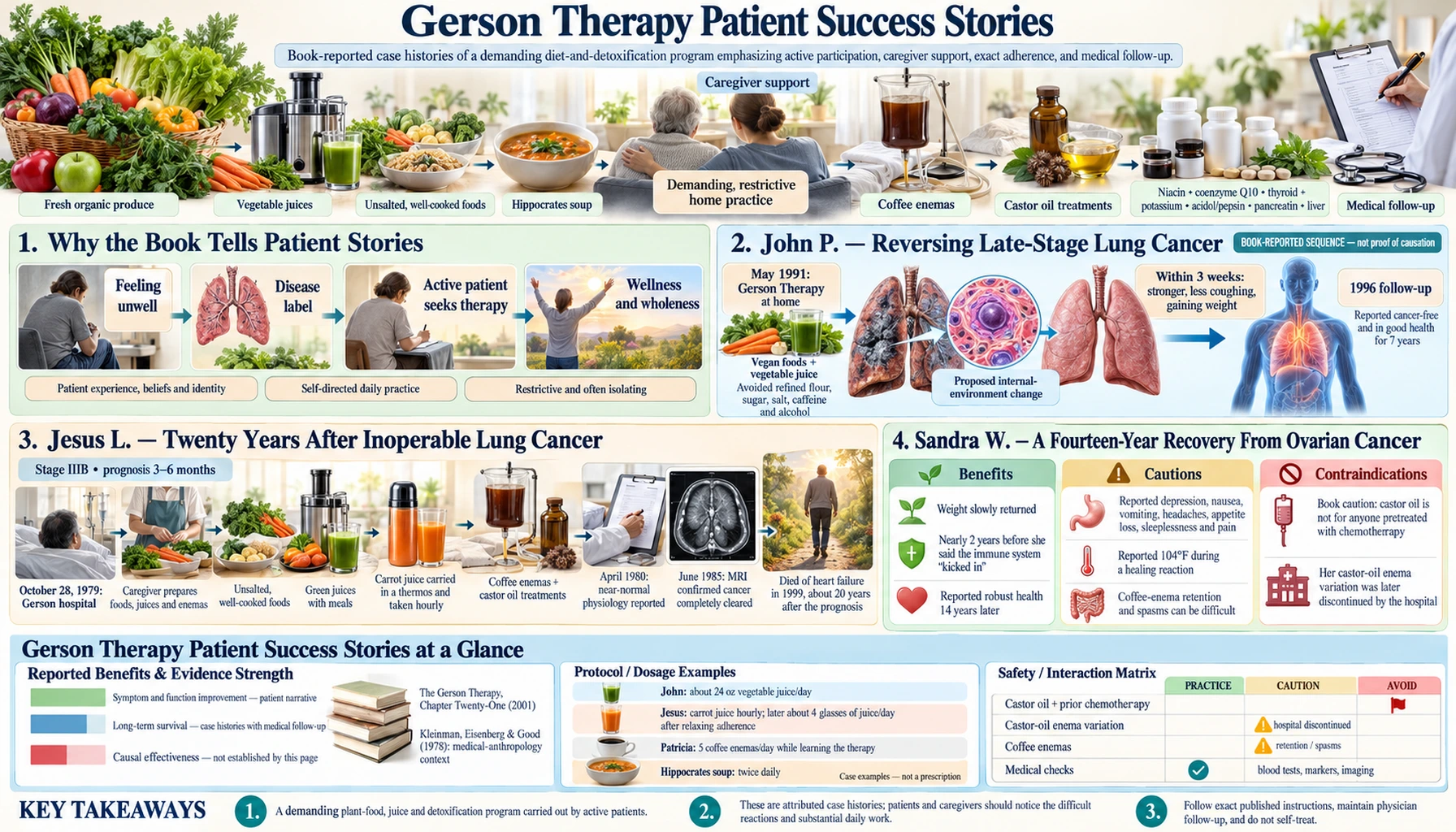
Chapter Twenty-One of The Gerson Therapy, “Success Stories by Patients,” gathers the case histories of people with serious chronic illness who chose Dr. Max Gerson’s dietary and detoxification program. The authors open by citing a medical anthropologist’s view that people come to a health system looking for wellness and wholeness, not only for a diagnosis — and they contrast the passive patient with the Gerson patient, who must actively seek out and carry out a difficult, highly restrictive and often isolating lifestyle.
The book reports four detailed recoveries — from late-stage lung cancer, inoperable large-cell lung cancer, ovarian cancer and metastatic pancreatic cancer — followed by one patient’s practical home-therapy advice and a cautionary account by Charlotte Gerson of a patient who believed he was following the therapy “perfectly” but was not. Patients are named here by first name and last initial only.
Table of Contents
- 1. Why the Book Tells Patient Stories
- 2. John P. — Reversing Late-Stage Lung Cancer
- 3. Jesus L. — Twenty Years After Inoperable Lung Cancer
- 4. Sandra W. — A Fourteen-Year Recovery From Ovarian Cancer
- 5. Sandra W.’s Suggestions for a Successful Gerson Therapy
- 6. Patricia A. — Pancreatic Cancer Gone for Almost Fifteen Years
- 7. “Phillip” — The Patient Who Thought Himself “Perfect”
- 8. Food Preparation, Cravings and Eating Enough
- 9. Common Threads in the Stories
- Key Research Papers
- Connections
- Featured Videos
1. Why the Book Tells Patient Stories
The chapter begins with a point from the field of medical anthropology: people often arrive at a doctor’s office feeling unwell and leave “labeled with a disease.” Some anthropologists, the book notes, call this the “veterinary practice of medicine,” because the patient’s own experience of illness — their opinions, beliefs and identity — becomes irrelevant except as a clue to the underlying disease.
The Gerson patients in this chapter, the authors say, were the opposite of passive. They sought the therapy out and practiced it themselves, knowing it is demanding and restrictive. Their goal was to live as close as possible to a full lifespan, and the book states that the Gerson Therapy has been allowing them to reach it.
2. John P. — Reversing Late-Stage Lung Cancer
In November 1989, John P., then sixty, was diagnosed with non-small-cell lung cancer — an adenocarcinoma — staged at level IIA by his oncologist. The diagnosis came as a shock: he had eaten a good diet, swum a thousand yards five days a week, never smoked, and had received an excellent health report just three months before.
The setting the book describes
The authors give the context of the time: in 1997, 178,100 Americans developed lung cancer and 160,400 died of it. Non-small-cell cancers account for about 75 percent of cases, and adenocarcinoma had risen to above 30 percent of all lung cancers. The book lists five-year survival figures for conventional treatment by stage, from 30–80 percent for stage I down to “considerably less than 5 percent — perhaps only 3 percent” for stage IV.
Surgery, recurrence and the choice
John underwent open-chest surgery followed by twenty-four radiation treatments, and his symptoms — constant cough sometimes with blood, hoarseness, shortness of breath, excess sputum, recurrent lung infections, weight loss, facial swelling and overwhelming fatigue — nearly disappeared. A year later the cough returned, and tests showed he would need another chest operation. He declined further surgery and chemotherapy and was told he had no chance of survival.
“I had researched lung cancer and realized that the only reason I got cancer was that my body supported it,” he explained. “If I didn’t change the internal environment of my body, the cancer would just come back again.” In May 1991 he began the Gerson Therapy at home. He was very weak and found it demanding, but, in his words, he was “facing the Grim Reaper” and highly motivated.
His results, in his words
Within three weeks, John reported, he knew it was working: he was stronger, coughing less and feeling much better — and, to his surprise, gaining weight on a vegetarian diet after months of becoming “just skin and bones.” He wrote that he had remained cancer-free and in good health for seven years, eating vegan, avoiding refined flour, sugar, salt, caffeine and alcohol, and still pressing and drinking about twenty-four ounces of vegetable juice a day.
When he returned in 1996 for a follow-up to a specialist he had consulted before his surgery, the book reports, the doctor was shocked to see him alive; his lung surgeon told him that with his disease there had been only about a 3 percent chance of five-year survival. “Eating the Gerson vegetarian way has saved my life,” he said. The authors note that he had gone well beyond double the usual five-year survival time — the benchmark the book says is defined as a “cure.”
3. Jesus L. — Twenty Years After Inoperable Lung Cancer
In January 1979, Jesus L., a sixty-six-year-old retired businessman from Mexico, came home from a trip with a severe cold that turned into a persistent cough and hoarseness. For six months it was treated as adult-onset asthma. X-rays finally showed a 5-centimeter round spot in the upper right lung, and an earlier annual X-ray had shown nothing — the mass had formed within about half a year.
Diagnosis and radiation
During surgery, the surgeon judged that removing the tumor would leave him too weak and took only a biopsy. The pathology showed large-cell undifferentiated carcinoma with spread to the bronchial and mediastinal areas — stage IIIB, the stage the book describes as not removable. His metastases were declared inoperable and his prognosis set at three to six months.
He received a course of high-energy radiation from a linear accelerator in the summer of 1979, aimed at relieving symptoms rather than curing the cancer. The book records the side effects: depression, loss of appetite, serious weight loss, darkened skin over the chest, and esophageal scarring that left him, even twenty years later, needing to swallow carefully. By late August the tumor had shrunk by about 80 percent, but he was given only a 50 percent estimate of avoiding recurrence. Less than a month after radiation ended, the cough and hoarseness returned worse than ever.
The Gerson Therapy and a devoted caregiver
Learning of the Gerson Therapy through his daughter, he arrived at the Gerson hospital in Tijuana with his wife, Dolores, on October 28, 1979. His physical response was, the book says, rapidly positive: his cancer markers and other lab tests improved. His spirits, however, hit bottom, and at home he struggled with the juices, coffee enemas, castor oil treatments and unsalted, well-cooked foods, which were foreign to his cultural background. Healing reactions came often and sometimes lasted a week, taking his appetite completely.
Dolores prepared his foods, juices and enemas and became the household’s Gerson therapist. “In effect,” the authors write, “his wife saved the life” of her husband. By the week between Christmas 1979 and New Year’s Day his flare-ups had diminished. Soon he returned to work part-time, going home for coffee enemas, meals and green juices and carrying carrot juice in a thermos to drink hourly.
Five years clear
At his first six-month checkup in April 1980 his markers and blood tests showed near-normal physiology, and his physician relaxed the diet to include yogurt, rye bread, raw skimmed milk and occasional fish and chicken. He became optimistic — telling stories, joking and singing. In 1981 he spoke at a Gerson survivors’ conference, and in June 1985 an MRI confirmed his cancer had completely cleared; his physician declared him officially cured. He returned for semiannual checkups twelve times in all.
After his physician’s sudden death, he markedly relaxed his adherence, dropping to about four glasses of juice a day while keeping a sensible diet. For the next fourteen years he and Dolores traveled widely across North America.
A later illness
In 1999, at eighty-six, after an Alaskan cruise, he developed back pain below the right shoulder blade that proved to be a soft-tissue sarcoma. A physician at the Tijuana facility suggested it might be a delayed effect of his radiation twenty years earlier. He returned to the Gerson Therapy at home, but in the last week of November 1999 he died suddenly of heart failure — some twenty years after being given three to six months to live.
4. Sandra W. — A Fourteen-Year Recovery From Ovarian Cancer
When the authors met Sandra W. in November 1999, she was fifty-one, working as a nanny and nutritionist, and taking maintenance care at the Gerson facility in Tijuana. Fourteen years earlier, ovarian cancer had threatened her life.
The background the book gives
The authors call ovarian cancer the fourth most frequent cause of cancer death in American women, citing 26,800 cases and 14,200 deaths in the United States in 1997. It spreads by shedding cells into the abdominal cavity, implanting on nearby organs, and metastasizing to lymph nodes.
Years of warning signs
Sandra’s problems began at seventeen with severe menstrual cramps. By twenty-three she had cysts on both ovaries removed, followed by surgery for endometriosis and then a third operation for a baseball-sized cyst. Widowed when her adopted son was three, she took up running at least four miles a day for eight years. Early in 1985 she woke in tremendous pain with a fluid-filled abdomen (ascites). Surgery to remove a grapefruit-sized cyst included a hysterectomy, and two days later she was told she had ovarian cancer.
Choosing a different path
She declined a further operation that would have required blood transfusions, and her health insurance coverage was canceled as a “preexisting condition.” At thirty-six, a widow with a seven-year-old son and no income, she moved in with her parents. Her mother, who had nursed cancer patients, helped her research options; a friend sent information on the Gerson Therapy, and after watching Charlotte Gerson’s lectures her mother said, “Feed the immune system and give it a chance to fight off the cancer itself.”
Detoxification — and the smell of perm
In September 1985 she spent ten days at the Gerson hospital learning the therapy. By then her weight had fallen from 120 to 92 pounds at five feet six and a half, and she remained bedridden for four months, nursed by her parents. She describes many detoxification reactions: depression, tears, constant nausea, vomiting, headaches, burning from castor oil, loss of appetite, sleeplessness and pain in joints, muscles and bones. Most strikingly, she says, she gave off the odor of permanent-waving solution — she had permed her hair about five times a year, and she believed the therapy was pulling those stored chemicals out. She also had been drinking up to three six-cup pots of coffee a day.
The authors draw the lesson that a person becomes what they put into and onto the body: to stay healthy, expose yourself only to good things.
Recovery
Her parents made juices from fresh, organic produce, and her weight slowly returned. “It took nearly two years of detoxifying and nourishing my body before the immune system kicked in,” she says; she saw it happen when her temperature rose to 104°F during a healing reaction, after which she “just got better and better.” She took no other medication or supplement beyond those the Gerson program prescribes — niacin, coenzyme Q10, thyroid, potassium, acidol/pepsin, pancreatin and liver. Fourteen years later she was, the authors write, “the picture of robust health.”
5. Sandra W.’s Suggestions for a Successful Gerson Therapy
Having followed the therapy full-time for two years and kept it as her lifestyle since, Sandra kept a diary of what she went through and offered her own tips. “The Gerson method is not for wimps,” she says; “it takes fighters!” You are not popping a pill — you must help yourself and ask family or friends for help, at least at the beginning. Her suggestions, in no particular order:
- Keep a diary of emotional swings, healing reactions, deviations from the program and other people’s reactions. You will discover what brought on a flare-up — and who your real friends are.
- Prepare the next day in advance after your last juice of the day: coffee, medications, produce deliveries, cleaning vegetables and meal planning. Being organized is a plus.
- Keep studying the Gerson books, videos and audiotapes. After almost fifteen years she still learned something new each time.
- On castor oil days, start early. She puts one tablespoon of cranberry or apple juice in a small medicine cup, then the required two tablespoons of castor oil, followed directly by a cup of hot coffee. The book cautions that castor oil is not for anyone pretreated with chemotherapy.
- After the castor oil, eat a piece of fruit and take your first coffee enema. It will be a “yucky-feeling” day, but the next day you will feel much better. She finds oral castor oil easier than a castor oil enema.
- Her castor oil enema method differs slightly from the official instructions, and she notes the Gerson hospital has since discontinued it, though it still works for her.
- Chamomile tea enemas are soothing and may be easier to hold when released toxins make holding coffee difficult.
- Don’t get upset if you can’t hold the coffee enema — try again or wait for the next one.
- Slow the flow to about five minutes by lowering the bucket or using the valve; she feels fewer spasms that way.
- If spasms persist, add a teaspoon of potassium to the four cups of coffee solution. Early in the therapy, she explains, the body may be potassium-depleted, which shows up as abdominal spasms.
- To reduce niacin flush, take niacin only on a full stomach, or let the tablet melt in the mouth or under the tongue.
- If you hire help, employ two or three people so there is always a backup.
- Think positively, play good music, count your blessings, and use the diary to get bad thoughts out of your head. Self-pity gets you nowhere.
- Every part matters — juices, food, medications, coffee. “Work hard! Stay with a stick-to-it attitude! Be disciplined! Succeed!”
She closes with faith: you are never given more than you can handle, and after coming through, “you may be the one to save someone else’s life beside your own!”
6. Patricia A. — Pancreatic Cancer Gone for Almost Fifteen Years
Patricia A., a Canadian woman of forty-six, developed pneumonia in September 1985. In January 1986 a CT-guided needle biopsy confirmed adenocarcinoma of the pancreas, and her specialist wrote that “there is no specific treatment indicated presently.” She remembers being told to go home and get her life in order because the cancer was inoperable. “I went through all the anguish, the crying, and I finally resigned myself to my own death.”
The cancer had spread to her gallbladder, liver and spleen. Within weeks she lost more than forty-five pounds and regularly vomited blood. The book says this stage carries a projected five-year survival of 1 percent or less, and she also had ascites, jaundice, pleural effusion, alcoholic hepatitis and pain.
“Pack your bag”
She then read a newspaper story about a man cured of pancreatic cancer with the Gerson Therapy. She decided she was not going to sit crying and dying, but would live her remaining months as well as she could for herself and her family. Though skeptical, “it was the only hope I had.” Her husband, Ron, insisted they go. They spent two weeks at the Gerson hospital learning to make organic juices, choose the right foods and self-administer five coffee enemas a day. “It wasn’t any fun,” she says, “but what choice did I have except to try?” Within ten days she felt considerably better than she had in months.
No evidence of recurrence
Committing to at least two years of strict home therapy, she reports that in December 1986 her doctor told her he thought she had the cancer licked. In a 1990 letter her family physician wrote that she had no evidence of recurrence and “what evidence of malignancy was present in 1985 has now gone,” adding that she had “survived what is generally a fatal illness and now lives life to the full.”
When the authors spoke with her in November 1999 she said, “I feel good, excellent in fact” — she had watched her grandchildren grow up. She still drinks plenty of fresh organic vegetable juice, takes a daily coffee enema, and sends regular blood tests and cancer markers to the Gerson hospital. Asked why she continues, her husband said: “Pat had been looking for a lifeline and once you’ve found one it’s very hard to let go.”
7. “Phillip” — The Patient Who Thought Himself “Perfect”
The chapter closes with an article by Charlotte Gerson, retitled from the Gerson Healing Newsletter (1999). She writes that to be sure patients follow the therapy exactly, she ought to follow them around their house and kitchen for twenty-four hours. Visiting a warm, enthusiastic patient she calls “Phillip,” recovering from melanoma with spread to the liver, she found that despite clean air, household help and a devoted wife, several deviations had crept in:
- Softened water. The home’s water softener replaced hard-water minerals with sodium, so he washed and bathed in salty water. Gerson writes that salt is easily absorbed through the skin, that sodium is an enzyme inhibitor needed for fast tumor growth, and that it underlies the “tissue damage syndrome” — cells losing potassium while sodium enters, causing edema and loss of function — which her father considered the beginning of all chronic disease. Cancer patients should avoid bathing in salt water, even the ocean.
- Avocados. His salad was loaded with them. Avocados are high in fat, she writes, and fats tend to stimulate new tumor growth; they are the second item on the Forbidden Foods list. Patients and caregivers should rely on the published Gerson materials, not memory or rumor.
- The wrong soup. The vegetable soup served was not the Hippocrates soup described in Dr. Gerson’s book. That soup’s specific ingredients, she explains, have a detoxifying effect on the kidneys, which is why it is eaten twice daily. Extra tomatoes or dry-roasted onions (no fat) can vary the flavor, but the basic recipe should stay unchanged.
- Weak enema coffee. The concentrate looked too weak for the usual 4-to-1 dilution. Each enema must contain the equivalent of three rounded tablespoons of coffee — check and recheck the preparation.
- Bread as filler (less serious). One slice of unsalted rye bread is fine once the salads, soup, potato, vegetables and fruit have been eaten, but bread should never be the main part of a meal.
Experienced Gerson physicians told her that subtle noncompliance is a common difficulty: patients sincerely assure them they are doing everything “perfectly” without realizing what is wrong. Her remedy is to study the Gerson book, handbook and videos thoroughly and review them over and over — echoing Sandra W.’s point that you always learn something new.
8. Food Preparation, Cravings and Eating Enough
Charlotte Gerson writes that simply boiling vegetables and putting them on a plate is not good enough. Cooked, peeled beets can be warmed with fresh applesauce, or dressed with onions, green pepper, vinegar and flaxseed oil as a beet salad; potato, string bean and butter bean salads are refreshing in summer. When caregivers report a patient is weak, losing weight and doing poorly, she says, it almost always turns out the patient craves pizza or other greasy, salty food — because they are hungry and not eating well-prepared Gerson meals.
“When they are on a nutritional therapy such as this one, they are on nothing if they don’t eat!” Eating properly, she writes, most emaciated patients gain weight and overweight ones lose it on the same regimen. Companions who share the meals often lose their own cravings for sweets.
- Fruit: summer fruits — cherries, apricots, peaches, nectarines, plums, pears, grapes — are high in vitamins, potassium and enzymes, with apples close behind year-round. Unless diabetic or suffering from candidiasis, patients should eat plenty of fruit at night, in the morning and between meals.
- Variety: fresh corn is fine, but eating it to the exclusion of other vegetables defeats the purpose; variety supplies a wide range of phytochemicals and trace minerals.
Her guiding principle: “I’ll do the best possible to help my sick body heal,” rather than “I’ll see how little I can do and still get away with it.”
9. Common Threads in the Stories
- A grave prognosis first. Each cancer patient had been told survival was unlikely — from “no chance” to three to six months.
- Healing reactions. Every story describes hard flare-ups — nausea, depression, fever, loss of appetite — which the book presents as the body releasing toxins.
- A caregiver. A wife, parents or a husband did much of the daily work; the book credits them repeatedly.
- Two years of strict adherence. Patients describe at least two years on the full program, and most kept parts of it for life.
- Exactness matters. Charlotte Gerson’s account shows how small departures — salt in bath water, avocados, weak coffee — undermine the program, and why she urges patients to restudy the materials.
- Medical follow-up. The patients continued regular checkups, blood tests and cancer markers under supervision.
Key Research Papers
- Gerson C, Walker M. Chapter Twenty-One, “Success Stories by Patients.” In: The Gerson Therapy: The Proven Nutritional Program for Cancer and Other Illnesses. New York: Kensington Publishing; 2001. Primary source for this page.
- Kleinman A, Eisenberg L, Good B. Culture, illness, and care: clinical lessons from anthropologic and cross-cultural research. Ann Intern Med. 1978;88(2):251-258. Cited by the chapter. PubMed search