Emil von Behring: Serum Therapy, Diphtheria, and the First Nobel Prize in Medicine
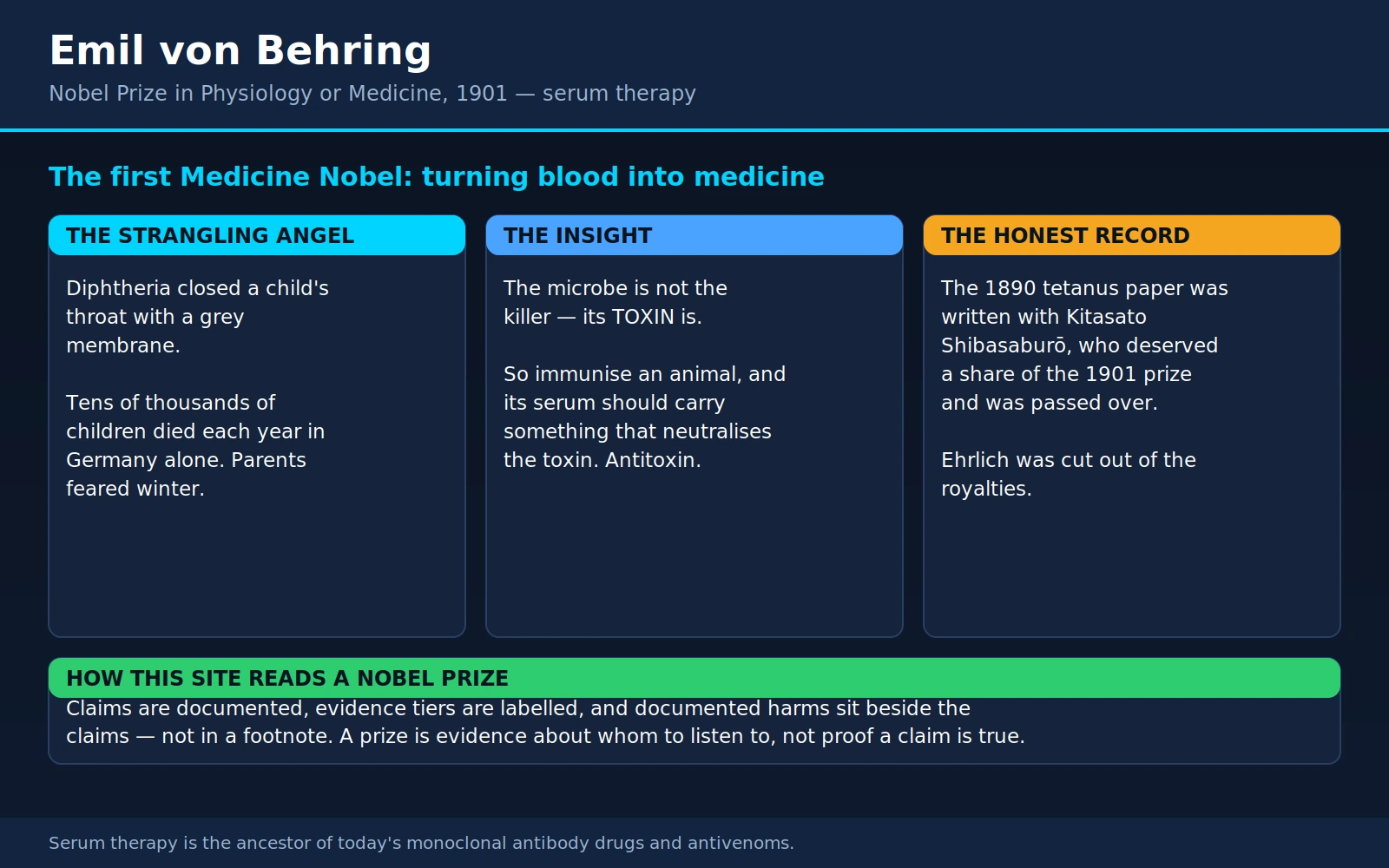
Table of Contents
- Who He Was
- The Strangling Angel of Children
- The Idea: The Microbe Is Not the Killer
- 1890, with Kitasato: Blood Becomes Medicine
- From Lab to Child
- The Money and the Friendship
- The Tuberculosis Stumble
- Toward Vaccines: From Borrowed Immunity to DTaP
- The Direct Line to Modern Medicine
- Where Mainstream Medicine Agrees — and What the Record Complicates
- Key Research Papers
- Connections
- Featured Videos
1. Who He Was
Emil von Behring (1854–1917) was the first person ever to receive the Nobel Prize in Physiology or Medicine. When the new prize was awarded for the first time in 1901, the committee did not reach for a theorist or a famous professor — it reached for the man whose invention was, at that very moment, pulling children back from the edge of suffocation in hospital wards across Europe. The citation honored his work on serum therapy, "especially its application against diphtheria," by which, in the committee's words, he had "placed in the hands of the physician a victorious weapon against illness and deaths." Behring had shown that the blood of an immunized animal contains something that neutralizes a bacterial poison — and that this something can be transferred, in a syringe of serum, to a dying child. He turned blood into medicine.
Nothing about his origins predicted it. Behring was born on March 15, 1854, in Hansdorf, West Prussia — today the village of Ławice in northern Poland — one of thirteen children of a village schoolmaster. A schoolmaster's salary divided thirteen ways does not send a son to university, however clever the son. The path that existed for a poor, gifted boy in Prussia ran through the army: in 1874 he entered the Friedrich-Wilhelms-Institut in Berlin, the military's medical academy, which trained physicians for free in exchange for years of service in uniform. He took his medical degree in 1878 and spent the next decade as a military surgeon, posted to cavalry regiments in the Prussian provinces.
Army medicine turned out to be a strange gift. Assigned in the early 1880s to evaluate iodoform, a then-fashionable antiseptic powder for wounds, Behring reached a conclusion that would quietly organize the rest of his life: iodoform did not seem to kill germs so much as it seemed to neutralize the poisons germs give off. The observation was rough, but the idea inside it — that you might fight a disease by disarming its toxin rather than by slaughtering its microbe — was the seed of everything that followed.
In 1888 the army posted him to Berlin, and in 1889 he joined the laboratory of Robert Koch, then the most famous microbe hunter alive, first at Koch's Hygiene Institute and from 1891 at the newly built Institute for Infectious Diseases. Koch's lab in those years was the closest thing medicine had to a champions' locker room: among the assistants were Paul Ehrlich and a visiting Japanese physician named Kitasato Shibasaburō. Within two years of arriving, the ex-army surgeon from Hansdorf would put all of them, and medicine itself, on a new road.
2. The Strangling Angel of Children
To feel the force of what Behring did, a modern reader first has to meet the enemy, because almost nobody alive today has seen it. Diphtheria is an infection of the throat caused by the bacterium Corynebacterium diphtheriae. It begins like an ordinary sore throat and low fever. Then, over a day or two, a leathery gray-white membrane grows across the tonsils and throat — the disease's name comes from the Greek for "leather hide." The membrane is not loose mucus; it is a dense mat of dead tissue, bacteria, and clotted immune cells, welded to the living surface underneath. Try to peel it away and the tissue bleeds. And it spreads — downward, toward the voice box and windpipe of a small child, whose airway is no wider than a drinking straw.
Parents in the nineteenth century knew exactly what came next, and their name for the disease says everything: the strangling angel of children. In Spain, after a horrific epidemic year, it was el garrotillo — the little garrote, the executioner's strangling cord. A child with laryngeal diphtheria fights harder and harder for air, with a barking cough and a high crowing sound on every breath, and without help can die of slow suffocation while fully conscious. The membrane was only half the horror: the bacterium's toxin also rides the bloodstream outward, poisoning the heart muscle and the nerves, so that some children who survived the choking died of heart failure days or weeks later, seemingly on the mend.
This was not a rare disease. It was a routine catastrophe of family life. In the late nineteenth century diphtheria killed tens of thousands of children every year in Germany alone — contemporary estimates ran on the order of fifty thousand — and comparable tolls fell on France, Britain, Russia, and the United States. Hospitals maintained entire croup wards for strangling children. Surgeons could open the windpipe below the blockage — tracheotomy — or slide a metal tube past the membrane, and those desperate measures saved some airways, but no scalpel could touch the poison already loose in the blood. Half or more of the children who reached the croup wards in a bad year did not leave them.
This is why parents a century and a half ago feared winter the way we might fear a diagnosis: diphtheria traveled the coughing, crowded, indoor months, and it took children preferentially. A family could put three healthy children to bed on a Sunday and have quarantine placards and small coffins by the next. Behring's fame in the 1890s — the crowds, the honors, the title "savior of the children" — is unintelligible until you understand that this was the enemy he was seen to have beaten.
3. The Idea: The Microbe Is Not the Killer — Its Toxin Is
By the late 1880s, Koch's school had proven that specific germs cause specific diseases. But diphtheria presented a puzzle. In 1883–84, Edwin Klebs and Friedrich Loeffler identified and cultured the diphtheria bacillus — and Loeffler noticed something odd. In autopsies, the bacteria stayed local, camped in the throat membrane, yet the fatal damage appeared far away, in the heart and nervous system. The germ never traveled to the organs it destroyed. Loeffler's inference: the bacillus must ship out a poison that does the long-distance killing.
The proof came from Paris in 1888. At the Pasteur Institute, Émile Roux and Alexandre Yersin grew diphtheria bacilli in broth, then forced the broth through a porcelain filter fine enough to strain out every bacterium. The clear, germ-free liquid that passed through still killed laboratory animals — with the classic organ damage of diphtheria. There it was: the microbe is the factory, but the toxin is the weapon. Tetanus told the same story even more starkly. The tetanus bacillus, Clostridium tetani, sits harmlessly in a dirty wound while its toxin travels the nerves and locks every muscle in the body rigid — the disease farmers knew as lockjaw.
Behring's leap was to take this seriously as a treatment problem. Nearly everyone else was hunting ways to kill bacteria inside the body — "internal disinfection" with harsh chemicals that mostly poisoned the patient along with the germ. Behring, the man who had decided iodoform worked by neutralizing poisons, asked a different question: if the toxin is the killer, can the body be taught to disarm it — and can that ability be given away? The plan: expose an animal to carefully graded, sublethal doses of toxin until it shrugs off many times a lethal dose; then draw its blood, let the cells settle out, and inject the clear golden serum into another animal. If protection travels in the syringe, immunity is not a mystical property of the survivor's flesh — it is a substance, and a substance can be bottled.
Working at Koch's institute through 1890, Behring on diphtheria and Kitasato on tetanus ground through the animal experiments — guinea pigs, rabbits, mice; toxin blunted with iodine compounds; doses escalated by tiny steps; failures buried and begun again. By late autumn the answer was in hand, and it was yes on every count. The serum of an immunized animal neutralized the toxin in a test tube. It protected a fresh animal that received serum before infection. Most astonishing of all, it could cure: an animal already sick could be rescued by serum from an immune one. Blood, as Behring liked to say with Goethe, is a very special juice.
4. 1890, with Kitasato: Blood Becomes Medicine
On December 4, 1890, the Deutsche Medizinische Wochenschrift carried a short paper by Emil Behring and Kitasato Shibasaburō: "On the establishment of diphtheria immunity and tetanus immunity in animals." Its experimental heart was tetanus — Kitasato's organism; he had been the first in the world to grow it in pure culture the year before — and its claims were laid out with military crispness: the blood of a tetanus-immune rabbit destroys the power of tetanus toxin; this property persists in cell-free serum; and that serum, injected into other animals, protects them and can even treat established infection. The authors closed with a flourish that has delighted immunologists ever since — a line from Goethe's Faust: "Blut ist ein ganz besonderer Saft" — blood is a very special juice. One week later Behring published the diphtheria companion paper under his own name, and in the years that followed his collaborator Erich Wernicke did much of the grinding work of turning weak diphtheria serum into something strong enough to matter.
It is hard to overstate what this one paper founded. The serum's toxin-destroying property needed a name, and it got one: antitoxin — the first antibody ever recognized, decades before anyone knew antibodies were proteins, let alone Y-shaped ones. The paper is the founding document of humoral immunology, the entire science of what circulates in our blood plasma to defend us — the science behind every vaccine titer ever measured and every monoclonal antibody drug ever infused. And the treatment it proposed — borrowing ready-made immunity from one body to protect another — created the category medicine still calls passive immunization. Active immunity is earned; a vaccine drills your own immune system until it can make its own antibodies. Passive immunity is borrowed, instant, and temporary — a transfusion of someone else's victory. Both concepts date, as practical medicine, from that December.
Honesty requires saying plainly what the Nobel committee of 1901 did not: Kitasato deserved to share the first prize, and he was passed over. The tetanus work that anchored the joint paper was built on his pure culture and done with his hands; he was nominated; the committee, awarding a new prize under a convention of single laureates, chose Behring alone. Kitasato never publicly complained. History has been steadily correcting the ledger, and this page joins it: the 1890 breakthrough was Behring and Kitasato.
What Kitasato did next matters to this site's story. He returned to Japan in 1892, discovered the plague bacillus in Hong Kong in 1894 (in a famous near-dead-heat with Yersin), and built his own research institution in Tokyo — the Kitasato Institute, formally founded in 1914 and still working today. Nearly a century later, a Kitasato Institute microbiologist named Satoshi Ōmura pulled a soil bacterium from a golf-course sample, and the avermectin compounds it yielded became ivermectin — and half of the 2015 Nobel Prize in Physiology or Medicine. The man denied a share of the first medicine Nobel founded the institute that earned one of its most celebrated recent ones. Scientific credit is imperfect; scientific lineage keeps better books.
Behring, for his part, understood exactly what he had. He later called serum therapy a means of "disinfection without poison" — the body's own specific chemistry doing what carbolic acid never could. The 1890 papers made the 36-year-old military doctor famous within months. Now came the harder problem: a cured guinea pig is not a cured child.
5. From Lab to Child
The legend is set on Christmas night, 1891, in a Berlin clinic: a child dying of diphtheria, an experimental syringe of antitoxin serum, and by morning a fever breaking and a membrane loosening — the first human life pulled back by the new medicine, on the most symbolically loaded night of the German calendar. It is a beautiful story, and this site tells it the way historians do: as a story. The documentation behind the date, the clinic, and the child is thin, and the tale hardened into print years later, polished by retelling. What is solidly documented is less cinematic but more important: through 1892 and 1893, antitoxin from Behring's circle was tried in Berlin hospital wards in growing case series, the early serum was often too weak, children still died, and the dosing had to be learned the hard way. First-in-human medicine was rough then in ways no modern trial would permit.
Two problems stood between a laboratory triumph and a public-health revolution: potency and supply. The solution to both had a name: Paul Ehrlich. Ehrlich worked out immunization schedules that drove serum strength far beyond what Behring's early animals gave, and — his enduring gift to all of medicine — he made antitoxin measurable. Ehrlich defined a reproducible antitoxin unit, anchored to a preserved standard serum, so that a physician injecting a child knew the dose in numbers rather than in hope. From 1896 he ran the state serum-control institute in the Berlin suburb of Steglitz, where every commercial batch in Germany had to pass testing. It was the birth of biological standardization — the ancestor of every "IU" on every vial in a modern pharmacy.
Supply came on four legs. The animal that turned antitoxin from a curiosity into an industry was the horse: big, placid, with liters of blood to spare, and tolerant of the immunization course. Immunized with graded toxin over weeks and then bled from the neck vein — trotting back to its stable afterward — a single good antitoxin horse could supply serum for thousands of children. From 1894 the Hoechst dye works manufactured Behring's serum at commercial scale, and stables of state-registered serum horses became public-health infrastructure on both sides of the Atlantic — New York City's health department famously kept its own.
Then the death rates moved. In 1894, Roux presented the Paris children's-hospital experience to the international hygiene congress in Budapest: with serum, diphtheria mortality on his wards had roughly halved — from around one death in two among the worst cases toward one in four — and the hall reportedly rose to its feet. German, English, and American hospital series through the later 1890s told the same story, sharper still once physicians learned the cardinal rule: inject early. Antitoxin neutralizes toxin still circulating in the blood; it cannot pry toxin out of a heart cell already poisoned. Given on day one or two of illness, serum turned diphtheria from a coin-flip into a disease most children survived; by the early twentieth century, case-fatality rates on well-run wards had fallen toward the single digits. It was medicine's first specific cure for an acute infectious disease — proof, delivered in the bodies of children, that treatment could be aimed.
This is the achievement the first Nobel Prize in Physiology or Medicine crowned in 1901 — and the same year the Kaiser raised the schoolmaster's son into the nobility as Emil von Behring. The prize diploma's language about "a victorious weapon against illness and deaths" reads, for once in the history of award citations, like plain description. You can read the committee's own summary at nobelprize.org.
6. The Money and the Friendship
Serum was not only salvation; it was product. Behring's arrangements with the Hoechst company made him, over time, a wealthy man — wealthy enough for an estate in Marburg, a villa on Capri, and eventually his own pharmaceutical company: the Behringwerke, founded in Marburg in 1904, which manufactured sera and vaccines under his name for a century (descendants of it live on inside today's pharmaceutical giants, including CSL Behring). None of that money was stolen — it was earned by a product that worked. But how the profits were divided is the ugliest well-documented episode of Behring's life.
Ehrlich's high-potency immunization methods and his unit of measurement were, by any fair reckoning, half the reason commercial serum was worth selling. The two men entered the Hoechst venture together, and then — as the standard histories reconstruct it — Behring maneuvered his partner out: Ehrlich was persuaded to renounce his share of the royalties, reportedly on Behring's assurance that he would help secure Ehrlich a state research institute of his own, help that never came in the promised form. The institute Ehrlich eventually led, he got through other patrons. The money from the serum flowed overwhelmingly to Behring. The friendship did not survive the arithmetic; the two greatest immunologists in Germany spent years barely on speaking terms, and Ehrlich's private letters about Behring make bitter reading.
This page will not sand the edges off its subject. Behring was a genuinely great scientist — and a sharp-elbowed, litigious, patent-minded operator who guarded credit jealously, quarreled with colleagues, absorbed the contributions of collaborators like Wernicke and Kitasato into his own legend, and cut his indispensable partner out of a fortune. Both facts are true at once. The children on the croup wards owed him their lives, and Ehrlich was owed better; gratitude and honesty can share a page. (Ehrlich's own Nobel came in 1908, shared with Élie Metchnikoff, for the theoretical foundations of immunity — and his later invention of Salvarsan opened chemotherapy. History paid the debt Behring didn't.)
7. The Tuberculosis Stumble
Every great career has a mountain it fails to climb. Behring's was tuberculosis — the same enemy that had humbled his mentor Koch when the overhyped "tuberculin" cure of 1890 collapsed. From the late 1890s until his death, Behring poured his prestige, his laboratories, and a great deal of Behringwerke money into TB, convinced he could repeat the diphtheria miracle against the era's biggest killer. He could not.
His centerpiece was a cattle vaccine: "bovovaccination," the inoculation of calves with live tubercle bacilli of the human type, which he believed too enfeebled in cattle to cause disease but strong enough to immunize. Early results looked promising, and for a few years the program had real momentum — herds were vaccinated in Germany and abroad. Then the accounting came due: protection proved partial and waned; vaccinated cattle could still become infected and shed bacilli; and the prospect of seeding dairy herds — and their milk — with live human-type TB germs came to look reckless rather than bold. By the First World War, bovovaccination was effectively abandoned. His parallel attempts at a human TB remedy ("tulase," toxin preparations from macerated bacilli) never produced convincing cures at all.
Inside the failure sat one genuinely important scientific fight, and Behring was on the better side of it. At the 1901 tuberculosis congress in London, Koch startled the world by declaring bovine and human tuberculosis essentially separate problems — cattle TB, he argued, posed little danger to people, so milk hygiene hardly mattered. Behring pushed back hard: he held that infant tuberculosis very often began in the milk bottle, with bovine bacilli slipping through a baby's gut, and he campaigned for treating and disinfecting milk. On the vaccine, history graded Behring a failure; on the milk, it graded him largely right. Bovine TB does infect children through raw milk — later commissions confirmed it against Koch's dismissal — and the pasteurization and tested-herd programs of the twentieth century closed exactly the door Behring had pointed at. (For the disease itself, see Mycobacterium tuberculosis.)
The TB decades took a personal toll that his public image concealed. Behring suffered recurring bouts of severe depression, spending long stretches in sanatoria; a thigh fracture in 1916 broke his remaining health, and on March 31, 1917, he died in Marburg of pneumonia, at 63, with the war still on and his tetanus serum in every field hospital. The failed TB campaign is part of his record — a reminder that the same self-certainty that let a military surgeon overturn therapeutics also let him spend twenty years refusing to hear "no" from a bacterium.
8. Toward Vaccines: From Borrowed Immunity to DTaP
Serum therapy had a built-in limit: borrowed immunity is a loan, not a wage. Injected horse antitoxin guards a child for a few weeks and is then cleared away, leaving the child as vulnerable as before — and a body that has met horse serum once may react against it the next time (the "serum sickness" of fevers, rashes, and aching joints that early pediatricians knew well). The obvious next question was Behring's final scientific project: instead of lending children antitoxin, could you teach each child's body to make its own?
His answer, announced in 1913, was the toxin–antitoxin mixture: diphtheria toxin blended with just enough antitoxin to muzzle it, injected so that the immune system could study the disarmed weapon and raise its own defenses. It worked — this was genuine active immunization against diphtheria, and in the 1920s public-health giants like William H. Park in New York carried toxin–antitoxin campaigns through hundreds of thousands of schoolchildren. But the mixture was a compromise, tricky to balance and occasionally dangerous when a batch's arithmetic failed. The finishing stroke came from the Pasteur Institute in the 1920s, where Gaston Ramon showed that treating toxin with formalin and warmth produced toxoid (his "anatoxine") — toxin permanently stripped of its poison but still wearing the molecular face the immune system needs to see, with Alexander Glenny's London group reaching the same trick and adding the alum adjuvant that sharpens the response. Toxoid was safe, stable, cheap, and potent. It is the diphtheria and tetanus vaccine we use to this day.
Follow that road to its end and it arrives in a modern pediatrician's refrigerator. The DTaP shot is a direct descendant of Behring's program: Diphtheria toxoid, Tetanus toxoid, and acellular Pertussis antigens against whooping cough (Bordetella pertussis). Its results are among the most absolute in medicine. Diphtheria — fifty thousand dead German children a year in Behring's youth — is now so rare in vaccinated countries that most practicing physicians will spend an entire career without seeing a single case; the United States records a case of respiratory diphtheria only once in a span of years. The disease has not gone soft — when vaccination collapsed in the former Soviet Union in the 1990s, diphtheria came straight back, with more than 150,000 cases and around 5,000 deaths. The strangling angel is not extinct, only held off by a toxoid descended from Behring's toxin–antitoxin idea. Tetanus tells the same story wherever vaccination and wound care reach — and still kills, mostly newborns, where they don't.
Behring lived to see one last vindication, on the worst possible stage. When the First World War began, the manured soil of Flanders was a tetanus factory, and in the first months lockjaw tore through the wounded of every army. Then routine prophylactic tetanus antitoxin — a shot of serum for every wounded man, as soon as possible after injury — became standing practice, and tetanus collapsed as a battlefield disease: in the British forces, from roughly eight cases per thousand wounded in the autumn of 1914 to a fraction of that for the rest of the war. Germany awarded Behring the Iron Cross — a soldier's decoration, given to a scientist — and newspapers called him the savior of the soldiers as they had once called him the savior of the children. Few humans have had two such titles honestly earned.
9. The Direct Line to Modern Medicine
Draw one line from 1890 to now and it runs straight through most of modern therapeutics. Behring's antitoxin was the first evidence that specific protective molecules — antibodies — circulate in blood; Ehrlich gave them a theory, the twentieth century gave them a structure, and in 1975 Köhler and Milstein learned to clone a single antibody-making cell into an immortal factory, making monoclonal antibodies — serum therapy with the impurities engineered away. Today those descendants — adalimumab for arthritis, rituximab for lymphoma, the checkpoint antibodies that unleashed immunotherapy against cancer, nirsevimab lent to newborns against RSV exactly as Behring's serum was lent to children against diphtheria — are among the most important and widely used drugs on Earth. And the original, unfashionable forms never left: snakebite antivenom is still concentrated animal serum raised the way Behring's horses were; diphtheria antitoxin itself, still horse-derived, still waits in national stockpiles for the rare case; rabies and tetanus immune globulins are passive immunization verbatim; and when COVID-19 arrived with no drugs on the shelf, medicine's first reflex was convalescent plasma — borrowing antibodies from survivors' blood, which is Behring and Kitasato's December 1890 idea, revived word for word 130 years later.
10. Where Mainstream Medicine Agrees — and What the Record Complicates
Where mainstream medicine agrees
On the science, there is no controversy to report. Serum therapy against diphtheria was real, was proven in the wards of many countries within a few years, and stands as medicine's first targeted cure for an acute infectious disease. The 1890 Behring–Kitasato paper is the founding document of humoral immunology — antibodies enter science as "antitoxin" — and passive immunization remains standard of care in its modern niches: immune globulins after rabies and tetanus exposures, antivenoms, monoclonal antibodies across a dozen specialties. The vaccine road Behring opened with toxin–antitoxin, finished by Ramon's and Glenny's toxoid, produced two of the most effective vaccines ever made; diphtheria and tetanus toxoids have been on the World Health Organization's essential-medicines list from its first edition. The first Nobel Prize in Medicine went to work that deserved it.
What the record complicates
The man is a harder file than the medicine. Kitasato Shibasaburō was co-author of the founding paper and owner of its strongest experiments, and the 1901 prize named Behring alone — an omission the field now states plainly, as this page does. The Ehrlich affair — a partner argued out of his royalty share on assurances that evaporated — is documented enough to be told without varnish, and it cost Behring the friendship of the one contemporary who was his scientific equal. His tuberculosis program consumed two decades and failed, in part because the certainty that served him in 1890 served him poorly against a slower, subtler microbe — though on the bovine-milk transmission question he was closer to right than Koch. Early serum therapy itself had real costs the heroic retellings skip: weak early batches, children lost while dosing was learned, and horse-serum reactions from rashes to the occasional fatal collapse — the price of a first-generation biological, and the reason Ehrlich's standardization mattered as much as Behring's idea. And the Christmas 1891 first-cure story is best enjoyed as what it is: a legend resting on thin paper. None of this shrinks the achievement. It replaces a marble statue with a human being — a poor schoolmaster's son who beat the strangling angel, shortchanged his friend, lost to tuberculosis, and left every child on Earth safer than he found them.
11. Key Research Papers
- Behring E, Kitasato S. Ueber das Zustandekommen der Diphtherie-Immunität und der Tetanus-Immunität bei Thieren. Dtsch Med Wochenschr 1890;16(49):1113-4 — the founding paper; it predates PubMed indexing, so the link is a PubMed search for the literature about it
- Kaufmann SH. Remembering Emil von Behring: from Tetanus Treatment to Antibody Cooperation with Phagocytes. mBio 2017;8(1)
- Kaufmann SHE. Emil von Behring: translational medicine at the dawn of immunology. Nat Rev Immunol 2017;17(6):341-3
- Winau F, Winau R. Emil von Behring and serum therapy. Microbes Infect 2002;4(2):185-8
- Kantha SS. A centennial review; the 1890 tetanus antitoxin paper of von Behring and Kitasato and the related developments. Keio J Med 1991;40(1):35-9
- Grundbacher FJ. Behring's discovery of diphtheria and tetanus antitoxins. Immunol Today 1992;13(5):188-90
- Graham BS, Ambrosino DM. History of passive antibody administration for prevention and treatment of infectious diseases. Curr Opin HIV AIDS 2015;10(3):129-34
- Sharma NC, Efstratiou A, Mokrousov I, et al. Diphtheria. Nat Rev Dis Primers 2019;5(1):81
- Yen LM, Thwaites CL. Tetanus. Lancet 2019;393(10181):1657-68
- Liu JK. The history of monoclonal antibody development — progress, remaining challenges and future innovations. Ann Med Surg (Lond) 2014;3(4):113-6
Live PubMed Searches
- Behring serum therapy history
- Diphtheria antitoxin history
- Tetanus antitoxin
- Diphtheria toxoid vaccine
- Passive immunization & monoclonal antibodies
Connections
- All Notable Doctors
- Robert Koch — the chief in whose Berlin institute the antitoxin work was done, and Behring's opponent in the bovine-TB dispute
- Satoshi Ōmura — the 2015 laureate from the institute founded by Kitasato, Behring's passed-over partner
- Élie Metchnikoff — champion of the rival cellular theory of immunity; shared the 1908 prize with Behring's estranged partner Ehrlich
- Alexander Fleming — the next revolution in anti-infective medicine, a generation after serum therapy
- Frederick Banting — another first-of-its-kind cure, and another famous fight over shared credit
- Nobel Prize in Medicine — the laureates' wing this page belongs to; Behring's 1901 award was the first ever given
- Clostridium tetani — the tetanus bacillus Kitasato tamed, whose antitoxin anchored the 1890 paper
- Bordetella pertussis — whooping cough, the "P" that joined Behring's "D" and "T" in the DTaP vaccine
- Mycobacterium tuberculosis — the microbe that defeated his last two decades
- All Bacteria
- Tetanus — the disease, from lockjaw to the modern vaccine schedule
- Immunology — the field whose humoral half begins with the word "antitoxin"