My Healthcare News · August 27, 2026
Mass Medication Without Consent: the Reversal, the Remand, and the Road to the Supreme Court
“Every human being of adult years and sound mind has a right to determine what shall be done with his own body.”
Schloendorff v. Society of New York Hospital, 1914Chlorine is added to water to treat the water — to kill bacteria and make it safe to drink. Fluoride is added to treat the person — a medical intervention meant to prevent tooth decay, delivered to entire U.S. populations without individual consent. On this view, fluoridation is mass medication administered without individual consent, without control over dose (intake rises with every glass), and without a practical way to refuse, since opting out means paying for filtration or bottled water. No one clears a polluted lake by pouring more toxins into the lake. The first step in clearing a lake or the human body, is to stop adding more toxins. Click to read more about Fluoride Toxicity …
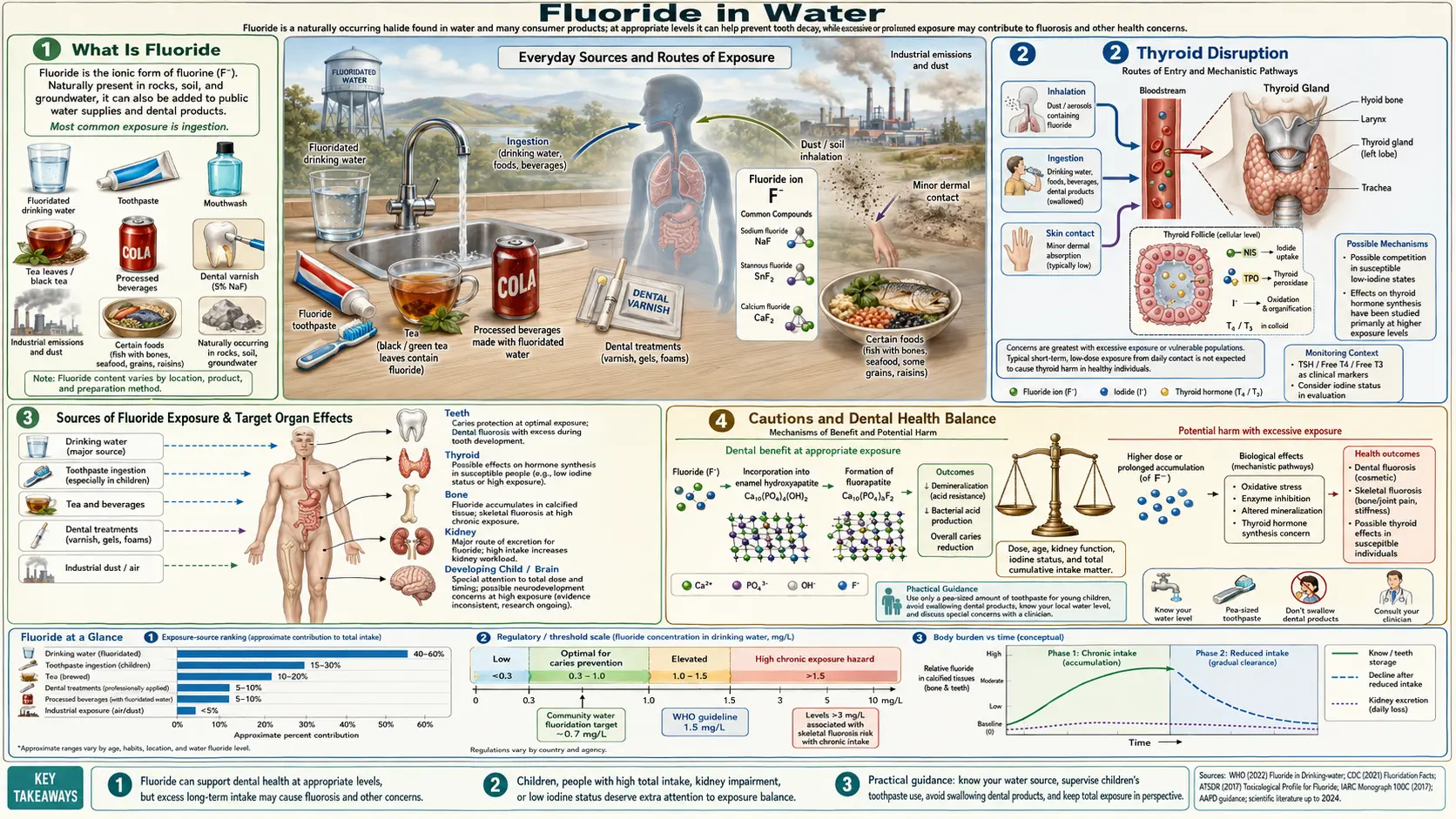
The sentence at the top of this page is not a slogan. It is American law — written by Justice Benjamin Cardozo in 1914, and taught to every first-year medical student since as the foundation of informed consent. A doctor who medicates a competent adult without permission commits a battery, however good the intentions and however beneficial the drug. That principle has governed every hospital, every clinic, and every pharmacy in this country for over a century. There is one glaring exception: the drinking water, where roughly 200 million Americans receive a daily dose of a substance added not to make the water safe, but to treat the people drinking it.
This year, the machinery around that exception finally began to move — in both directions at once. On May 21, 2026, the Ninth Circuit Court of Appeals erased the only federal court ruling ever to find that fluoridation at the recommended U.S. level poses an unreasonable risk to children's developing brains. It did so on procedure, not science: the panel never said fluoridation is safe, and pointedly declined to touch that question. Meanwhile the states are not waiting for the courts. Utah and Florida have already ended fluoridation by statute, Robert F. Kennedy Jr.'s health agencies have moved against swallowed fluoride on several fronts, and on August 3, 2026, the U.S. Environmental Protection Agency (EPA) published the protocol for a full re-assessment of fluoride's toxicity — the document that could lawfully unwind the whole program.
This article follows up on all of it: what Judge Edward Chen actually ruled in 2024, what the appeals court just undid and on what grounds, whether the case can reach the U.S. Supreme Court, what Secretary Kennedy has actually done versus announced, and why the consent argument — the one in the quotation above — does not depend on winning any of those fights. The dose problem and the consent problem exist even if fluoride were harmless. The science suggesting it is not harmless only raises the stakes.
Table of Contents
- The News at a Glance
- Medication Without Consent: the Legal Argument
- A Drug With No Dose, No Doctor, and No Way to Refuse
- Dosing People Who Cannot Benefit
- Boiling Makes It Worse: Fluoride in the Kitchen
- What Judge Chen Ruled in 2024
- What the Ninth Circuit Did on May 21
- The Time-Machine Problem: Ruling on a 2020 Record
- The Supreme Court Question
- What Kennedy's Agencies Have Actually Done
- The U.S. Environmental Protection Agency's Two Hats
- Where Removal Is Already Winning
- The Rest of the Rich World Mostly Said No
- What Fluoridation's Defenders Say — and the Honest Reply
- What You Can Do Now
- What to Watch Next
- Sources and Primary Documents
- Key Research Papers
- PubMed Topic Searches
- Connections
- Featured Videos
The News at a Glance
- May 21, 2026 — A three-judge Ninth Circuit panel vacated Judge Edward Chen's landmark September 2024 ruling that fluoridation at 0.7 mg/L presents an unreasonable risk to children, holding that Chen “commandeered” the case procedurally. The panel did not decide whether fluoride is safe.
- The remand — The case returns to Judge Chen in San Francisco, who must now re-decide it using only the evidence from the first trial, which closed in June 2020 — excluding the strongest science published since.
- The Supreme Court — There is no Supreme Court ruling on fluoridation, and there never has been. Plaintiffs' counsel Michael Connett said after the reversal that he was weighing a petition for certiorari. As this edition goes to press, no petition has appeared on the Court's public docket.
- August 3, 2026 — The U.S. Environmental Protection Agency released its Protocol for Developing the Fluoride Human Health Toxicity Assessment, the next step in the expedited scientific review Administrator Lee Zeldin announced in April 2025 alongside Secretary Kennedy.
- The states — Utah (March 2025) and Florida (May 2025) have banned fluoridation statewide; bills were introduced in 18 states in 2025 and more followed in 2026.
- The U.S. Food and Drug Administration (FDA) — On October 31, 2025, the agency restricted — but did not remove, as first promised — prescription swallowed-fluoride drops and tablets for children.
Medication Without Consent: the Legal Argument
Start where the creed at the top of this page starts, because the entire case for removal can be built from it without citing a single toxicology study.
In 1914, Mary Schloendorff consented to an examination under anesthesia and explicitly refused surgery. Surgeons removed a tumor anyway. Justice Cardozo's opinion for the New York Court of Appeals made her refusal the law of the land: a competent adult's body is theirs to govern, and treatment without consent is not medicine but trespass. Over the following century that principle hardened into the doctrine of informed consent — reaffirmed after Nuremberg, codified in state statutes, and enforced daily in malpractice courts. Its requirements are familiar: the patient must be told what the intervention is, what it is for, what the risks are, and must be free to say no. Our companion article, Water Fluoridation and Informed Consent, walks through the doctrine in detail.
Now apply the doctrine to the tap. Chlorination treats the water: it kills pathogens so that what reaches your glass is safe to drink, exactly as pasteurization treats milk. Nobody's body is being medicated; a water parameter is being corrected. Fluoridation is categorically different. The water is already safe. Fluoride is added to treat the person — to produce a pharmacological effect (decay prevention) in human tissue (tooth enamel). By the plain logic of food-and-drug law, a substance added to prevent disease in humans is a drug, and the U.S. Food and Drug Administration has in fact never approved swallowed fluoride as one: the fluoride drops and tablets that pediatricians prescribed for decades were never put through U.S. Food and Drug Administration approval, a fact the agency itself emphasized when it moved against them in 2025 (see below).
Delivered through the municipal main, this drug arrives with none of the safeguards the law demands everywhere else. There is no disclosure of risks — most residents could not name their water system's fluoride level. There is no individualized prescribing: the same concentration reaches the newborn mixing into formula, the kidney patient who cannot excrete it, and the laborer drinking five liters a day. And there is no meaningful refusal: the only way to opt out is to buy your way out, through filtration systems or bottled water — a tax on dissent that falls hardest on the poorest households, the very people fluoridation is claimed to help.
Why, then, have American courts not struck it down? Because for seventy years the challenges were heard under a different body of law. Mid-century courts analyzed fluoridation as public health regulation under the states' police power — the same authority that supports mandatory vaccination under Jacobson v. Massachusetts — and consistently upheld it, while the U.S. Supreme Court declined, again and again, to take a fluoridation case. The informed-consent objection was never really adjudicated on its own terms; it was absorbed into deference. That is precisely why the modern fight has moved to two other arenas: federal chemical-safety law, where the risk question can be litigated on evidence (the case discussed below), and state legislatures, where the consent argument needs no judge's permission to prevail — and where it has begun to win.
A Drug With No Dose, No Doctor, and No Way to Refuse
Every legitimate medication in America carries a dose. Fluoridated water cannot, by its nature. The concentration is fixed — 0.7 milligrams per liter, per the Public Health Service's 2015 recommendation — but the dose is whatever you drink, and nobody drinks the same amount.
- An exclusively formula-fed infant takes in far more water per pound of body weight than any adult — which is why even the U.S. Centers for Disease Control and Prevention (CDC) and the American Dental Association concede that mixing formula with fluoridated tap water can cause mild dental fluorosis, and note that parents “may” use low-fluoride bottled water instead. A concession that the default dose is wrong for a whole class of patients is not a small concession.
- Athletes, outdoor workers, and people with diabetes insipidus drink multiples of the average intake. Their dose rises accordingly. No one adjusts it, because no one can.
- People with impaired kidney function clear fluoride poorly and accumulate more of it in bone. In any clinic, renal status changes the prescription. At the tap, it changes nothing.
- Fluoride arrives from other sources too — toothpaste, tea, processed food and beverages made with fluoridated water — so the water sits on top of a baseline nobody is measuring.
Defenders answer that the concentration is set low enough to be safe at any plausible intake. But that is an argument that the uncontrolled dosing is probably tolerable, not that it is consented to — and “probably tolerable” is exactly the proposition the federal litigation put on trial.
Dosing People Who Cannot Benefit
Every drug is prescribed to patients who can benefit from it. Fluoridation inverts that too, because the water main cannot check who is drinking.
Fluoride's claimed benefit acts on one tissue: natural tooth enamel. Roughly one in six American seniors has no natural teeth at all, and millions more chew with dentures and titanium implants — none of which can develop a cavity, ever. Acrylic does not demineralize; titanium does not decay. For this entire population the intervention has a benefit of exactly zero, while the exposure — to bone, kidneys, and thyroid, in the age group with the most accumulated fluoride in its skeleton and the least kidney function to clear it — continues with every glass, every cup of coffee, every bowl of soup, for the rest of their lives. A physician who prescribed a decay-prevention drug to a patient with no teeth would be corrected by any pharmacist in the country. The water system prescribes it to them daily, and nobody can stop it at the meter.
Now notice the asymmetry that decides the whole policy question. If fluoridation ends, the person who wants fluoride loses nothing: fluoride drops and tablets exist, are inexpensive, and can be added to one's own glass at a dose chosen with one's own dentist — Utah wrote exactly this into its 2025 law by authorizing pharmacists to provide them. Opting in costs pennies and a decision. But while fluoridation continues, the person who does not want it — the denture wearer, the parent mixing formula, the kidney patient, the simply unconsenting — must buy reverse-osmosis equipment or bottled water for every drop the household drinks and cooks with, forever. Opting out costs hundreds of dollars a year and still fails at every restaurant, school fountain, and coffee pot in town. A policy whose opt-in is a drop in a glass and whose opt-out is a plumbing project has the burden pointing exactly backwards — which is why “those who want it can add it to their own water” is not a quip but the entire solution, and the one the consent principle has required all along.
Boiling Makes It Worse: Fluoride in the Kitchen
A dangerous piece of folk wisdom holds that boiling water “purifies” it — and for the things water treatment is actually for, it does. Boiling kills microbes, and it drives off much of the chlorine, which is a volatile gas. Watch the contrast, because it is the treat-the-water-versus-treat-the-person distinction playing out in your kettle: the disinfectant leaves when you boil; the medication stays — and concentrates.
Fluoride is not a gas. It is a dissolved mineral ion, and it cannot evaporate. When water boils away as steam, every milligram of fluoride stays behind in less and less water. The arithmetic is unforgiving and proportional: simmer a pot of soup or stock down to half its volume and you have doubled its fluoride concentration; reduce a sauce to a third and you have tripled it. A long-simmered bone broth — the very food this site recommends for joints and gut — becomes a fluoride concentrate when it is built on fluoridated tap water. Rice, pasta, beans, and oatmeal absorb the water they are cooked in, fluoride included. Coffee and tea are brewed concentrations of the tap — and tea adds a second dose on top, because the tea plant naturally accumulates fluoride in its leaves. A household that faithfully drinks bottled water but cooks with the tap has not opted out; it has opted into a more concentrated form.
This is why the population-level dose is even less controlled than the previous section suggested: the 0.7 mg/L figure describes water leaving the treatment plant, not food arriving at the table. It also explains a point of frequent confusion about removal. Boiling in an open pot concentrates fluoride in the pot. Only capturing the steam and discarding the pot — distillation — removes it, because the fluoride stays in the residue while the condensed steam runs clean. If you filter, filter the water you cook with, not just the water you sip; the water guide covers which methods work.
What Judge Chen Ruled in 2024
The case began as paperwork. In 2016, Food & Water Watch, the Fluoride Action Network, Moms Against Fluoridation, and several families petitioned the U.S. Environmental Protection Agency under Section 21 of the TSCA to ban the deliberate addition of fluoride to drinking water as an unreasonable neurotoxic risk. The U.S. Environmental Protection Agency (EPA) denied the petition in early 2017. Section 21 has a remarkable feature: a citizen whose petition is denied may sue and have a federal court decide the risk question fresh, on evidence, rather than merely reviewing the agency's paperwork for reasonableness. The groups filed suit in April 2017 in the Northern District of California, where the case — Food & Water Watch, Inc. v. EPA, No. 3:17-cv-02162 — landed before Senior District Judge Edward M. Chen.
Chen heard a first bench trial in June 2020, then a second in early 2024, and on September 24, 2024 issued an 80-page ruling that made history: the first federal judicial finding that fluoridation chemicals at the U.S.-recommended concentration of 0.7 mg/L “present an unreasonable risk of injury to health” specifically, reduced IQ in children — within the meaning of TSCA. He was careful about what he was and was not saying:
“It should be noted that this finding does not conclude with certainty that fluoridated water is injurious to public health,” Chen wrote, but “there is an unreasonable risk of such injury, a risk sufficient to require the U.S. Environmental Protection Agency to engage with a regulatory response.”
That is how TSCA is built: the statute does not wait for certainty of harm, it acts on unreasonable risk — with an ample margin of safety, and without considering cost. Chen leaned heavily on the National Toxicology Program's August 2024 systematic review, which concluded with moderate confidence that fluoride exposures at or above 1.5 mg/L are consistently associated with lower IQ in children. His reasoning: 1.5 is barely twice the level deliberately added to American taps, some Americans drink water naturally at or above it, pregnant women and formula-fed infants have no margin at all — and a drug with that risk profile, administered to two hundred million people who never agreed to take it, obligates the regulator to act. He ordered the U.S. Environmental Protection Agency to begin a rulemaking response, leaving the remedy — warning, lowering, or prohibition — to the agency.
The U.S. Environmental Protection Agency under President Biden appealed in January 2025. And here the politics turned strange: the incoming Trump administration's health wing, led by Secretary Kennedy, publicly celebrated the ruling — while its Justice Department kept fighting to overturn it, and succeeded.
What the Ninth Circuit Did on May 21
On May 21, 2026, a Ninth Circuit panel — Senior Circuit Judge Sidney R. Thomas, Circuit Judge Ronald Gould, and Chief District Judge Brian Morris of Montana, sitting by designation — issued a short, unsigned, unpublished memorandum in Food & Water Watch v. EPA, No. 25-384, vacating Chen's ruling in full.
Read the disposition carefully, because what it does not say matters as much as what it does. The panel did not hold that fluoridation is safe. It did not disturb a single scientific finding. It reversed on the party presentation principle — the rule, most recently sharpened by the Supreme Court in United States v. Sineneng-Smith (2020), that judges must decide the case the parties bring rather than build a better one themselves. After the 2020 trial, both sides told Chen he could and should rule on the existing record. Instead, the panel found, he held the case in abeyance for a year and a half to wait for the National Toxicology Program's final monograph — a document the parties had stipulated they would not present — then convened a second trial around it. In the panel's words:
“The district court abused its discretion when it refused to rule on the first trial record, despite the parties’ assertions that it should, and when it held the case in abeyance to wait for the completion of an additional study to which the parties had already stipulated not to present at trial.”
Arguing for the government at the March 3 hearing in San Francisco, the Justice Department's Robert Stander had framed the stakes procedurally: letting the case be decided on evidence that post-dated the 2016 petition “renders the petition a meaningless formality.” Notably, the panel did not go that far — it expressly held that Chen did not err by considering evidence beyond the 2016 petition at the first trial, since both parties had introduced such evidence. The fatal act was the judge's own: insisting on the NTP monograph after the parties had closed their case. The panel also sent the question of the families' standing back down for another look, and ended with one operative sentence: vacated and remanded, with instructions “to rule based solely on the first trial record.”
Michael Connett, the attorney who has carried the case since 2017, called it “a threadbare opinion” resting on “an expansive and unprecedented application of the party presentation principle,” and noted the panel “didn't address the factual merits of the lower court's determination that fluoridation poses an unreasonable risk.” On that last point he is simply describing the document: the merits finding was not reviewed, and no court has ever examined the modern evidence and pronounced 0.7 mg/L safe.
The Time-Machine Problem: Ruling on a 2020 Record
The remand instruction is the part with teeth. Judge Chen must now re-decide the case “based solely on the first trial record” the evidence as it stood in June 2020. Connett's summary: the panel “ordered the court to travel back in time to August 2020 and render its decision based on the (now stale) factual record as it existed at that time.”
What falls outside that record is precisely the science that made the 2024 ruling so hard to dismiss: the NTP's final monograph (August 2024) with its moderate-confidence conclusion; the NTP scientists' pooled dose-response meta-analysis in JAMA Pediatrics (January 2025), which reported lower IQ with increasing fluoride exposure across 74 studies; and the 2024 Cochrane review, which — from the other direction — found the dental benefit of fluoridation in the toothpaste era to be far smaller than its mid-century reputation. What remains inside the 2020 record is not nothing: the prospective mother-child cohort studies from Canada (Green 2019) and Mexico (Bashash 2017), funded by the U.S. National Institutes of Health, were the backbone of the first trial, and Chen found the plaintiffs' experts credible the first time. He is free to reach the same conclusion again on the older evidence — and whichever way he rules, a fresh appeal is all but certain.
Sit with the irony for a moment. The nation's premier toxicology program spent years producing the definitive federal review of fluoride's neurotoxicity; a federal judge waited for it, weighed it, and acted on it; and an appeals court has now ordered the decision re-made as if that review did not exist — not because the science is wrong, but because waiting for it was procedurally improper. Whatever one thinks of the party presentation principle, the result is that the United States' judicial answer on fluoride will be rendered, in 2026 or 2027, on a 2020 snapshot of the evidence.
The Supreme Court Question
Readers have asked us to follow up on “the Supreme Court ruling.” Let us be precise, because precision is the whole game here: the U.S. Supreme Court has never ruled on water fluoridation — not in this case, not in any case. Across seven decades of state-court challenges the Court declined review every time it was asked, which is how fluoridation has survived without the country's highest court ever examining it. The May 21 decision came from the Ninth Circuit, one rung below, and the Supreme Court's only appearance in it is as the source of the Sineneng-Smith party-presentation precedent the panel applied.
Could this case finally put fluoridation — or at least its procedure — before the Justices? Connett said after the ruling that he would be “reviewing our legal options in the coming days, including the potential of filing a petition for cert to the Supreme Court.” The mechanics: a certiorari petition is ordinarily due 90 days from the judgment — a window that ran to roughly August 19, 2026 — unless the plaintiffs obtained an extension from the circuit justice or first sought rehearing en banc before the full Ninth Circuit, either of which resets the clock. As we publish, no petition appears on the Supreme Court's public docket and no rehearing grant has been reported. The honest odds: the Court grants about 1% of petitions, and an unpublished, non-precedential procedural memorandum is an unlikely vehicle — though the question of how far the party presentation principle reaches into a trial court's management of evidence is genuinely unsettled, and this panel's application of it was, as Connett says, unusually muscular. The likelier path runs through the remand: Judge Chen rules again on the 2020 record, someone appeals, and the science question returns to the Ninth Circuit with the procedure cured.
One more Supreme Court is worth knowing about — a foreign one, because it shows what a highest court can do when it confronts the consent logic squarely. In 1973 the Supreme Court of the Netherlands ruled that Dutch water law authorized treating water, not people: adding a substance to serve a medical purpose in the drinkers had no legal basis. Dutch fluoridation ended, permanently. Half a century later, the Netherlands — with no fluoride in any tap — has some of the healthiest teeth in Europe. The American version of that ruling has never been sought on its own terms. It may not need to be, because the legislatures are getting there first.
What Kennedy's Agencies Have Actually Done
Robert F. Kennedy Jr. arrived at U.S. Department of Health and Human Services (HHS) in February 2025 having already declared his position — days before the 2024 election he described fluoride in a post on X as “an industrial waste associated with arthritis, bone fractures, bone cancer, IQ loss, neurodevelopmental disorders, and thyroid disease” and said the incoming administration would advise removing it from public water. Eighteen months in, here is the honest ledger of announcement versus action.
The U.S. Centers for Disease Control and Prevention recommendation — announced, not yet done. On April 7, 2025, standing in Salt Lake City with the U.S. Environmental Protection Agency Administrator Lee Zeldin days after Utah's ban took effect, Kennedy said he would direct the U.S. Centers for Disease Control and Prevention to stop recommending community water fluoridation and would assemble a task force on the question. It matters more than it sounds: fluoridation is a local decision, and the U.S. Centers for Disease Control and Prevention's recommendation is the authority every city council leans on. But as of this writing the formal guidance has not changed — the U.S. Centers for Disease Control and Prevention's fluoridation pages still describe the practice as safe and effective. What has changed is capacity: the April 2025 U.S. Department of Health and Human Services restructuring eliminated the U.S. Centers for Disease Control and Prevention's Division of Oral Health, the office that ran the federal fluoridation program. The recommendation stands, for now, with almost nobody left behind it.
The U.S. Food and Drug Administration and swallowed fluoride — promised a removal, delivered a restriction. On May 13, 2025, the U.S. Food and Drug Administration announced it would act to remove concentrated ingestible fluoride prescription drops and tablets for children from the market by late October, Commissioner Marty Makary's office noting these products were never U.S. Food and Drug Administration-approved and citing evidence on the infant gut microbiome, thyroid effects, and “possibly decreased IQ.” When the deadline arrived on October 31, 2025, the agency stopped short of the full removal: it now recommends the products not be given to children under three, or to any child at low or moderate risk of cavities, and says it will pursue enforcement against unapproved products marketed for those groups — while leaving them available for high-risk children over three. The American Dental Association's own headline captured it: the U.S. Food and Drug Administration was “halting [its] previously promised ban.” Still, register what even the restriction concedes: the federal government's drug regulator now formally advises against swallowed fluoride for toddlers — the age group most exposed, pound for pound, through fluoridated tap water it does not regulate.
The pattern. The MAHA agencies talk faster than they act — we documented the same gap in our August 10 generally recognized as safe (GRAS) coverage. But direction of travel is unmistakable, and on fluoride every completed federal action since 2025 has pointed one way: toward less of it swallowed by fewer children.
The U.S. Environmental Protection Agency's Two Hats
The U.S. Environmental Protection Agency spent 2025 and 2026 doing two things that look contradictory until you see the institutional logic. With one hand, its lawyers fought Judge Chen's ruling all the way to the May 21 reversal — defending the agency's procedural turf, as agencies of both parties reflexively do. With the other, its leadership launched exactly the scientific re-examination the ruling would have compelled. On the same April 2025 stage where Kennedy made his U.S. Centers for Disease Control and Prevention announcement, Administrator Zeldin announced an “expedited review” of the science on fluoride in drinking water, explicitly citing the NTP report.
On August 3, 2026, that review produced its first public milestone: the Protocol for Developing the Fluoride Human Health Toxicity Assessment, released under the Safe Drinking Water Act as part of what the agency calls its gold-standard science initiative. The protocol is the methods document — it lays out how the U.S. Environmental Protection Agency will weigh the neurodevelopmental literature in deriving a new toxicity value for fluoride. That number is the legal linchpin: it feeds the maximum-contaminant-level goal, and from there the enforceable ceiling, currently a 4.0 mg/L standard set in 1986 — nearly six times the concentration cities deliberately add, and a level at which the National Research Council already concluded in 2006 that children's teeth and bones were not protected. If the assessment lands anywhere near the NTP's 1.5 mg/L signal, the arithmetic of federal fluoride regulation changes for the first time in forty years — and with it, every state and municipal decision downstream. Watch for the assessment's public comment window; we will cover it when it opens.
Where Removal Is Already Winning
While the federal case loops through procedure, the consent argument has been winning where it needs no judge: in statehouses.
Utah went first. On March 27, 2025, Governor Spencer Cox signed HB 81, making Utah the first state to prohibit adding fluoride to public water systems, effective May 7, 2025. Note the shape of the law, because it is the consent principle made statute: the same bill authorized pharmacists to prescribe fluoride supplements to anyone who wants them. Fluoride was not banned as a substance — it was moved from the water main back to the pharmacy, from a dose imposed on everyone to a medicine chosen by each. Sponsors framed it exactly that way: as ending mass medication without individual consent, not as a verdict on fluoride itself.
Florida followed. On May 15, 2025, Governor Ron DeSantis signed SB 700, which — in the cleanest legislative statement of the treat-the-water-versus-treat-the-person distinction yet — prohibits water systems from using additives for health purposes unrelated to water quality. Chlorine stays; fluoride went, statewide, on July 1, 2025. Florida's surgeon general had recommended against community fluoridation the previous November, citing the neurodevelopmental literature.
The map is moving. Hawaii never fluoridated its public systems in the first place — and, like the Netherlands, has not suffered for it in any way its dentists can blame on the tap. Legislators in 18 states introduced fluoridation bans or local-choice bills in 2025; Montana's died on a deadline and Tennessee's failed in the Senate, but the 2026 sessions brought a fresh wave, tracked in CareQuest's August 2026 policy map. And beneath the state layer, city councils and utility boards — the bodies that actually control the feed pumps — have been voting to stop one by one, as they always could. That is where this issue has always lived, and where any reader can act on it (see below).
The Rest of the Rich World Mostly Said No
Americans are routinely told fluoridation is settled science celebrated everywhere. The map says otherwise. Most of the rich world does not fluoridate its water and never did. Germany, France, Sweden, Norway, Denmark, the Netherlands, Belgium, Austria, Switzerland, Japan — no fluoridated public water, either never adopted or abandoned decades ago. Within the EU, Ireland stands alone with mandatory nationwide fluoridation; in England roughly one household in ten receives it. Several European countries instead offer fluoridated salt in the grocery store — a delivery method whose entire design is consent, since the unfluoridated package sits on the same shelf.
The usual rejoinder is that these countries compensate with toothpaste, school programs, and dental care — which is true, and is precisely the point. The World Health Organization caries data show tooth decay collapsing since 1970 across fluoridated and unfluoridated nations alike, on essentially the same curve. The decline tracks the arrival of fluoride toothpaste and modern hygiene, not the plumbing. Europe's experience is a seventy-year natural experiment demonstrating that a country can have healthy teeth without medicating anyone through the tap — and it is the quiet reason the “public health catastrophe” predictions around removal deserve skepticism.
What Fluoridation's Defenders Say — and the Honest Reply
This site's position is in the creed at the top of the page. Position is not license to misstate the other side, so here it is at full strength — with the reply.
“It works.” Partly, and much less than it used to. The 2024 Cochrane review — the field's most rigorous evidence synthesis — found that in studies conducted after fluoride toothpaste became universal in 1975, starting fluoridation may yield roughly a quarter of one decayed baby tooth less per child and three or four more caries-free children per hundred, with the authors noting the contemporary benefit “may be smaller than previously reported” and the evidence on adults and on stopping fluoridation weak. The mid-century numbers that built the program — 50 to 60 percent reductions — belong to a world without fluoride toothpaste. The marginal benefit still exists; it is modest, and it is deliverable by consented means. Even the U.S. Centers for Disease Control and Prevention has long acknowledged fluoride's action is predominantly topical — at the enamel surface — which is an argument for toothpaste you can spit out, not for a systemic dose you cannot.
“Removal will hurt poor children most.” This is the strongest card, and it is played honestly by serious people. A 2025 JAMA Health Forum modeling study projected that removing fluoride from all U.S. public water would produce about 25 million additional decayed teeth in children over five years at a societal cost near $9.8 billion, concentrated among publicly insured and uninsured kids; a follow-up analysis in March 2026 warned state bans could raise childhood decay. And Calgary, which stopped fluoridating in 2011, recorded more cavities in young children than fluoridated Edmonton and voted to resume. The reply is not to wave these numbers away — it is to notice what they assume: that nothing replaces the water dose. Utah's law shows the alternative — prescription fluoride for families who choose it. School sealant programs, free toothpaste, and dental coverage deliver larger per-child effects than fluoridation, with consent, targeted at exactly the high-risk children the models worry about. A society that wants to spend $9.8 billion on poor children's teeth has better instruments than medicating everyone's grandmother.
“The IQ studies involve higher exposures.” Largely true, and worth stating plainly: the NTP's moderate-confidence finding applies at and above 1.5 mg/L, roughly twice the U.S. additive level, and the NTP found the data insufficient to establish the effect at 0.7. The dose-response meta-analyses (Taylor 2025) and the U.S. National Institutes of Health-funded North American cohorts (Green 2019, Bashash 2017) suggest the association reaches lower — especially for the fetus and the formula-fed infant, whose water-borne dose is highest — but the low-dose evidence is genuinely contested, and we say so on our Neurotoxicity and IQ page. Here is why it does not rescue the program: uncertainty about a neurotoxicant's threshold is a reason to stop administering it to infants without permission, not a reason to continue. That is Judge Chen's “risk sufficient to require a regulatory response,” and it is ordinary medical ethics — no physician doses a patient inside the error bars of a developing-brain study without asking. Two million Americans, incidentally, drink water naturally at or above 1.5 mg/L, squarely inside the NTP's finding, and fluoridation's defenders rarely mention them at all.
What You Can Do Now
Consent begins with information, and you are entitled to all of it today.
- Learn your number. Your utility's annual Consumer Confidence Report — posted online or mailed with the bill — states your system's fluoride level. If you are on a private well, test: natural fluoride above 1.5 mg/L is common in parts of the Southwest and the well owner is the only regulator on duty.
- If you want it out of your water, filter correctly — and filter the cooking water too. Boiling does not remove fluoride; it concentrates it (see above). Ordinary carbon pitchers do not remove fluoride either. Reverse osmosis, activated alumina, bone-char carbon, and distillation do. Our water and binders guide covers the options and costs, and the Fluoride Chelation hub reviews — honestly, evidence tiers labeled — what does and does not help reduce body burden.
- Protect the highest-dose patient in the house. If an infant is formula-fed on fluoridated tap water, the fluorosis risk is acknowledged by the U.S. Centers for Disease Control and Prevention itself; low-fluoride bottled or filtered water removes it entirely.
- Keep the teeth — by choice. Removal of fluoride from water is not removal of fluoride from life. Toothpaste delivers the topical benefit with a spit-out consent mechanism built in; supervise children to a pea-sized dab. Prefer no fluoride at all? See our hydroxyapatite versus fluoride comparison and the tooth decay article — decay is bacteria, sugar, and time (watch the mechanism), and every lever there is yours to pull.
- Act where the pump is. Fluoridation is a local decision in most of America. City councils and water boards end it by ordinary vote, and hundreds have. Attend, ask for the consent justification on the record, and cite the primary documents below — they are stronger than any pamphlet. State-level bills are tracked in the CareQuest map; the U.S. Environmental Protection Agency assessment will open for public comment.
What to Watch Next
- The remand. Judge Chen must re-decide Food & Water Watch v. EPA on the June 2020 trial record. Whichever side loses will appeal; the science question can return to the Ninth Circuit with the procedural defect cured.
- The Supreme Court docket. A certiorari petition from the plaintiffs remains possible; none is docketed as we publish. We will report it the week it appears.
- The U.S. Environmental Protection Agency assessment. The August 3 protocol's next milestones — peer review and the draft toxicity assessment — are where the 4.0 mg/L ceiling of 1986 finally meets the 2024 science. Public comment will open.
- The U.S. Centers for Disease Control and Prevention. Kennedy's April 2025 pledge to end the federal recommendation is now sixteen months old. When the guidance formally changes, hundreds of “we follow U.S. Centers for Disease Control and Prevention” council resolutions lose their anchor overnight.
- The U.S. Food and Drug Administration's enforcement against ingestible fluoride products marketed for children under three.
- The 2027 state sessions — and, before them, any 2026 special-session moves in the states whose bills stalled.
Sources and Primary Documents
Court holdings and quotations are taken from the filed opinions themselves; agency actions from the agencies' own releases; named individuals' quotes are attributed to the outlet that reported them.
- U.S. Court of Appeals for the Ninth Circuit. Food & Water Watch, Inc. v. EPA, No. 25-384, memorandum disposition (unpublished), filed May 21, 2026. cdn.ca9.uscourts.gov
- U.S. District Court, N.D. Cal. Food & Water Watch, Inc. v. EPA, No. 3:17-cv-02162-EMC, findings of fact and conclusions of law, September 24, 2024 (Chen, J.) Docket via govinfo.gov
- Ninth Circuit revokes ‘commandeering’ judge's fluoride ruling. Courthouse News Service, May 21, 2026. courthousenews.com
- Court overturns landmark fluoride ruling, sides with EPA. E&E News / Politico, May 2026. eenews.net
- U.S. EPA. EPA Announces Next Step in Gold Standard Review of Fluoride to Inform Protective Recommendations (release of the Protocol for Developing the Fluoride Human Health Toxicity Assessment). August 3, 2026. epa.gov
- U.S. Food and Drug Administration. U.S. Food and Drug Administration Begins Action to Remove Ingestible Fluoride Prescription Drug Products for Children from the Market. May 13, 2025. fda.gov
- ADA News. U.S. Food and Drug Administration to restrict sale of fluoride supplements, halting previously promised ban. October 31, 2025. adanews.ada.org
- Kennedy tells U.S. Centers for Disease Control and Prevention to change guidance on fluoride in drinking water. The Washington Post, April 7, 2025. washingtonpost.com
- National Toxicology Program. NTP Monograph on the State of the Science Concerning Fluoride Exposure and Neurodevelopment and Cognition. August 2024. ntp.niehs.nih.gov
- MultiState. States Move to Ban Water Fluoridation (Utah and Florida Enacted Laws in 2025). May 27, 2025. multistate.us
- CareQuest Institute. 2026 Community Water Fluoridation Policy Map: State Legislative Activity. Updated August 6, 2026. carequest.org
- U.S. Centers for Disease Control and Prevention. Scientific Statement on Community Water Fluoridation (the federal recommendation as it still stands). cdc.gov
- National Research Council. Fluoride in Drinking Water: A Scientific Review of U.S. Environmental Protection Agency's Standards. National Academies Press, 2006. nap.nationalacademies.org
- Schloendorff v. Society of New York Hospital, 211 N.Y. 125, 105 N.E. 92 (1914) (Cardozo, J.)
- United States v. Sineneng-Smith, 590 U.S. 371 (2020) (the party presentation principle).
Key Research Papers
- Taylor KW, et al. Fluoride Exposure and Children's IQ Scores: A Systematic Review and Meta-Analysis. JAMA Pediatrics. 2025;179(3):282–292. — doi:10.1001/jamapediatrics.2024.5542 · PubMed PMID: 39761023
- Iheozor-Ejiofor Z, et al. Water fluoridation for the prevention of dental caries. Cochrane Database of Systematic Reviews. 2024;(10):CD010856. — doi:10.1002/14651858.CD010856.pub3 · PubMed PMID: 39362658
- Green R, et al. Association Between Maternal Fluoride Exposure During Pregnancy and IQ Scores in Offspring in Canada. JAMA Pediatrics. 2019;173(10):940–948. — doi:10.1001/jamapediatrics.2019.1729 · PubMed PMID: 31424532
- Bashash M, et al. Prenatal Fluoride Exposure and Cognitive Outcomes in Children at 4 and 6–12 Years of Age in Mexico. Environmental Health Perspectives. 2017;125(9):097017. — doi:10.1289/EHP655 · PubMed PMID: 28937959
- Grandjean P. Developmental fluoride neurotoxicity: an updated review. Environmental Health. 2019;18:110. — doi:10.1186/s12940-019-0551-x · PubMed PMID: 31856837
- Choi AL, et al. Developmental Fluoride Neurotoxicity: A Systematic Review and Meta-Analysis. Environmental Health Perspectives. 2012;120(10):1362–1368. — doi:10.1289/ehp.1104912 · PubMed PMID: 22820538
- Choi SE, Simon L, et al. Projected Outcomes of Removing Fluoride From US Public Water Systems (the defenders' strongest modeling evidence — read alongside the reply above). JAMA Health Forum. 2025;6(5):e251166. — doi:10.1001/jamahealthforum.2025.1166 · PubMed PMID: 40445598
PubMed Topic Searches
Connections
- Fluoride in Water — the full overview: history, exposure sources, testing
- Fluoride Toxicity — the hub this story extends
- Water Fluoridation and Informed Consent — the legal argument in depth
- Neurotoxicity and IQ — the evidence, graded honestly
- Thyroid Disruption
- Dental Fluorosis — the visible marker of overdose
- Skeletal Fluorosis
- Pineal Gland and Sleep
- Fluoride Chelation — reducing body burden, evidence tiers labeled
- Binders, Sweating, and Water — which filters actually remove fluoride
- Hydroxyapatite vs Fluoride — the consented alternative
- Tooth Decay — what fluoride is actually for
- How Cavities Form — animation
- Toxic Minerals — category index
- News Archive