 — April 13, 2026
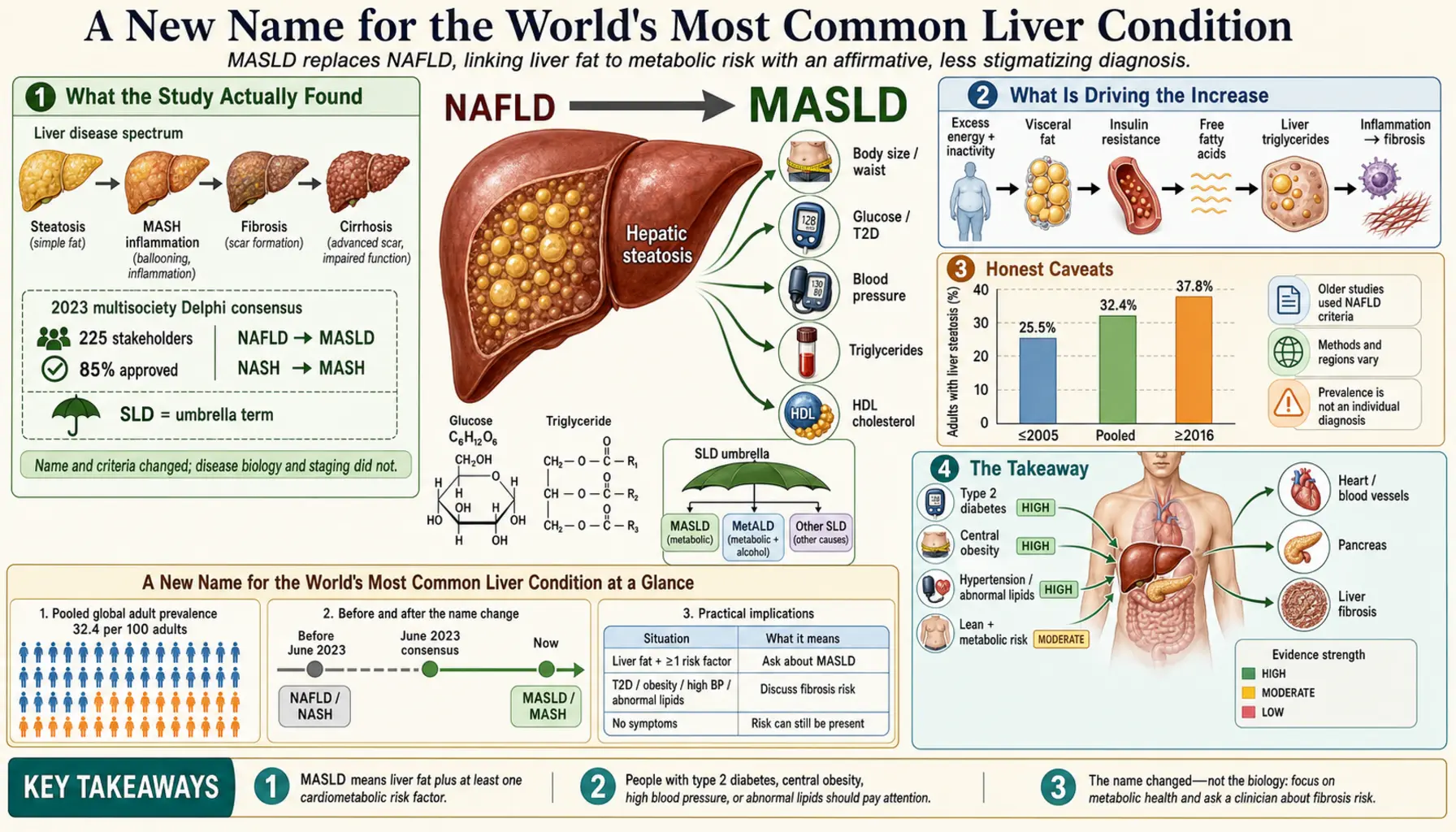
On April 13, 2026, The Lancet Gastroenterology & Hepatology published online a Global Burden of Disease (GBD) 2023 analysis of fatty liver disease across 204 countries and territories. The GBD 2023 MASLD Collaborators estimated that roughly 1.3 billion people — 16.1% of the global population — were living with metabolic dysfunction-associated steatotic liver disease (MASLD) in 2023, and their forecasting model projects about 1.8 billion by 2050. Below is what the analysis reports and where its numbers carry uncertainty.
A New Name for the World's Most Common Liver Condition
MASLD is the build-up of excess fat in the liver in people who also have at least one of five cardiometabolic risk factors, such as extra weight, high blood sugar, or abnormal blood lipids. The name replaced non-alcoholic fatty liver disease (NAFLD) in June 2023, through a Delphi consensus process led by three pan-national liver associations — the American Association for the Study of Liver Diseases (AASLD), the European Association for the Study of the Liver (EASL) and the Latin American Association for the Study of the Liver (ALEH). The consensus paper gives the principal limitations of the old terms as their reliance on exclusionary terms (a diagnosis defined by what it is not) and the use of potentially stigmatising language. It also created a separate category, MetALD, for people with MASLD who drink more alcohol (140–350 g a week for women and 210–420 g a week for men), and it reports that 98% of an existing European NAFLD registry cohort would meet the new MASLD criteria. The inflamed form, steatohepatitis, is now called MASH.
The FDA notes that many people with MASH do not have symptoms until they experience severe liver damage. A 2024 review of the disease’s natural history reports that a minority of patients develop inflammation and risk progressive scarring (fibrosis) that can result in cirrhosis; progression to cirrhosis occurs in 3–5% of patients and often takes more than 20 years, and the severe outcomes it discusses include decompensated cirrhosis and liver cancer. This study counts everyone estimated to have the condition, not only those whose disease progresses.
What the Study Actually Found
The core numbers are these. In 2023 an estimated 1.3 billion people had MASLD, an age-standardised prevalence of 14,429.3 per 100,000 population. Since 1990 the raw number of cases has jumped 142.7% — from roughly 0.5 billion to 1.3 billion — while the age-standardised prevalence rate rose a more modest 28.6%. MASLD was responsible for about 3.6 million DALYs (disability-adjusted life-years, a combined measure of years lost to early death and years lived with disability) in 2023.
Looking ahead, the model projects roughly 1.8 billion cases by 2050, a 42% increase over 2023, with the age-standardised prevalence rate edging up to 15,774.9 per 100,000. The burden is not spread evenly: the highest prevalence was in North Africa and the Middle East (29,246.1 per 100,000), while the highest DALY rate fell in Andean Latin America (152.3 per 100,000). Men had consistently higher age-standardised prevalence than women.
What Is Driving the Increase
The study assessed three risk factors for the MASLD burden: smoking, high body-mass index and high fasting plasma glucose. Of these, high fasting plasma glucose made the largest contribution to the age-standardised MASLD DALY rate in 2023 (2.2 per 100,000), followed by high body-mass index (1.4 per 100,000) and smoking (1.0 per 100,000). Other risk and protective factors were not quantified, a limitation noted in the caveats below. High blood sugar and excess body weight are also central features of type 2 diabetes, metabolic syndrome, and obesity.
The gap between the 142.7% jump in raw cases and the 28.6% rise in the age-standardised rate reflects how the two measures are built: crude counts grow with a larger and older population, while the age-standardised rate adjusts for differences in age structure. The age-standardised rate still rose, from 11,217.2 per 100,000 in 1990 to 14,429.3 in 2023. For the years to 2050, the authors’ decomposition analysis attributes the projected change in case numbers primarily to population growth, particularly in sub-Saharan Africa and North Africa and the Middle East, and less to population ageing or epidemiological change.
Honest Caveats
Several limitations bear on how these figures are read. First, GBD is a modeling exercise: it combines surveys, published studies, and statistical estimation to fill gaps between countries and years. It is an estimate, not a headcount, and the paper reports its uncertainty as 95% uncertainty intervals (1.2 to 1.4 billion for the 2023 case count). AJMC’s summary of the paper lists its limitations as scarce data from low-resourced countries, basing the risk-attributable burden on relative-risk relationships for liver cancer due to MASLD, and missing quantifiable data on other risk and protective factors. Second, the same summary reports that the study relied on ultrasound-based data without histological (biopsy) confirmation. A meta-analysis of 49 studies found ultrasound reliable and accurate for detecting moderate-to-severe fatty liver compared with biopsy (sensitivity 84.8%, specificity 93.6%). Ultrasound shows liver fat, not scarring; for fibrosis, the 2024 European clinical practice guideline describes a stepwise approach using blood-based scores and then imaging such as transient elastography.
Third: prevalence is not severity. The prevalence figure counts everyone estimated to have MASLD, including people with liver fat alone; the 2024 natural-history review cited above reports that only a minority of patients develop inflammation and progressive fibrosis. Finally, the 2050 figures come from a forecasting model that used fasting plasma glucose and mean BMI as predictors; they are projections, not observations.
What Guidelines and Trials Report
The 2024 European clinical practice guideline on MASLD, issued jointly by the liver, diabetes and obesity associations EASL, EASD and EASO, advises lifestyle modification for adults with MASLD — weight loss, dietary changes, physical exercise and discouraging alcohol consumption — along with optimal management of coexisting conditions, including incretin-based therapies for type 2 diabetes or obesity where indicated. In a 52-week lifestyle study of 293 people with biopsy-proven NASH, those who lost at least 5% of their body weight reached NASH resolution more often (58%) than those who lost less; among those who lost at least 10%, 90% had NASH resolution and 45% had regression of fibrosis.
In the United States, the FDA has approved two medicines for MASH with moderate-to-advanced liver scarring, both under its accelerated approval pathway: resmetirom on March 14, 2024, which the agency described as the first treatment for these patients (see FDA Approves Resmetirom, the First Drug for Fatty-Liver Scarring), and semaglutide injection, a drug already approved for other uses, on August 15, 2025. The 2024 European guideline lists resmetirom, where locally approved, as a MASH-targeted treatment to be considered for adults with non-cirrhotic MASH and significant fibrosis (stage 2 or higher), and states that no MASH-targeted drug can currently be recommended for the cirrhotic stage.
On case-finding, the same guideline describes testing for liver fibrosis with non-invasive tests in people with cardiometabolic risk factors, abnormal liver enzymes, or signs of liver fat on imaging, particularly those with type 2 diabetes or with obesity plus additional metabolic risk factors: a blood-based score such as FIB-4 first, then imaging such as transient elastography, to rule advanced fibrosis in or out.
Evidence on diet and supplements is more limited. A 2021 meta-analysis of observational studies found the highest level of coffee consumption associated with lower odds of significant liver fibrosis in people with NAFLD (relative risk 0.65), and no association with NAFLD incidence or prevalence; its authors write that the amount of coffee needed for any protective effect has not been established. In the PIVENS trial, 247 adults with NASH and without diabetes received vitamin E (800 IU daily), pioglitazone or placebo for 96 weeks; vitamin E improved NASH more often than placebo (43% vs 19%) but did not significantly improve fibrosis scores. Milk thistle (silymarin) is commonly used for chronic liver disease; in two 48-week placebo-controlled biopsy trials in NASH (99 and 78 patients), silymarin did not meet its primary histology endpoint — the first trial’s authors wrote that a possible reduction in fibrosis remains to be confirmed in a larger trial, and the second trial’s authors described the effect as inconclusive. Decisions about medicines and supplements belong with a clinician.
The authors’ own interpretation centres on scale and health systems: with a global prevalence of 16.1% and about 1.3 billion people living with MASLD in 2023, they write that the condition has and will continue to have substantial health and economic impacts worldwide, and that the inverse association between the Healthcare Access and Quality (HAQ) Index and age-standardised DALY rates suggests countries with lower health-care access and quality might be less well positioned to manage the growing MASLD burden.
Sources
- GBD 2023 MASLD Collaborators. Global burden of metabolic dysfunction-associated steatotic liver disease, 1990–2023, and projections to 2050: a systematic analysis for the Global Burden of Disease Study 2023. Lancet Gastroenterology & Hepatology. Epub April 13, 2026. doi:10.1016/S2468-1253(26)00011-7
- The Lancet Gastroenterology & Hepatology — article abstract
- Institute for Health Metrics and Evaluation (IHME / GBD) — study library entry
- AJMC — “Fatty Liver Disease Could Affect 1.8 Billion People by 2050”
Key Research Papers
The primary papers behind the figures above, each checked against its PubMed record before it was written down (the 98% registry figure is from the consensus paper’s full text).
- GBD 2023 MASLD Collaborators (2026). Global burden of metabolic dysfunction-associated steatotic liver disease, 1990-2023, and projections to 2050: a systematic analysis for the Global Burden of Disease Study 2023. Lancet Gastroenterology & Hepatology 11(6):463-494. — PubMed PMID: 41990758
- Rinella ME, Lazarus JV, Ratziu V, Francque SM, Sanyal AJ, Kanwal F, et al.; NAFLD Nomenclature consensus group (2023). A multisociety Delphi consensus statement on new fatty liver disease nomenclature. Hepatology 78(6):1966-1986. — PubMed PMID: 37363821
- Hagström H, Shang Y, Hegmar H, Nasr P (2024). Natural history and progression of metabolic dysfunction-associated steatotic liver disease. Lancet Gastroenterology & Hepatology 9(10):944-956. — PubMed PMID: 39243773
- Hernaez R, Lazo M, Bonekamp S, Kamel I, Brancati FL, Guallar E, Clark JM (2011). Diagnostic accuracy and reliability of ultrasonography for the detection of fatty liver: a meta-analysis. Hepatology 54(3):1082-1090. — PubMed PMID: 21618575
- European Association for the Study of the Liver (EASL); European Association for the Study of Diabetes (EASD); European Association for the Study of Obesity (EASO) (2024). EASL-EASD-EASO Clinical Practice Guidelines on the management of metabolic dysfunction-associated steatotic liver disease (MASLD). Journal of Hepatology 81(3):492-542. — PubMed PMID: 38851997
- Vilar-Gomez E, Martinez-Perez Y, Calzadilla-Bertot L, Torres-Gonzalez A, Gra-Oramas B, Gonzalez-Fabian L, et al. (2015). Weight Loss Through Lifestyle Modification Significantly Reduces Features of Nonalcoholic Steatohepatitis. Gastroenterology 149(2):367-378.e5. — PubMed PMID: 25865049
- Ebadi M, Ip S, Bhanji RA, Montano-Loza AJ (2021). Effect of Coffee Consumption on Non-Alcoholic Fatty Liver Disease Incidence, Prevalence and Risk of Significant Liver Fibrosis: Systematic Review with Meta-Analysis of Observational Studies. Nutrients 13(9):3042. — PubMed PMID: 34578919
- Sanyal AJ, Chalasani N, Kowdley KV, McCullough A, Diehl AM, Bass NM, et al.; NASH CRN (2010). Pioglitazone, vitamin E, or placebo for nonalcoholic steatohepatitis. New England Journal of Medicine 362(18):1675-1685. — PubMed PMID: 20427778
- Wah Kheong C, Nik Mustapha NR, Mahadeva S (2017). A Randomized Trial of Silymarin for the Treatment of Nonalcoholic Steatohepatitis. Clinical Gastroenterology and Hepatology 15(12):1940-1949.e8. — PubMed PMID: 28419855
- Navarro VJ, Belle SH, D'Amato M, Adfhal N, Brunt EM, Fried MW, et al.; SyNCH Study Group (2019). Silymarin in non-cirrhotics with non-alcoholic steatohepatitis: A randomized, double-blind, placebo controlled trial. PLoS One 14(9):e0221683. — PubMed PMID: 31536511