 — March 31, 2026
Does a Walkable Neighborhood Really Get You Moving? A 7,439-Twin Study Finds a Small Rise in Walking
On March 31, 2026, Washington State University highlighted a study on a long-standing question: when people who live in walkable neighborhoods walk more, is it the neighborhood doing the work — or do active people simply choose to live in walkable places? Those two explanations look alike in ordinary data, and the distinction bears on public spending on sidewalks, transit, and mixed-use development. The WSU-led team’s approach to separating them was to study twins.
What the researchers actually did
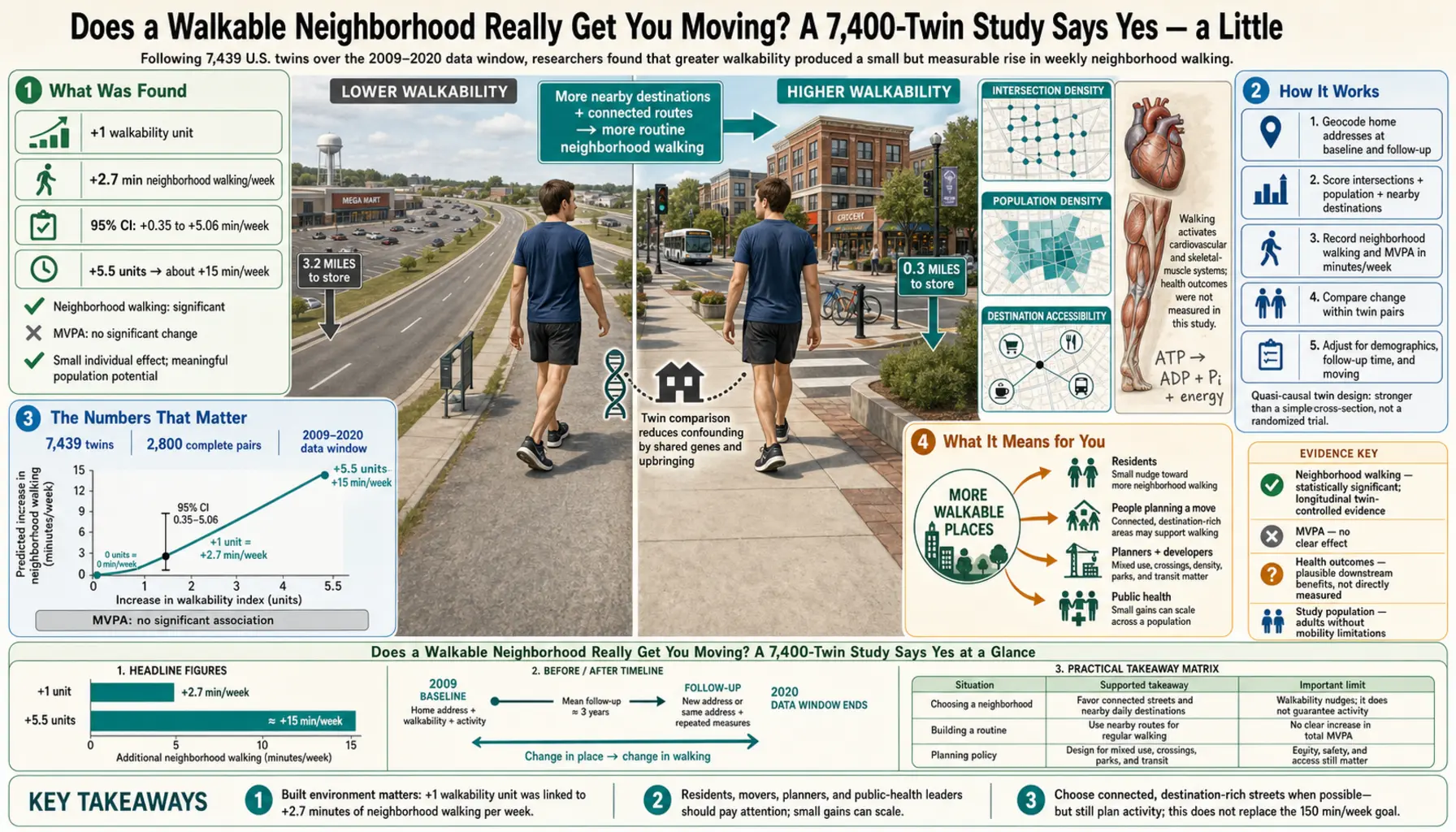
The paper, “Longitudinal Association Between Walkability and Physical Activity in Twins,” was published in the American Journal of Preventive Medicine (September 2025; online June 16, 2025) by Glen Duncan and colleagues, drawing on a community-based twin registry (the Washington State Twin Registry). It analyzed longitudinal data from 7,439 identical and fraternal twins, comprising 2,800 complete twin pairs, covering 2009 to 2020. Participants were free of mobility limitations and had lived at their current address for at least a year. The design is a longitudinal twin cohort rather than a study limited to people who moved: the researchers related change in neighborhood walkability to change in physical activity, and moving status was one of the covariates they adjusted for. The abstract does not describe the walkability index; the team’s earlier cross-sectional paper on the same registry defined walkability from intersection density, population density, and destination accessibility, with outcomes of self-reported weekly minutes of neighborhood walking and of moderate-to-vigorous physical activity (MVPA).
Why twins are the trick
Identical twins share essentially all of their genes and were usually raised in the same household; fraternal twins share about half their genes and, usually, the same upbringing. That shared background is what muddies an ordinary walkability study — genetics, childhood habits, family attitudes toward being active. By comparing twins with each other, the study’s “quasi-causal” models control for genetic and shared-environment confounding. If the more-walkable twin walks more than their co-twin, it is much harder to write off as “they were just a more active person to begin with.” That is why the authors describe their result as quasi-causal rather than merely a correlation.
What it found
The result is modest: change in neighborhood walkability was associated with change in neighborhood walking but not with change in moderate-to-vigorous physical activity, and this held after controlling for genetic and shared environmental confounding, demographic covariates, length of follow-up, and moving status. In the abstract’s numbers, a 1-unit increase in walkability was associated with about 2.7 additional minutes of neighborhood walking per week, and the authors state that moving to a neighborhood 5.5 units higher in walkability could increase neighborhood walking by about 15 minutes per week. The abstract reports no confidence intervals and no step counts; activity was measured in minutes. WSU’s release also quotes an elasticity — a 1% increase in walkability associated with a 0.42% increase in neighborhood walking — which is the headline figure of the team’s earlier cross-sectional paper (American Journal of Epidemiology, 2025, 5,477 twin pairs), not of the longitudinal study; the release’s figure of about 19 more minutes of walking a week per resident for a 55% increase in walkability does not appear in either abstract. In both papers the association with MVPA did not hold once familial and demographic factors were accounted for.
What the findings show
The study points to the built environment as one influence on how much people walk, separate from personal motivation. The per-person change is small — minutes per week. WSU’s release presents the finding in terms of population health, where a small shift across many residents is the quantity of interest; neither abstract estimates a disease outcome. For context, the 2018 Physical Activity Guidelines for Americans set a target for adults of at least 150 to 300 minutes a week of moderate-intensity aerobic activity (or 75 to 150 minutes of vigorous activity), and state that physical activity can reduce the risk of many chronic diseases. Related conditions are covered under Cardiology (including heart disease) and Endocrinology (including type 2 diabetes).
Limitations
Several limits apply. First, the per-person association is small — about 2.7 minutes of walking a week per walkability unit, and about 15 minutes for a 5.5-unit difference. Second, only neighborhood walking changed; moderate-to-vigorous physical activity did not, so the findings do not show walkability substituting for that kind of activity. Third, the team’s walking measures are self-reported, and self-reported activity is prone to over-reporting. Fourth, no one was randomly assigned to a neighborhood, so the authors describe the relationship as “quasi-causal” rather than proven cause. On timing: the data run from 2009 to 2020, the paper was published in 2025, and WSU publicized it on March 31, 2026; the news is a public release about an existing dataset, not new fieldwork.
Questions the research leaves open
The study measures one modest effect of the built environment on walking; it does not test whether that walking changes weight, blood pressure, or disease risk. Because walkability was associated with neighborhood walking but not with moderate-to-vigorous activity in either of the team’s papers, structured exercise remains a separate behavior that these findings do not account for. The abstract does not report confidence intervals, objectively measured activity, or how the effect differed between identical and fraternal pairs.
Sources
- Washington State University news release, March 31, 2026 — Walkable neighborhoods can boost physical activity, population health
- Duncan GE, Avery AR, Pilgrim MJD, Amram O, Mooney SJ, Rundle AG. Longitudinal Association Between Walkability and Physical Activity in Twins. American Journal of Preventive Medicine. DOI: 10.1016/j.amepre.2025.107950
Key Research Papers
- Duncan GE, Avery AR, Pilgrim MJD, Amram O, Mooney SJ, Rundle AG (2025). Longitudinal Association Between Walkability and Physical Activity in Twins. American Journal of Preventive Medicine 69(3):107950. — PubMed PMID: 40532794
- Duncan GE, Hurvitz PM, Williams BD, Avery AR, Pilgrim MJD, Tsang S, Amram O, Mooney SJ, Rundle AG (2025). Association between neighborhood walkability and physical activity in a community-based twin sample. American Journal of Epidemiology 194(2):340-348. — PubMed PMID: 39666447
- Piercy KL, Troiano RP, Ballard RM, Carlson SA, Fulton JE, Galuska DA, George SM, Olson RD (2018). The Physical Activity Guidelines for Americans. JAMA 320(19):2020-2028. — PubMed PMID: 30418471