 — March 25, 2026
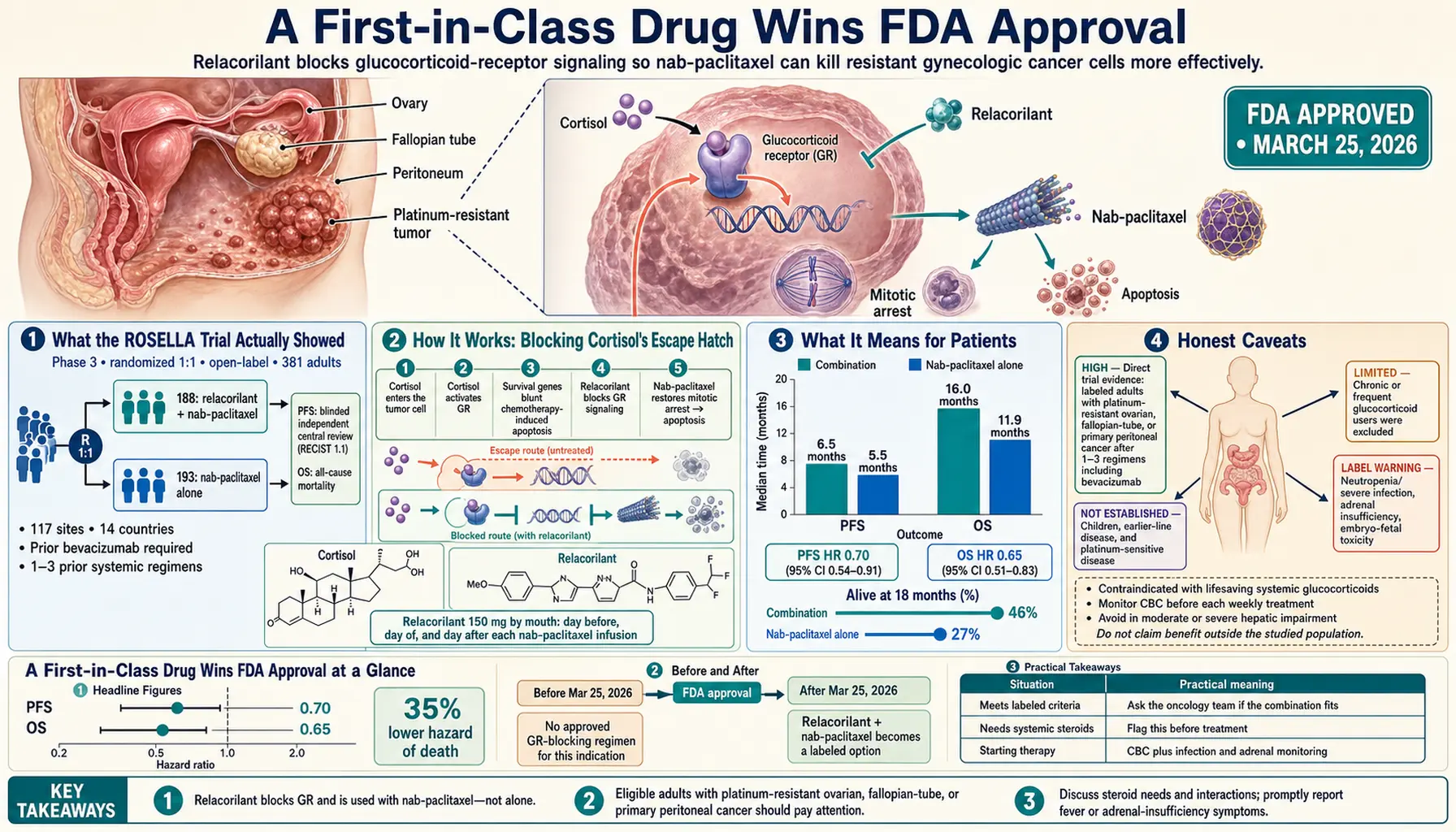
Platinum-resistant ovarian cancer is described in the research literature as a difficult-to-treat disease with limited therapeutic options. Once the disease stops responding to platinum chemotherapy, the chemotherapy that remains holds it back for only a few months: in the trial described below, the cancer grew again after a median of 5.5 months in women given chemotherapy alone. On March 25, 2026, the U.S. Food and Drug Administration approved a first-in-class drug that works by a different mechanism — blocking the receptor through which the stress hormone cortisol acts inside tumor cells — on the strength of a randomized phase 3 trial in which women given the drug with chemotherapy lived longer on average. What follows covers what was approved, what the trial found, and the limits of the evidence.
Table of Contents
- 1. A First-in-Class Drug Wins FDA Approval
- 2. What the ROSELLA Trial Actually Showed
- 3. How It Works: Blocking Cortisol's Escape Hatch
- 4. What the Approval Adds
- 5. Honest Caveats
- 6. Key Points
- Sources
- Key Research Papers
- Featured Videos
1. A First-in-Class Drug Wins FDA Approval
On March 25, 2026, the FDA approved relacorilant, an oral glucocorticoid receptor antagonist, in combination with the chemotherapy drug nab-paclitaxel (albumin-bound paclitaxel). The approval covers adults with platinum-resistant epithelial ovarian, fallopian tube, or primary peritoneal cancer who have already received one to three prior systemic treatment regimens, at least one of which included the anti-angiogenic drug bevacizumab. It is a regular approval, not an accelerated one: the FDA based it on the trial's progression-free and overall survival results, and the prescribing information carries no accelerated-approval statement.
What sets the approval apart is the mechanism. The trial's investigators describe relacorilant as a first-in-class selective glucocorticoid receptor antagonist, and the March 2026 decision was the drug's first approval for any use. It does not attack the tumor directly. Instead it is designed to remove a cortisol-driven defense that tumor cells use to survive chemotherapy — a different approach from that of the chemotherapy drugs used in this setting.
2. What the ROSELLA Trial Actually Showed
The approval rests on a single open-label, randomized phase 3 study called ROSELLA (also known as GOG-3073 and ENGOT-ov72), run at 117 hospitals and oncology centres in 14 countries. It enrolled 381 women with platinum-resistant ovarian, fallopian tube, or primary peritoneal cancer, all previously treated with bevacizumab, and randomly assigned them, in a coin-flip 1:1 split, to receive either relacorilant plus nab-paclitaxel (188 women) or nab-paclitaxel alone (193). Because the two groups were formed by random assignment and compared directly, the trial is stronger evidence than a single-arm study could be. It was open-label, so patients and their doctors knew which treatment was given; progression was judged by blinded independent central review.
Two numbers matter most:
- Overall survival — how long women lived — rose from a median of 11.9 months (95% CI 10.0–13.8) on chemotherapy alone to 16.0 months (95% CI 13.0–18.3) with the combination in the final analysis, after a median follow-up of 24.8 months. That is a 4.1-month improvement in the median, and statistically it corresponds to a 35% lower hazard of death (hazard ratio 0.65, 95% CI 0.51–0.83; p = 0.0004). At 18 months, 46% of the combination group and 27% of the chemotherapy-alone group were alive. The trial's authors describe the gain as statistically and clinically significant.
- Progression-free survival — how long before the cancer grew again, as judged by blinded independent central review — improved from a median of 5.5 months to 6.5 months (hazard ratio 0.70, 95% CI 0.54–0.91; p = 0.0076), a 30% lower hazard of the disease worsening.
The final overall-survival results were presented at the Society of Gynecologic Oncology's 2026 Annual Meeting on Women's Cancer and published online in The Lancet on April 10, 2026. The earlier progression-free-survival results, with an interim overall-survival analysis, had been reported at the 2025 ASCO Annual Meeting and published in The Lancet in June 2025.
3. How It Works: Blocking Cortisol's Escape Hatch
Many chemotherapy drugs kill cancer cells by pushing them into a self-destruct program called apoptosis. Laboratory studies show that glucocorticoids — cortisol, the body's main stress hormone, and synthetic versions such as dexamethasone — can blunt that program. When a glucocorticoid binds to the glucocorticoid receptor inside an ovarian cancer cell, it switches on pro-survival genes (such as SGK1 and DUSP1); in cell-line experiments this reduced chemotherapy-induced cell death, and blocking the receptor partly reversed the protection. Most high-grade serous ovarian tumors express the receptor (25 of 27 primary tumors in one study). In a tissue study covering 481 patients, women whose tumors had high receptor expression had shorter progression-free survival after surgery and chemotherapy, but not shorter overall survival; a separate genomic analysis linked high receptor gene expression to shorter overall survival.
Relacorilant blocks that receptor. By keeping cortisol from flipping the survival switch, it is designed to restore the effect of the accompanying chemotherapy; the trial report describes it as increasing a tumour's sensitivity to chemotherapy by reducing cortisol signalling. An older glucocorticoid receptor antagonist, mifepristone, is non-selective — it also blocks the progesterone receptor — and the 2017 paper describing relacorilant's discovery notes that this lack of selectivity leads to unwanted side effects in some patients. Relacorilant was developed to be selective for the glucocorticoid receptor.
4. What the Approval Adds
For women whose ovarian cancer has become platinum-resistant and who have already received bevacizumab, treatment options have been limited. The approval adds a combination that, in a randomized trial, extended median overall survival by 4.1 months. Relacorilant's mechanism differs from those of the drugs these women have usually received before, although its partner, nab-paclitaxel, is a taxane, and 99.5% of the trial's participants had already received a taxane. The trial did not select patients by any tumor biomarker. An earlier phase 3 trial that also found longer overall survival in platinum-resistant disease (MIRASOL, 2023, testing the antibody-drug conjugate mirvetuximab soravtansine) enrolled only women whose tumors had high folate-receptor-alpha expression.
The result is also a proof of concept for blocking cortisol signaling alongside chemotherapy. A 2026 drug-development review lists relacorilant as under development for other solid tumours, including pancreatic and prostate cancer, as well as for Cushing syndrome.
5. Honest Caveats
Several things are worth holding onto so the headline does not outrun the reality.
This is a treatment, not a cure. The median survival went from about 12 to 16 months. That is a genuine and welcome gain, but the disease in this setting remains very serious, and the benefit is measured in months, not years.
Relative versus absolute benefit. A “35% reduction in the risk of death” sounds larger than “4 more months of median survival,” yet both describe the same result. The relative figure is the statistic the trial reports; the absolute figure is what it means in months of life. Individual results vary widely around a median — some women benefit far more, some not at all.
It applies to a specific group. The approval is for platinum-resistant disease after one to three prior regimens including bevacizumab. It is not a first-line therapy, it was not tested in platinum-sensitive disease, and it is given with chemotherapy, not instead of it — so the side effects of nab-paclitaxel still apply, plus whatever the combination adds. The trial also excluded patients who needed chronic or frequent glucocorticoid treatment. Treatment decisions in this setting belong with a gynecologic oncologist.
Side effects and label warnings. In the final analysis the most common adverse events in the combination group were neutropenia (64%), anemia (61%), fatigue (54%), and nausea (44%); the investigators report that adverse events were similar in both groups once adjusted for how long patients stayed on treatment. The prescribing information carries no boxed warning. It lists a contraindication for patients who need systemic glucocorticoids for a lifesaving purpose (for example, immunosuppression after an organ transplant), because the drug blocks their effect, and warnings for neutropenia and severe infections, adrenal insufficiency, worsening of conditions treated with glucocorticoids, and harm to a developing fetus.
6. Key Points
Relacorilant plus nab-paclitaxel is FDA-approved for adults with platinum-resistant epithelial ovarian, fallopian tube, or primary peritoneal cancer who have received one to three prior systemic treatment regimens, at least one of which included bevacizumab. The approval rests on one open-label, randomized phase 3 trial (ROSELLA, 381 women), in which median overall survival was 16.0 months with the combination and 11.9 months with nab-paclitaxel alone. The drug works by blocking the glucocorticoid receptor, a mechanism unlike those of the earlier therapies in this setting. Whether the combination fits a particular person's situation is a question for the treating oncology team.
Sources
- U.S. Food and Drug Administration. FDA approves relacorilant with nab-paclitaxel for platinum-resistant epithelial ovarian, fallopian tube, or primary peritoneal cancer. March 25, 2026. fda.gov — approval announcement
- Lorusso D, Gladieff L, O'Malley DM, et al. Overall survival with relacorilant and nab-paclitaxel in patients with platinum-resistant ovarian cancer (ROSELLA): a phase 3 randomised controlled trial. The Lancet. 2026;407:1513–1524. Full text · DOI: 10.1016/S0140-6736(26)00462-9
- Olawaiye AB, Gladieff L, O'Malley DM, et al. Relacorilant and nab-paclitaxel in patients with platinum-resistant ovarian cancer (ROSELLA): an open-label, randomised, controlled, phase 3 trial (progression-free survival results). The Lancet. 2025;405:2205–2216. DOI: 10.1016/S0140-6736(25)01040-2
- The drug's maker. Press release announcing the FDA approval of relacorilant plus nab-paclitaxel for platinum-resistant ovarian cancer. Company press release
- Relacorilant FDA Approval History. Drugs.com. Approval history
- The ASCO Post. Relacorilant Plus Nab-Paclitaxel Improves Overall Survival in Platinum-Resistant Ovarian Cancer. 2026. News coverage
Key Research Papers
The primary papers behind the figures above, each checked against PubMed or Crossref; the approval details, dosing and warnings come from the FDA announcement and prescribing information listed under Sources.
- Lorusso D, Gladieff L, O'Malley DM, Kim JW, Garbaos G, Fagotti A, et al. (2026). Overall survival with relacorilant and nab-paclitaxel in patients with platinum-resistant ovarian cancer (ROSELLA): a phase 3 randomised controlled trial. The Lancet 407(10538):1513-1524. — PubMed PMID: 41974149
- Olawaiye AB, Gladieff L, O'Malley DM, Kim JW, Garbaos G, Salutari V, et al. (2025). Relacorilant and nab-paclitaxel in patients with platinum-resistant ovarian cancer (ROSELLA): an open-label, randomised, controlled, phase 3 trial. The Lancet 405(10496):2205-2216. — PubMed PMID: 40473448
- Olawaiye A, Gladieff L, Gilbert L, Kim JW, Scaranti M, Salutari V, et al. (2025). ROSELLA: A phase 3 study of relacorilant in combination with nab-paclitaxel versus nab-paclitaxel monotherapy in patients with platinum-resistant ovarian cancer (GOG-3073, ENGOT-ov72). Journal of Clinical Oncology 43(17_suppl):LBA5507 (2025 ASCO Annual Meeting abstract). — DOI: 10.1200/JCO.2025.43.17_suppl.LBA5507
- Blair HA (2026). Relacorilant: First Approval. Drugs 86(9):1553-1561. — PubMed PMID: 42334771
- Stringer-Reasor EM, Baker GM, Skor MN, Kocherginsky M, Lengyel E, Fleming GF, Conzen SD (2015). Glucocorticoid receptor activation inhibits chemotherapy-induced cell death in high-grade serous ovarian carcinoma. Gynecologic Oncology 138(3):656-662. — PubMed PMID: 26115975
- Greenstein AE, Hunt HJ (2021). Glucocorticoid receptor antagonism promotes apoptosis in solid tumor cells. Oncotarget 12(13):1243-1255. — PubMed PMID: 34194622
- Veneris JT, Darcy KM, Mhawech-Fauceglia P, Tian C, Lengyel E, Lastra RR, et al. (2017). High glucocorticoid receptor expression predicts short progression-free survival in ovarian cancer. Gynecologic Oncology 146(1):153-160. — PubMed PMID: 28456378
- Veneris JT, Huang L, Churpek JE, Conzen SD, Fleming GF (2019). Glucocorticoid receptor expression is associated with inferior overall survival independent of BRCA mutation status in ovarian cancer. International Journal of Gynecological Cancer 29(2):357-364. — PubMed PMID: 30683758
- Hunt HJ, Belanoff JK, Walters I, Gourdet B, Thomas J, Barton N, et al. (2017). Identification of the clinical candidate (R)-(1-(4-fluorophenyl)-6-((1-methyl-1H-pyrazol-4-yl)sulfonyl)-4,4a,5,6,7,8-hexahydro-1H-pyrazolo[3,4-g]isoquinolin-4a-yl)(4-(trifluoromethyl)pyridin-2-yl)methanone (CORT125134): a selective glucocorticoid receptor (GR) antagonist. Journal of Medicinal Chemistry 60(8):3405-3421. — PubMed PMID: 28368581
- Moore KN, Angelergues A, Konecny GE, García Y, Banerjee S, Lorusso D, et al. (2023). Mirvetuximab soravtansine in FRα-positive, platinum-resistant ovarian cancer. New England Journal of Medicine 389(23):2162-2174. — PubMed PMID: 38055253