— March 17, 2026
· FDA Phases Out Synthetic Food Dyes


Table of Contents
- The FDA’s Synthetic Dye Phase-Out: Where It Stood in March 2026
- Kennedy Directs FDA to Explore Ending Self-Affirmed GRAS
- FDA Action on Ingestible Fluoride Drugs for Children
- FDA 2026 Human Foods Program: Three Priority Areas
- Multivitamins and Epigenetic Aging Clocks in the COSMOS Trial
- Prebiotic Fiber (Inulin) in a Knee Osteoarthritis Trial
- Fecal Microbiota Transplant Trials With Cancer Immunotherapy
- Key Research Papers
- Connections
- Featured Videos
The FDA’s Synthetic Dye Phase-Out: Where It Stood in March 2026
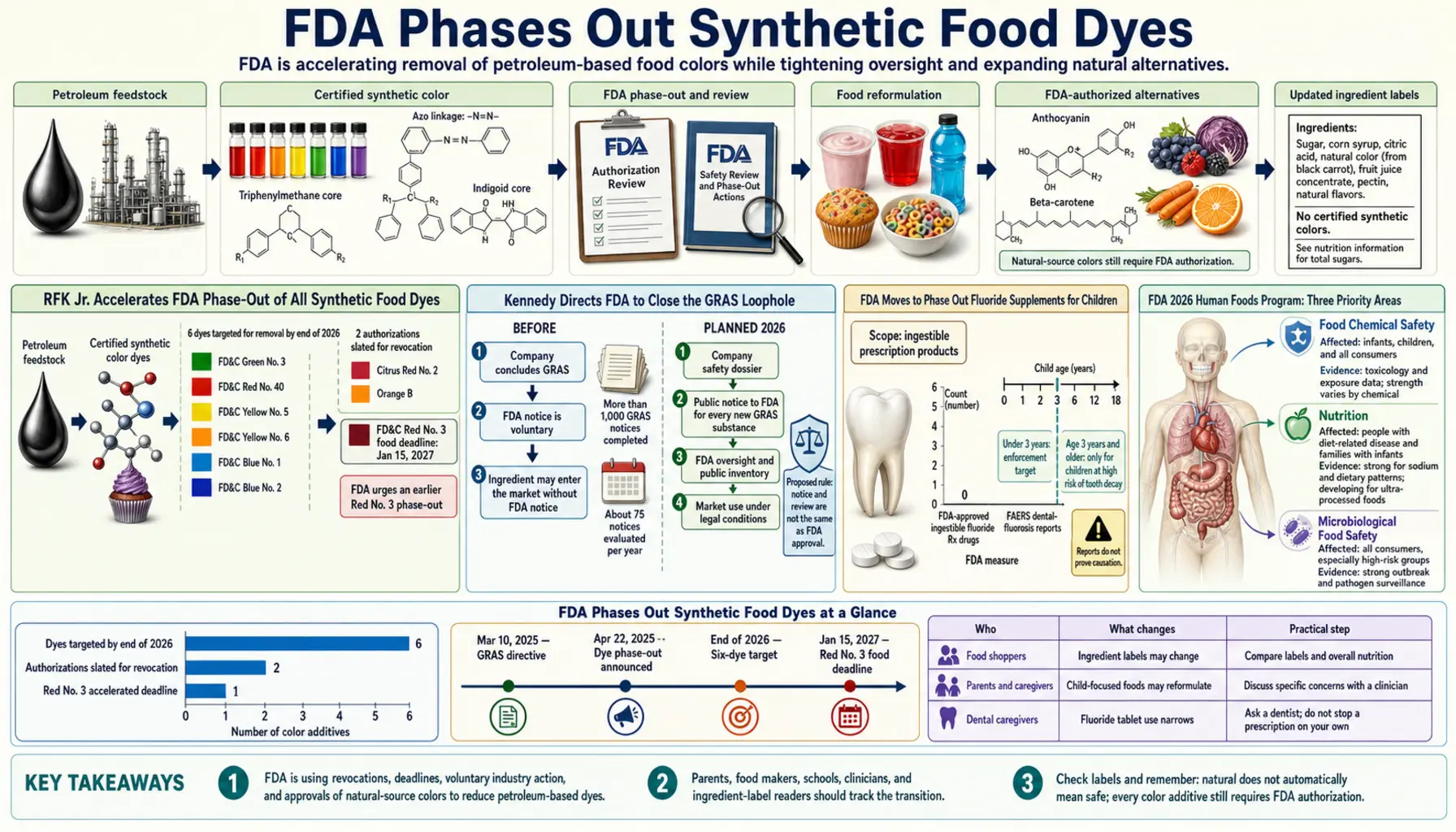
On 22 April 2025 the U.S. Department of Health and Human Services (HHS) and the FDA announced measures to phase out petroleum-based synthetic dyes from the U.S. food supply. The release said the FDA would work with industry to eliminate six certified dyes — FD&C Green No. 3, Red No. 40, Yellow No. 5, Yellow No. 6, Blue No. 1 and Blue No. 2 — “by the end of next year,” and would start the process to revoke the authorizations of Citrus Red No. 2 and Orange B “within the coming months.” It also asked food companies to remove FD&C Red No. 3 sooner than required: the FDA had revoked Red No. 3’s authorization in food and ingested drugs in an order published on 16 January 2025 (90 FR 4628), on data showing that it induces cancer in male rats, with deadlines of 15 January 2027 for food and 18 January 2028 for ingested drugs. The removal of the six main dyes rests on voluntary industry commitments, not on a rule.
By the date of this article the FDA had proposed removing Orange B, permitted only on frankfurter and sausage casings and last batch certified in 1978 (proposed order of 17 September 2025, 90 FR 44786); no Citrus Red No. 2 proposal had been published. It had also approved colors from natural sources: Galdieria extract blue, an expanded use of butterfly pea flower extract and calcium phosphate (orders of 12 May 2025; 90 FR 20104, 20101 and 20097), gardenia (genipin) blue (15 July 2025; 90 FR 31586), and, on 6 February 2026, beetroot red (91 FR 5295) and wider use of spirulina extract (91 FR 5291). Later in 2026: after objections were filed, the effective dates of the beetroot red and spirulina extract orders were delayed indefinitely as of 20 March 2026 (91 FR 13965 and 13966); on 23 July 2026 the FDA finalized the Orange B revocation (91 FR 46276, effective 8 September 2026) and proposed revoking Citrus Red No. 2 (91 FR 46330).
On industry commitments, a 14 July 2025 FDA release stated that “about 40 percent of the food industry has committed to a voluntary phase-out of such dyes.” The FDA’s pledge tracker, current as of 15 September 2026, gives the target for the six dyes as “by the end of 2027,” and many of the listed commitments cover school foods first. At the state level, KFF Health News reported in January 2026 that roughly 75 bills aimed at food dyes were introduced in 37 states in 2025. West Virginia’s law (House Bill 2354, approved 24 March 2025) treats food containing FD&C Red No. 3, Red No. 40, Yellow No. 5, Yellow No. 6, Blue No. 1, Blue No. 2 or Green No. 3, butylated hydroxyanisole or propylparaben as adulterated from 1 January 2028, and has barred the seven dyes from school nutrition program meals since 1 August 2025.
On the evidence behind the concern, a 2007 randomised, double-blinded, placebo-controlled crossover trial in The Lancet (153 three-year-olds and 144 eight- and nine-year-olds) found that drinks containing mixes of artificial colours plus the preservative sodium benzoate increased a global hyperactivity measure compared with placebo; the authors attributed the effect to the colours or the preservative or both. A health effects assessment by California’s Office of Environmental Health Hazard Assessment (OEHHA), dated April 2021 and published as a peer-reviewed review in 2022, found that 16 of 25 challenge studies identified some evidence of an association between synthetic food dyes and adverse behaviour in children, statistically significant in 13; it concluded that the human trials and animal studies support an association and that the FDA’s acceptable daily intakes rest on older studies not designed to assess these behavioural effects.
Sources: FDA.gov, MedLifeGuide, KFF Health News; Federal Register documents cited by number above; West Virginia Legislature, HB 2354 (2025), enrolled version
Kennedy Directs FDA to Explore Ending Self-Affirmed GRAS
On 10 March 2025 HHS Secretary Robert F. Kennedy Jr. directed the FDA to explore rulemaking to eliminate the self-affirmed GRAS (Generally Recognized as Safe) pathway. HHS described the current system this way: the FDA “strongly encourages” companies to submit GRAS notices, “but industry can self-affirm that the use of a substance is GRAS without notifying the FDA.” The release said the FDA had completed and published more than 1,000 GRAS notices and evaluates an average of 75 a year, and that HHS would work with Congress on legislation to “completely close the GRAS loophole.”
The FDA’s 2026 Human Foods Program deliverables state that “FDA will publish a proposed regulation to require the submission to FDA of GRAS notices for all new substances claimed to be GRAS.” Later in 2026: the proposed rule, “Substances Generally Recognized as Safe,” was published on 11 August 2026 (91 FR 51834, Docket FDA-2025-N-3262).
Sources: HHS.gov, CNN, Washington Post
FDA Action on Ingestible Fluoride Drugs for Children
On 13 May 2025 the FDA announced it was “initiating action to remove concentrated ingestible fluoride prescription drug products for children from the market” — drops and chewable tablets that are swallowed and that, the agency said, have never been FDA-approved — and set 31 October 2025 as the goal date for completing a safety review and public comment period. The release cited studies on the gut microbiome and reported associations with thyroid disorders, weight gain and possibly decreased IQ. On 31 October 2025 the FDA announced restrictions rather than a full removal: its program page states that “FDA recommends that ingestible fluoride drug products be limited to children aged three years and older who are at high risk for tooth decay,” and the agency sent notices to four companies about products labeled outside those limits.
Separately, the EPA was appealing a 24 September 2024 federal district court ruling (Food & Water Watch v. EPA, Northern District of California) that fluoridation at 0.7 mg/L poses an “unreasonable risk” of reduced IQ in children under the Toxic Substances Control Act, and that ordered the agency to begin rulemaking; the appeal was framed on procedural grounds rather than contesting the risk finding. Later in 2026: on 21 May 2026 the Ninth Circuit vacated the ruling on procedural grounds and remanded the case without addressing the risk finding.
Sources: PBS News, Axios, Children's Health Defense; FDA news releases of 13 May and 31 October 2025
FDA 2026 Human Foods Program: Three Priority Areas
On 10 February 2026 the FDA released its Human Foods Program 2026 Priority Deliverables, organized in three areas:
- Food Chemical Safety — a proposed regulation requiring GRAS notices for all new substances claimed to be GRAS, a shift from petroleum-based dyes toward colors from natural sources with faster review, and post-market reviews of chemicals such as phthalates, BHA and BHT
- Reducing Chronic Disease Through Better Nutrition — developing a federal definition of ultra-processed foods (UPFs) with USDA, along with front-of-package labeling and infant formula work
- Microbiological Food Safety — preventing pathogen-related foodborne illness, including oversight of imported foods and implementation of the food traceability rule
On 17 February 2026 Food Safety Magazine reported that Secretary Kennedy had named Kyle Diamantas, the FDA’s Deputy Commissioner for Human Foods, and Grace Graham, the FDA’s Deputy Commissioner for Policy, Legislation, and International Affairs, Senior Counselors for the FDA at HHS, with both keeping their FDA positions.
Sources: FDA.gov, Food Safety Magazine
Research: Multivitamins and Epigenetic Aging Clocks in the COSMOS Trial
A prespecified ancillary study of the COSMOS randomized trial, published in Nature Medicine in March 2026, measured five DNA-methylation “epigenetic clocks” in 958 participants over 2 years. Compared with placebo, a daily multivitamin-multimineral modestly slowed the rate of increase of two second-generation clocks, with a between-group difference in yearly change of 0.113 years for PCGrimAge and 0.214 years for PCPhenoAge; the PCGrimAge effect was larger in people whose biological aging was accelerated at baseline. Cocoa extract (500 mg of cocoa flavanols a day) had no effect on any of the five clocks. The authors described the effects as statistically significant but small and wrote that further studies are needed to determine their clinical relevance.
Source: Nature Medicine 2026
Prebiotic Fiber (Inulin) in a Knee Osteoarthritis Trial
In a 2 × 2 factorial randomized trial published in Nutrients in February 2026, 117 adults with knee osteoarthritis received for 6 weeks 20 g a day of the prebiotic fiber inulin, a digital physiotherapy-supported exercise program, both, or a 10 g a day maltodextrin placebo. Compared with placebo, pain on a numerical rating scale fell with inulin (between-group difference −1.11 points, p = 0.045) and with exercise (−1.55, p = 0.002), with no added effect from combining them. Inulin also improved grip strength and measures of pain sensitivity and raised blood butyrate and GLP-1, while the timed walking and sit-to-stand tests improved with exercise rather than inulin. Inulin is a dietary fiber found in chicory root and Jerusalem artichokes; the authors linked the grip-strength gain to the rise in GLP-1, “suggesting a gut-muscle link,” and the trial adds to research on the gut-joint connection.
Fecal Microbiota Transplant Trials With Cancer Immunotherapy
Three early-phase trials published together in Nature Medicine on 28 January 2026 tested fecal microbiota transplantation (FMT) from donors alongside immune checkpoint inhibitors:
- FMT-LUMINate (phase 2, open-label, no control group): a single FMT by oral capsules before first-line treatment. The objective response rate was 80% (16 of 20) in non-small cell lung cancer, meeting the primary endpoint, and 75% (15 of 20) in melanoma, where 13 patients (65%) on dual checkpoint therapy had grade 3 or higher adverse events.
- PERFORM (phase 1, 20 patients with metastatic kidney cancer): the safety endpoint was met, with grade 3 immune-related adverse events in 10 of 20 patients and no serious FMT-related toxicity; 9 of 18 evaluable patients responded.
- TACITO (randomized, double-blind, placebo-controlled phase 2a, 45 patients with metastatic kidney cancer): the primary endpoint, freedom from progression at 12 months, was not met (70% vs 41%, P = 0.053); median progression-free survival was longer with donor FMT (24.0 vs 9.0 months).
The authors describe the results as supporting the safety and potential efficacy of FMT with immunotherapy and calling for further trials. The work adds to research on the role of the gut microbiome in immune function and response to cancer treatment.
Key Research Papers
- McCann D, Barrett A, Cooper A, Crumpler D, Dalen L, Grimshaw K, et al. (2007). Food additives and hyperactive behaviour in 3-year-old and 8/9-year-old children in the community: a randomised, double-blinded, placebo-controlled trial. Lancet 370(9598):1560-1567. — PubMed PMID: 17825405
- Miller MD, Steinmaus C, Golub MS, Castorina R, Thilakartne R, Bradman A, Marty MA (2022). Potential impacts of synthetic food dyes on activity and attention in children: a review of the human and animal evidence. Environmental Health 21(1):45. — PubMed PMID: 35484553
- Li S, Hamaya R, Zhu H, Chen BH, Pereira AC, Ivey KL, et al. (2026). Effects of daily multivitamin-multimineral and cocoa extract supplementation on epigenetic aging clocks in the COSMOS randomized clinical trial. Nature Medicine 32(3):1012-1022. — PubMed PMID: 41803341
- Kouraki A, Franks S, Vijay A, Kurien T, Taylor MA, Smith SL, et al. (2026). Effect of prebiotic supplementation with and without physiotherapy on pain and pain sensitivity in people with knee osteoarthritis. Nutrients 18(5):714. — PubMed PMID: 41829888
- Duttagupta S, Messaoudene M, Hunter S, Desilets A, Jamal R, Mihalcioiu C, et al. (2026). Fecal microbiota transplantation plus immunotherapy in non-small cell lung cancer and melanoma: the phase 2 FMT-LUMINate trial. Nature Medicine 32(4):1337-1350. — PubMed PMID: 41606121
- Fernandes R, Jabbarizadeh B, Rajeh A, Hong MMY, Baines KJ, Ernst S, et al. (2026). Fecal microbiota transplantation plus immunotherapy in metastatic renal cell carcinoma: the phase 1 PERFORM trial. Nature Medicine 32(4):1325-1336. — PubMed PMID: 41606120
- Porcari S, Ciccarese C, Heidrich V, Rondinella D, Quaranta G, Severino A, et al. (2026). Fecal microbiota transplantation plus pembrolizumab and axitinib in metastatic renal cell carcinoma: the randomized phase 2 TACITO trial. Nature Medicine 32(4):1316-1324. — PubMed PMID: 41606119
PubMed Topic Searches
- Clinical trials on synthetic food dyes and children's health — PubMed search
- Clinical trials on fluoride supplementation in children — PubMed search
- Clinical trials on ultra-processed foods and chronic disease — PubMed search
- Clinical trials on multivitamins and biological aging — PubMed search
- Clinical trials on inulin and osteoarthritis — PubMed search
- Clinical trials on FMT and immunotherapy — PubMed search
Connections
Featured Videos