 — March 4, 2026
· Muscle Strength and How Long Older Women Live
— March 4, 2026
· Muscle Strength and How Long Older Women Live
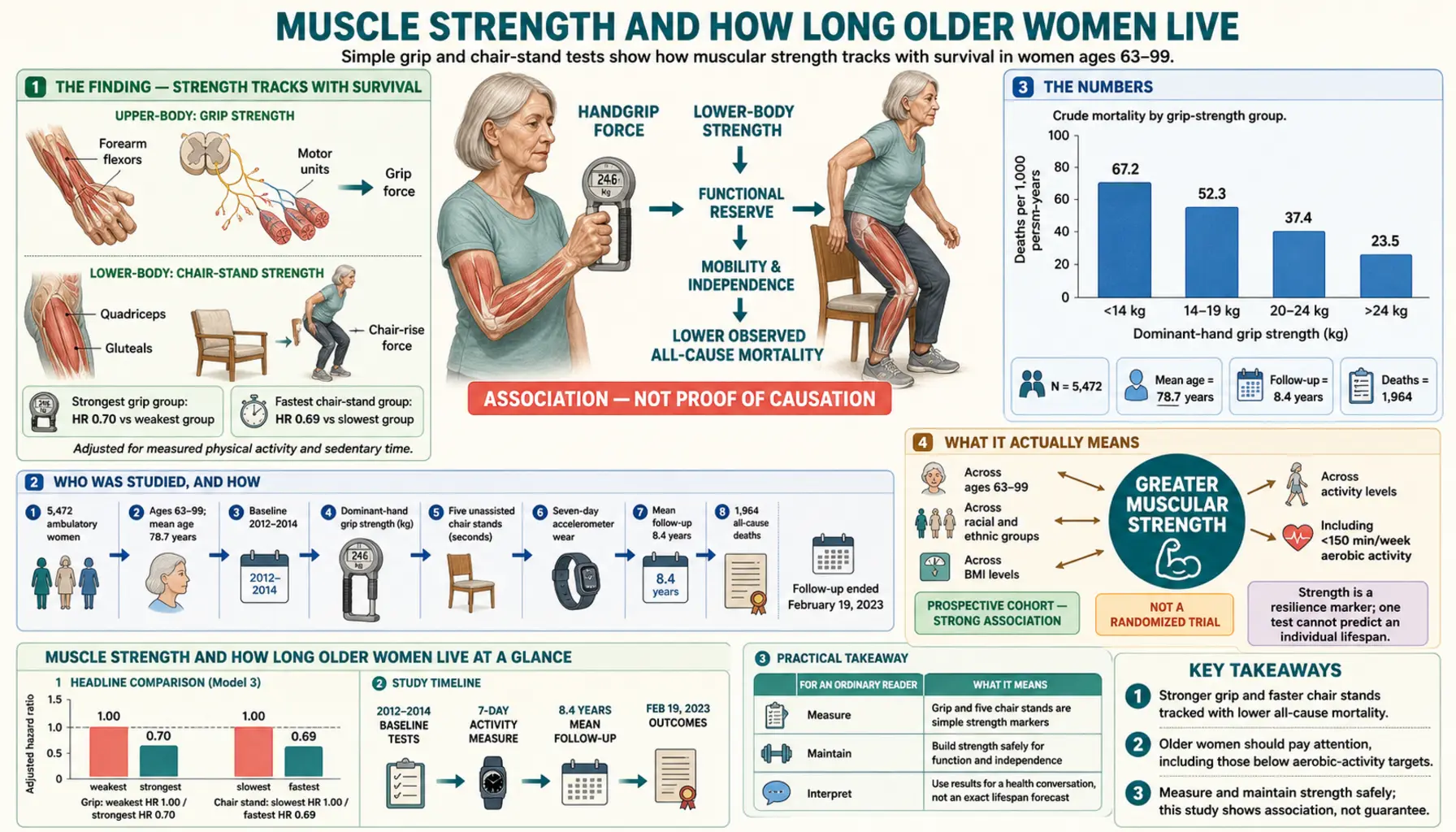
Most longevity headlines in 2026 come with an asterisk roughly the size of a laboratory mouse. Senolytics that rejuvenate aged rodents, epigenetic reprogramming that resets a cell’s clock in a dish, supplements that add a few days to a nematode — most of it has not been shown to change survival in human beings. The finding covered in a March 3, 2026 feature in the Washington Post is different in kind. It came from a large study of real people, followed for the better part of a decade, and its message is almost aggressively low-tech: among nearly 5,500 older women, those who were physically stronger were meaningfully less likely to die — and that association held even after accounting for how much they actually moved, measured by accelerometer. No pill, no clinic, no gene therapy. Just strength.
Table of Contents
- 1. The Finding — Strength Tracks With Survival
- 2. Who Was Studied, and How
- 3. The Numbers
- 4. What It Actually Means
- 5. Honest Caveats
- 6. Reading the Evidence
- Sources
- Key Research Papers
- Connections
- Featured Videos
1. The Finding — Strength Tracks With Survival
The study, titled “Muscular Strength and Mortality in Women Aged 63 to 99 Years,” was published in JAMA Network Open on February 13, 2026, followed by a University at Buffalo news release on February 18 and press coverage into early March. It was led by Michael J. LaMonte of the University at Buffalo, working with colleagues at UC San Diego, Stanford, and other institutions, and it draws on the Objective Physical Activity and Cardiovascular Health (OPACH) study, an ancillary study of the long-running Women’s Health Initiative in which activity was measured with accelerometers rather than questionnaires.
The headline in one sentence: in ambulatory older women, greater muscular strength was associated with lower all-cause mortality — even when the models accounted for how much moderate-to-vigorous activity they got, how long they sat, how fast they walked, and how inflamed their bloodwork was. Strength, in other words, appears to carry information about survival that accelerometer-measured activity minutes do not fully capture.
2. Who Was Studied, and How
The analysis followed 5,472 ambulatory women aged 63 to 99 (mean age 78.7), examined at home between 2012 and 2014, for a mean of 8.4 years, during which 1,964 of them died. Two simple, cheap, physical measures did most of the work:
- Handgrip strength of the dominant hand, measured seated with a hand-held dynamometer — a squeeze test long used in cohort studies as a simple estimate of overall muscle strength.
- The timed chair-stand test — how quickly a person can rise from a seated position to standing five times in a row, unassisted — a practical readout of lower-body strength and power (the ability to move one’s own body mass against gravity).
What makes the study more than a rediscovery of an old association is what the investigators controlled for. Physical activity was not self-reported; it was measured with a hip-worn accelerometer, 24 hours a day for seven days. Successive models adjusted for age, race and ethnicity, education, body weight, blood pressure, smoking, alcohol, age at menopause, self-rated health, walking-aid use, and a count of 11 chronic conditions; then for accelerometer-measured sedentary time and moderate-to-vigorous activity; then for sedentary time and walking speed (a timed 2.5-metre walk, used as a proxy for cardiorespiratory fitness); and, in the 4,414 women with a blood result, for systemic inflammation (high-sensitivity C-reactive protein). Strength stayed in the picture in each of those models.
3. The Numbers
Comparing the strongest women to the weakest:
- Grip strength: women in the highest quartile (grip above 24 kg) had a hazard ratio of 0.67 (95% CI, 0.58–0.78) versus the lowest quartile (below 14 kg), after adjustment for age, sociodemographic, lifestyle and clinical factors — about a one-third lower risk of death over follow-up. Adding accelerometer-measured sedentary time and moderate-to-vigorous activity changed it only slightly, to 0.70 (95% CI, 0.61–0.82). On a continuous scale, each additional 7 kg of grip strength (one standard deviation) was associated with roughly a 12% lower mortality risk (hazard ratio 0.88; 95% CI, 0.84–0.93).
- Chair-stand speed: women in the fastest quartile (five stands in 11.1 seconds or less) had a hazard ratio of 0.63 (95% CI, 0.54–0.73) versus the slowest (about 16.7 seconds or slower) — roughly a 37% lower risk of death. With sedentary time and moderate-to-vigorous activity added, it was 0.69 (95% CI, 0.59–0.79).
The grip-strength association also held in subgroups where it might have been expected to fade. Per 7 kg, the hazard ratio was 0.90 (95% CI, 0.82–0.98) in women below the guideline level of 150 minutes a week of moderate-to-vigorous activity and 0.88 (0.83–0.94) in women meeting it; the authors also report an association among women with under 10 minutes a day of such activity and among women who used a walking aid. The chair-stand association was less consistent. Comparing quartiles, it remained significant in every model, but on the continuous per-standard-deviation scale it lost statistical significance once health and lifestyle factors were added (hazard ratio 0.96; 95% CI, 0.93–1.01), and within most subgroups it was not significant. The authors suggest chair-stand time may be a broader marker of aging-related health status, while grip strength more directly reflects muscle strength output.
4. What It Actually Means
For years, public-health messaging around aging has focused mainly on aerobic activity — the guideline figure of at least 150 minutes a week of moderate-intensity activity such as brisk walking. This study does not contradict that guidance. What it adds is a second, semi-independent axis: in these data, muscular strength was not just a byproduct of being active; it was its own predictor. In the models that held accelerometer-measured activity and sitting time constant, the stronger women still had, on average, the lower mortality risk.
Why might raw strength matter on its own? Muscle is more than a motor. It is the body’s principal reservoir of amino acids, a major site of glucose disposal, and a secretory organ that releases signaling molecules called myokines, many of them in response to contraction. Strong muscles also mean a person can rise from a chair, climb a curb, and catch themselves before a stumble becomes a fall or a hip fracture. Grip strength, meanwhile, works as a low-cost risk marker: investigators in the international PURE study described it as “a simple, inexpensive risk-stratifying method” for death and cardiovascular disease. As LaMonte put it in the University at Buffalo’s release, “Healthy aging probably is best pursued through adequate amounts of both aerobic and muscle-strengthening physical activities.”
5. Honest Caveats
This is a large human study with objectively measured activity and no mouse-sized asterisk. It still comes with limits.
It is observational, not a trial. An association between strength and survival is not proof that building strength adds years. Nobody randomized these women to lift weights. The clean interpretation — “get stronger and you will live longer” — is consistent with earlier observational research linking grip strength to survival, but this study alone cannot establish it; the PURE investigators likewise wrote that further research is needed “to test whether improvement in strength reduces mortality.”
Reverse causation is the ghost in every study like this. Undiagnosed illness, early cancer, and the slow slide of frailty all sap muscle strength and raise the risk of dying. The authors worked to blunt this — adjusting for inflammation, chronic disease, self-rated health, walking-aid use, walking speed, and objectively measured activity, and repeating the analysis without the deaths in the first 3 and 5 years of follow-up, with comparable results — but no statistical model fully exorcises a sick person who is weak because they are already sick. Nutrition status was not systematically collected in OPACH. Residual confounding remains possible.
It is women only, and a select group of them. The cohort is older women who were healthy enough to be ambulatory and to complete the testing and a week of accelerometer wear — not men, and not the frailest. The authors note that because OPACH is part of the Women’s Health Initiative, which studied postmenopausal women, the results do not necessarily generalize to men or to younger women. Grip-strength research in mixed-sex cohorts points the same direction: in the PURE study of 139,691 adults aged 35 to 70 in 17 countries, each 5 kg lower grip strength was associated with a 16% higher risk of death from any cause (hazard ratio 1.16; 95% CI, 1.13–1.20), and in a Hiroshima cohort of 4,912 men and women followed for nearly three decades, greater grip strength predicted lower mortality in both sexes.
Grip strength is a proxy, not a magic number. A dynamometer reading is a convenient window onto overall muscle strength and neuromuscular health. A higher reading marks that underlying state; it is not an outcome in itself. In this study the association changed little when C-reactive protein was added, and the authors conclude that the link between strength and mortality “seemingly involves mechanisms beyond inflammation.”
6. Reading the Evidence
The study measured strength once and followed survival; it tested no intervention. The activity most often linked to building strength, resistance and strength training, already appears in federal guidance: the Physical Activity Guidelines for Americans (2nd edition, 2018) call for muscle-strengthening activities on 2 or more days a week for adults, and for older adults multicomponent activity that includes balance training as well as aerobic and muscle-strengthening activities. The authors write that their finding “supports current national recommendations that promote participation in muscle strengthening activity,” while noting that the type and amount of strengthening activity linked to specific outcomes still needs to be characterized. In the University at Buffalo’s release, LaMonte said a trip to the gym may not be necessary: “Even using soup cans or books as a form of resistance provides stimulus to skeletal muscles and could be used by individuals for whom other options are not feasible.” Protein enters the picture through research on aging muscle: a pooled analysis of laboratory studies in healthy men found that older men needed a greater protein intake relative to body weight, in a single meal, than younger men to maximally stimulate muscle protein synthesis (research on leucine and creatine in aging muscle is covered on their own pages). Vitamin D is often discussed in connection with muscle function and falls, but a 2018 meta-analysis of 37 randomized trials (34,144 participants) found that vitamin D supplementation did not reduce falls (relative risk 0.97; 95% CI, 0.93–1.02).
The same release adds, citing LaMonte, that older adults in particular are advised to consult a health care provider about the safety of beginning muscle-strengthening exercises, and that people new to such exercise may work with a physical therapist or exercise specialist. What the study cannot show is whether building strength later in life changes survival; that question would need randomized trials.
Sources
Primary Study
- LaMonte MJ, Hyde ET, Nguyen S, Castro E, Seguin-Fowler RA, Eaton CB, Miller CR, Di C, Stefanick ML, LaCroix AZ. Muscular Strength and Mortality in Women Aged 63 to 99 Years. JAMA Network Open. 2026;9(2):e2559367. doi:10.1001/jamanetworkopen.2025.59367 Search PubMed · PMC full text
News Coverage (Reported March 2026)
- Washington Post, Wellness. “Muscle strength is associated with longevity, study shows.” March 3, 2026. washingtonpost.com/wellness/2026/03/03/muscle-strength-longevity-study
- University at Buffalo. “Study: For women over 60, muscle strength matters.” News release, February 18, 2026. buffalo.edu/news/releases/2026/02
Supporting Literature
- Leong DP, Teo KK, Rangarajan S, et al. Prognostic value of grip strength: findings from the Prospective Urban Rural Epidemiology (PURE) study. Lancet. 2015;386(9990):266–273. doi:10.1016/S0140-6736(14)62000-6
- Sasaki H, Kasagi F, Yamada M, Fujita S. Grip strength predicts cause-specific mortality in middle-aged and elderly persons. American Journal of Medicine. 2007;120(4):337–342. amjmed.com
Key Research Papers
The primary paper and the studies used to check this article, each verified against its PubMed record and abstract.
- LaMonte MJ, Hyde ET, Nguyen S, Castro E, Seguin-Fowler RA, Eaton CB, et al. (2026). Muscular Strength and Mortality in Women Aged 63 to 99 Years. JAMA Network Open 9(2):e2559367. — PubMed PMID: 41686437
- Sasaki H, Kasagi F, Yamada M, Fujita S (2007). Grip strength predicts cause-specific mortality in middle-aged and elderly persons. American Journal of Medicine 120(4):337-342. — PubMed PMID: 17398228
- Wolfe RR (2006). The underappreciated role of muscle in health and disease. American Journal of Clinical Nutrition 84(3):475-482. — PubMed PMID: 16960159
- Pedersen BK, Febbraio MA (2012). Muscles, exercise and obesity: skeletal muscle as a secretory organ. Nature Reviews Endocrinology 8(8):457-465. — PubMed PMID: 22473333
- Leong DP, Teo KK, Rangarajan S, Lopez-Jaramillo P, Avezum A Jr, Orlandini A, et al. (2015). Prognostic value of grip strength: findings from the Prospective Urban Rural Epidemiology (PURE) study. Lancet 386(9990):266-273. — PubMed PMID: 25982160
- Piercy KL, Troiano RP, Ballard RM, Carlson SA, Fulton JE, Galuska DA, et al. (2018). The Physical Activity Guidelines for Americans. JAMA 320(19):2020-2028. — PubMed PMID: 30418471
- Moore DR, Churchward-Venne TA, Witard O, Breen L, Burd NA, Tipton KD, et al. (2015). Protein ingestion to stimulate myofibrillar protein synthesis requires greater relative protein intakes in healthy older versus younger men. Journals of Gerontology, Series A: Biological Sciences and Medical Sciences 70(1):57-62. — PubMed PMID: 25056502
- Bolland MJ, Grey A, Avenell A (2018). Effects of vitamin D supplementation on musculoskeletal health: a systematic review, meta-analysis, and trial sequential analysis. Lancet Diabetes & Endocrinology 6(11):847-858. — PubMed PMID: 30293909
PubMed Topic Searches
Connections
- Exercise — Movement as Medicine
- Longevity Protocols
- Creatine for Aging and Sarcopenia
- Leucine and Sarcopenia Prevention
- Amino Acids & Protein
- Vitamin D3 — Muscle and Falls
- Orthopedics
- Antioxidants
- Lab Tests