— March 1, 2026
· Coffee Enemas: 25 Health Benefits


Table of Contents
25 Claimed Health Benefits of Coffee Enemas and What the Research Shows
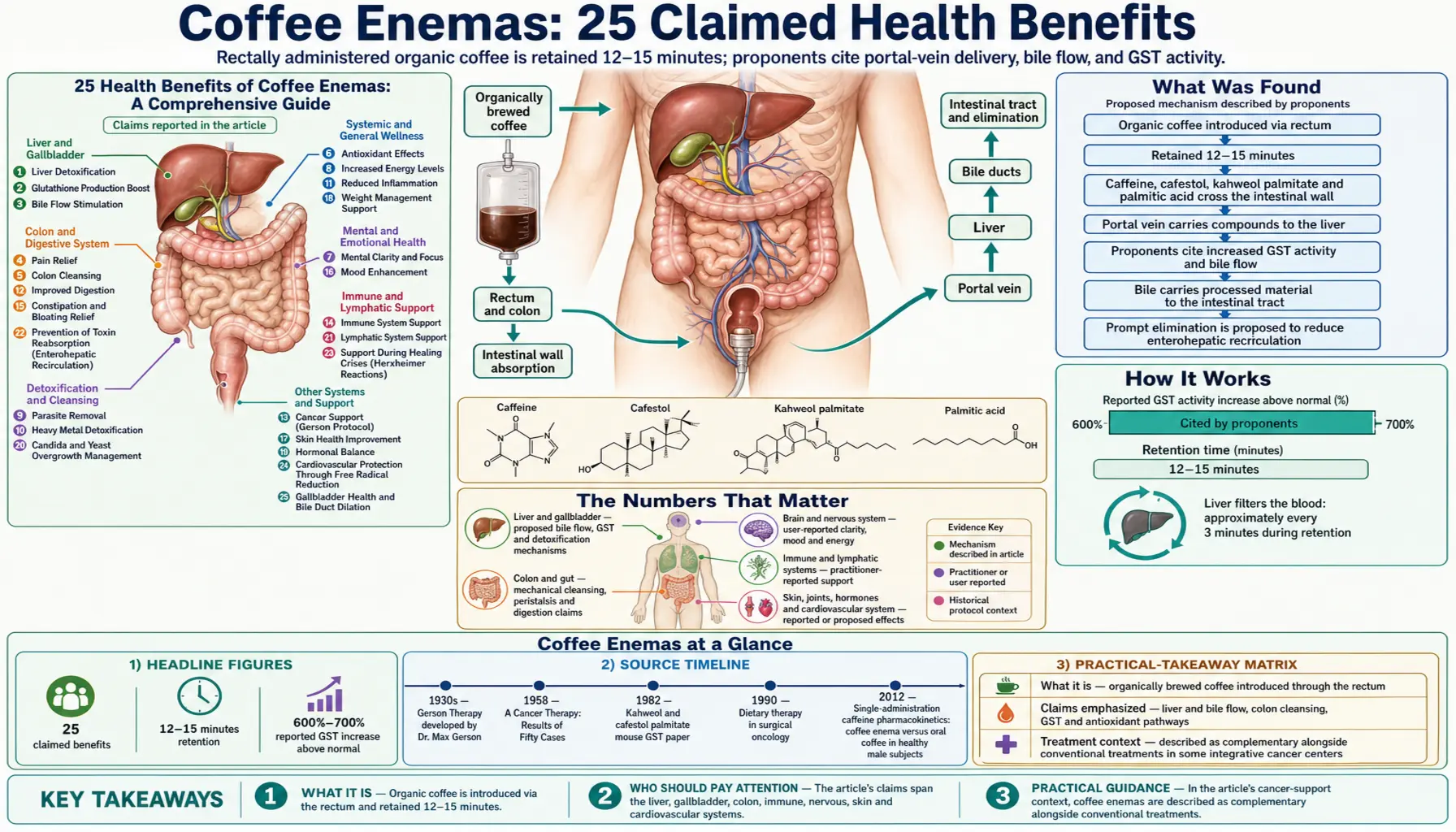
Coffee enemas have been used in holistic and integrative practice for nearly a century, most prominently as part of the Gerson Therapy protocol that Dr. Max Gerson developed from the 1930s onward (the protocol, and Gerson’s own account of it, are covered in the Max Gerson coffee-enema pages). The practice introduces brewed coffee into the colon through the rectum. Proponents state that coffee compounds — including caffeine, cafestol, kahweol palmitate and palmitic acid — are absorbed through the intestinal wall and carried to the liver through the portal vein. The 25 benefits below are the ones most often claimed by practitioners and holistic health writers. Each claim is followed by what published research reports.
The evidence in brief. A 2020 systematic review that searched Western, Korean, Chinese and Japanese databases found no study reporting the effectiveness of self-administered coffee enemas; the nine case reports it found all described adverse events, seven of them colitis (Son 2020). The few controlled human studies are small: an 11-man crossover trial measured caffeine absorption (Teekachunhatean 2013), an 11-man crossover trial measured blood antioxidant markers (Teekachunhatean 2012), and a 34-patient pilot study tested coffee enemas as a bowel preparation for capsule endoscopy (Kim 2014). No controlled trial found in PubMed tested any of the 25 claims below for its stated health outcome. A 2010 review of the Gerson regimen states that none of its theories, including the bile-duct and detoxification rationale for coffee enemas, has been substantiated by scientific research (Cassileth 2010). A 2021 narrative review by a practitioner who uses them reports that she, her patients and other practitioners find them useful for a variety of symptoms (Isaacs 2021).
1. Liver Detoxification
The claim: Gerson Therapy proponents describe the coffee enema as stimulating the liver to release stored “toxic bile” into the intestine for elimination. As presented in the Gerson literature (attributed to a 1985 conference talk by Harold Manner, Ph.D.), the liver filters the body’s entire blood supply about every three minutes, so the blood passes through it several times while the enema is retained.
What research shows: No controlled study has measured toxin removal from the liver after a coffee enema. The 2020 systematic review found no effectiveness study of any kind (Son 2020), and a 2010 review of the Gerson regimen states that the theory that coffee enemas excrete toxic breakdown products through the bile and colon wall has not been substantiated (Cassileth 2010). A 1992 critique in JAMA examined the rationale for treating cancer with coffee enemas and diet (Green 1992).
2. Glutathione Production Boost
The claim: Proponents state that cafestol and kahweol palmitate in coffee greatly increase the activity of glutathione S-transferase (GST), a detoxification enzyme. The Gerson literature gives figures of 600% (liver) and 700% (small bowel) and states that analogous results occur in people taking coffee enemas.
What research shows: The GST finding comes from mice. Lee Wattenberg’s laboratory reported that green coffee beans fed in the diet increased GST activity in the small-intestine lining and liver of mice, and identified kahweol palmitate (and, less potently, cafestol palmitate) as the active compounds (Lam 1982); the study did not involve enemas or people, and its abstract does not report the 600%/700% figures. In the one human trial that measured blood glutathione, 11 healthy men given coffee enemas three times weekly for six visits, or oral coffee for 11 days, showed no increase in serum glutathione or decrease in malondialdehyde, and serum total antioxidant capacity (TEAC) fell from baseline at day 12 after the enemas (Teekachunhatean 2012).
3. Bile Flow Stimulation
The claim: Proponents state that coffee enemas make the gallbladder release more bile, that palmitic acid in coffee dilates the bile ducts, and that the extra bile flow carries toxins out and helps absorption of vitamins A, D, E and K.
What research shows: The Gerson account traces the bile-duct claim to 1920s experiments in which caffeine was given rectally to rats. No study found here measured bile flow, bile-duct width or vitamin absorption in people after a coffee enema. In a 34-patient pilot study, adding a coffee enema to a standard laxative preparation before capsule endoscopy was associated with a trend toward better visibility in the mid and distal small intestine, where excreted bile can obscure the view; the authors call for larger randomized studies (Kim 2014).
4. Pain Relief
The claim: Proponents state that caffeine absorbed from the enema dilates blood vessels and relaxes smooth muscle, easing pain. Gerson reported pain relief in his cancer patients, and practitioners describe relief in arthritis, fibromyalgia and chronic fatigue syndrome.
What research shows: Pain relief from coffee enemas has not been tested in a controlled trial. The accounts are Gerson’s own clinical reports and practitioners’ observations, set out on the Gerson coffee-enema component page. In healthy volunteers, the caffeine reaching the blood from a coffee enema was about 3.5 times lower (peak level and total exposure) than from a comparable oral coffee drink (Teekachunhatean 2013).
5. Colon Cleansing
The claim: Proponents state that coffee enemas wash out accumulated waste, “mucoid plaque” and debris, soften stool, stimulate peristalsis, reduce reabsorption of toxins and favor beneficial gut bacteria.
What research shows: Any enema introduces fluid that can trigger a bowel movement. The broader idea that retained intestinal waste poisons the body (“autointoxication”) fell out of medical favour once its scientific rationale was shown to be wrong; a 1997 historical review concludes that today’s colonic-irrigation experts offer only theories and anecdotes in its support (Ernst 1997). No study found here measured gut bacteria or nutrient absorption after coffee enemas. Seven of the nine case reports in the 2020 systematic review described colitis after self-administration, which the case authors most often attributed to the coffee fluid itself (Son 2020).
6. Antioxidant Effects
The claim: Proponents state that coffee’s antioxidants are absorbed through the colon wall and, together with raised GST activity, protect cells from oxidative damage.
What research shows: In the 11-man crossover trial, neither single nor repeated coffee enemas raised serum glutathione or lowered the oxidative-damage marker malondialdehyde, and serum TEAC antioxidant capacity was lower than baseline at day 12 (Teekachunhatean 2012).
7. Mental Clarity and Focus
The claim: Users report sharper thinking and better concentration, which proponents attribute to absorbed caffeine and a reduced toxic burden, and describe as alertness without the jitteriness of drinking coffee.
What research shows: Mental clarity after a coffee enema has not been measured in a study found here. The measured fact is that a coffee enema delivered about 3.5 times less caffeine to the blood than a comparable oral coffee drink, with a slightly faster time to peak and the same half-life (Teekachunhatean 2013).
8. Increased Energy Levels
The claim: Increased energy is among the most frequently reported benefits; proponents attribute it to toxin removal, improved liver function and caffeine, and describe it as lasting without a caffeine “crash.”
What research shows: No controlled study of energy or fatigue after coffee enemas was found. The “no crash” claim has not been tested; the only pharmacokinetic study found lower caffeine exposure from an enema than from drinking coffee (Teekachunhatean 2013).
9. Parasite Removal
The claim: Proponents state that the flushing action and bile flow wash out parasites and their eggs and disrupt protective biofilms, and some practitioners include coffee enemas in anti-parasitic protocols.
What research shows: No study of coffee enemas against any intestinal parasite was found in PubMed. Parasitic infections and their treatment are covered in the Gastroenterology section.
10. Heavy Metal Detoxification
The claim: Proponents state that raised glutathione binds mercury, lead and cadmium for excretion in bile, and some practitioners include coffee enemas in heavy-metal protocols, including for people with amalgam fillings or undergoing chelation.
What research shows: No study measuring heavy-metal excretion after coffee enemas was found. The human trial that measured serum glutathione found no increase after coffee enemas (Teekachunhatean 2012). Heavy-metal exposure is covered on the Heavy Metals page.
11. Reduced Inflammation
The claim: Proponents state that flushing toxins and coffee’s antioxidants lower systemic inflammation, and users report improvements in joint pain, digestive disorders and skin conditions.
What research shows: No study of inflammatory markers after coffee enemas was found. The case-report literature runs the other way for the bowel itself: colitis and proctocolitis (inflammation of the colon and rectum) have been reported after coffee enemas, presenting with abdominal pain and rectal bleeding (Lee CJ 2008; Keum 2010; Lee AH 2020; Son 2020).
12. Improved Digestion
The claim: Proponents state that increased bile flow and colon cleansing improve fat digestion, nutrient absorption and regularity, and users report less bloating and gas.
What research shows: No controlled study of digestion, absorption, bloating or gas after coffee enemas was found; the 2020 systematic review found no effectiveness study for any indication (Son 2020).
13. Cancer Support (Gerson Protocol)
The claim: Coffee enemas are a core part of the Gerson Therapy, which combines them with organic juices and a salt-free diet. Dr. Max Gerson theorized that keeping the liver working through frequent coffee enemas lets the body clear the toxic breakdown products released as tumors break down. Some integrative cancer centers use the procedure alongside conventional treatment.
What research shows: No randomized trial of the Gerson Therapy or of coffee enemas in cancer was found in PubMed. A 2010 review reports that proponents claim recovery rates as high as 70% to 90%, but that case reviews by the National Cancer Institute and the New York County Medical Society found no evidence of usefulness for the Gerson diet (Cassileth 2010). The closest controlled evidence comes from a related regimen: in an NCI-sponsored study of 55 patients with inoperable pancreatic cancer, those who chose a regimen of pancreatic enzymes, supplements, detoxification and an organic diet had a median survival of 4.3 months, against 14.0 months for those who chose gemcitabine-based chemotherapy, and a worse quality of life (Chabot 2010). A 1990 Lancet report also examined juices, coffee enemas and cancer (Reed 1990), and a 1992 JAMA critique examined the rationale for the treatment (Green 1992). Gerson’s own case series and the 1995 melanoma retrospective review are set out on the Gerson research-evidence page.
14. Immune System Support
The claim: Proponents state that lowering the toxic load on the liver restores immune defenses, and that removing parasites, candida and harmful bacteria from the gut supports immunity.
What research shows: No study of immune measures after coffee enemas was found. Case reports describe the opposite kind of event — bacteria entering the bloodstream: a 1984 report of polymicrobial enteric septicemia from coffee enemas (Margolin 1984), and a 2019 report of Clostridium septicum bloodstream infection with brain involvement in a person whose natural remedies included coffee enemas, which the authors say may have played a role (Mirzai 2019).
15. Constipation and Bloating Relief
The claim: Proponents state that the fluid softens hard stool and stimulates bowel movements, that caffeine relaxes intestinal muscle, and that regular coffee enemas retrain the bowel; immediate relief from bloating is among the most often reported effects.
What research shows: Any enema can produce a bowel movement; no trial compared coffee enemas with plain-water enemas or standard treatments for constipation, and none tested the “retraining” claim. A Korean case of acute colitis with severe abdominal pain and rectal bleeding followed a coffee enema used for constipation (Lee CJ 2008).
16. Mood Enhancement
The claim: Proponents state that coffee enemas release endorphins and stimulate the vagus nerve, and users describe feeling calmer, with some reporting fewer symptoms of depression and anxiety.
What research shows: No study measuring endorphins, vagal activity, mood, depression or anxiety after coffee enemas was found.
17. Skin Health Improvement
The claim: Users report clearer skin, and proponents state that internal detoxification addresses the causes of acne, eczema and psoriasis, so the skin no longer acts as an “overflow” detoxification organ.
What research shows: No study of coffee enemas in acne, eczema, psoriasis or any skin condition was found. The “overflow organ” idea is part of the autointoxication theory reviewed by Ernst (1997).
18. Weight Management Support
The claim: Proponents state that coffee enemas improve digestion and metabolism, remove waste and water weight, and support liver and hormone function in processing fats.
What research shows: No study of body weight, fat loss or metabolic rate with coffee enemas was found.
19. Hormonal Balance
The claim: Proponents state that by boosting liver detoxification, coffee enemas help clear excess estrogen and hormone-disrupting chemicals that would otherwise recirculate.
What research shows: No study of hormone levels after coffee enemas was found.
20. Candida and Yeast Overgrowth Management
The claim: Practitioners include coffee enemas in anti-candida protocols, stating that bile flow and small-intestine alkalinity discourage yeast and that flushing removes yeast colonies from the colon wall.
What research shows: No study of coffee enemas and Candida or any yeast was found in PubMed.
21. Lymphatic System Support
The claim: Proponents state that coffee enemas stimulate lymphatic circulation, moving waste out of tissues and reducing fluid retention.
What research shows: No study of lymphatic flow or fluid retention after coffee enemas was found.
22. Prevention of Toxin Reabsorption (Enterohepatic Recirculation)
The claim: Proponents state that coffee enemas interrupt enterohepatic recirculation — the reabsorption in the gut of substances the liver has excreted into bile — so toxins leave the body instead of cycling back to the liver. The Gerson literature calls the coffee enema a non-reabsorbed, repeatable choleretic (bile-flow agent).
What research shows: Enterohepatic recirculation is a real physiological process, but no study measured whether coffee enemas change it. A 2010 review lists the bile-excretion rationale among the Gerson theories that have not been substantiated (Cassileth 2010).
23. Support During Healing Crises (Herxheimer Reactions)
The claim: Holistic practitioners use coffee enemas for Herxheimer (“die-off”) reactions — headaches, fatigue, aches and flu-like symptoms during antimicrobial or detoxification protocols — and state that faster removal of the released toxins shortens and eases them. The Gerson literature describes “flare-ups” during its therapy in similar terms.
What research shows: No study of coffee enemas during Herxheimer reactions or detoxification “flare-ups” was found.
24. Cardiovascular Protection Through Free Radical Reduction
The claim: Proponents state that raised GST activity and free-radical neutralization from coffee enemas protect the arteries and lower the risk of heart disease.
What research shows: No cardiovascular outcome has been studied with coffee enemas, and the human trial of antioxidant markers found no benefit (Teekachunhatean 2012). The same compounds credited with the GST effect, cafestol and kahweol, have a measured cardiovascular-relevant effect when taken by mouth: in human studies they strongly raise serum VLDL and LDL cholesterol and slightly lower HDL cholesterol (van Tol 1997). Whether they reach the blood from an enema has not been measured.
25. Gallbladder Health and Bile Duct Dilation
The claim: Proponents state that coffee enemas make the gallbladder contract and empty, that palmitic acid dilates the bile ducts and keeps bile from stagnating, lowering the risk of gallstones; some practitioners compare it to exercise for the gallbladder.
What research shows: No study of gallbladder emptying, bile-duct diameter or gallstone risk after coffee enemas was found; the bile-duct claim rests on 1920s rectal-caffeine experiments in rats described in the Gerson literature (see claim 3).
Reported Hazards
Case reports and reviews in the medical literature describe these harms after coffee enemas:
- Rectal burns. Three case reports describe burns of the rectum from hot coffee enemas; in one, the burns led to a benign stricture and then rectal perforation (Sashiyama 2008; Jones 2010; Kim S 2012).
- Colitis and proctocolitis. Seven of nine case reports in a 2020 systematic review described colitis after self-administration (Son 2020); individual reports include acute colitis with severe pain and rectal bleeding (Lee CJ 2008) and proctocolitis (Keum 2010; Lee AH 2020).
- Infection and sepsis. A 1984 report describes polymicrobial enteric septicemia from coffee enemas (Margolin 1984); a 2019 report describes Clostridium septicum sepsis with brain involvement in which coffee enemas may have played a role (Mirzai 2019).
- Deaths and electrolyte disturbance. A 1980 JAMA report is titled “Deaths related to coffee enemas”; PubMed indexes it under naturopathy and hypokalemia (low blood potassium) mortality (Eisele 1980).
- Outcomes in cancer. In the NCI-sponsored pancreatic-cancer study, patients who chose an enzyme-and-detoxification regimen survived a median 4.3 months, against 14.0 months with chemotherapy (Chabot 2010).
The 2020 systematic review concludes that, given unsolved safety issues and insufficient evidence of effectiveness, it does not recommend self-administered coffee enemas as a self-care practice (Son 2020). Decisions about any treatment belong with a clinician.
Sources
- Gerson, M. (1958). A Cancer Therapy: Results of Fifty Cases. Gerson Institute.
- Lechner, P. & Kronberger, I. (1990). “Experiences with the use of dietary therapy in surgical oncology.” Aktuelle Ernährungsmedizin, 15(2), 72–78.
- Lam, L.K.T., Sparnins, V.L., & Wattenberg, L.W. (1982). “Isolation and identification of kahweol palmitate and cafestol palmitate as active constituents of green coffee beans that enhance glutathione S-transferase activity in the mouse.” Cancer Research, 42(4), 1193–1198.
- Teekachunhatean, S. et al. (2013). “Pharmacokinetics of caffeine following a single administration of coffee enema versus oral coffee consumption in healthy male subjects.” ISRN Pharmacology, 2013:147238.
- Gerson Institute — Coffee Enema: 8 Things You Need to Know (proponents’ account)
- An enema-product retailer’s article on claimed coffee enema benefits
- An enema-kit retailer’s article on claimed detox benefits of coffee enemas
- A holistic practice’s article on claimed benefits of coffee enemas
- An alternative cancer clinic’s article on detoxing with coffee enemas
- A wellness business’s article on claimed benefits of coffee enemas
Key Research Papers
The primary papers behind the findings above, each checked against its PubMed record; most of the case reports have no abstract, and only their titles and indexing are reported here.
- Lam LK, Sparnins VL, Wattenberg LW (1982). Isolation and identification of kahweol palmitate and cafestol palmitate as active constituents of green coffee beans that enhance glutathione S-transferase activity in the mouse. Cancer Research 42(4):1193-8. — PubMed PMID: 7059995
- Teekachunhatean S, Tosri N, Rojanasthien N, Srichairatanakool S, Sangdee C (2013). Pharmacokinetics of Caffeine following a Single Administration of Coffee Enema versus Oral Coffee Consumption in Healthy Male Subjects. ISRN Pharmacology 2013:147238. — PubMed PMID: 23533801
- Teekachunhatean S, Tosri N, Sangdee C, Wongpoomchai R, Ruangyuttikarn W, Puaninta C, et al. (2012). Antioxidant effects after coffee enema or oral coffee consumption in healthy Thai male volunteers. Human & Experimental Toxicology 31(7):643-51. — PubMed PMID: 22249393
- Kim ES, Chun HJ, Keum B, Seo YS, Jeen YT, Lee HS, et al. (2014). Coffee enema for preparation for small bowel video capsule endoscopy: a pilot study. Clinical Nutrition Research 3(2):134-41. — PubMed PMID: 25136541
- Isaacs LL (2021). Coffee Enemas: A Narrative Review. Alternative Therapies in Health and Medicine 27(3):46-49. — PubMed PMID: 33711817
- Son H, Song HJ, Seo HJ, Lee H, Choi SM, Lee S (2020). The safety and effectiveness of self-administered coffee enema: A systematic review of case reports. Medicine (Baltimore) 99(36):e21998. — PubMed PMID: 32899046
- Green S (1992). A critique of the rationale for cancer treatment with coffee enemas and diet. JAMA 268(22):3224-7. — PubMed PMID: 1433763
- Cassileth B (2010). Gerson regimen. Oncology (Williston Park) 24(2):201. — PubMed PMID: 20361473
- Chabot JA, Tsai WY, Fine RL, Chen C, Kumah CK, Antman KA, et al. (2010). Pancreatic proteolytic enzyme therapy compared with gemcitabine-based chemotherapy for the treatment of pancreatic cancer. Journal of Clinical Oncology 28(12):2058-63. — PubMed PMID: 19687327
- Ernst E (1997). Colonic irrigation and the theory of autointoxication: a triumph of ignorance over science. Journal of Clinical Gastroenterology 24(4):196-8. — PubMed PMID: 9252839
- van Tol A, Urgert R, de Jong-Caesar R, van Gent T, Scheek LM, de Roos B, et al. (1997). The cholesterol-raising diterpenes from coffee beans increase serum lipid transfer protein activity levels in humans. Atherosclerosis 132(2):251-4. — PubMed PMID: 9242972
- Reed A, James N, Sikora K (1990). Juices, coffee enemas, and cancer. Lancet 336(8716):677-8. — PubMed PMID: 1975864
- Eisele JW, Reay DT (1980). Deaths related to coffee enemas. JAMA 244(14):1608-9. — PubMed PMID: 7420666
- Margolin KA, Green MR (1984). Polymicrobial enteric septicemia from coffee enemas. Western Journal of Medicine 140(3):460. — PubMed PMID: 6710988
- Sashiyama H, Hamahata Y, Matsuo K, Akagi K, Tsutsumi O, Nakajima Y, et al. (2008). Rectal burn caused by hot-water coffee enema. Gastrointestinal Endoscopy 68(5):1008; discussion 1009. — PubMed PMID: 18657805
- Jones LE, Norris WE (2010). Rectal burn induced by hot coffee enema. Endoscopy 42 Suppl 2:E26. — PubMed PMID: 20073005
- Kim S, Cha JM, Lee CH, Shin HP, Park JJ, Joo KR, et al. (2012). Rectal perforation due to benign stricture caused by rectal burns associated with hot coffee enemas. Endoscopy 44 Suppl 2 UCTN:E32-3. — PubMed PMID: 22396264
- Lee CJ, Song SK, Jeon JH, Sung MK, Cheung DY, Kim JI, et al. (2008). [Coffee enema induced acute colitis]. Korean Journal of Gastroenterology 52(4):251-4. — PubMed PMID: 19077527
- Keum B, Jeen YT, Park SC, Seo YS, Kim YS, Chun HJ, et al. (2010). Proctocolitis caused by coffee enemas. American Journal of Gastroenterology 105(1):229-30. — PubMed PMID: 20054322
- Lee AH, Kabashneh S, Tsouvalas CP, Rahim U, Khan MY, Anees M, et al. (2020). Proctocolitis From Coffee Enema. ACG Case Reports Journal 7(1):e00292. — PubMed PMID: 32309489
- Mirzai S, Rifai AO, Webb S, Rifai K, Reiner A (2019). Probable Clostridium septicum pneumocephalus in a user of natural remedies with newly diagnosed diabetes mellitus type 1. IDCases 17:e00581. — PubMed PMID: 31312601
PubMed Topic Searches
- Clinical trials on coffee enema therapy — PubMed search
- Clinical trials on Gerson therapy and cancer — PubMed search
- Clinical trials on coffee and glutathione S-transferase — PubMed search
- Clinical trials on cafestol and kahweol liver effects — PubMed search
- Clinical trials on bile flow and detoxification — PubMed search
- Clinical trials on colon hydrotherapy — PubMed search
Connections
Featured Videos