 — February 12, 2026
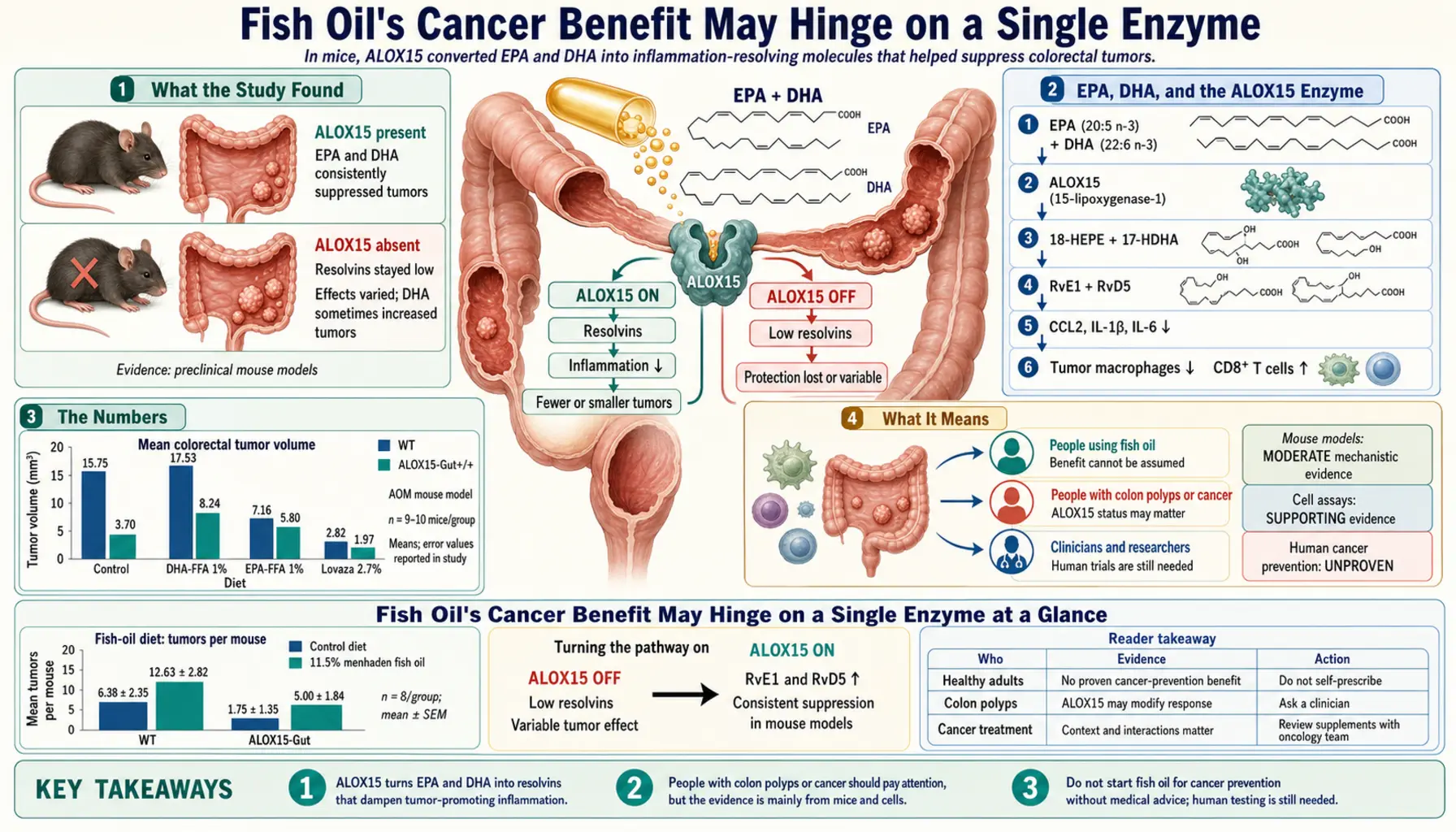
Fish Oil's Cancer Benefit May Hinge on a Single Enzyme
In mid-February 2026, a finding from Michigan Medicine and the University of Texas MD Anderson Cancer Center moved through the health-news cycle with an uncomfortable message: a daily fish-oil capsule may not do what many people assume, and in one specific biological context it might even do the opposite. The underlying peer-reviewed study appeared online in Cellular and Molecular Gastroenterology and Hepatology in August 2025; the February 2026 press coverage from the University of Michigan is what carried it to a general audience. The core result is worth understanding precisely, because it is neither “fish oil is bad” nor “fish oil is good.” It is a story about a single enzyme.
Table of Contents
1. What the Study Found
Working in mice, the team led by Imad Shureiqi tested how the two main omega-3 fatty acids in fish oil — EPA (eicosapentaenoic acid) and DHA (docosahexaenoic acid) — affect the formation of colorectal cancer. They compared ordinary mice with mice engineered to make the human enzyme ALOX15, or 15-lipoxygenase-1, in the cells lining the intestine, across several mouse models of colorectal cancer and several forms of EPA and DHA (free fatty acids, ethyl esters, triglycerides, a menhaden fish-oil diet and a prescription EPA-plus-DHA ethyl-ester drug). In the ordinary mice, whose own version of the enzyme made little resolvin, the supplements had variable effects: the menhaden fish-oil diet increased the number of colon tumors in an inflammation-driven model, DHA increased the number of large tumors in a genetic model, and the authors summarize that EPA (as a free fatty acid or ethyl ester) inhibited tumor formation while DHA in the same forms did not. In the mice carrying human ALOX15, tumor formation was lower than in ordinary mice on the same diet with every EPA and DHA formulation tested, alongside higher resolvin levels, lower levels of the inflammatory signals CCL2, IL-1β and IL-6, fewer tumor-associated macrophages and more CD8 T cells in the tumors. In other words, the same supplements pointed in different directions depending on one host factor.
2. EPA, DHA, and the ALOX15 Enzyme
Omega-3s act on inflammation by more than one route. In this study, EPA and DHA lowered colonic prostaglandins such as PGE2 whether or not ALOX15 was present. A second route runs through the conversion of EPA and DHA into a family of signaling molecules called resolvins, which help switch off chronic inflammation, a major contributor to cancer development. ALOX15 is a key enzyme in making resolvins from EPA and DHA. The catch — and the reason this matters for people — is that ALOX15 is frequently lost in the human colon as colorectal tumors develop. So the tissue in which colorectal tumors form is often the tissue least equipped to turn omega-3s into resolvins. In the ordinary mice, EPA and DHA supplements raised blood levels of the fatty acids but produced minimal changes in colonic resolvins. With human ALOX15 in the intestinal lining, resolvin levels rose, and the two most abundant ones, RvE1 and RvD5, suppressed CCL2, IL-1β and IL-6 and increased the tumor-cell-engulfing activity of mouse macrophages in laboratory cell experiments.
3. The Numbers
The authors, citing the 2012 National Health Interview Survey, put the number of U.S. adults taking fish-oil supplements at about 19 million, which is what makes even a mouse study like this newsworthy. There is no human percentage to report — this was an animal experiment, with 5 to 17 mice per group — but the paper’s tables give a sense of scale. In a model in which a carcinogen plus a colitis-inducing chemical drive tumors (8 mice per group), ordinary mice averaged 6.38 tumors each on the control diet and 12.63 on an 11.5% menhaden fish-oil diet; mice carrying intestinal human ALOX15 averaged 1.75 and 5.00. In a carcinogen-only model (9 to 10 mice per group), mean tumor volume in ordinary mice was 15.75 mm³ on the control diet, 17.53 on DHA, 7.16 on EPA and 2.82 on the prescription EPA-plus-DHA drug; in mice carrying two copies of the human ALOX15 transgene the figures were 3.70, 8.24, 5.80 and 1.97. The comparison that favors ALOX15 is between the two kinds of mice on the same diet: within the transgenic mice, the menhaden-oil diet still averaged more tumors, and the DHA diet a larger mean tumor volume, than the control diet in these two experiments. Nor did EPA outperform DHA everywhere: in one repeat experiment, the transgene’s strongest effect was seen with DHA. That is a qualitative, mechanistic result, not a dosing table, and the authors present it as one.
4. What It Means
The message the authors themselves emphasize is modest. Shureiqi, quoted in the university’s press release, put it as “Not all fish oil supplements are the same,” adding that it is also important to ask whether the person taking a supplement has the enzymes needed to metabolize it. The paper’s conclusion calls for colonic ALOX15 status to be taken into account when developing prevention strategies that use EPA and DHA to lower colon-cancer risk. According to the press release, the team is developing medications designed to boost ALOX15 levels in cancer cells, with the goal of enhancing the body’s ability to process EPA and DHA. That is a research direction, not an available treatment — but on this evidence fish oil looks less like a one-size-fits-all supplement and more like a conditional one: in these mice, its effect depended on the enzymes already present in the colon.
5. Honest Caveats
Several cautions belong in bold. First, this is a preclinical mouse study. Mouse colon-cancer models are useful for working out mechanism but map imperfectly onto human disease, and the study does not show that fish oil causes cancer in people. Second, the study does not test omega-3 safety in people. In the VITAL trial described next, no excess risk of bleeding or other serious adverse events was observed; a 2021 meta-analysis of seven cardiovascular-outcome trials (81,210 patients) did find a higher risk of atrial fibrillation with marine omega-3 supplements (hazard ratio 1.25), greater in trials testing more than 1 gram a day (1.49) than in those testing 1 gram or less (1.12). Third — and this is the honest backdrop to almost every supplement headline — the landmark randomized trial of omega-3 supplements and cancer came back null. The VITAL trial randomized 25,871 U.S. adults (men 50 and older, women 55 and older) to 1 gram of marine omega-3 daily or placebo and found no significant reduction in either of its primary end points, invasive cancer of any type (hazard ratio 1.03) or major cardiovascular events (hazard ratio 0.92), over a median 5.3 years. The enzyme work offers one possible reason why omega-3 results have been inconsistent, which the paper describes as conflicting: if the benefit depends on a host enzyme that some people have lost, then averaging everyone together could blur a real effect in one subgroup into an overall null — a hypothesis not yet tested in people. Finally, the findings do not yet identify who would or would not benefit. The press release says the results suggest testing cancer patients for ALOX15 could be important when considering omega-3 prevention strategies, but this research, done in mice, cannot yet guide any individual’s decision to take or skip fish oil.
6. Reading the Evidence
In the university’s press release, Shureiqi is reported as advising patients to speak with their doctors before starting fish-oil supplements. The release notes that most of the data come from animal studies, and says the results suggest that people with colon polyps who do not have active ALOX15 may not receive the same protective benefit from EPA and DHA. The study tested purified EPA and DHA, a menhaden fish-oil diet and a prescription omega-3 drug in mice; it did not study eating whole fish. What it changes is the model of how omega-3s work: in these mice, their effect ran through enzymes and pathways that can differ from one individual to the next. Whether the same holds in people, and whether matching a supplement to a person’s biology would change cancer outcomes, has not been tested — that science is only beginning.
Sources
- Michigan Medicine (University of Michigan) Health Lab. “Fish oil supplements may not work for certain cancer patients.” February 2026. michiganmedicine.org/health-lab
- ScienceDaily. “Omega-3 fish oil supplements could backfire without this key enzyme.” February 13, 2026 (source: Michigan Medicine – University of Michigan). sciencedaily.com/releases/2026/02/260212234216
- Zuo X, Kiyasu Y, Liu Y, Deguchi Y, Liu F, Moussalli M, Tan L, Wei B, Wei D, Yang P, Shureiqi I. “Colorectal 15-Lipoxygenase-1 as a Host Factor Determining the Effects of Eicosapentaenoic Acid and Docosahexaenoic Acid on Colorectal Tumorigenesis in Mice.” Cellular and Molecular Gastroenterology and Hepatology. Published online August 14, 2025. doi:10.1016/j.jcmgh.2025.101607
- Manson JE, Cook NR, Lee IM, et al. “Marine n-3 Fatty Acids and Prevention of Cardiovascular Disease and Cancer” (VITAL trial). New England Journal of Medicine. 2019;380(1):23–32. PMID 30415637
Key Research Papers
The primary papers behind the figures above, each checked against its PubMed record and abstract (and, for the mouse study, its full text) before it was written down.
- Zuo X, Kiyasu Y, Liu Y, Deguchi Y, Liu F, Moussalli M, Tan L, Wei B, Wei D, Yang P, Shureiqi I (2025). Colorectal 15-Lipoxygenase-1 as a Host Factor Determining the Effects of Eicosapentaenoic Acid and Docosahexaenoic Acid on Colorectal Tumorigenesis in Mice. Cellular and Molecular Gastroenterology and Hepatology 19(12):101607. — PubMed PMID: 40818741
- Manson JE, Cook NR, Lee IM, Christen W, Bassuk SS, Mora S, et al.; VITAL Research Group (2019). Marine n-3 Fatty Acids and Prevention of Cardiovascular Disease and Cancer. New England Journal of Medicine 380(1):23-32. — PubMed PMID: 30415637
- Gencer B, Djousse L, Al-Ramady OT, Cook NR, Manson JE, Albert CM (2021). Effect of Long-Term Marine ω-3 Fatty Acids Supplementation on the Risk of Atrial Fibrillation in Randomized Controlled Trials of Cardiovascular Outcomes: A Systematic Review and Meta-Analysis. Circulation 144(25):1981-1990. — PubMed PMID: 34612056