 — February 10, 2026
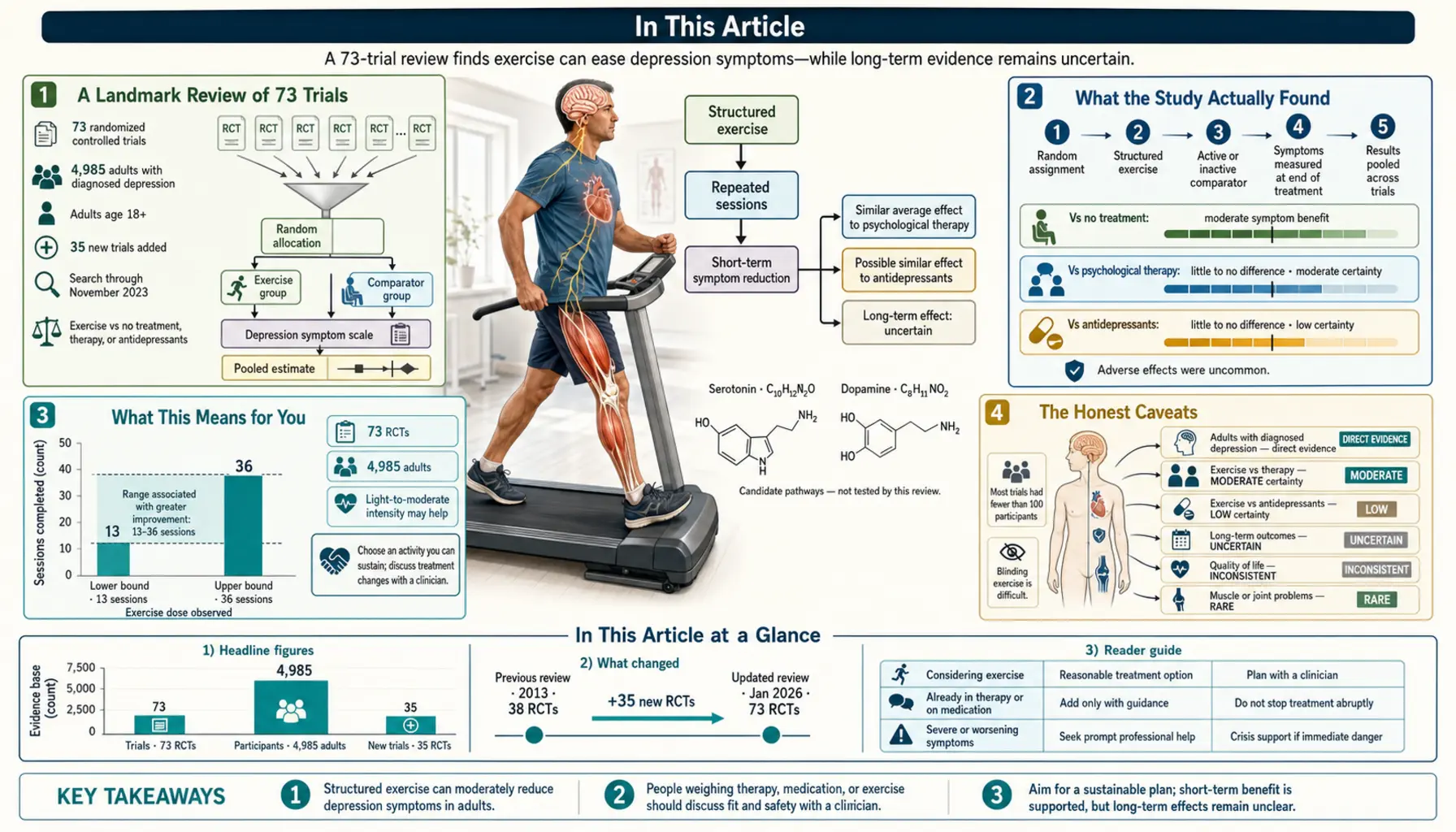
A major evidence review published in January 2026 reached a conclusion that sounds almost too simple: for adults living with depression, structured exercise probably eases symptoms about as much as talking therapy does. The authors rated that comparison moderate-certainty evidence, and they set out clear limits alongside it — many trials were small, few followed people after treatment ended, and the comparison with antidepressants rests on only five trials.
In This Article
A Landmark Review of 73 Trials
The work comes from the Cochrane Database of Systematic Reviews, published on January 8, 2026 and led by Andrew J. Clegg and colleagues. It updates a Cochrane review first published in 2008 and last updated in 2013. Cochrane reviews are widely regarded as the gold standard of medical evidence because they do not run a single new experiment; instead, they gather every eligible trial on a question, pool the results and grade how certain the evidence is. This one gathered 73 randomized controlled trials involving at least 4,985 adults who had been diagnosed with depression; 69 of the trials contributed data to the pooled analyses.
A randomized controlled trial is the fairest test medicine has: people are assigned by chance to one approach or another, which keeps hidden differences between groups from skewing the result. In these trials, adults with depression were assigned to an exercise program, to no treatment or a control activity, to psychological therapy, or to antidepressant medication — and their symptoms were measured at the end of treatment and, in a minority of trials, at a later follow-up.
What the Study Actually Found
Three findings stand out. First, compared with no treatment or a control activity, exercise was linked to a moderate reduction in depressive symptoms (57 trials, 2,189 participants; standardised mean difference −0.67), which the authors rated low-certainty evidence — in their words, exercise “may result in a reduction” in symptoms. Second, when exercise was compared head-to-head with psychological therapy, the improvements were similar in size (“probably little to no difference”) — a conclusion the authors rated as moderate-certainty evidence drawn from ten trials with 414 participants. Third, exercise appeared to have comparable effects to antidepressant medication (five trials, 330 participants), though here the evidence was thinner and rated low-certainty, and the authors note that their conclusions on both active comparisons rest on a few small trials.
The review also offered a rough sense of dose. According to Cochrane’s press release on the review, greater improvement was linked to completing 13 to 36 exercise sessions, light-to-moderate intensity activity may be more helpful than vigorous workouts, and programs that combined different types of activity, as well as resistance training, appeared more effective than aerobic exercise alone. Adverse events were uncommon: the review lists musculoskeletal injuries and worsening depression among some people who exercised, and diarrhoea, sexual dysfunction and fatigue among some people taking the antidepressant sertraline.
Reading the Evidence
For people living with depression, the review places structured exercise among the approaches with randomized-trial evidence behind them, alongside psychological therapy and antidepressants. Cochrane’s plain-language summary notes that some health guidelines suggest exercise could be used as an alternative treatment, and that many people prefer to try alternative approaches; the lead author, Professor Clegg, described exercise as “a safe and accessible option for helping to manage symptoms of depression.” The review measured depressive symptoms, treatment acceptability, quality of life, cost and adverse events; wider effects of exercise on sleep, the heart or blood sugar were not among its outcomes.
The key word, though, is structured. The trials tested organised exercise programs, often supervised — not general advice to “be more active.” As the caveats below explain, that distinction limits how far the findings carry over to everyday life.
The Honest Caveats
The review itself is careful about the limits of its findings. Several limitations deserve plain statement:
- Many of the trials were small — often fewer than 100 people, according to Cochrane’s press release. When the review authors restricted the analysis to the seven most rigorously conducted trials (447 participants, with concealed allocation, intention-to-treat analysis and blinded outcome assessment), the apparent benefit of exercise became smaller (standardised mean difference −0.46 rather than −0.67), though, as an outside expert noted, still statistically significant. Randomisation was adequately concealed in only 22 of the 73 trials. That is a familiar pattern, and it means the true effect may be more modest than the headline suggests.
- The long term is unclear. Only nine trials (405 participants) reported longer-term follow-up, and the authors rated that evidence very uncertain, so how durable the improvement is once the sessions stop remains unknown.
- The people studied may not be typical. An outside expert commenting on the review noted that it mainly covered structured, often supervised exercise programmes, which tend to attract motivated volunteers who are willing and able to take part, and that this limits how well the findings apply to the wider population of people with depression. Notably, the review excluded a large real-world UK trial (TREAD) that tested simply encouraging people to become more active, with support from a physical activity facilitator on top of usual care — a closer match to everyday life. In that trial of 361 adults, the added support increased physical activity but did not improve depression outcomes or reduce antidepressant use compared with usual care alone.
- Not everything was tested. According to Cochrane’s press release, gentle practices such as yoga, qigong, and stretching were not evaluated here, so this review says nothing for or against them.
For those reasons, an outside expert framed physical activity as “probably best viewed as a helpful option or addition to existing treatments, rather than as a direct replacement for established care,” and noted that the review cannot say with confidence whether people would do as well switching from medication or therapy to exercise alone.
Key Points
The trials behind these findings used structured programs, and Cochrane’s press release links greater improvement with completing 13 to 36 sessions at light-to-moderate intensity. The authors call for larger, higher-quality trials to work out which characteristics of exercise help which people and whether the benefits last; in Professor Clegg’s words, “we still need larger, high-quality studies.”
Outside experts were consistent on one point. The Royal College of Psychiatrists’ presidential lead for physical health said exercise “should not be seen as a replacement for therapy, medication and other forms of professional treatment,” and a researcher at King’s College London said decisions on switching or combining approaches “should be made collaboratively with healthcare providers.” Motivation is part of the picture too: the TREAD investigators suggested that earlier positive trials may have recruited people who already had a commitment to physical activity.
Decisions about depression treatment belong with a clinician. In the United States, 988, the Suicide & Crisis Lifeline, answers calls and texts at any time, day or night. Related approaches are covered on the meditation and natural anxiety relief pages.
Sources
- Clegg AJ, et al. Exercise for depression. Cochrane Database of Systematic Reviews. 2026, Issue 1. Art. No.: CD004366. doi:10.1002/14651858.CD004366.pub7
- Cochrane plain-language summary — “Is exercise effective for treating depression?” cochrane.org/evidence/CD004366
- “Scientists find exercise rivals therapy for depression.” ScienceDaily, January 8, 2026. sciencedaily.com/releases/2026/01/260107225516.htm
- Science Media Centre — expert reaction to exercise having similar results as therapy for treating depression (January 8, 2026). sciencemediacentre.org
Key Research Papers
- Clegg AJ, Hill JE, Mullin DS, Harris C, Smith CJ, Lightbody CE, et al. (2026). Exercise for depression. Cochrane Database of Systematic Reviews 1(1):CD004366. — PubMed PMID: 41500513
- Chalder M, Wiles NJ, Campbell J, Hollinghurst SP, Haase AM, Taylor AH, et al. (2012). Facilitated physical activity as a treatment for depressed adults: randomised controlled trial. BMJ 344:e2758. — PubMed PMID: 22674921
- Chalder M, Wiles NJ, Campbell J, Hollinghurst SP, Searle A, Haase AM, et al. (2012). A pragmatic randomised controlled trial to evaluate the cost-effectiveness of a physical activity intervention as a treatment for depression: the treating depression with physical activity (TREAD) trial. Health Technology Assessment 16(10):1-164. — PubMed PMID: 22398106