Lion's Mane Mushroom: History and Traditional Use
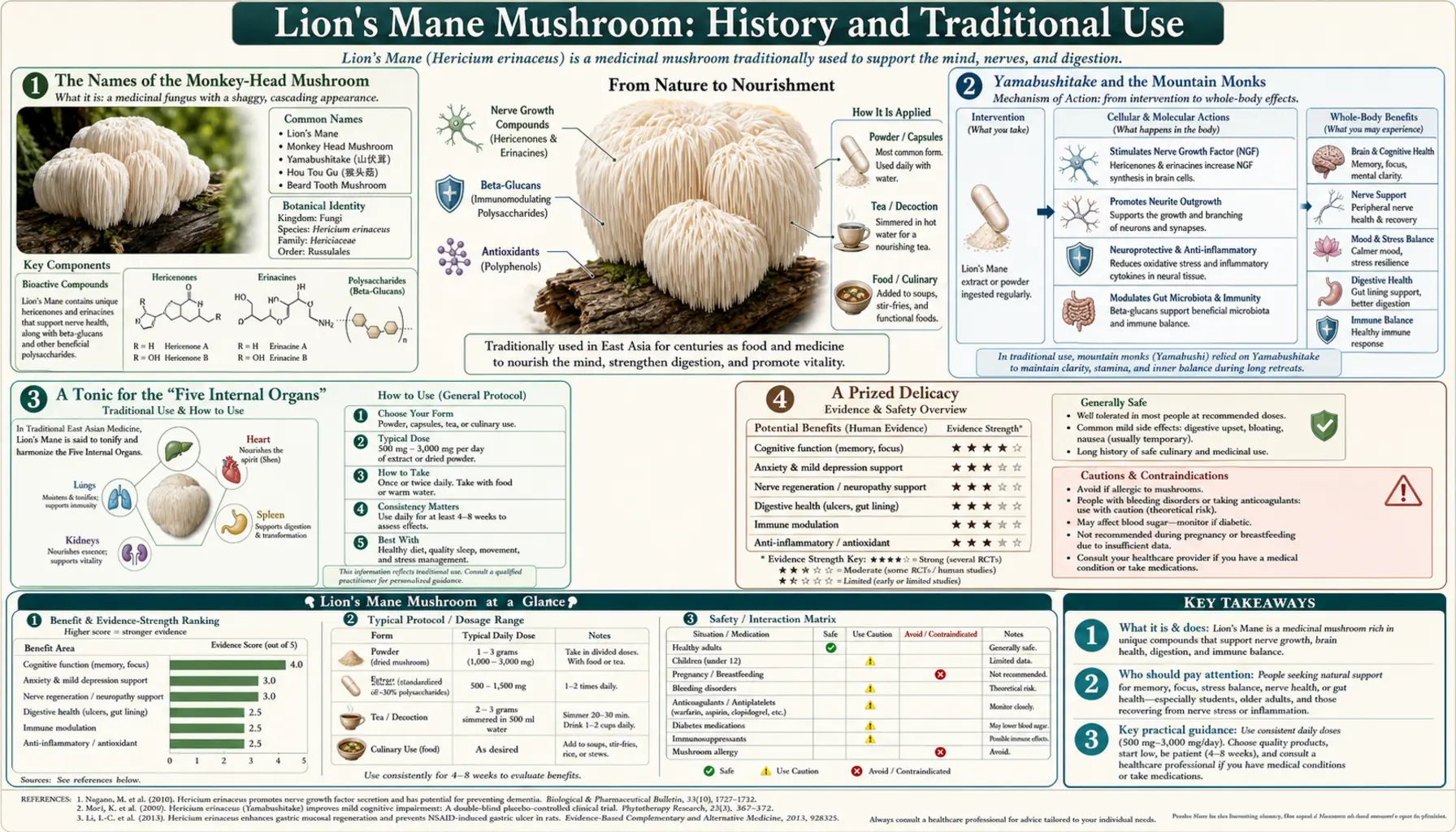
Long before anyone spoke of "nootropics," lion's mane (Hericium erinaceus) was already two things at once across East Asia: a prized food and a gentle tonic. In China it was the "monkey-head mushroom"; in Japan it took the name of the mountain monks whose pom-pom robes its cascading spines were said to resemble. This article traces what the historical record actually supports — the meaning of the mushroom's names, its place in Chinese and Japanese tradition as a food and a remedy for the digestion and the "five internal organs," its old reputation as a delicacy, the comparatively recent move from wild forage to cultivated crop, and the two laboratory milestones in the 1990s that gave the mushroom its modern molecular story. Where a fact is firmly documented we say so; where a claim is folklore, marketing, or still uncertain, we name it as such rather than dress it up as history.
Table of Contents
- The Names of the Monkey-Head Mushroom
- Yamabushitake and the Mountain Monks
- A Tonic for the "Five Internal Organs"
- A Prized Delicacy
- From Wild Forage to Cultivated Crop
- Naming the Species: Botany and Taxonomy
- From Tradition to Laboratory: Hericenones and Erinacines
- Tradition Versus the Modern Nootropic Story
- Research Papers and References
- Connections
- Featured Videos
The Names of the Monkey-Head Mushroom
A mushroom this striking gathers names, and lion's mane has several. The English name is the newest and the plainest: a description of the shaggy white cascade of spines that hangs from the fruiting body like a frozen waterfall or an animal's mane. The older names, the ones that carry the history, come from China and Japan.
In Chinese the mushroom is hóutóugū (猴头菇; traditional 猴頭菇), which translates literally as "monkey-head mushroom." The image is the same one English speakers reach for — a round, furry head — but the comparison is to a monkey rather than a lion. The name describes the mushroom's globe-like, spine-covered shape, and it is the everyday Chinese name for the fungus to this day.
The botanical name tells a different story, one about appearance rather than affection. Hericium erinaceus is built from two Latin words that both point to the hedgehog: the genus name Hericium derives from a Latin word for hedgehog, and the species epithet erinaceus is the Latin adjective for the same animal. In other words, the scientists who named it and the cooks who ate it saw the same thing — a dense covering of soft spines — and reached for whichever spiny creature came to mind. Monkey, lion, hedgehog, even "bearded tooth" (another English folk name): every name for this mushroom is really a name for its spines.
Yamabushitake and the Mountain Monks
The Japanese name is the most evocative of all, and the one most often retold. In Japan the mushroom is yamabushitake (山伏茸). The final syllable, take, simply means "mushroom." The first part, yamabushi, is the name of a class of ascetic mountain monks associated with Shugendō — a Japanese tradition that blends Buddhism with mountain worship and older folk religion, and whose practitioners sought spiritual power through austerities in remote forested peaks. The mushroom's name therefore reads, roughly, as "mountain-monk mushroom."
Why that name? The most commonly given explanation is visual: the mushroom's shaggy, hanging spines are said to resemble part of the distinctive garment worn by the yamabushi — in particular the rows of small pom-pom-like ornaments on their robes. A second, looser association simply ties the fungus to the same wild mountain forests where these monks practised. Both explanations are traditional readings of the name rather than documented statements of intent, and reference works are careful to present the link as one of resemblance and habitat, not as a recorded origin story.
It is worth separating two things that are easy to blur together. That the Japanese name refers to the yamabushi is well established and recorded in standard references. The more colourful claim — that mountain monks routinely brewed the mushroom into a tea to sharpen their minds for meditation — is widely repeated in modern wellness writing but is not something the historical record firmly establishes; it is best treated as an attractive tradition rather than a documented practice. The name is real history; the meditation-tea anecdote is folklore that may or may not be true.
A Tonic for the "Five Internal Organs"
Lion's mane has a long place in traditional Chinese medicine, where it was valued less as a treatment for one specific illness than as a general strengthening food-medicine — the kind of thing eaten to build a person up rather than to knock a disease down. In the traditional framework it was described as nourishing to the "five internal organs" — the liver, lung, spleen, heart, and kidney — the classical Chinese-medical grouping used to describe the body as a whole.
Within that broad role, the mushroom's most consistent traditional association is with the digestion. It was used to support what the tradition calls the spleen and stomach — in practical terms, the appetite and the gut — and was reached for in cases of digestive weakness and stomach complaints, as well as being given as a restorative to people who were run-down or convalescing. The same digestive reputation carried into Japanese use, where the mushroom was likewise eaten as a nourishing, fortifying food.
Two cautions belong here. First, terms such as "tonifying the spleen" or "nourishing the five organs" are descriptions of how a traditional system classified and used the mushroom; they are not modern medical diagnoses, and a traditional indication is not the same as proven effectiveness. Second, much of what is written today about the precise organ-by-organ traditional uses leans on later compilations and modern summaries rather than a single ancient text, so this page describes the tradition in the broad terms the sources reliably support — a digestive and whole-body tonic — rather than claiming a more exact pedigree than the record can bear.
A Prized Delicacy
For most of its history, lion's mane was prized at least as much for the table as for the medicine chest. It has long been regarded across China, Japan, and neighbouring cuisines as a choice edible mushroom — the sort of ingredient singled out as a delicacy rather than everyday fare. Cooks value its firm, meaty texture and a flavour that modern eaters often compare to crab or lobster, which is why it now turns up as a seafood substitute in plant-based cooking. Young, fresh fruiting bodies are considered the best eating; older specimens grow tougher and can turn faintly bitter.
Its standing as a delicacy was reinforced for centuries by simple scarcity. Lion's mane grows on hardwood trees and was, before modern cultivation, gathered only from the wild, which kept supply limited and the mushroom relatively exclusive. A popular claim holds that it was once reserved for Chinese royalty or imperial tables; this is frequently repeated but is not something the documentary record firmly confirms, so it is fairer to say the mushroom was a scarce and highly valued delicacy than to state as fact that it was a strictly royal one. What is not in doubt is that lion's mane was eaten with pleasure long before it was studied in a laboratory — its history is a food history first.
From Wild Forage to Cultivated Crop
For most of its recorded history lion's mane was a foraged mushroom. In the wild it grows as a saprotroph and weak parasite on dead or wounded hardwoods — beech, oak, walnut, maple — in the temperate forests of Asia, Europe, and North America, fruiting mostly in late summer and autumn. Because it depends on mature hardwood and appears unpredictably, it was never an abundant find, and that scarcity is a thread running through its whole history: prized partly because it was hard to get.
The decisive change is surprisingly recent. The artificial cultivation of Hericium erinaceus was first reported in China in 1988, using methods such as inoculated logs, bottles, and polypropylene bags of substrate. Cultivation is what turned a scarce forest delicacy into a mushroom that ordinary people could buy, and it is also what made the modern supplement industry possible: reliable, large-scale supply of both the fruiting body and the laboratory-grown mycelium dates from this cultivation era, not from antiquity.
The same scarcity that once made lion's mane exclusive has also made wild populations vulnerable. As old-growth hardwood has been lost, the mushroom has become uncommon in parts of its range, and it has been red-listed in several European countries as a species of conservation concern. There is a quiet irony in the modern picture: a mushroom now mass-cultivated and sold worldwide is, in its wild form, something foragers in some regions are asked to photograph and leave alone.
Naming the Species: Botany and Taxonomy
The mushroom's scientific history is shorter and far better dated than its folk history, because it belongs to the well-documented world of European botany. Lion's mane was first formally described by the French botanist Jean Baptiste François Bulliard, who named it Hydnum erinaceus in 1781 — placing it, as was then usual, among the tooth fungi of the genus Hydnum. That original name, Hydnum erinaceus, is what botanists call the basionym: the foundation on which the modern name is built.
A few years later the mushroom was moved to its own genus by the pioneering mycologist Christiaan Hendrik Persoon, who is credited with establishing the genus Hericium. The transfer gives the species its accepted modern name and author citation: Hericium erinaceus (Bull.) Pers., conventionally dated to 1797. The parentheses around "Bull." are themselves a piece of recorded history — a botanical convention signalling that Bulliard named the species first and Persoon later reclassified it.
Taxonomically, lion's mane sits among the tooth fungi: instead of gills or pores, it bears its spore-producing surface on the hanging spines that give it every one of its names. It is the most distinctive member of its genus, and unlike its relatives Hericium coralloides and Hericium americanum it forms a single unbranched clump — one of the features that makes it, for foragers, one of the easier mushrooms to recognise with confidence.
From Tradition to Laboratory: Hericenones and Erinacines
For thousands of years lion's mane was used without anyone knowing what, chemically, it actually contained. That changed in the early 1990s through the work of the Japanese chemist Hirokazu Kawagishi and his colleagues, in research that gives the mushroom its clearest, best-documented scientific milestones.
In 1991, Kawagishi and co-workers reported the isolation of compounds they named hericenones (specifically hericenones C, D, and E) from the fruiting body of the mushroom, and showed that they stimulated the synthesis of nerve growth factor (NGF) — a protein essential to the growth and survival of nerve cells — in cultured cells. Three years later, in 1994, the same group reported a second, structurally different family of NGF-stimulating compounds, the erinacines (erinacines A, B, and C), this time isolated from the cultured mycelium rather than the fruiting body. These two discoveries are the hinge of lion's mane's modern story: for the first time, named molecules were tied to a plausible biological mechanism behind the mushroom's old reputation as something good for the body.
It is worth being precise about what this did and did not establish. Identifying a compound that boosts NGF in a dish of cells is a genuine and important finding, and it is the reason research interest in lion's mane accelerated. But it is the starting point of the modern evidence story, not its conclusion — the question of whether eating the mushroom meaningfully changes human health is a separate one, taken up in the companion Lion's Mane Benefits articles. What belongs to history is the milestone itself: the moment, in 1991 and 1994, when a traditional food acquired a molecular address.
Tradition Versus the Modern Nootropic Story
If you meet lion's mane today, you most likely meet it as a "brain" or "nootropic" mushroom — a capsule, powder, or coffee additive sold to sharpen memory and focus. It is worth knowing how new that framing is. The word nootropic was coined only in the 1970s, and the marketing of lion's mane as a cognitive enhancer is a development of the last few decades, built on the laboratory NGF findings described above. The traditional reputation of the mushroom, by contrast, was centred on the digestion and on general bodily strength — a tonic and a delicacy, not specifically a memory pill.
This is not to say the two pictures are unrelated. Traditional whole-body tonics were often credited with effects on vigour and clarity in a loose, general way, and it is fair to say lion's mane was esteemed as a restorative. But the sharp modern focus on the brain specifically — on neurons, NGF, and cognition — is a twentieth- and twenty-first-century overlay, drawn from chemistry and early research rather than handed down from ancient practice. An honest history keeps the two apart: the long record supports a digestive and tonic food prized as a delicacy, while the nootropic story is recent and still being tested.
The thread connecting them is real, though. A scarce mushroom foraged from old hardwoods, eaten as a delicacy, given as a gentle tonic for the gut and the "five organs," named after monkeys and mountain monks — and then, in the 1990s, found to contain compounds that nudge nerve cells to grow. Following that thread carefully, without inflating folklore into fact, is the whole point of knowing the history.
Research Papers and References
The list below combines key peer-reviewed sources on Hericium erinaceus with curated PubMed topic-search links into the historical, ethnomycological, and phytochemical literature. Author names, titles, and journals are given as plain text; only the stable DOI, PMID, or archive link is hyperlinked, and each opens in a new tab. The taxonomic facts in this article (Bulliard 1781; Persoon's genus Hericium; the name Hericium erinaceus (Bull.) Pers., 1797) and the name etymologies follow standard mycological reference sources.
- Friedman M. Chemistry, nutrition, and health-promoting properties of Hericium erinaceus (Lion's Mane) mushroom fruiting bodies and mycelia and their bioactive compounds. Journal of Agricultural and Food Chemistry. 2015;63(32):7108-7123. — doi:10.1021/acs.jafc.5b02914
- Ma BJ, Shen JW, Yu HY, Ruan Y, Wu TT, Zhao X. Hericenones and erinacines: stimulators of nerve growth factor (NGF) biosynthesis in Hericium erinaceus. Mycology. 2010;1(2):92-98. — doi:10.1080/21501201003735556
- Kawagishi H, Ando M, Sakamoto H, et al. Hericenones C, D and E, stimulators of nerve growth factor (NGF)-synthesis, from the mushroom Hericium erinaceum. Tetrahedron Letters. 1991;32(35):4561-4564. — doi:10.1016/0040-4039(91)80039-9
- Kawagishi H, Shimada A, Shirai R, et al. Erinacines A, B and C, strong stimulators of nerve growth factor (NGF)-synthesis, from the mycelia of Hericium erinaceum. Tetrahedron Letters. 1994;35(10):1569-1572. — doi:10.1016/S0040-4039(00)76760-8
- Mori K, Inatomi S, Ouchi K, Azumi Y, Tuchida T. Improving effects of the mushroom Yamabushitake (Hericium erinaceus) on mild cognitive impairment: a double-blind placebo-controlled clinical trial. Phytotherapy Research. 2009;23(3):367-372. — PMID: 18844328
- Hericium erinaceus ethnomycology and traditional use — PubMed: Hericium erinaceus traditional use
- Hericenones and erinacines — phytochemistry and NGF — PubMed: hericenones and erinacines
External Authoritative Resources
- NCCIH — Mushrooms (medicinal mushrooms overview)
- Encyclopaedia Britannica — Lion's mane mushroom
- PubMed — All research on Hericium erinaceus
Connections
- Lion's Mane Mushroom
- Lion's Mane Benefits
- All Mushrooms
- Chaga Mushroom
- Reishi Mushroom
- Turkey Tail Mushroom
- Bacopa Monnieri
- Ginkgo Biloba
- Ashwagandha