Selenosis (Selenium Toxicity): Hair and Nail Loss
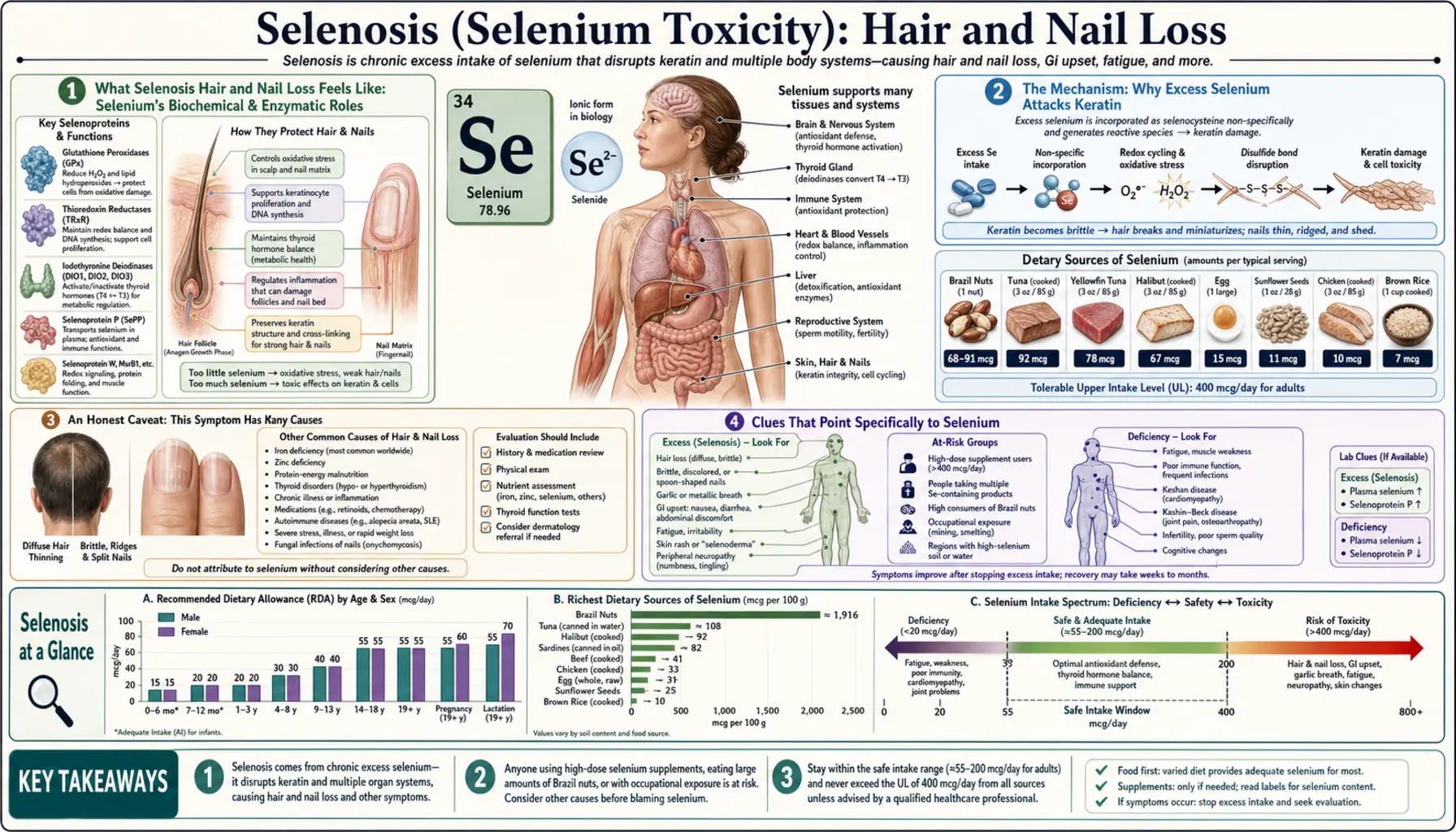
Selenium is an essential mineral, but the gap between “enough” and “too much” is narrow — a 2012 review describes a U-shaped link in which both low and high selenium status carry risks — and when intake climbs too high for too long, one of the most recognizable signs is hair that breaks off and sheds, and nails that turn brittle, ridged, and finally fall away. This state of selenium excess is called selenosis. The hair and nail changes can be alarming, but two honest points matter from the start. First, the same brittle hair and crumbling nails have many far more common causes — thyroid disease, iron deficiency, and ordinary stress shedding among them — so this symptom is not proof of selenium toxicity. Second, selenosis is genuinely uncommon: it is essentially a problem of over-supplementation or of living where the soil and water are unusually selenium-rich, not something an ordinary varied diet is known to produce. This page explains how the hair and nail changes feel, the mechanism behind them, the much more likely alternative explanations, the clues that point specifically to selenium, and how the situation is confirmed and reversed.
Table of Contents
- What Selenosis Hair and Nail Loss Feels Like
- The Mechanism: Why Excess Selenium Attacks Keratin
- An Honest Caveat: This Symptom Has Many Causes
- Clues That Point Specifically to Selenium
- Common Causes of Selenium Excess
- How Selenium Excess Is Assessed
- How Selenium Excess Is Corrected
- Red Flags: Situations Treated as Urgent
- Key Research Papers
- Connections
- Featured Videos
What Selenosis Hair and Nail Loss Feels Like
Of all the signs of selenium excess, the changes in hair and nails are the most distinctive. The US Institute of Medicine’s 2000 review names hair and nail brittleness and loss as the most frequently reported features of chronic selenosis, and in the endemic outbreak recognized in Enshi County, China, in 1961, loss of hair and nails was the most common sign. With chronic excess the changes tend to come on gradually; in a 2008 US outbreak involving a grossly over-strength supplement, symptoms began within two weeks of starting the product. They often arrive alongside a metallic or garlic-like odor on the breath that is another classic clue.
The hair changes typically unfold like this:
- Brittleness. The hair becomes dry and fragile, snapping off easily rather than growing to its usual length. Many people notice it as short, broken hairs and increased breakage when combing or washing.
- Shedding. As the excess continues, hair sheds more than normal — on the pillow, in the shower drain, in the brush — and the scalp hair visibly thins.
- How common it was in one outbreak. In the 2008 US outbreak, hair loss was reported by 72% of the 201 people affected, and 29% still had hair loss 90 days or more later.
The nail changes are just as telling, and often run in parallel:
- Discoloration. In the 2008 outbreak, nail discoloration or brittleness was reported by 61% of those affected.
- Brittleness and splitting. The nail plate weakens, splits at the free edge, and breaks easily.
- Shedding of the nail. In the more advanced picture, the nail loosens from its bed and may fall off entirely (a process called onychomadesis), with a new nail slowly pushing through behind it. In the 2008 outbreak, fingernail discoloration and loss was still present 90 days or more later in 52% of people. In the Chinese studies of endemic selenosis, finger-nail signs were the first symptoms used to diagnose the condition.
Crucially, this is diffuse hair and nail change — it affects hair across the scalp and multiple nails at once, rather than a single bald patch or one damaged fingernail. That widespread, “everything at once” pattern, especially when it tracks with recent heavy supplement use or a garlic odor, is what raises the possibility of selenosis. On its own, though, brittle hair and crumbling nails are common and could mean any number of things — which is the subject of a later section.
The Mechanism: Why Excess Selenium Attacks Keratin
To understand why too much selenium damages hair and nails, it helps to know what hair and nails are actually made of. Both are built almost entirely from keratin, a tough structural protein. What gives keratin its strength is a dense web of internal cross-links called disulfide bonds — chemical bridges that form between sulfur atoms on the amino acid cysteine. Think of a strand of keratin as a rope whose individual fibers are stitched together at thousands of points; those sulfur-to-sulfur stitches are what keep the rope from fraying. The body builds these stitches using sulfur. The exact way excess selenium damages them has not been fully worked out; two explanations are described.
Selenium sits directly below sulfur on the periodic table and behaves chemically much like it. The Institute of Medicine notes that selenomethionine, the main food form, is incorporated randomly into body proteins in place of the sulfur amino acid methionine. A commonly proposed explanation, not directly demonstrated in human hair, is that excess selenium likewise ends up where sulfur belongs in keratin, forming selenium-containing analogues of the cysteine cross-links (selenotrisulfides and related species). On this view, the substitute bridges are less stable than sulfur bridges, so the keratin is built with faulty stitching and the hair and nails come out structurally weak — brittle, prone to breaking, and apt to shed.
An analogy for that explanation. Imagine a knitter who normally joins each row with strong wool thread but, having run low, starts using a cheaper thread that looks almost identical and slips into the same needle just as easily. The sweater still comes off the needles looking finished. But the substitute thread frays and snaps under the slightest pull, so the garment unravels at the seams. Selenium is that look-alike thread: it slots into keratin where sulfur should go, and the finished hair and nails simply come apart at the joins.
There is a second strand to the mechanism. Selenium in modest amounts is a powerful antioxidant — it is the active center of glutathione peroxidase and other selenoproteins that protect cells from oxidative damage (see Selenium and Antioxidant Defense). But in excess, selenium can act as a pro-oxidant: a 2020 review describes how, at high doses, selenomethionine is metabolized to selenols that redox-cycle, generate superoxide radicals and react with thiols (sulfur groups). Hair follicles and nail beds are rapidly dividing tissues, and one interpretation is that this makes them especially vulnerable when the redox balance tips.
Both proposed mechanisms point the same way: too much selenium, by impersonating sulfur and by turning oxidative, undermines the keratin that hair and nails are made of, and the visible consequence is breakage, shedding, and loss.
An Honest Caveat: This Symptom Has Many Causes
Brittle hair, hair shedding, and weak or ridged nails are extremely common, and in the vast majority of people they have nothing to do with selenium. Selenium excess is, in fact, an uncommon cause. Explanations that are far more common include:
- Thyroid disease. Both an underactive and an overactive thyroid classically cause hair thinning and brittle nails. It is checked with standard blood tests. (Selenium and the thyroid are closely linked — see Selenium and Thyroid Function, hypothyroidism, and Hashimoto's thyroiditis.)
- Iron deficiency. Low iron, with or without anemia, has been studied as a cause of hair shedding, mostly in women; a 2006 review found that some studies link iron deficiency to diffuse hair loss and telogen effluvium while others do not. (See Iron.)
- Telogen effluvium — stress shedding. A physical or emotional shock — childbirth, major illness, surgery, a crash diet, high fever, or severe stress — commonly triggers a wave of diffuse shedding after a delay of weeks to months. It is alarming but usually self-correcting.
- Other nutritional gaps. Inadequate protein, zinc, or biotin can weaken hair and nails. (Notably, this is a problem of too little, the opposite of selenosis.)
- Pattern hair loss. Androgenetic (male- or female-pattern) hair loss is a very common cause of thinning, though its pattern usually differs from the diffuse shedding of selenosis.
- Medications and treatments. Chemotherapy, retinoids (high-dose vitamin A relatives), some antithyroid and anticoagulant drugs, and others can cause hair loss and nail changes.
- Local nail problems. Brittle, crumbling nails are very often due to fungal infection, repeated wetting, harsh manicure chemicals, or simple trauma — affecting one or a few nails rather than all of them.
The bottom line: damaged hair and nails on their own do not establish selenium toxicity. These changes have many causes, and selenium is only one of them — and a relatively rare one. The next section describes the circumstances in which selenium becomes a more likely explanation.
Clues That Point Specifically to Selenium
Selenium rises up the list of suspects only when certain features line up. Any one of these on its own is weak; together they make a far stronger case:
- A high-dose selenium supplement. This is the single most important clue. The US tolerable upper intake level (UL) for adults is 400 micrograms per day, set by the Institute of Medicine in 2000 with hair and nail brittleness and loss as the critical endpoint. Selenium from several products taken together adds up. A product containing far more selenium than its label states is a documented cause too.
- The garlic or metallic breath odor. Attributed to dimethyl selenide and other methylated selenium compounds breathed out when intake is high, a persistent garlic-like smell on the breath and skin is one of the most characteristic accompaniments of selenosis and, paired with hair and nail loss, is a strong pointer.
- The cluster of other selenosis features. Selenium excess tends to produce a recognizable group of problems together: hair and nail changes, the breath odor, skin rashes or lesions, gastrointestinal upset (nausea, diarrhea), fatigue and irritability, and in more serious or prolonged cases neurological symptoms such as numbness or tremor. A constellation is more convincing than a single sign.
- A high-selenium environment. In parts of central China (Enshi County, Hubei Province), selenium-rich soil has delivered toxic amounts through locally grown food, and endemic selenosis there was defined largely by loss of hair and nails. Seleniferous areas also exist in the western United States (for example western South Dakota and eastern Wyoming) and the Venezuelan Andes; the Institute of Medicine’s 2000 review found no recognized cases of human selenosis in any US or Canadian seleniferous area.
- The timing fits. The changes began weeks to months after starting a new supplement or increasing a dose, and they affect hair and nails diffusely rather than in one spot.
If none of these apply — no high-dose supplement, no unusual breath odor, no high-selenium locale — selenium is an unlikely explanation, and the common causes above are more likely. Where several do apply, selenium testing (next section) can help clarify the picture.
Common Causes of Selenium Excess
Selenium toxicity essentially never comes from eating an ordinary, varied diet. It arises in a small number of specific situations:
- Over-supplementation. The main documented route in North America, where no recognized cases have come from seleniferous soils. People take selenium for thyroid health, immunity, or cancer prevention, sometimes combining several products that each contain it. In the large SELECT trial (35,533 men), 200 mcg/day of selenium did not prevent prostate cancer; a secondary analysis of an earlier US trial found more type 2 diabetes with 200 mcg/day than with placebo (hazard ratio 1.55). The 400 mcg/day UL is a safety limit rather than a toxicity threshold: the Institute of Medicine took a no-observed-adverse-effect level of 800 mcg/day from the Enshi follow-up studies, where the lowest intake linked to persistent nail signs was about 913 mcg/day, and divided it by an uncertainty factor of 2.
- Mislabeled or defective products. A 2008 US outbreak investigated by the CDC was traced to a liquid dietary supplement that contained 200 times its labeled concentration of selenium. Investigators identified 201 cases in 10 states; the median estimated intake was 41,749 mcg/day, and the most frequent symptoms were diarrhea (78%), fatigue (75%), hair loss (72%), joint pain (70%) and nail discoloration or brittleness (61%). The authors concluded that manufacturing standards like those used in the pharmaceutical industry might have prevented it.
- Very high-selenium foods eaten to excess. Brazil nuts naturally contain very high concentrations of selenium, but the amount varies enormously: in 162 nuts analyzed from each of two Brazilian regions, the averages were 3.06 and 36.0 ppm, and individual nuts ranged from 0.03 to 512 ppm. In a New Zealand trial, two nuts a day expected to supply about 100 mcg actually averaged 53 mcg (range 20–84 mcg). Organ meats and seafood are also selenium-rich. The concern described in the research is sustained excess.
- A naturally high-selenium environment (geological). In seleniferous regions, the mineral concentrates in soil, water, and locally grown crops and grains, so everyday food carries far more selenium than usual. This is the setting of endemic selenosis. In Enshi County, China, during the peak years 1961–1964, almost 50% of the 248 inhabitants of the five most affected villages were affected; estimated daily intakes averaged 4.99 mg (range 3.20–6.69 mg), and the selenium came from a high-selenium coal that weathered into the soil.
- Industrial and occupational exposure. Selenium is used in making ceramics, glass, photoelectric cells, pigments, semiconductors and steel, and workers in these industries can be exposed to selenium compounds; acute industrial overexposure is a different, more severe scenario than dietary selenosis.
The route matters because the remedy differs: in supplement cases, intake falls when the product is stopped; for an environmental source, the change involves the water or food supply, which is a public-health undertaking.
How Selenium Excess Is Assessed
Assessment usually starts with a careful history: which supplements and multivitamins are taken and at what doses, whether Brazil nuts or organ meats are eaten regularly, whether the breath has taken on a garlic-like odor, and whether the person lives in or has moved from a high-selenium area.
Several laboratory measurements are available, each reflecting a different time window:
- Blood (serum or plasma) selenium reflects recent and ongoing intake. In the 2008 outbreak, the laboratory reference range for serum selenium was 125 micrograms per liter or less, and the mean initial level in 8 patients was 751 micrograms per liter. The Institute of Medicine notes that plasma levels above the range where selenoproteins plateau depend heavily on the chemical form of selenium eaten.
- Whole-blood selenium reflects intake over a somewhat longer period than serum.
- Hair and nail selenium. Hair and nail selenium correlate with intake in some studies, but the Institute of Medicine judged them of limited use outside well-controlled studies: deposition depends on the form of selenium, dietary methionine and hair color, and some shampoos contain selenium.
- Urinary selenium reflects recent intake; the Institute of Medicine considers it an index of toxicity only under carefully controlled conditions. In the 2008 outbreak, the mean initial urine selenium in 7 patients was 166 micrograms per 24 hours, against a reference range of 55 or less.
It is worth knowing that selenium is not part of a routine blood panel — a Comprehensive Metabolic Panel does not include it, so it must be requested specifically. Because the hair and nail changes have so many other causes, work-ups commonly check thyroid function and iron studies in parallel, so that a normal selenium result points toward those causes instead. A dermatologist may examine the scalp and nails directly (see Dermatology) to characterize the pattern of loss.
How Selenium Excess Is Corrected
The reassuring news is that chronic dietary or supplement-related selenosis is usually reversible, and the treatment is often simple. The cornerstone is removing the source:
- Removing the source. Stopping the selenium-containing supplement or supplements is the central step described in case reports and outbreak follow-ups. Reducing Brazil nuts and other very high-selenium foods, or addressing a high-selenium water supply, applies when those are the source. In over-supplementation cases, the body clears the excess once intake falls.
- Recovery of hair and nails. Because hair and nails grow slowly, the visible recovery lags behind the chemistry: a damaged nail has to grow out completely before it looks normal again. In the 2008 outbreak, fingernail discoloration and loss persisted 90 days or more in 52% of people and hair loss in 29%. In the Chinese follow-up of five people with persistent nail signs, the signs had disappeared when they were re-examined in 1992, by which time their average blood selenium had fallen from 1,346 to 968 micrograms per liter.
- Supportive care. Any accompanying problems — gastrointestinal upset, skin lesions, neurological symptoms — are managed on their own merits while the body offloads the surplus.
- Severe or acute poisoning is different. A large, acute selenium overdose (for example, a massive accidental ingestion or serious industrial exposure) is a medical emergency managed in hospital with intensive supportive care; a toxicology review describes acute ingestion of selenious acid as almost invariably fatal, preceded by stupor, low blood pressure and respiratory depression. There is no simple, well-established antidote for selenium; treatment centers on stopping exposure and supporting the body. This is far removed from the gradual, recoverable hair-and-nail selenosis of everyday over-supplementation.
The broader finding is that, for selenium, more is not better. Selenium is essential, but a 2012 review concludes that additional selenium may benefit people with low status while those with adequate-to-high status might be affected adversely, and selenium from several supplements adds together toward the 400 mcg/day UL. Food sources are covered in the food sources of selenium page and the selenium overview.
Red Flags: Situations Treated as Urgent
Most selenosis from supplements unfolds slowly and is not an emergency — but certain situations are treated as urgent:
- A large accidental or intentional overdose — for instance, swallowing a great many selenium tablets, or a young child getting into a supplement bottle. This is treated as an emergency, even before symptoms appear; poison control centers and emergency services handle such exposures.
- Difficulty breathing, low blood pressure, or drowsiness and stupor — features described in serious acute selenium poisoning, which is managed as an emergency.
- New numbness, tingling, weakness, tremor, or trouble with balance or thinking — possible neurological effects; the Institute of Medicine lists nervous-system abnormalities among the reported signs of selenosis.
- Hair loss or nail changes plus a garlic-like breath odor in someone taking high-dose selenium — not an emergency, but the combination that points most clearly toward selenosis; confirming the cause and ruling out the common alternatives is a clinician’s task.
- Hair shedding or nail problems without any selenium link — the likely causes (thyroid disease, iron deficiency, stress shedding, and others) are common and treatable. Excess selenium is itself a documented cause of hair loss.
Poison control centers give immediate advice on possible overdoses. Decisions about supplements belong with a clinician.
Key Research Papers
- MacFarquhar JK, Broussard DL, Melstrom P, et al. (2010). Acute Selenium Toxicity Associated With a Dietary Supplement. Archives of Internal Medicine;170(3):256-261. — DOI: 10.1001/archinternmed.2009.495. — doi:10.1001/archinternmed.2009.495
- Rayman MP (2012). Selenium and human health. The Lancet;379(9822):1256-1268. — DOI: 10.1016/S0140-6736(11)61452-9. — doi:10.1016/S0140-6736(11)61452-9
- Vinceti M, Filippini T, Wise LA (2018). Environmental Selenium and Human Health: an Update. Current Environmental Health Reports;5(4):464-485. — DOI: 10.1007/s40572-018-0213-0. — doi:10.1007/s40572-018-0213-0
- Vinceti M, Maraldi T, Bergomi M, Malagoli C (2009). Risk of Chronic Low-Dose Selenium Overexposure in Humans: Insights From Epidemiology and Biochemistry. Reviews on Environmental Health;24(3):231-248. — DOI: 10.1515/reveh.2009.24.3.231. — doi:10.1515/reveh.2009.24.3.231
- Fordyce FM (2013). Selenium Deficiency and Toxicity in the Environment. In Essentials of Medical Geology;375-416. — DOI: 10.1007/978-94-007-4375-5_16. — doi:10.1007/978-94-007-4375-5_16
- Combs GF Jr (2015). Biomarkers of Selenium Status. Nutrients;7(4):2209-2236. — DOI: 10.3390/nu7042209. — doi:10.3390/nu7042209
- Rayman MP (2020). Selenium intake, status, and health: a complex relationship. Hormones;19(1):9-14. — DOI: 10.1007/s42000-019-00125-5. — doi:10.1007/s42000-019-00125-5
- Huang Z, Rose AH, Hoffmann PR (2012). The Role of Selenium in Inflammation and Immunity: From Molecular Mechanisms to Therapeutic Opportunities. Antioxidants & Redox Signaling;16(7):705-743. — DOI: 10.1089/ars.2011.4145. — doi:10.1089/ars.2011.4145
- National Institutes of Health, Office of Dietary Supplements (2024). Selenium — Health Professional Fact Sheet (toxicity, upper intake level, and adverse effects). — NIH ODS Fact Sheet
- Yang G, Zhou R (1994). Further observations on the human maximum safe dietary selenium intake in a seleniferous area of China. Journal of Trace Elements and Electrolytes in Health and Disease;8(3-4):159-165. — PubMed PMID: 7599506
- Yang GQ, Wang SZ, Zhou RH, Sun SZ (1983). Endemic selenium intoxication of humans in China. American Journal of Clinical Nutrition;37(5):872-881. — PubMed PMID: 6846228
- Institute of Medicine (2000). Dietary Reference Intakes for Vitamin C, Vitamin E, Selenium, and Carotenoids, chapter 7: Selenium. Washington, DC: National Academies Press. — doi:10.17226/9810
- Barceloux DG (1999). Selenium. Journal of Toxicology: Clinical Toxicology;37(2):145-172. — PubMed PMID: 10382553
- Chang JC, Gutenmann WH, Reid CM, Lisk DJ (1995). Selenium content of Brazil nuts from two geographic locations in Brazil. Chemosphere;30(4):801-802. — PubMed PMID: 7889353
- Thomson CD, Chisholm A, McLachlan SK, Campbell JM (2008). Brazil nuts: an effective way to improve selenium status. American Journal of Clinical Nutrition;87(2):379-384. — PubMed PMID: 18258628
- Lippman SM, Klein EA, Goodman PJ, et al. (2009). Effect of selenium and vitamin E on risk of prostate cancer and other cancers: the Selenium and Vitamin E Cancer Prevention Trial (SELECT). JAMA;301(1):39-51. — PubMed PMID: 19066370
- Stranges S, Marshall JR, Natarajan R, et al. (2007). Effects of long-term selenium supplementation on the incidence of type 2 diabetes: a randomized trial. Annals of Internal Medicine;147(4):217-223. — PubMed PMID: 17620655
- Trost LB, Bergfeld WF, Calogeras E (2006). The diagnosis and treatment of iron deficiency and its potential relationship to hair loss. Journal of the American Academy of Dermatology;54(5):824-844. — PubMed PMID: 16635664
PubMed Topic Searches
Connections
- All Minerals
- Selenosis Symptom Hub
- Selenosis and Garlic Breath
- Selenosis and Stomach Upset
- Selenosis and Nerve Problems
- Selenium Deficiency Hub
- Selenium Overview
- Food Sources of Selenium
- Selenium and Antioxidant Defense
- Selenium and Thyroid Function
- Sulfur
- Zinc
- Iron
- Hair Loss
- Dermatology
- Hypothyroidism
- Hashimoto's Thyroiditis
- Comprehensive Metabolic Panel