⚠ Evidence warning: Clinical trials or other evidence do not support the claim that iron-deficiency anemia is often copper-deficiency anemia in disguise and that treating it with high-dose iron without attention to copper worsens long-term outcomes. This page keeps it as a report of what people, websites or other media say.
Molybdenum for Iron Utilization
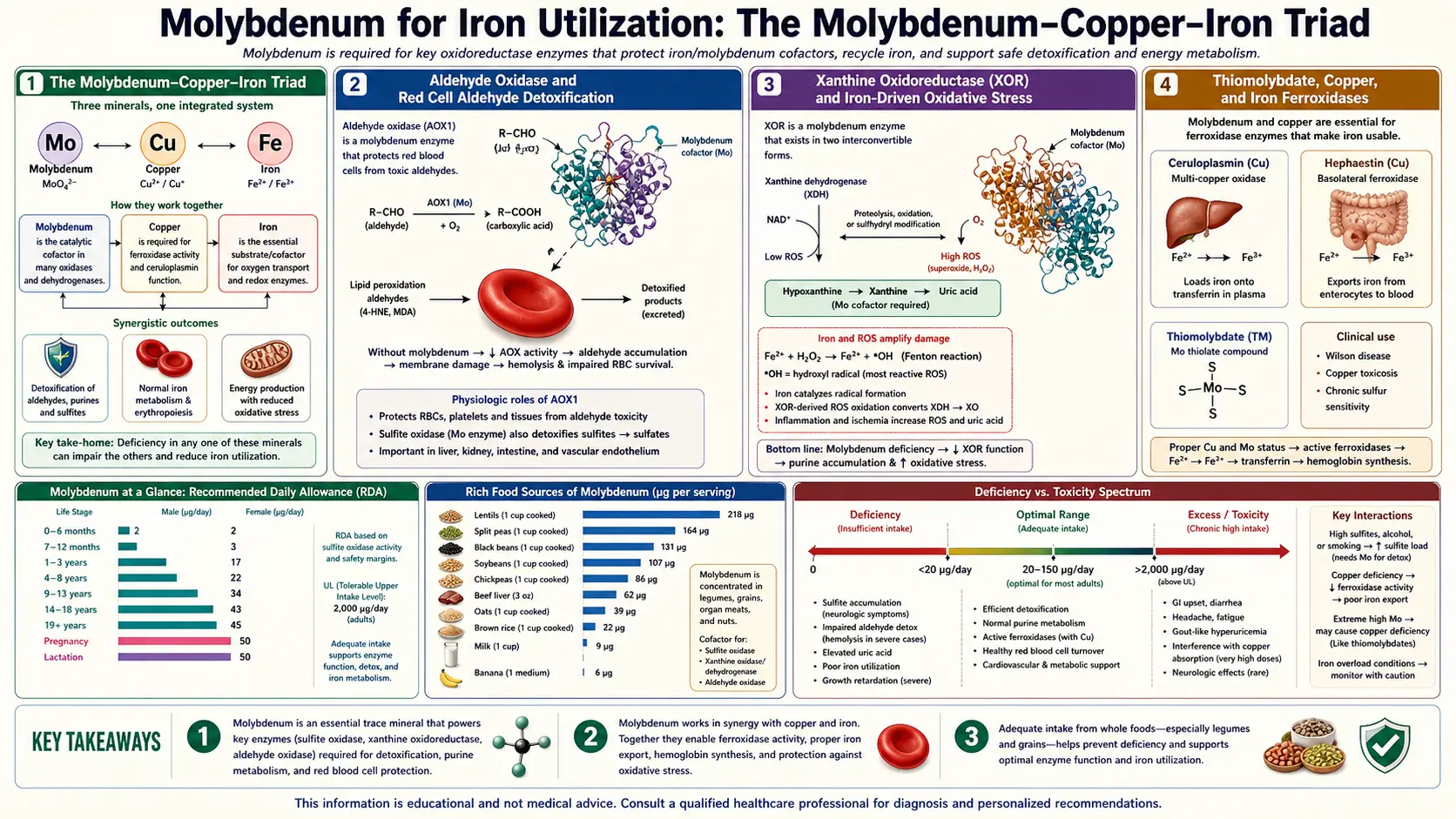
The relationship between molybdenum and iron metabolism is more intricate than the textbook accounts suggest. Molybdenum's direct role is through aldehyde oxidase, which oxidizes biogenic aldehydes that can otherwise damage red blood cells, and through xanthine oxidoreductase, which sits at a key crossroads of iron-dependent oxidative chemistry. But the larger story is the molybdenum-copper-iron triad — three trace minerals whose biological availability is mechanically linked: high molybdenum drives copper deficiency via thiomolybdate complex formation; copper deficiency in turn impairs iron utilization through ceruloplasmin and hephaestin (the copper-dependent ferroxidases that load iron onto transferrin); and the resulting "low-copper anemia" is frequently misdiagnosed. This deep-dive maps the molecular mechanisms, the single reported case of molybdenum deficiency on total parenteral nutrition (TPN), the diagnostic implications, and the cofactor biosynthesis defects (MoCoSulfurase deficiency) that disrupt the system.
Table of Contents
- The Molybdenum-Copper-Iron Triad
- Aldehyde Oxidase and Red Cell Aldehyde Detoxification
- Xanthine Oxidoreductase and Iron-Driven Oxidative Stress
- Thiomolybdate, Copper, and Iron Ferroxidases
- TPN-Driven Molybdenum Deficiency and Anemia
- MoCo Biosynthesis Defects (MOCS1/2/3, MOCOS, GPHN)
- Molybdenum Cofactor Sulfurase Deficiency
- Iron Overload, Copper, and the Molybdenum Question
- Diagnostic Implications — Situations Where Molybdenum Comes Up
- Supplementation: Balancing the Three Minerals
- Key Research Papers
- Connections
- Featured Videos
The Molybdenum-Copper-Iron Triad
Three transition metals — molybdenum (Mo), copper (Cu), and iron (Fe) — have biochemically intertwined fates. Each is required in trace amounts, each cycles between oxidation states to perform electron-transfer catalysis, and each can substitute for or block the others under specific conditions. The mechanical links that matter for iron utilization:
- Mo ↔ Cu antagonism — molybdate (MoO42−) in the presence of sulfide (HS−) forms thiomolybdate complexes (MoOS32−, MoS42−) that bind copper with very high affinity. High dietary molybdenum (especially with high sulfur) can therefore deplete the copper pool, producing functional copper deficiency even when copper intake is adequate. This effect is dramatically amplified in ruminant animals (where rumen sulfate-reducing bacteria generate abundant sulfide) and is the basis for "molybdenum toxicity" in cattle grazing on high-Mo pastures.
- Cu → Fe ferroxidase function — copper is the essential catalytic metal in ceruloplasmin (the plasma ferroxidase) and hephaestin (the membrane-bound enterocyte ferroxidase). These enzymes oxidize ferrous iron (Fe2+) to ferric iron (Fe3+), the form that transferrin binds and circulates. Without functional ferroxidase, iron cannot be loaded onto transferrin, cannot be transported to bone marrow erythroid precursors, and cannot be incorporated into hemoglobin — even when iron stores are adequate.
- Net effect — high molybdenum → depleted copper → impaired ferroxidase activity → iron "trapped" in stores but unavailable for erythropoiesis → "low-copper anemia" that may be microcytic, normocytic or macrocytic (small, normal-sized or large red cells), often with low neutrophils, with normal or even elevated serum ferritin (iron stores are adequate) and low serum copper / low ceruloplasmin (the actual rate-limiting deficiency).
The clinical signature of low-copper anemia: red blood cells that may be small (microcytic), normal-sized (normocytic) or large (macrocytic), often with concurrent neutropenia (copper is required for neutrophil maturation), normal or elevated ferritin, low serum iron, low transferrin saturation, low serum copper, low ceruloplasmin, sometimes high free Mo. Iron supplementation does not correct the anemia — in fact it may worsen it by saturating ferroxidase capacity. Copper supplementation rapidly corrects the anemia within weeks.
This is why molybdenum intake and copper status are linked, and why copper (and indirectly molybdenum) status is one of the questions raised when an anemia does not respond to iron ("iron-refractory anemia").
Copper deficiency often harms the spinal cord and nerves as well as the blood (myeloneuropathy). In a Mayo Clinic review of 40 patients with copper deficiency and blood abnormalities (Halfdanarson et al. 2008), anemia and low neutrophils (neutropenia) were the most common blood findings and most patients also had nerve findings, most commonly myeloneuropathy; 10 patients (25%) had had weight-loss (bariatric) surgery and another 14 (35%) other surgery on the stomach or bowel, most commonly gastric resection. A 2017 case report and review (Wazir and Ghobrial) notes that the blood problems respond promptly to copper replacement but the nerve problems do not, which is why the authors call early diagnosis essential for a good outcome.
Aldehyde Oxidase and Red Cell Aldehyde Detoxification
Aldehyde oxidase (AOX1) — one of the four molybdenum-dependent enzymes in humans — oxidizes a broad range of aldehydes, including biogenic aldehydes generated during normal cellular metabolism. Several of these AOX1 substrates are particularly relevant to red blood cell biology:
- Pyridoxal (vitamin B6 aldehyde) — AOX1 converts pyridoxal to pyridoxic acid. Pyridoxal-5-phosphate (PLP, the active B6 form) is essential for hemoglobin synthesis: the rate-limiting enzyme of heme synthesis, aminolevulinic acid synthase (ALA synthase), requires PLP as cofactor. Disturbance of B6 metabolism can therefore impair hemoglobin production — one of the rarer causes of sideroblastic anemia.
- Retinaldehyde — AOX1 contributes to converting retinaldehyde to retinoic acid, which is required for normal erythropoiesis through retinoic acid receptor signaling in the bone marrow erythroid niche. Vitamin A deficiency is a recognized cause of anemia that is often refractory to iron supplementation.
- 4-hydroxynonenal (4-HNE) and malondialdehyde (MDA) — lipid peroxidation products. Red blood cells, with their high membrane lipid content and oxygen exposure, generate these continuously. AOX1 in the liver clears the circulating pool; reduced AOX1 activity allows accumulation that can damage red cell membranes and shorten erythrocyte lifespan.
- Biogenic aldehydes from neurotransmitter and amine metabolism — including the aldehyde intermediates of dopamine, serotonin, and various dietary amines
The clinical signal of severe AOX1 dysfunction (combined molybdenum cofactor deficiency, MoCoSulfurase deficiency, or rare AOX1 polymorphisms) includes accumulation of aldehyde metabolites that can be measured in urine.
Humans also have a fourth molybdenum enzyme, the mitochondrial amidoxime-reducing component (mARC), identified in 2006 (Oskarsson and Kippler 2023). It reduces N-hydroxylated compounds; a 2011 review (Havemeyer et al.) describes a major role in drug metabolism, especially in activating so-called "amidoxime prodrugs" and in detoxifying N-hydroxylated foreign chemicals, though its normal role in the body is still largely unknown.
Xanthine Oxidoreductase and Iron-Driven Oxidative Stress
Xanthine oxidase (XO) and xanthine dehydrogenase (XDH) sit at a key intersection of iron-dependent oxidative chemistry. The XO form generates superoxide (O2−) and hydrogen peroxide (H2O2) as catalytic byproducts. In the presence of free iron, hydrogen peroxide drives the Fenton reaction:
H2O2 + Fe2+ → ·OH + OH− + Fe3+
Hydroxyl radical (·OH) is the most reactive species in biological chemistry, indiscriminately damaging lipids, proteins, and DNA. Fenton-driven oxidative damage is a central mechanism in:
- Iron-overload toxicity — in hereditary hemochromatosis, transfusion-dependent thalassemia, and other iron-overload states
- Ischemia-reperfusion injury — XO-derived H2O2 plus released iron from damaged ferritin creates a particularly toxic combination
- Atherosclerosis and vascular disease — vascular wall XO plus circulating iron contribute to low-density lipoprotein (LDL) oxidation
The therapeutic implication is that xanthine oxidase inhibition (with allopurinol or febuxostat) reduces H2O2 generation and therefore reduces Fenton-driven damage in the presence of iron overload. Several small studies have explored allopurinol as adjunctive therapy in conditions where iron-driven oxidative damage matters (thalassemia, sickle cell disease, ischemia-reperfusion in cardiac surgery), with generally favorable but not definitive results.
The molybdenum implication: adequate molybdenum supports normal XO function; severe deficiency abolishes XO activity (and therefore both purine catabolism and H2O2 generation). The XDH form — the dominant physiological form — produces much less reactive oxygen species (ROS) than the XO form, so the net effect of normal molybdenum status is primarily metabolic rather than oxidative.
Thiomolybdate, Copper, and Iron Ferroxidases
The mechanism by which excess molybdenum impairs iron utilization runs through copper. In the gut and in plasma, molybdate ions can react with sulfide (HS−, generated by sulfate-reducing bacteria in the gut and by endogenous cysteine catabolism) to form thiomolybdates:
MoO42− + HS− → MoO3S2− + OH−
MoO42− + 2 HS− → MoO2S22− + 2 OH−
MoO42− + 3 HS− → MoOS32− + 3 OH−
MoO42− + 4 HS− → MoS42− (tetrathiomolybdate) + 4 OH−
The fully thio-substituted form, tetrathiomolybdate (TM), is the most potent copper chelator in the series and binds copper with picomolar affinity, forming a stable Mo-Cu-S cluster that the body cannot easily disassemble. The complex is then excreted via the bile.
This mechanism is therapeutically exploited as ammonium tetrathiomolybdate in Wilson disease, where it is used to remove tissue copper. The same mechanism is the basis for the agricultural problem of molybdenum-induced copper deficiency in ruminants grazing on high-Mo pastures.
The iron consequence:
- Ceruloplasmin requires 6 copper atoms per molecule for its ferroxidase activity. Copper depletion produces apo-ceruloplasmin (the copper-free form) which has no ferroxidase function. Plasma ferrous iron cannot be oxidized to ferric iron and therefore cannot bind transferrin.
- Hephaestin, the membrane-bound ferroxidase at the basolateral surface of enterocytes, is also copper-dependent. Without hephaestin, dietary iron absorbed through the apical divalent metal transporter 1 (DMT1) cannot exit the enterocyte through ferroportin in a usable form.
- The net effect is functional iron deficiency despite adequate iron intake and stores
This sequence — high Mo → thiomolybdate → Cu sequestration → ferroxidase failure → iron unavailability — explains why molybdenum status matters for iron utilization indirectly through copper.
TPN-Driven Molybdenum Deficiency and Anemia
Direct molybdenum deficiency in humans has been documented essentially only in patients on long-term total parenteral nutrition (TPN) without molybdenum supplementation. The landmark case is Abumrad et al. 1981 (Am J Clin Nutr): a 24-year-old patient with Crohn's disease on prolonged TPN developed:
- Tachycardia and tachypnea
- Mental status changes progressing to coma
- Visual scotomata
- Sulfite oxidase failure (high urinary sulfite, low urinary sulfate, low serum methionine due to methionine catabolism inhibition by sulfite accumulation)
- Xanthine oxidase failure (low serum and urinary uric acid, elevated urinary xanthine and hypoxanthine)
- Resolution within days of adding ammonium molybdate to the TPN formula
The case did not specifically emphasize iron-utilization anemia (the patient's primary problem was the metabolic encephalopathy). A 2023 scoping review for the Nordic Nutrition Recommendations (Oskarsson and Kippler) describes this as the one reported case of a syndrome suggestive of molybdenum deficiency: a patient with Crohn's disease on total parenteral nutrition lacking molybdenum for 12 months, with irritability, fast heart rate (tachycardia), fast breathing (tachypnea) and night blindness, low plasma methionine, low serum uric acid, and low urinary sulfate, thiosulfate and uric acid; 300 mcg/day of ammonium molybdate improved the symptoms. The same review found no reports of clinical signs of molybdenum deficiency in otherwise healthy people.
Molybdenum is not routinely added to TPN. A 2018 review of trace elements in children's parenteral nutrition (Zemrani et al.) calls molybdenum provision controversial, notes that molybdenum is thought to reach patients as a contaminant of the solutions, and reports that the American Society for Parenteral and Enteral Nutrition (ASPEN) and the Australasian Society for Parenteral and Enteral Nutrition (AuSPEN) do not provide molybdenum supplementation, while the European Society of Pediatric Gastroenterology, Hepatology and Nutrition (ESPGHAN) and the European Society of Parenteral and Enteral Nutrition (ESPEN) give 1 mcg/kg/day to preterm infants and 0.25 mcg/kg/day to children on long-term parenteral nutrition. The authors report that their own unit had not encountered clinical molybdenum deficiency in 20 years despite no supplementation.
The 2018 review found no reports of molybdenum deficiency in children; deficiency has been described in one adult receiving long-term parenteral nutrition without supplementation.
MoCo Biosynthesis Defects (MOCS1/2/3, MOCOS, GPHN)
The biosynthesis of the molybdopterin cofactor (Moco) requires the coordinated function of multiple gene products:
- MOCS1 — converts guanosine triphosphate (GTP) to cyclic pyranopterin monophosphate (cPMP), the first committed step
- MOCS2 — converts cPMP to molybdopterin
- MOCS3 — provides sulfur transfer for the molybdopterin synthesis
- GPHN (gephyrin) — inserts molybdenum into the molybdopterin scaffold
- MOCOS (molybdenum cofactor sulfurase) — performs the terminal sulfuration step required for xanthine oxidase and aldehyde oxidase function specifically (sulfite oxidase is preserved)
Mutations in MOCS1, MOCS2, MOCS3, or GPHN produce molybdenum cofactor deficiency (MoCD), with simultaneous failure of all four molybdoenzymes. The clinical presentation is dominated by sulfite toxicity (see the Sulfite Metabolism page for full details), but the concurrent loss of xanthine and aldehyde oxidase activity has documented effects on iron metabolism:
- Accumulation of aldehyde substrates that can damage red blood cell membranes
- Loss of pyridoxal → pyridoxic acid oxidation, potentially affecting B6 status and hemoglobin synthesis
- Accumulation of xanthine, which can substitute partially for hypoxanthine in salvage reactions but accumulates in tissues and can precipitate as crystals in kidneys
MOCS1 deficiency (MoCD type A) is the one form for which a replacement therapy exists: fosdenopterin (cPMP) — a synthetic version of the MOCS1 product — was U.S. Food and Drug Administration-approved in February 2021. Daily intravenous infusion initiated within days of birth restores cofactor biosynthesis and rescues the molybdenum-dependent enzyme activities. Treatment is lifelong.
Molybdenum Cofactor Sulfurase Deficiency
A particularly interesting variant is molybdenum cofactor sulfurase (MOCOS) deficiency, also known as xanthinuria type II. The MOCOS enzyme performs the final sulfuration step that activates xanthine oxidase and aldehyde oxidase (but not sulfite oxidase, which uses a separate sulfuration mechanism via SUOX itself).
MOCOS-deficient patients therefore have:
- Absent xanthine oxidase activity (presenting as xanthinuria — very low uric acid, elevated urinary xanthine, risk of xanthine kidney stones)
- Absent aldehyde oxidase activity (impaired metabolism of AOX1 substrate drugs)
- Preserved sulfite oxidase activity (and therefore none of the catastrophic neurological features of MoCD or isolated sulfite oxidase deficiency (ISOD))
The clinical phenotype is generally mild — xanthine kidney stones, low serum uric acid, and clinically silent unless drug metabolism issues arise. Some patients are detected only incidentally on biochemistry showing low uric acid.
The relevance to iron utilization: MOCOS deficiency affects the AOX1-mediated aldehyde clearance pathway discussed above. Whether this contributes to anemia or impaired iron utilization in MOCOS-deficient patients is poorly characterized in the literature — the cohort is small and clinical reports focus on the more prominent xanthinuria features.
Iron Overload, Copper, and the Molybdenum Question
The reverse problem — iron overload — also matters, particularly among men, postmenopausal women, and those with hereditary hemochromatosis (HFE C282Y/H63D variants). In the Hemochromatosis and Iron Overload Screening (HEIRS) study of 99,711 people recruited in primary care (Adams et al. 2005), two copies of the C282Y variant were found in 0.44% of non-Hispanic white participants, while in the US National Health and Nutrition Examination Survey (NHANES) iron deficiency (ferritin ≤15 ng/mL) in women of reproductive age rose from 11.6% to 17.4% between 1999–2000 and 2021–2023 (Pfeiffer et al. 2026). Iron overload drives Fenton-mediated oxidative damage, contributes to liver fibrosis, cardiomyopathy, diabetes, and hypogonadism, and is the focus of much clinical attention.
The molybdenum-copper-iron relationship in iron overload:
- Adequate ceruloplasmin (and therefore adequate copper) is essential for maintaining the ferric-bound transferrin pool. In aceruloplasminemia (genetic absence of ceruloplasmin), iron accumulates pathologically in tissues despite normal HFE genotype — an iron-loading anemia caused by inability to mobilize iron stores
- High-dose molybdenum supplementation that depletes copper could in principle worsen iron loading or impair iron mobilization in patients with subclinical ceruloplasmin insufficiency
- The tetrathiomolybdate / Wilson disease parallel is instructive: TM is used to chelate copper in Wilson disease (where copper overload is the problem); the same chemistry inadvertently happens in livestock with high Mo and high S intake, producing copper-deficient cattle
For people with iron overload (hereditary hemochromatosis, thalassemia, transfusion-dependent anemias), the concern this mechanism raises is the copper-depleting effect of high-dose molybdenum supplements. The adult US Recommended Dietary Allowance (RDA) is 45 mcg/day and the US tolerable upper intake level is 2 mg/day (see the figures below).
Conversely, Morley Robbins's work on copper-iron dysregulation emphasizes that "iron-deficiency anemia" is often actually copper-deficiency anemia in disguise, and that treating with high-dose iron without addressing copper status can worsen long-term outcomes by driving iron accumulation in tissues without functional transport.
Diagnostic Implications — Situations Where Molybdenum Comes Up
Molybdenum enters the picture of iron-related problems in a few specific situations:
- Iron-refractory anemia — anemia that does not respond to iron supplementation. Low serum copper and low ceruloplasmin point to copper deficiency; when they are low, both a primary copper deficiency and the molybdenum-thiomolybdate-copper axis are possible explanations, and molybdenum-rich supplements are one question (a few "all in one" trace mineral products contain disproportionately high molybdenum that can sequester copper)
- Long-term TPN — the setting of the only reported human case of molybdenum deficiency; ASPEN does not provide molybdenum supplementation, while the European guidelines give children and preterm infants small per-kilogram amounts (see above). Prolonged parenteral nutrition is also a recognized risk factor for copper deficiency (Wazir and Ghobrial 2017)
- Inflammatory bowel disease with persistent anemia — persistent anemia here can involve several nutrients at once (iron, B12, folate, copper and ceruloplasmin), and molybdenum becomes a question mainly when supplements containing it are taken
- Bariatric surgery — gastric bypass and duodenal switch dramatically alter trace mineral absorption. Copper deficiency is recognized after bariatric surgery; molybdenum status is less well-studied
- Wilson disease patients on tetrathiomolybdate — the therapy deliberately lowers copper, the metal the ferroxidase enzymes depend on, so iron handling is a point of attention in these patients
- Cystic fibrosis patients — pancreatic insufficiency-driven fat-soluble vitamin malabsorption may be accompanied by trace mineral status disturbances
- Patients with unexplained xanthinuria — low uric acid (<1 mg/dL) without obvious cause is the pattern seen in xanthine oxidase deficiency (XDH variants) or MOCOS deficiency, both of which have implications for AOX1-substrate drug metabolism
Laboratory testing for molybdenum status is not routinely available in most clinical labs. Serum molybdenum measurement is possible at specialty labs but interpretation is difficult; urinary sulfite and xanthine measurement provides indirect evidence of molybdoenzyme activity; serum uric acid below 2 mg/dL without identifiable cause is a red flag for xanthine oxidase dysfunction.
Supplementation: Balancing the Three Minerals
The intake figures and findings that bear on the three minerals:
- Molybdenum — the adult Recommended Dietary Allowance is 45 mcg/day (50 mcg/day in pregnancy and breastfeeding); food sources include legumes, whole grains and nuts. Practitioners who use molybdenum for sulfite-metabolism or detoxification purposes describe doses of 75–500 mcg/day with attention to copper status
- Copper — the adult Recommended Dietary Allowance is 900 mcg/day; food sources include organ meats, shellfish, cocoa, sesame seeds and sunflower seeds, and low-dose supplements supply 1–2 mg/day. High-dose zinc supplementation taken at the same time can drive copper deficiency via metallothionein induction in enterocytes
- Iron — food sources include red meat, poultry, fish, beans and dark leafy greens (with vitamin C). Routine high-dose iron without a documented deficiency carries a risk of iron loading in postmenopausal women and men
- Zinc — relevant because of zinc-copper antagonism. Long-term high-dose zinc (>50 mg/day) without copper repletion is a recognized cause of copper deficiency and secondary anemia
- Vitamin C — supports non-heme iron absorption; also has uricosuric effect (mildly lowers serum uric acid)
- Vitamin A — required for normal erythropoiesis; deficiency contributes to anemia that may be refractory to iron alone
The official upper limits for molybdenum rest on animal data. The US Institute of Medicine set a tolerable upper intake level of 2 mg/day, and the former EU Scientific Committee on Food set 0.6 mg/day in 2000; both were based on reproductive toxicity in a 9-week rat study, an effect that more recent guideline studies in rats did not reproduce. Duplicate-diet studies in Finland and Denmark found usual intakes of 112 and 100 mcg/day (Oskarsson and Kippler 2023).
The scenario practitioners describe most often is a person on a multi-mineral supplement that contains disproportionately high molybdenum and low copper, who develops mild copper deficiency and "iron-refractory anemia" over months; they report that changing the mineral balance and rechecking after 8–12 weeks often resolves the problem.
Key Research Papers
- Abumrad NN et al. (1981). Amino acid intolerance during prolonged total parenteral nutrition reversed by molybdate therapy. American Journal of Clinical Nutrition. — PubMed PMID: 6795919
- Suttle NF (2010). Mineral Nutrition of Livestock (chapter on Cu-Mo-S interactions). CABI. — PubMed
- Brewer GJ et al. (2006). Treatment of Wilson disease with ammonium tetrathiomolybdate: IV. Comparison of tetrathiomolybdate and trientine in a double-blind study of treatment of the neurologic presentation of Wilson disease. Archives of Neurology. — PubMed PMID: 16606763
- Hellman NE, Gitlin JD (2002). Ceruloplasmin metabolism and function. Annual Review of Nutrition. — PubMed PMID: 12055353
- Halfdanarson TR et al. (2008). Hematological manifestations of copper deficiency: a retrospective review. European Journal of Haematology. — PubMed PMID: 18284630
- Williams DM (1983). Copper deficiency in humans. Seminars in Hematology. — PubMed PMID: 6410510
- Anderson GJ, Frazer DM (2017). Current understanding of iron homeostasis. American Journal of Clinical Nutrition. — PubMed PMID: 29070551
- Schwarz G, Mendel RR (2006). Molybdenum cofactor biosynthesis and molybdenum enzymes. Annual Review of Plant Biology. — PubMed PMID: 16669776
- Ichida K et al. (2001). Mutation of human molybdenum cofactor sulfurase gene is responsible for classical xanthinuria type II. Biochemical and Biophysical Research Communications. — PubMed PMID: 11302742
- Vyoral D, Petrak J (2017). Therapeutic potential of hepcidin — the master regulator of iron metabolism. Pharmacological Research. — PubMed PMID: 27867027
- Mills KC, Curry SC (1994). Acute iron poisoning. Emergency Medicine Clinics of North America. — PubMed PMID: 8187690
- Pietrangelo A (2010). Hereditary hemochromatosis: pathogenesis, diagnosis, and treatment. Gastroenterology. — PubMed PMID: 20542038
- Zemrani B, McCallum Z, Bines JE (2018). Trace Element Provision in Parenteral Nutrition in Children: One Size Does Not Fit All. Nutrients. — PubMed PMID: 30469420
- Oskarsson A, Kippler M (2023). Molybdenum - a scoping review for Nordic Nutrition Recommendations 2023. Food & Nutrition Research. — PubMed PMID: 38187804
- Havemeyer A, Lang J, Clement B (2011). The fourth mammalian molybdenum enzyme mARC: current state of research. Drug Metabolism Reviews. — PubMed PMID: 21942410
- Wazir SM, Ghobrial I (2017). Copper deficiency, a new triad: anemia, leucopenia, and myeloneuropathy. Journal of Community Hospital Internal Medicine Perspectives. — PubMed PMID: 29046759
- Adams PC et al. (2005). Hemochromatosis and iron-overload screening in a racially diverse population. New England Journal of Medicine. — PubMed PMID: 15858186
- Pfeiffer CM et al. (2026). The Prevalence of Nutritional Imbalances in the US Population Over Time: Biomarker Data from the Cross-Sectional National Health and Nutrition Examination Survey (NHANES 1999-2000 through August 2021-August 2023). Current Developments in Nutrition. — PubMed PMID: 42163863
PubMed Topic Searches
Connections
- All Minerals
- Molybdenum Benefits Hub
- Molybdenum Overview
- Molybdenum for Detoxification
- Molybdenum for Sulfite Metabolism
- Molybdenum for Uric Acid
- Copper
- Zinc
- Sulfur
- Copper-Iron Dysregulation
- Whole-Food Copper Sources
- Anemia
- Vitamin C (Iron Absorption)
- Vitamin A (Erythropoiesis)
- Vitamin B6 (Hemoglobin Synthesis)
- Vitamin B12
- Liver Disease
- Organ Meats
- Deficiency
- Toxicity
- History