Copper Deficiency: Hair and Skin Pigment
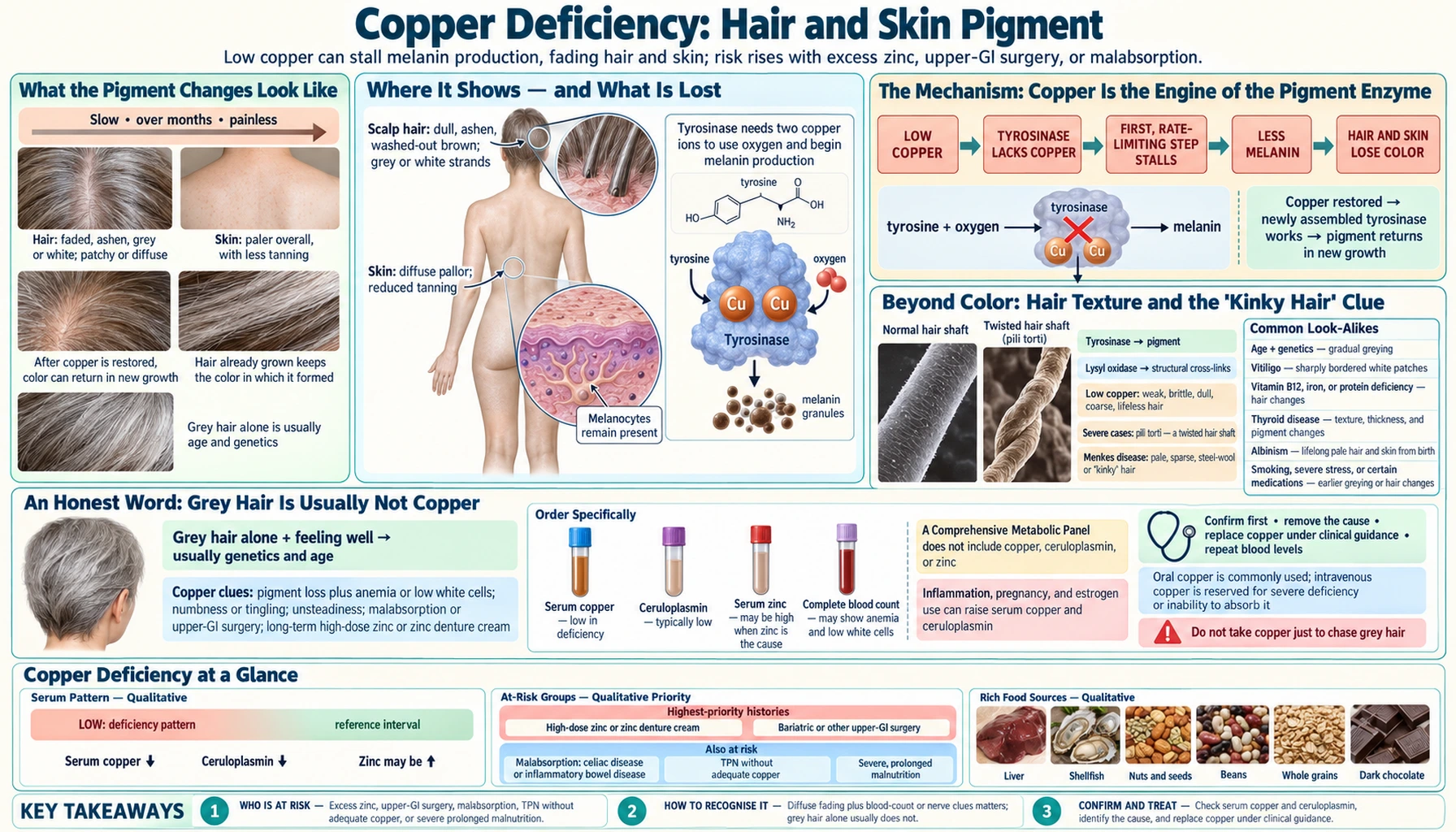
One of the less frequent but more visible signs of copper deficiency shows up in the mirror: hair that loses its color, and sometimes paler skin. Reviews list hypopigmentation of the hair among the less frequent manifestations of acquired copper deficiency, behind anemia, low white-cell counts and bone changes. The reason is precise — the enzyme the body uses to make melanin, the brown-black pigment of hair and skin, is a copper enzyme. This page explains why low copper can drain color from hair, why grey hair is far more often genetics and age than a copper problem, the clues that point toward copper, and how clinicians confirm and treat the deficiency. (Other effects of low copper — the blood, the nerves, and the bones — live on their own sibling pages.)
Table of Contents
- What the Pigment Changes Look Like
- The Mechanism: Copper Is the Engine of the Pigment Enzyme
- Beyond Color: Hair Texture and the “Kinky Hair” Clue
- An Honest Word: Grey Hair Is Usually Not Copper
- When Pigment Loss Actually Points to Copper
- What Drives Copper Low Enough to Affect Pigment
- How Copper Deficiency Is Confirmed
- How Low Copper Is Treated in Reported Cases
- Red Flags Described in Clinical Reports
- Key Research Papers
- Connections
- Featured Videos
What the Pigment Changes Look Like
Unlike the deeper effects of copper deficiency, the pigment changes are something you can see. They tend to develop slowly, and they are painless — which is exactly why they are so easy to write off as ordinary aging. The classic picture has a few recognizable features:
- Loss of hair color (hypopigmentation). Dark hair fades toward a dull, ashen, or “washed-out” brown, or develops grey and white strands. Reviews list hair hypopigmentation as a less frequent sign of acquired copper deficiency (Olivares & Uauy 1996). Two small case-control studies found lower average serum copper in young people with premature greying than in matched controls — 66 patients under 20 and 66 controls in Iran (Fatemi Naieni et al. 2012), and 60 patients and 30 controls in Egypt (El-Sheikh et al. 2018). These studies show an association; they do not show that low copper caused the greying.
- Paler skin. The skin may look lighter overall. The effect described is diffuse rather than a sharply bordered white patch — and in copper deficiency, pallor can also come from the anemia that commonly accompanies it.
- Color can return when copper is restored. In one reported infant with Menkes disease, the white scalp hair contained eumelanin and pheomelanin at only half the levels of controls, and after two months of copper-histidinate injections the scalp hair changed to dark brown (Tomita et al. 1992). Systematic data on re-pigmentation in adults with acquired copper deficiency are lacking.
The single most important thing to understand at the outset is that these changes are non-specific — meaning many ordinary things cause the exact same appearance. Faded or greying hair is overwhelmingly a feature of genetics and getting older. Clinical reviews treat pigment loss as a copper clue mainly when it appears alongside the company copper deficiency usually keeps: unexplained anemia and low white-cell counts, numbness or unsteadiness from nerve damage, or a clear reason for poor copper absorption. This is covered below.
The Mechanism: Copper Is the Engine of the Pigment Enzyme
The color of hair, skin, and eyes comes from melanin, a pigment built by specialized cells called melanocytes. To make melanin, those cells run a small chemical assembly line that starts with the amino acid tyrosine and converts it, step by step, into the dark pigment. The very first — and rate-limiting — step of that line is performed by an enzyme called tyrosinase, described as the rate-limiting enzyme of melanin synthesis (Ando et al. 2007). And tyrosinase is a copper enzyme: it belongs to the coupled binuclear copper family, with a pair of copper ions at its active site that bind oxygen and drive the reaction (Kipouros & Solomon 2023; Setaluri 2008). Without copper loaded into it, tyrosinase is a tool with no cutting edge — present, but unable to do its job.
So the logic of copper-deficiency hypopigmentation is direct and short: no copper → tyrosinase can't function → melanin isn't made → hair and skin lose color. The melanocytes are still there and still willing; they simply can't complete the first step of pigment production. This is the proposed reason the change can reverse: supply copper again, newly assembled tyrosinase loads its copper, the assembly line restarts, and freshly grown hair comes in with its color restored.
An analogy. Picture a paint factory where tyrosinase is the mixing machine that turns raw ingredients into colored paint. Copper is the cutting blade inside that machine. Take the blade out and nothing else changes — the factory still stands, the raw tyrosine still arrives on the conveyor, the workers (melanocytes) still show up — but the machine can no longer process the batch, so no paint comes out and everything downstream goes colorless. Slot the blade back in and the paint flows again. Copper is that blade for the pigment machine.
This is the same copper-and-tyrosinase chemistry that explains the dramatic depigmentation in the inherited copper-transport disorder Menkes disease, where a faulty copper transporter (ATP7A) fails to deliver copper to the secreted copper enzymes; the peculiar “kinky” hair is one of its main manifestations, and white hair with reduced melanin has been documented (Tümer & Møller 2010; Kaler 2011; Tomita et al. 1992). Acquired copper deficiency in adults is usually a milder, treatable echo of the same underlying problem — the enzyme is starved of its copper rather than permanently cut off from it.
Beyond Color: Hair Texture and the “Kinky Hair” Clue
Copper does a second job in hair that is worth knowing, because together with the color change it can make the picture more recognizable. A different copper enzyme, lysyl oxidase, is a copper-dependent enzyme that cross-links collagen and elastin, the structural proteins of skin, blood vessels and other connective tissue (Zhang et al. 2025). In Menkes disease, where copper cannot reach the secreted copper enzymes, connective-tissue disturbances appear together with the peculiar “kinky” hair (Tümer & Møller 2010). Under the microscope that hair is twisted along its shaft, a finding called pili torti (“twisted hair”), documented together with white hair in the infant described by Tomita et al. (1992). Hair texture changes in milder acquired deficiency in adults are not well characterized in the sources cited here.
In short: copper shortage can affect the color of hair through tyrosinase and, at least in Menkes disease, its structure as well; lysyl oxidase is the copper enzyme behind the connective-tissue side of the picture. The bone, ligament, and blood-vessel side of that same lysyl-oxidase story is covered on the sibling page on bone and connective tissue.
An Honest Word: Grey Hair Is Usually Not Copper
It would be misleading to read this page and conclude that grey or thinning hair means you are low in copper. In the overwhelming majority of people, faded and greying hair has nothing to do with copper at all. A 2020 systematic review of premature greying graded only a few treatments, at low grade (calcium pantothenate and PABA), and copper was not among them (Mahendiratta et al. 2020); excess copper also carries its own toxicity (see the cautions below). Here are the far more common explanations for the same appearance:
- Genetics and age — by far the leading cause. Greying with age is normal, and its timing runs in families. Bhat et al. (2013) describe premature greying as occurring more commonly without any underlying pathology and as reportedly inherited in an autosomal dominant pattern.
- Vitiligo. An autoimmune condition in which the body destroys melanocytes, producing sharply bordered white patches of skin (and sometimes white hair within them). This is a distinct disease, not a copper deficiency.
- Other nutritional factors. A 2020 systematic review found low vitamin B12, folic acid and biotin, and low serum calcium and ferritin associated with premature greying (Mahendiratta et al. 2020); malnutrition can also change hair color (Goldberg & Lenzy 2010), and a review of hair loss covers several micronutrients beyond copper (Almohanna et al. 2019).
- Thyroid disease. Thyroid disorders are among the conditions associated with premature greying (Mahendiratta et al. 2020).
- Smoking and certain medications are associated with earlier greying; a systematic review found premature greying more prevalent in smokers than non-smokers (Babadjouni et al. 2021; Mahendiratta et al. 2020).
- Albinism and other inherited pigment conditions cause lifelong pale hair and skin from birth — a different mechanism entirely.
The honest bottom line: pigment loss is a real but uncommon sign of copper deficiency, and it is almost never the only sign. In a person who is greying and otherwise well, genetics and age are the far more likely explanation than copper. Pigment changes become medically interesting only in the specific context described next.
When Pigment Loss Actually Points to Copper
Clinicians take hair or skin depigmentation seriously as a copper sign when it does not stand alone — when it travels with the other, more reliable features of copper deficiency. The combination, not the pigment change by itself, is the clue. Suspicion rises when faded hair or pale skin appears together with any of these:
- Unexplained blood-count abnormalities — anemia and a low white-cell (especially neutrophil) count that no one can otherwise explain. Reviews describe anemia and neutropenia as the most constant manifestations of acquired copper deficiency, detailed on the anemia and low white cells page (Olivares & Uauy 1996; Halfdanarson et al. 2008).
- Neurological symptoms — numbness or tingling in the feet, unsteadiness in the dark, or a gradually worsening difficulty walking, the picture of copper-deficiency myelopathy described on the nerve damage and balance page (Kumar 2006).
- A clear reason for copper malabsorption — especially previous bariatric (weight-loss) or other upper-gastrointestinal surgery, or long-term high-dose zinc intake (zinc supplements or heavy, chronic use of certain zinc-containing denture creams), both of which are documented routes to copper deficiency (Halfdanarson et al. 2008; Kumar 2006; Nations et al. 2008).
Pigment loss plus any of these is a meaningfully different situation from grey hair alone. In that setting, clinical reviews describe measuring copper (Moon et al. 2021). Pigment loss with a completely normal blood count, no neurological symptoms, and no malabsorption risk is much less likely to reflect copper deficiency.
What Drives Copper Low Enough to Affect Pigment
Copper deficiency severe enough to visibly drain color from hair and skin is uncommon and rarely happens without a reason. The same handful of causes underlies all of copper deficiency's effects:
- Excess zinc — a well-documented cause. High zinc intake induces a protein (metallothionein) in intestinal cells that blocks the absorption of copper from food and the reabsorption of copper the body secretes into the gut, producing a negative copper balance (Brewer et al. 1985). Excessive zinc ingestion is a known cause of acquired copper deficiency (Kumar 2006), and one series described four patients who chronically used very large amounts of zinc-containing denture cream and developed low copper, high zinc and neurologic disease (Nations et al. 2008).
- Upper-gastrointestinal surgery. Copper is absorbed in the stomach, duodenum and jejunum, and gastric bypass, gastrectomy and short-bowel syndrome commonly lead to copper malabsorption (Moon et al. 2021). In a Mayo Clinic review of 40 patients with copper deficiency and blood abnormalities, 25% had undergone bariatric surgery and another 35% other gastrointestinal surgery, most often gastric resection; no cause was found in 12 (Halfdanarson et al. 2008). Deficiency can surface several years after a gastric bypass (Griffith et al. 2009).
- Malabsorption conditions — celiac disease, inflammatory bowel disease, and other enteropathies that damage the absorbing surface of the small intestine (Wazir & Ghobrial 2017).
- Prolonged intravenous (TPN) feeding without adequate copper, a recognized risk factor (Wazir & Ghobrial 2017; Griffith et al. 2009).
- Inadequate intake in the setting of severe, prolonged malnutrition — most described cases of acquired copper deficiency have been in malnourished children (Olivares & Uauy 1996); it is uncommon on a varied diet, since copper is widespread in food.
For most people eating a varied diet, copper is plentiful — shellfish, organ meats such as liver, nuts and seeds, whole grains, beans, and dark chocolate are all rich sources (see the full copper-rich foods list). Outright dietary deficiency is the exception, not the rule, which is why the causes above — zinc excess and malabsorption in particular — do most of the real-world work.
How Copper Deficiency Is Confirmed
Confirming copper deficiency is done with blood tests, not by looking at hair. Two measurements are usually drawn together because copper is carried in the blood largely by a copper-transport protein:
- Serum copper — the total amount of copper in the blood. It is low in deficiency.
- Ceruloplasmin — the main copper-carrying protein in the blood. Serum copper and ceruloplasmin are both reduced in moderate to severe deficiency but are less sensitive to marginal deficiency (Olivares & Uauy 1996). Milne (1998) notes that copper enzymes in blood cells may reflect copper stores better, because plasma copper and ceruloplasmin respond to factors unrelated to copper nutrition.
Because the leading culprits are zinc excess and malabsorption, a serum zinc level is often measured as well — high zinc with low copper was the pattern in the denture-cream patients (Nations et al. 2008), and hyperzincemia may be present even without known zinc ingestion (Kumar 2006) — along with an evaluation for malabsorption or a surgical history when the picture fits. A standard Comprehensive Metabolic Panel does not include copper, ceruloplasmin, or zinc, so they are separate tests. A complete blood count is also typically run, because the anemia and low white-cell counts of copper deficiency are both an important clue and a way to gauge severity.
One caveat: pregnancy, infections and inflammation raise serum copper even during copper deprivation, which can conceal a change in copper status (Louro et al. 2001), and ceruloplasmin is an acute-phase protein (Harvey & McArdle 2008). This is one reason results are read alongside the whole clinical picture rather than as a single number.
How Low Copper Is Treated in Reported Cases
In the reports and reviews cited here, treatment follows the cause: the deficiency is confirmed by blood tests, the source of copper loss is addressed, and copper is replaced.
- Addressing the cause. Where excess zinc is the cause, case series describe stopping the zinc source: in the denture-cream series, serum zinc improved in three patients after the cream was stopped (Nations et al. 2008). Treating an underlying malabsorption condition serves the same purpose.
- Copper supplementation — in confirmed deficiency, copper supplementation resolves the anemia and neutropenia promptly and completely and may prevent neurological deterioration; neurological improvement, when it occurs, is often partial (Kumar 2006; Halfdanarson et al. 2008). Doses and durations in reported cases vary and are set by the treating clinician, with repeat blood levels.
- Intravenous copper — has been used in severe deficiency after gastric bypass and in malabsorption after bowel surgery, followed in some cases by oral copper (Griffith et al. 2009; Moon et al. 2021).
- Food sources. Copper is present in liver, shellfish, nuts and seeds, beans, whole grains, and dark chocolate, listed in full on the copper-rich foods page.
A two-sided caution in the research. No evidence cited here shows copper supplements reversing greying that comes from genetics and age, and too much copper is itself toxic (covered on the copper toxicity hub). Copper and zinc also interact in the gut, a relationship covered further on the zinc page. The reviews cited here describe confirming a deficiency by blood test before treatment.
Red Flags Described in Clinical Reports
Hair and skin pigment changes themselves are not an emergency — they develop slowly and are harmless on their own. Clinical reports place the concern on the company they may keep. These are the combinations the cited reviews link to copper deficiency:
- Symptoms of anemia — unusual fatigue, breathlessness on exertion, pallor, or a racing heart.
- Frequent or unexplained infections, which can reflect the low white-cell counts of copper deficiency.
- Numbness, tingling, or pins-and-needles in the feet or hands, or new unsteadiness when walking, especially in the dark — these point to nerve involvement, which can be irreversible (Moon et al. 2021; Kumar 2006).
- A history of bariatric or other upper-gastrointestinal surgery, or long-term high-dose zinc use (including zinc-containing denture creams), in anyone with new pigment, blood, or nerve symptoms — Moon et al. (2021) argue that copper testing should be considered in people with malabsorptive states or altered gut anatomy.
- Sharply bordered white patches of skin (rather than a diffuse fading), which point toward vitiligo, a separate autoimmune condition, rather than copper deficiency.
The research picture is one of proportion: greying hair by itself, in a person who is otherwise well, is common and usually reflects genetics and age. Greying or fading plus anemia, infections, or nerve symptoms is the pattern the clinical literature links to copper deficiency, and the nerve damage is the part reported as least reversible (Kumar 2006; Griffith et al. 2009). Decisions about testing and treatment belong with a clinician.
Key Research Papers
- Danks DM (1988). Copper Deficiency in Humans. Annual Review of Nutrition;8:235-257. — DOI: 10.1146/annurev.nu.08.070188.001315. — doi:10.1146/annurev.nu.08.070188.001315
- Halfdanarson TR, Kumar N, Li CY, Phyliky RL, Hogan WJ (2008). Hematological manifestations of copper deficiency: a retrospective review. European Journal of Haematology;80(6):523-531. — DOI: 10.1111/j.1600-0609.2008.01050.x. — doi:10.1111/j.1600-0609.2008.01050.x
- Kumar N (2006). Copper Deficiency Myelopathy (Human Swayback). Mayo Clinic Proceedings;81(10):1371-1384. — DOI: 10.4065/81.10.1371. — doi:10.4065/81.10.1371
- Kumar N, Elliott MA, Hoyer JD, Harper CM Jr, Ahlskog JE, Phyliky RL (2005). “Myelodysplasia,” Myeloneuropathy, and Copper Deficiency. Mayo Clinic Proceedings;80(7):943-946. — DOI: 10.4065/80.7.943. — doi:10.4065/80.7.943
- Setaluri V (2008). ‘How tyrosinase got its copper’ not a Just So Story! Pigment Cell & Melanoma Research;21(6):594-595. — DOI: 10.1111/j.1755-148X.2008.00509.x. — doi:10.1111/j.1755-148X.2008.00509.x
- Goldberg LJ, Lenzy Y (2010). Nutrition and hair. Clinics in Dermatology;28(4):412-419. — DOI: 10.1016/j.clindermatol.2010.03.038. — doi:10.1016/j.clindermatol.2010.03.038
- Almohanna HM, Ahmed AA, Tsatalis JP, Tosti A (2019). The Role of Vitamins and Minerals in Hair Loss: A Review. Dermatology and Therapy;9(1):51-70. — DOI: 10.1007/s13555-018-0278-6. — doi:10.1007/s13555-018-0278-6
- Tümer Z, Møller LB (2010). Menkes disease. European Journal of Human Genetics;18(5):511-518. — DOI: 10.1038/ejhg.2009.187. — doi:10.1038/ejhg.2009.187
- Kaler SG (2011). ATP7A-related copper transport diseases — emerging concepts and future trends. Nature Reviews Neurology;7(1):15-29. — DOI: 10.1038/nrneurol.2010.180. — doi:10.1038/nrneurol.2010.180
- Milne DB (1998). Copper intake and assessment of copper status. The American Journal of Clinical Nutrition;67(5 Suppl):1041S-1045S. — DOI: 10.1093/ajcn/67.5.1041S. — doi:10.1093/ajcn/67.5.1041S
- Collins JF, Klevay LM (2011). Copper. Advances in Nutrition;2(6):520-522. — DOI: 10.3945/an.111.001222. — doi:10.3945/an.111.001222
- National Institutes of Health, Office of Dietary Supplements. Copper — Health Professional Fact Sheet. — NIH ODS Copper Fact Sheet
- Olivares M, Uauy R (1996). Copper as an essential nutrient. The American Journal of Clinical Nutrition;63(5 Suppl):791S-796S. — PubMed PMID: 8615366
- Tomita Y, Kondo Y, Ito S, Hara M, Yoshimura T, Igarashi H, Tagami H (1992). Menkes’ disease: report of a case and determination of eumelanin and pheomelanin in hypopigmented hair. Dermatology;185(1):66-68. — PubMed PMID: 1638075
- Fatemi Naieni F, Ebrahimi B, Vakilian HR, Shahmoradi Z (2012). Serum iron, zinc, and copper concentration in premature graying of hair. Biological Trace Element Research;146(1):30-34. — PubMed PMID: 21979243
- El-Sheikh AM, Elfar NN, Mourad HA, Hewedy ES (2018). Relationship between Trace Elements and Premature Hair Graying. International Journal of Trichology;10(6):278-283. — PubMed PMID: 30783336
- Bhat RM, Sharma R, Pinto AC, Dandekeri S, Martis J (2013). Epidemiological and investigative study of premature graying of hair in higher secondary and pre-university school children. International Journal of Trichology;5(1):17-21. — PubMed PMID: 23960391
- Mahendiratta S, Sarma P, Kaur H, et al. (2020). Premature graying of hair: Risk factors, co-morbid conditions, pharmacotherapy and reversal — A systematic review and meta-analysis. Dermatologic Therapy;33(6):e13990. — PubMed PMID: 32654282
- Babadjouni A, Pouldar Foulad D, Hedayati B, Evron E, Mesinkovska N (2021). The Effects of Smoking on Hair Health: A Systematic Review. Skin Appendage Disorders;7(4):251-264. — PubMed PMID: 34307472
- Ando H, Kondoh H, Ichihashi M, Hearing VJ (2007). Approaches to identify inhibitors of melanin biosynthesis via the quality control of tyrosinase. Journal of Investigative Dermatology;127(4):751-761. — PubMed PMID: 17218941
- Kipouros I, Solomon EI (2023). New mechanistic insights into coupled binuclear copper monooxygenases from the recent elucidation of the ternary intermediate of tyrosinase. FEBS Letters;597(1):65-78. — PubMed PMID: 36178078
- Zhang J, Lu M, Guan X, Hao J, Li Y, Zhang L, Li C (2025). The Role of Lysyl Oxidase in the Pathological Stage of Atherosclerosis: Structural Stabilizer or Disease Driver? Current Atherosclerosis Reports;27(1):69. — PubMed PMID: 40616695
- Brewer GJ, Hill GM, Dick RD, Prasad AS, Cossack ZT (1985). Interactions of trace elements: clinical significance. Journal of the American College of Nutrition;4(1):33-38. — PubMed PMID: 3886759
- Nations SP, Boyer PJ, Love LA, Burritt MF, Butz JA, Wolfe GI, Hynan LS, Reisch J, Trivedi JR (2008). Denture cream: an unusual source of excess zinc, leading to hypocupremia and neurologic disease. Neurology;71(9):639-643. — PubMed PMID: 18525032
- Griffith DP, Liff DA, Ziegler TR, Esper GJ, Winton EF (2009). Acquired copper deficiency: a potentially serious and preventable complication following gastric bypass surgery. Obesity;17(4):827-831. — PubMed PMID: 19148115
- Moon N, Aryan M, Westerveld D, Nathoo S, Glover S, Kamel AY (2021). Clinical Manifestations of Copper Deficiency: A Case Report and Review of the Literature. Nutrition in Clinical Practice;36(5):1080-1085. — PubMed PMID: 33037701
- Wazir SM, Ghobrial I (2017). Copper deficiency, a new triad: anemia, leucopenia, and myeloneuropathy. Journal of Community Hospital Internal Medicine Perspectives;7(4):265-268. — PubMed PMID: 29046759
- Louro MO, Cocho JA, Tutor JC (2001). Assessment of copper status in pregnancy by means of determining the specific oxidase activity of ceruloplasmin. Clinica Chimica Acta;312(1-2):123-127. — PubMed PMID: 11580917
- Harvey LJ, McArdle HJ (2008). Biomarkers of copper status: a brief update. British Journal of Nutrition;99(Suppl 3):S10-S13. — PubMed PMID: 18598583
PubMed Topic Searches
Connections
- All Minerals
- Copper Deficiency Symptom Hub
- Copper Deficiency: Anemia & Low White Cells
- Copper Deficiency: Nerve Damage & Balance
- Copper Deficiency: Bone & Connective Tissue
- Copper Toxicity Hub
- Copper Overview
- Copper Benefits
- Copper and Connective Tissue
- Copper and Neurological Health
- Copper-Rich Foods
- Zinc
- Iron
- Comprehensive Metabolic Panel
- Anemia
- Dermatology
- Beef Liver
- Dark Chocolate
- Blackstrap Molasses