CA-125 Test: Ovarian Cancer Marker Lab Guide
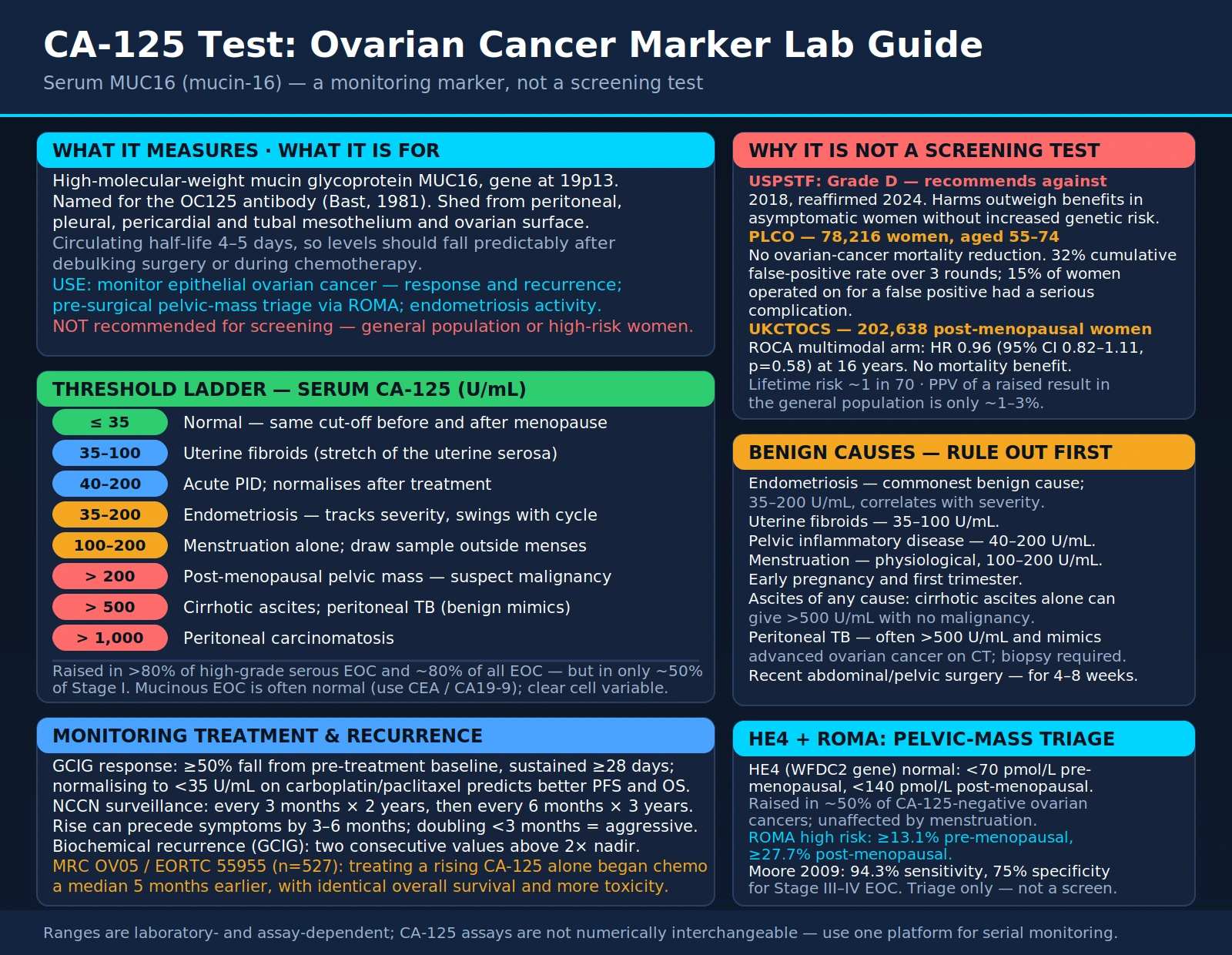
Table of Contents
- What is CA-125?
- Biology and Normal Values
- CA-125 in Ovarian Cancer
- Why CA-125 Has Not Worked as a Screening Test
- PLCO and UKCTOCS: The Screening Trials
- HE4 and the ROMA Score
- Benign Causes of CA-125 Elevation
- CA-125 in BRCA1/2 Carriers and High-Risk Women
- Monitoring Treatment and Recurrence
- Key Research Papers
- Connections
- Featured Videos
What is CA-125?
CA-125 (cancer antigen 125) is an antigenic determinant on a high-molecular-weight glycoprotein, recognised by a monoclonal antibody that was raised using an ovarian cancer cell line (PubMed PMID: 2651469). Bast and colleagues described that mouse antibody, OC125, in 1981: it reacted with each of six epithelial ovarian carcinoma cell lines and with tumour tissue from 12 of 20 ovarian cancer patients, but did not bind a variety of nonmalignant tissues, including adult and fetal ovary (PubMed PMID: 7028788). In 2001 the antigen was cloned and identified as a new mucin, named MUC16 (PubMed PMID: 11369781).
The serum assay Bast's group reported in 1983 used 35 U/mL as the upper limit, the cut-off still quoted today (details under Biology and Normal Values).
The uses the research describes:
- Monitoring epithelial ovarian cancer: in the 1983 study, rising or falling CA-125 matched progression or regression of disease in 42 of 45 instances (93%).
- Assessing a pelvic mass before surgery: combined with a second marker, HE4, in the ROMA algorithm.
- Endometriosis: a 2016 meta-analysis found CA-125 useful to rule the condition in, but a normal result could not rule it out.
- Screening: two large randomised trials (PLCO and UKCTOCS) did not find a reduction in ovarian cancer deaths, and the US Preventive Services Task Force recommends against screening women without symptoms who are not known to have a high-risk hereditary syndrome.
Biology and Normal Values
The sequence reported in 2001 has the features of a mucin: an N-terminal region rich in serine, threonine and proline, made of nine partially conserved tandem repeats of 156 amino acids each, and a C-terminal region containing a possible transmembrane segment. Levels of MUC16 messenger RNA tracked CA-125 expression across a panel of cell lines (PubMed PMID: 11369781).
A 1989 review by Jacobs and Bast described CA-125 as expressed by epithelial ovarian tumours and by various other pathological and normal tissues of Müllerian origin. Its function was unclear, though its distribution suggested a physiological role (PubMed PMID: 2651469).
Reference Range
In the 1983 validation of the serum assay, only 1% of 888 apparently healthy people and 6% of 143 patients with nonmalignant disease had CA-125 above 35 U/mL, against 82% (83 of 101) of patients with surgically demonstrated ovarian carcinoma (PubMed PMID: 6310399).
Menstrual cycle: a study of healthy premenopausal women aged 18 to 39, tested with two commercial assays, found CA-125 highest during menses with both. Values fell by about 0.2 U/mL per day from menses to the end of the cycle, a net fall of 5.8 U/mL, and the authors wrote that these changes may not be clinically significant in healthy women (PubMed PMID: 21765119).
Assay Methods
The same study reported good agreement between the two commercial assays on reference ranges, despite the assays recognising different epitopes (PubMed PMID: 21765119).
CA-125 in Ovarian Cancer
The OC125 antibody reacts with an antigen common to most nonmucinous epithelial ovarian carcinomas, so mucinous tumours were outside its reach from the start. In the 1983 study, 82% of patients with ovarian carcinoma had raised levels, and in 38 patients monitored over 2 to 60 months values ranged from less than 1 to more than 8,000 U/mL (PubMed PMID: 6310399).
A single cut-off misses many cancers. Among the 155 invasive epithelial ovarian or tubal cancers in the screened UKCTOCS group, a fixed cut-off of more than 35 U/mL at the last annual screen would have identified 41.3% (64 of 155). A cut-off of more than 30 U/mL would have identified 48.4%, and more than 22 U/mL 66.5%. Interpreting the serial CA-125 values with the Risk of Ovarian Cancer Algorithm (ROCA) detected 87.1% (135 of 155) (PubMed PMID: 25964255).
Treatment Response Criteria
The Gynecological Cancer Intergroup (GCIG) has published consensus definitions that use serum CA-125 to define progression-free survival after first-line therapy and response to treatment in recurrent disease. Its 2011 update aligns them with the RECIST 1.1 imaging criteria. The GCIG notes that the definitions were developed in patients receiving cytotoxic chemotherapy and had not yet been validated in patients receiving molecular targeting agents (PubMed PMID: 21270624).
Surveillance After Complete Response
Serum CA-125 often rises several months before clinical or symptomatic relapse. The MRC OV05/EORTC 55955 trial tested whether starting chemotherapy on a rising CA-125 alone improved survival, and found no evidence that it did. Its authors concluded that the value of routine CA-125 measurement in follow-up after a complete response to first-line treatment is not proven (PubMed PMID: 20888993). The trial is described under Monitoring Treatment and Recurrence.
Why CA-125 Has Not Worked as a Screening Test
Ovarian cancer is often found at a late stage, so a blood test that found it early has long been hoped for. The trials point to several problems.
- Few positives are cancer: over the first four annual screening rounds of the PLCO trial, 1.4–1.8% of CA-125 tests were positive in each round. The positive predictive value of the combined CA-125 and ultrasound screen was 1.0–1.3% per round. There were 19.5 surgeries for every screen-detected cancer, and 72% of screen-detected cancers were already late stage (III/IV) (PubMed PMID: 19305319).
- A fixed cut-off misses cancers: in UKCTOCS, a cut-off of more than 35 U/mL would have flagged 41.3% of the 155 invasive cancers in the screened group (PubMed PMID: 25964255).
- Benign conditions raise CA-125: pregnancy, endometriosis and menstruation, as well as other cancers, can raise serum CA-125 (PubMed PMID: 2651469). See Benign Causes below.
- Harms of follow-up: in PLCO, 1,080 of 3,285 women with false-positive results had surgery, and 163 of them (15%) had at least one serious complication (PubMed PMID: 21642681).
The US Preventive Services Task Force's 2018 statement found adequate evidence that screening does not reduce ovarian cancer mortality. It found the harms, including unnecessary surgery in women who do not have cancer, to be at least moderate and in some cases substantial. It concluded with moderate certainty that the harms outweigh the benefit, and it recommends against screening asymptomatic women (a D recommendation). The recommendation applies to women not known to have a high-risk hereditary cancer syndrome (PubMed PMID: 29450531).
PLCO and UKCTOCS: The Screening Trials
Two large randomised trials tested CA-125-based screening against no screening, with death from ovarian cancer as the outcome.
PLCO Trial (United States)
The Prostate, Lung, Colorectal and Ovarian Cancer Screening Trial randomised 78,216 women aged 55 to 74 at 10 US centres between 1993 and 2001. The screening group was offered annual CA-125 for 6 years and transvaginal ultrasound for 4 years. The usual-care group was not offered screening (PubMed PMID: 21642681). At a median follow-up of 12.4 years:
- Ovarian cancer was diagnosed in 212 women in the screening group and 176 in the usual-care group.
- 118 women in the screening group and 100 in the usual-care group died of ovarian cancer (mortality rate ratio 1.18, 95% CI 0.82–1.71): no reduction in ovarian cancer deaths.
- Of 3,285 women with false-positive results, 1,080 had surgical follow-up, and 163 of them (15%) had at least one serious complication.
The authors concluded that simultaneous screening with CA-125 and transvaginal ultrasound did not reduce ovarian cancer mortality, and that diagnostic evaluation after a false-positive result was associated with complications.
PLCO used a single CA-125 cut-off. A later analysis applied the ROCA algorithm to PLCO's own CA-125 values. Even under best-case assumptions it would not have produced a significant mortality benefit (relative risk 0.90, 95% CI 0.69–1.17) (PubMed PMID: 23065684).
UKCTOCS Trial (United Kingdom)
The UK Collaborative Trial of Ovarian Cancer Screening randomised 202,638 postmenopausal women aged 50 to 74. Women at increased familial risk of ovarian cancer were excluded. The women were assigned in a 1:1:2 ratio to three groups:
- Multimodal screening (MMS): annual serum CA-125 interpreted with the ROCA algorithm. Women at normal risk returned to annual screening, those at intermediate risk had a repeat CA-125, and those at elevated risk had a repeat CA-125 plus transvaginal ultrasound (PubMed PMID: 25964255).
- Annual transvaginal ultrasound screening (USS).
- No screening.
2016 report (median follow-up 11.1 years): the primary analysis estimated a mortality reduction of 15% with MMS (95% CI −3 to 30; p=0.10) and 11% with USS (95% CI −7 to 27; p=0.21), neither significant. A prespecified analysis that excluded cancers already present at the first screen showed a significant difference for MMS. The authors wrote that further follow-up was needed before firm conclusions could be drawn (PubMed PMID: 26707054).
2021 report (median follow-up 16.3 years): compared with no screening, MMS raised the incidence of stage I disease by 47.2% and lowered the incidence of stage IV disease by 24.5%. Deaths from ovarian or tubal cancer were 296 in the MMS group, 291 in the USS group and 619 in the no-screening group (which was twice the size of each screening group). No significant reduction in deaths was seen with MMS (p=0.58) or USS (p=0.36). The authors wrote that the fall in stage III or IV disease was not enough to translate into lives saved, and that general population screening "cannot be recommended" (PubMed PMID: 33991479).
HE4 and the ROMA Score
CA-125 has also been studied together with a second marker to estimate whether a pelvic mass that has already been found is likely to be malignant.
HE4 (Human Epididymis Protein 4)
HE4, also known as WAP four-disulphide core domain protein 2, was studied in women with endometriosis, endometrial cancer and ovarian cancer and in healthy controls. Compared with healthy controls (mean 40.5 pM), mean serum HE4 was significantly higher in endometrial cancer (99.2 pM) and ovarian cancer (1125.4 pM). It was not raised in ovarian endometriomas (46.0 pM) or other endometriosis (45.5 pM). CA-125, in contrast, was raised in ovarian cancer, in advanced endometriosis with peritoneal or deep lesions, and in endometriomas. The authors concluded that measuring both markers helps tell ovarian tumours from endometriotic cysts (PubMed PMID: 19337252).
A study of 180 women (126 with endometriosis, 54 healthy) found no significant variation in serum HE4 across the phases of the menstrual cycle. Combined estrogen-progestin contraceptives did not significantly affect HE4 levels (PubMed PMID: 22426487).
ROMA Score
The Risk of Ovarian Malignancy Algorithm (ROMA) combines serum HE4 and CA-125, with separate formulas for premenopausal and postmenopausal women, and sorts women into low- and high-risk groups. The model was first tested in a 12-site prospective study of 531 women with a pelvic mass who were scheduled for surgery (Moore 2009):
- Postmenopausal women: sensitivity 92.3% and specificity 75.0%.
- Premenopausal women: sensitivity 76.5% and specificity 74.8%.
- Overall, 93.8% of epithelial ovarian cancers were classified as high risk.
The study's rationale was that women with epithelial ovarian cancer have better outcomes when treated at centres experienced in managing it. The authors proposed the model for triaging patients to such centres (PubMed PMID: 18851871).
A 2011 prospective, blinded validation in 472 women with an adnexal mass (89 with a malignancy) reported a sensitivity of 92.3% and specificity of 76.0% in postmenopausal women, and a sensitivity of 100% and specificity of 74.2% in premenopausal women, for detecting ovarian cancer. Across all women, sensitivity was 93.8%, specificity 74.9% and negative predictive value 99.0% (PubMed PMID: 21775843). Both studies enrolled women who already had a pelvic or adnexal mass; neither addresses screening women without one.
HE4 has also been studied for telling peritoneal tuberculosis from ovarian cancer (see Benign Causes below).
Benign Causes of CA-125 Elevation
Raised CA-125 is not specific to cancer. In the 1983 study, 6% of 143 patients with nonmalignant disease were above 35 U/mL (PubMed PMID: 6310399). The 1989 review lists pregnancy, endometriosis and menstruation, along with other cancers, as conditions that can raise serum CA-125 (PubMed PMID: 2651469).
Gynecologic Conditions
- Endometriosis: a 2016 meta-analysis found 22 studies with 3,626 participants. Pooling 14 studies (2,920 participants) that used a cut-off of 30 U/mL or more gave a specificity of 93% and a sensitivity of 52%. CA-125 was more sensitive for moderate or severe endometriosis (63%) than for minimal disease (24%). The authors called it a rule-in test and noted that a result below 30 U/mL cannot rule endometriosis out (PubMed PMID: 27173590). CA-125 was raised in advanced endometriosis with peritoneal or deep lesions and in ovarian endometriomas (PubMed PMID: 19337252).
- Menstruation: CA-125 is highest during menses, with a net fall of 5.8 U/mL across the cycle in healthy women (PubMed PMID: 21765119).
- Pregnancy: listed among the physiological states that can raise CA-125 (PubMed PMID: 2651469).
Non-Gynecologic Conditions
- Cirrhosis and ascites: in a retrospective study of 172 adults with cirrhosis, 85% had raised CA-125. Levels rose with the degree of ascites, the MELD score and the Child-Turcotte-Pugh class, and were near normal in patients with no ascites detectable on ultrasound. The authors suggested that mechanical stretch of the peritoneum, rather than portal hypertension itself, explains the rise (PubMed PMID: 30271734).
- Heart failure: a 2011 review reported that trials have consistently found CA-125 could serve as both a diagnostic and a prognostic marker of heart failure, although the mechanism had not been established (PubMed PMID: 21525015).
- Peritoneal tuberculosis: case reports describe peritoneal tuberculosis with ascites and raised CA-125 mimicking ovarian cancer. In one report, a 56-year-old woman underwent exploratory laparotomy for presumed ovarian cancer, and the final diagnosis was peritoneal tuberculosis (PubMed PMID: 28337102). A review of 31 patients thought before surgery to have epithelial ovarian cancer, whose pathology showed peritoneal tuberculosis, found both HE4 and CA-125 significantly lower than in ovarian cancer. The best cut-offs for telling them apart were HE4 above 151.4 pmol/L and CA-125 above 563.5 U/mL, and combining the two markers improved specificity (PubMed PMID: 26667154).
What the Overlap Means
Because so many conditions raise CA-125, the 1989 review described it as having limited sensitivity and specificity. It still found CA-125 of clinical value in the pre-operative diagnosis and monitoring of ovarian malignancy (PubMed PMID: 2651469). Interpreting a result for a particular person is a matter for a clinician.
CA-125 in BRCA1/2 Carriers and High-Risk Women
In a prospective cohort of 6,036 BRCA1 and 3,820 BRCA2 carriers, the cumulative risk of ovarian cancer to age 80 was 44% (95% CI 36%–53%) for BRCA1 and 17% (95% CI 11%–25%) for BRCA2 carriers (PubMed PMID: 28632866).
The general-population trials do not answer the question for these women. UKCTOCS excluded women at increased familial risk (PubMed PMID: 33991479), and the USPSTF recommendation does not apply to women known to have a high-risk hereditary cancer syndrome (PubMed PMID: 29450531).
Screening Studied in High-Risk Women (UKFOCSS)
Phase II of the UK Familial Ovarian Cancer Screening Study enrolled women with an estimated lifetime risk of ovarian or fallopian tube cancer of 10% or more, at 42 UK centres. They had a CA-125 test interpreted with ROCA every 4 months, plus transvaginal ultrasound once a year or within 2 months of an abnormal ROCA result. Risk-reducing salpingo-oophorectomy was encouraged throughout (PubMed PMID: 28240969).
- 4,348 women had 13,728 women-years of screening, with a median follow-up of 4.8 years.
- 19 invasive cancers were diagnosed within 1 year of a screen: 13 were found by screening and 6 were found unexpectedly at risk-reducing surgery. There were no symptomatic interval cancers.
- 10 of the 19 (52.6%) were stage I–II. 7 of the 19 (36.8%) were stage IIIb–IV, compared with 17 of 18 (94.4%) cancers diagnosed more than 1 year after screening ended.
- Modelled sensitivity was 94.7%, positive predictive value 10.8% and negative predictive value 100%.
The authors described ROCA-based screening as an option for high-risk women who defer or decline risk-reducing surgery, given its sensitivity and the stage shift. They added that it remains unknown whether the strategy would improve survival.
Risk-Reducing Surgery
In an international registry of 5,783 women with a BRCA1 or BRCA2 mutation, followed for an average of 5.6 years, bilateral oophorectomy was associated with an 80% reduction in the risk of ovarian, fallopian tube or peritoneal cancer (HR 0.20, 95% CI 0.13–0.30). Among women with no cancer history at baseline, it was associated with a 77% reduction in all-cause mortality to age 70 (HR 0.23, 95% CI 0.13–0.39) (PubMed PMID: 24567435). These are observational findings, not a randomised comparison.
Monitoring Treatment and Recurrence
Monitoring is the use the original 1983 study proposed: rising or falling CA-125 matched the course of disease in 42 of 45 instances (PubMed PMID: 6310399).
During First-Line Chemotherapy
In 101 patients with suboptimal residual stage III or IV ovarian cancer from a Southwest Oncology Group trial (SWOG 8412) of platinum-based chemotherapy, the pretreatment CA-125 did not predict survival. The CA-125 level 8 weeks after starting treatment did. Median survival was 26 months with CA-125 below 35 U/mL at 8 weeks and 15 months above it. It was 21 months for women whose CA-125 had fallen below 50% of baseline at 8 weeks and 10 months for those above 50% (PubMed PMID: 16595148).
CA-125 and Recurrence Timing: MRC OV05/EORTC 55955
The trial registered women in complete remission after first-line platinum-based chemotherapy who had a normal CA-125. Clinical examination and CA-125 measurement were done every 3 months, and patients and investigators were masked to the CA-125 results. When CA-125 exceeded twice the upper limit of normal, patients were randomised to start chemotherapy at once (within 28 days) or to continue masked follow-up, with treatment starting at clinical or symptomatic relapse (PubMed PMID: 20888993).
- 1,442 patients were registered, and 529 were randomised (265 early, 264 delayed).
- At a median follow-up of 56.9 months there was no evidence of a difference in overall survival (HR 0.98, 95% CI 0.80–1.20, p=0.85).
- Median survival from randomisation was 25.7 months with early treatment and 27.1 months with delayed treatment.
The authors concluded that the trial showed no survival benefit from treating relapse early on the basis of a raised CA-125 alone, and that the value of routine CA-125 measurement in follow-up after a complete response is not proven.
Maintenance Therapies
In a phase 2 placebo-controlled trial of 265 patients with platinum-sensitive, relapsed, high-grade serous ovarian cancer, olaparib maintenance lengthened progression-free survival (median 8.4 vs 4.8 months; hazard ratio 0.35). An interim analysis showed no significant overall survival difference (hazard ratio 0.94). Progression was defined by the RECIST imaging criteria (PubMed PMID: 22452356). The GCIG notes that its CA-125 definitions had not yet been validated in patients receiving molecular targeting agents (PubMed PMID: 21270624).
Key Research Papers
- Bast RC Jr, Klug TL, St John E, et al. (1983). A radioimmunoassay using a monoclonal antibody to monitor the course of epithelial ovarian cancer. N Engl J Med. 309(15):883-7. — PubMed PMID: 6310399
- Buys SS, Partridge E, Black A, et al. (2011). Effect of screening on ovarian cancer mortality: the Prostate, Lung, Colorectal and Ovarian (PLCO) Cancer Screening Randomized Controlled Trial. JAMA. 305(22):2295-303. — PubMed PMID: 21642681
- Menon U, Gentry-Maharaj A, Burnell M, et al. (2021). Ovarian cancer population screening and mortality after long-term follow-up in the UK Collaborative Trial of Ovarian Cancer Screening (UKCTOCS): a randomised controlled trial. Lancet. 397(10290):2182-2193. — PubMed PMID: 33991479
- Rustin GJ, van der Burg ME, Griffin CL, et al. (2010). Early versus delayed treatment of relapsed ovarian cancer (MRC OV05/EORTC 55955): a randomised trial. Lancet. 376(9747):1155-63. — PubMed PMID: 20888993
- Moore RG, McMeekin DS, Brown AK, et al. (2009). A novel multiple marker bioassay utilizing HE4 and CA125 for the prediction of ovarian cancer in patients with a pelvic mass. Gynecol Oncol. 112(1):40-6. — PubMed PMID: 18851871
- Pinsky PF, Zhu C, Skates SJ, et al. (2013). Potential effect of the risk of ovarian cancer algorithm (ROCA) on the mortality outcome of the Prostate, Lung, Colorectal and Ovarian (PLCO) trial. Int J Cancer. 132(9):2127-33. — PubMed PMID: 23065684
- Markman M, Federico M, Liu PY, et al. (2006). Significance of early changes in the serum CA-125 antigen level on overall survival in advanced ovarian cancer. Gynecol Oncol. 103(1):195-8. — PubMed PMID: 16595148
- Rustin GJ, Vergote I, Eisenhauer E, et al. (2011). Definitions for response and progression in ovarian cancer clinical trials incorporating RECIST 1.1 and CA 125 agreed by the Gynecological Cancer Intergroup (GCIG). Int J Gynecol Cancer. 21(2):419-23. — PubMed PMID: 21270624
- Hirsch M, Duffy J, Davis CJ, et al. (2016). Diagnostic accuracy of cancer antigen 125 for endometriosis: a systematic review and meta-analysis. BJOG. 123(11):1761-8. — PubMed PMID: 27173590
- Menon U, Ryan A, Kalsi J, et al. (2015). Risk Algorithm Using Serial Biomarker Measurements Doubles the Number of Screen-Detected Cancers Compared With a Single-Threshold Rule in the United Kingdom Collaborative Trial of Ovarian Cancer Screening. J Clin Oncol. 33(18):2062-71. — PubMed PMID: 25964255
- Finch AP, Lubinski J, Møller P, et al. (2014). Impact of oophorectomy on cancer incidence and mortality in women with a BRCA1 or BRCA2 mutation. J Clin Oncol. 32(15):1547-53. — PubMed PMID: 24567435
- Ledermann J, Harter P, Gourley C, et al. (2012). Olaparib maintenance therapy in platinum-sensitive relapsed ovarian cancer. N Engl J Med. 366(15):1382-92. — PubMed PMID: 22452356
- Bast RC Jr, Feeney M, Lazarus H, et al. (1981). Reactivity of a monoclonal antibody with human ovarian carcinoma. J Clin Invest. 68(5):1331-7. — PubMed PMID: 7028788
- Yin BW, Lloyd KO. (2001). Molecular cloning of the CA125 ovarian cancer antigen: identification as a new mucin, MUC16. J Biol Chem. 276(29):27371-5. — PubMed PMID: 11369781
- Jacobs I, Bast RC Jr. (1989). The CA 125 tumour-associated antigen: a review of the literature. Hum Reprod. 4(1):1-12. — PubMed PMID: 2651469
- Partridge E, Kreimer AR, Greenlee RT, et al. (2009). Results from four rounds of ovarian cancer screening in a randomized trial. Obstet Gynecol. 113(4):775-782. — PubMed PMID: 19305319
- Jacobs IJ, Menon U, Ryan A, et al. (2016). Ovarian cancer screening and mortality in the UK Collaborative Trial of Ovarian Cancer Screening (UKCTOCS): a randomised controlled trial. Lancet. 387(10022):945-956. — PubMed PMID: 26707054
- US Preventive Services Task Force; Grossman DC, Curry SJ, Owens DK, et al. (2018). Screening for Ovarian Cancer: US Preventive Services Task Force Recommendation Statement. JAMA. 319(6):588-594. — PubMed PMID: 29450531
- McLemore MR, Aouizerat BE, Lee KA, et al. (2012). A comparison of the cyclic variation in serum levels of CA125 across the menstrual cycle using two commercial assays. Biol Res Nurs. 14(3):250-6. — PubMed PMID: 21765119
- Huhtinen K, Suvitie P, Hiissa J, et al. (2009). Serum HE4 concentration differentiates malignant ovarian tumours from ovarian endometriotic cysts. Br J Cancer. 100(8):1315-9. — PubMed PMID: 19337252
- Hallamaa M, Suvitie P, Huhtinen K, et al. (2012). Serum HE4 concentration is not dependent on menstrual cycle or hormonal treatment among endometriosis patients and healthy premenopausal women. Gynecol Oncol. 125(3):667-72. — PubMed PMID: 22426487
- Edula RG, Muthukuru S, Moroianu S, et al. (2018). CA-125 Significance in Cirrhosis and Correlation with Disease Severity and Portal Hypertension: A Retrospective Study. J Clin Transl Hepatol. 6(3):241-246. — PubMed PMID: 30271734
- Yilmaz MB, Nikolaou M, Cohen Solal A. (2011). Tumour biomarkers in heart failure: is there a role for CA-125? Eur J Heart Fail. 13(6):579-83. — PubMed PMID: 21525015
- Chien JC, Fang CL, Chan WP. (2016). Peritoneal tuberculosis with elevated CA-125 mimicking ovarian cancer with carcinomatosis peritonei: Crucial CT findings. EXCLI J. 15:711-715. — PubMed PMID: 28337102
- Zhang L, Chen Y, Liu W, Wang K. (2016). Evaluating the clinical significances of serum HE4 with CA125 in peritoneal tuberculosis and epithelial ovarian cancer. Biomarkers. 21(2):168-72. — PubMed PMID: 26667154
- Kuchenbaecker KB, Hopper JL, Barnes DR, et al. (2017). Risks of Breast, Ovarian, and Contralateral Breast Cancer for BRCA1 and BRCA2 Mutation Carriers. JAMA. 317(23):2402-2416. — PubMed PMID: 28632866
- Moore RG, Miller MC, Disilvestro P, et al. (2011). Evaluation of the diagnostic accuracy of the risk of ovarian malignancy algorithm in women with a pelvic mass. Obstet Gynecol. 118(2 Pt 1):280-288. — PubMed PMID: 21775843
- Rosenthal AN, Fraser LSM, Philpott S, et al. (2017). Evidence of Stage Shift in Women Diagnosed With Ovarian Cancer During Phase II of the United Kingdom Familial Ovarian Cancer Screening Study. J Clin Oncol. 35(13):1411-1420. — PubMed PMID: 28240969
PubMed Topic Searches
- PubMed: NCCN guidelines, ovarian cancer
- PubMed: CA-125 in endometriosis, systematic reviews
- PubMed: ROCA CA-125 trend algorithm in UKCTOCS
- PubMed: Surveillance outcomes for ovarian cancer risk
- PubMed: UKCTOCS long-term mortality analysis
- PubMed: MRC OV05/EORTC 55955 early vs delayed treatment
- PubMed: ROMA score, CA-125 and HE4
- PubMed: PLCO false-positive CA-125 and surgical harms
- PubMed: GCIG CA-125 response criteria
- PubMed: Olaparib maintenance and CA-125 monitoring
Connections
- All Lab Tests
- Tumor Markers — the complete guide to what these tests can and cannot say
- AFP Test
- CEA Test
- PSA Test
- Complete Blood Count
- Comprehensive Metabolic Panel
- Ovarian Cancer
- Endometriosis
- Uterine Fibroids
- Cervical Cancer