Lovage for the Urinary Tract — Tradition and the Regulatory Record
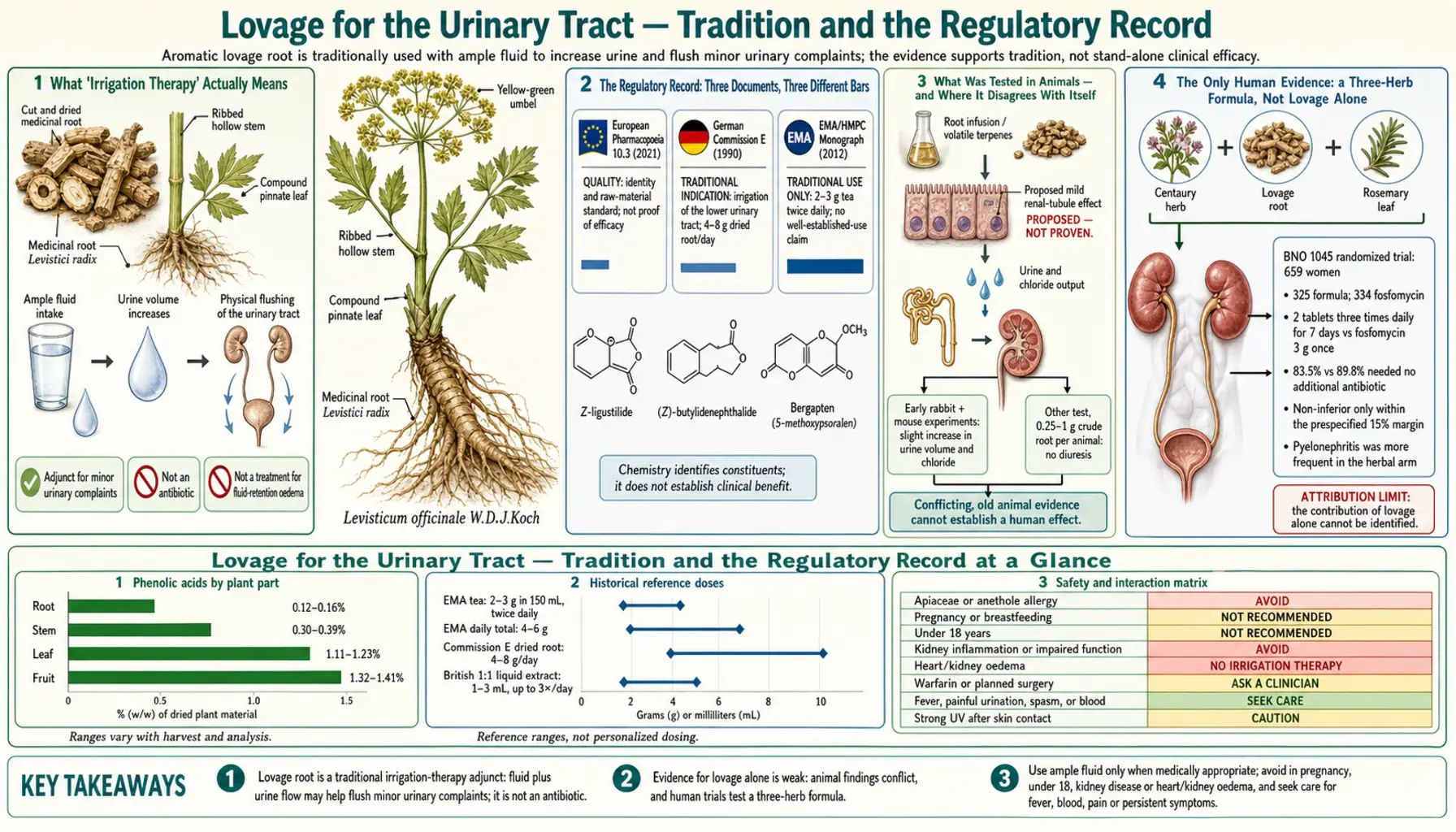
Lovage root's use as a urinary "flushing" herb is the single best-documented traditional claim on this plant — not because anyone has run a clinical trial, but because three separate European regulatory bodies have each formally examined the question and left a paper trail. Read together, that paper trail tells a more precise story than any one document alone: a health-claim petition that was rejected, a traditional-use registration that was granted on a completely different evidentiary bar, and a 1990s national monograph whose stone-prevention claim quietly disappeared from the 2012 European version. None of that is a scandal. It is exactly how the traditional-use system is designed to work, and understanding the difference between "rejected" and "registered" is the whole point of this page.
Table of Contents
- What "Irrigation Therapy" Actually Means
- The Regulatory Record: Three Documents, Three Different Bars
- What Was Tested in Animals — and Where It Disagrees With Itself
- The Only Human Evidence: a Three-Herb Formula, Not Lovage Alone
- The Kidney-Stone ("Gravel") Claim in Context
- Who Should Not Use Lovage This Way
- A Precise Look at the Lithium and Diuretic-Stacking Caution
- The Honest Bottom Line
- Key Research Papers
- Connections
What "Irrigation Therapy" Actually Means
European phytotherapy uses a specific term, Durchspülungstherapie — "irrigation therapy" — for a category of mild aquaretic herbs taken with generous additional water. The mechanism claimed is not pharmacological diuresis in the sense of a loop or thiazide diuretic forcing sodium and water out of the kidney. It is closer to mechanical: a larger volume of dilute urine passing through the bladder and urethra more often, on the theory that this discourages the adhesion of bacteria and the aggregation of the mineral crystals that seed kidney stones. Lovage root sits in this category alongside goldenrod (Solidago species), parsley fruit, and stinging nettle herb — a group reviewed together in a widely cited survey of urologic botanicals.
This distinction matters because it sets the right expectation. Nobody is claiming lovage root forces the kidneys to excrete more sodium the way furosemide does. The traditional claim is narrower and more plausible on its face: drink a tea, drink extra water alongside it, and produce more frequent, more dilute urine for a few hours. Whether that narrower claim is actually true in a person who drinks the tea is a separate question, addressed below.
The Regulatory Record: Three Documents, Three Different Bars
Three official European assessments of lovage root's urinary-tract use exist, from three different eras and under three different legal standards. Reading only one of them gives a misleading picture; reading all three in sequence shows a coherent, honest evolution.
| Source | Year | Legal Instrument | Finding |
|---|---|---|---|
| German Commission E | 1990 | National monograph (Bundesanzeiger No. 101) | Approved: "Irrigation therapy for inflammation of the lower urinary tract and for prevention of kidney gravel." Dosage 4–8 g/day. No efficacy trial required or cited. |
| EFSA Panel on Dietetic Products, Nutrition and Allergies | 2009 | EU health-claim petition under Regulation (EC) 1924/2006 | Rejected: the petitioned claim that lovage "improves diuretic function" was found not substantiated by the evidence submitted. |
| EMA Committee on Herbal Medicinal Products (HMPC) | 2012 | Traditional-use registration, Directive 2004/24/EC Art. 16d | Registered: "Traditional herbal medicinal product used to increase the amount of urine to achieve flushing of the urinary tract as an adjuvant in minor urinary complaints." No stone-prevention wording. Explicitly not assessed for efficacy. |
Read in isolation, "rejected by EFSA" and "registered by the HMPC" look contradictory. They are not, because the two bodies were answering different questions under different laws. EFSA's 2009 opinion was assessing a specific, modern health claim — the kind of statement that could legally appear on a food label asserting a measurable physiological effect — against the evidentiary standard that any such claim requires: controlled evidence that the effect exists. The submitted dossier did not clear that bar, and the claim was refused. The HMPC's 2012 monograph, three years later, was not evaluating whether lovage root works. Its own text is explicit that pharmacodynamic and pharmacokinetic data are "not required" for a traditional-use registration, and that the entire basis for registration is a documented 30-year history of use (15 years within the European Community) plus pharmacological plausibility — not a trial result. Two academic reviews of the HMPC system make this two-track structure explicit for anyone who wants the full mechanics of how "traditional use" differs from "well-established use" under EU law.
The quieter finding is the disappearance of the stone-prevention wording. Commission E in 1990, and most of the classic pharmacognosy references compiled in the HMPC's own assessment report (the British Herbal Compendium, the British Herbal Pharmacopoeia, Wichtl's Herbal Drugs and Phytopharmaceuticals, the PDR for Herbal Medicines), all state the indication as covering both urinary-tract inflammation and prevention of kidney gravel. The final 2012 EU-wide indication text keeps the flushing claim and drops the stone-prevention claim entirely. The HMPC assessment report does not spell out why in a single sentence, but the pattern is consistent with a general tightening: a mechanical "more urine flow" claim is easier to defend as plausible than a claim that the same mechanism prevents a specific disease process (crystal aggregation) for which lovage root has no controlled evidence at all, in any species.
What Was Tested in Animals — and Where It Disagrees With Itself
The HMPC's own assessment report is unusually candid about the non-clinical evidence, and it is worth reporting the disagreement plainly rather than picking the flattering half. Early 20th-century experiments in rabbits and mice using an infusion of lovage root found only a "slight increase" in urine volume and chloride-ion concentration. But the same assessment report separately notes that other tests of lovage root, at doses of 0.25–1 g of crude drug per animal, found no diuretic effect at all. Both findings come from the same regulatory document, describing lovage root itself rather than an isolated compound. This is a genuine, unresolved contradiction in the primary animal literature, not a case where the herb "sort of" works — some experiments found a small effect, others found none, and no modern controlled repeat has settled which is closer to correct.
Separately, the phthalide compounds that give lovage its aroma — ligustilide and butylidenephthalide — have real, quantified smooth-muscle-relaxant activity in isolated animal tissue (rat mesenteric artery, rat aorta, guinea-pig ileum). That mechanism is discussed in full, with its actual numbers, on the carminative and laboratory bioactivity page. It is a plausible reason lovage root might relax ureteral or bladder smooth muscle, but "plausible relaxant mechanism exists" and "the whole root actually increases urine flow in a living animal" are two different claims, and the second one is the one with genuinely mixed results.
The Only Human Evidence: a Three-Herb Formula, Not Lovage Alone
Search the clinical literature for lovage and urinary tract infection and almost everything that surfaces traces back to one product: Canephron® N, a German phytotherapeutic combining centaury herb (Centaurium erythraea), lovage root (Levisticum officinale), and rosemary leaf (Rosmarinus officinalis). A 2013 review pooled 17 clinical studies of this product across more than 3,100 patients, covering prophylaxis and treatment of urinary tract infection in adults and children, adjunct therapy for kidney-stone patients (a 10-day add-on course increased the rate of spontaneous stone elimination compared with standard therapy alone), and use during pregnancy. Only one adverse effect — a skin rash — was reported across the entire pooled population, and no teratogenic or fetotoxic signal was seen.
That sounds like a real positive result, and in one narrow sense it is: it is genuine clinical experience, not a laboratory finding. But it needs the formula-substitution caveat applied directly, not buried. This is evidence for a specific three-herb combination product, not for lovage root taken alone, and the compound's own reviewer states plainly that "some of the studies were not well designed" and that "their statistical significance remains unclear." Centaury and rosemary both carry their own traditional bitter-digestive and antimicrobial reputations; there is no way to apportion Canephron N's apparent benefit among its three ingredients from this literature. The honest verdict for this specific piece of evidence is old, weak, and positive — a real body of clinical experience, poorly controlled by modern standards, and not attributable to lovage in isolation.
The Kidney-Stone ("Gravel") Claim in Context
It is worth asking how lovage's kidney-stone reputation compares to the broader field of botanical urolithiasis research, rather than judging it in isolation. Recent systematic reviews of plant-based urolithiasis therapies in general find the same pattern that shows up here: a very large traditional and preclinical literature (rodent stone-induction models, in-vitro crystallization assays) and a genuinely small number of adequately controlled human trials for almost any single botanical, lovage included. A 2021 clinical review of kidney-stone prevention notes that even for well-studied dietary interventions — fluid intake itself being the best-supported one — the evidence quality for most "natural" stone-prevention claims remains preclinical. Lovage root is not an outlier in this field; it is a typical example of it. The one piece of actual human outcome data specific to lovage — the Canephron N stone-elimination finding above — is real, but again belongs to the three-herb product, not to lovage alone.
Who Should Not Use Lovage This Way
This is the one part of the record where every source agrees exactly, without exception, across eight decades of monographs: irrigation therapy is specifically wrong for anyone whose heart or kidneys are already struggling to manage fluid. The HMPC's official contraindication language is hypersensitivity to lovage or other Apiaceae plants; its special warning tells anyone with fever, painful urination, spasms, or blood in the urine to see a doctor rather than self-treat. Commission E's older, more explicit language — repeated verbatim across Hagers Handbuch, Wichtl's reference text, and the PDR for Herbal Medicines — states it as a direct contraindication: no irrigation therapy in cases of oedema due to limited heart and kidney function, and no use in acute inflammation of the kidney parenchyma with impaired kidney function. The logic is simple and does not need a trial to justify it: deliberately increasing urine output is exactly the wrong instruction to give a body that is already failing to manage its own fluid balance. If you have heart failure, chronic kidney disease, or unexplained swelling, this is a job for a doctor, not a garden herb.
The HMPC monograph additionally does not recommend use in children and adolescents under 18, sets a maximum duration of 2–4 weeks even for appropriate adult use, and does not recommend use in pregnancy or lactation "in the absence of sufficient data" — a precautionary default, not a demonstrated-harm finding. Worth noting precisely: the older, more dramatic reputation of "lovage" as a uterine stimulant and abortifacient herb traces to a different plant entirely. Chuchupate, used by Spanish- and Mexican-American communities in New Mexico for exactly that purpose, is Ligusticum porteri — a different genus that happens to share an ancient Latin root name (Ligusticum) with Levisticum, the same etymological coincidence that gave garden lovage its own name. The HMPC's own assessment report flags this directly: that strong tradition belongs to Ligusticum porteri, "but not Levisticum officinale." Levisticum officinale does carry its own, separate and much milder traditional listing as a menstrual remedy (the British Herbal Compendium includes "menstrual disorders" among its traditional indications), which is why the pregnancy caution is retained — but it is a precautionary, data-absent default rather than a demonstrated reproductive hazard, and the assessment report notes this recommendation has itself been "discussed and questioned" in the pharmacognosy literature.
A Precise Look at the Lithium and Diuretic-Stacking Caution
Lithium has one of the narrowest therapeutic windows of any drug still in routine use, and its renal clearance is genuinely sensitive to changes in sodium and fluid handling — a classic clinical pharmacology review of lithium drug interactions documents this in detail for actual pharmaceutical diuretics, thiazides especially, where the interaction is well established and dose adjustment or closer monitoring is standard practice. It would be tempting to simply transfer that caution onto lovage root. The more honest version, applying the same scrutiny used everywhere else on this page, is narrower: lovage root's own diuretic effect in humans has never been demonstrated in a controlled trial, and the animal data above is genuinely mixed, including reports of no effect at all. Treating an unproven herbal aquaretic as pharmacologically equivalent to a thiazide for interaction-severity purposes would itself be an overclaim in the other direction.
What survives scrutiny is a narrower, still-real point: fluid and electrolyte status matters for lithium clearance more than most drugs, the direction of any lovage effect (if real) is the same direction as a diuretic, and nobody has studied the combination. That is exactly the kind of absent-data situation where the honest move is disclosure rather than either alarm or reassurance — anyone taking lithium, or any other narrow-therapeutic-index drug where fluid and electrolyte shifts matter, should mention any herbal "flushing" tea to their prescriber, not because a lovage-lithium case report exists (none does), but because the uncertainty itself is the reason to ask.
The Honest Bottom Line
Lovage root's urinary-tract reputation is the most institutionally documented traditional claim this plant has, and that documentation is precisely what allows a precise answer: it is registered for traditional use in the European Union on the strength of centuries of consistent use plus plausible pharmacology, it was rejected as a modern health claim because nobody has run the controlled trial that would prove it, the one piece of positive human outcome data belongs to a three-herb combination product rather than lovage alone, and the animal pharmacology genuinely disagrees with itself. None of that makes the traditional use fraudulent — the HMPC's own conclusion is that the benefit/risk balance is positive for use as a minor adjuvant, taken briefly, with plenty of water, by someone whose heart and kidneys are already working normally. It does mean nobody should describe lovage root as a proven diuretic, and nobody with heart or kidney impairment should use it as one at all.
Key Research Papers
- Naber KG. Efficacy and safety of the phytotherapeutic drug Canephron® N in prevention and treatment of urogenital and gestational disease: review of clinical experience in Eastern Europe and Central Asia (2013). Research and Reports in Urology. — PubMed: Naber, Canephron N review
- Yarnell E. Botanical medicines for the urinary tract (2002). World Journal of Urology. — PubMed: Yarnell, botanical urinary medicines
- Tsukanov AY, Matveev EV, Nurgalieva AI, et al. The use of complex herbal supplements for the prevention and treatment of urinary tract infections (2021). Urologiia. — PubMed: Tsukanov, herbal UTI supplements
- Miran M, Monsef Esfahani H, Jung JH, et al. Characterization and Antibacterial Activity of Phthalides from the Roots of the Medicinal Herb Levisticum officinale (2020). Iranian Journal of Pharmaceutical Research. — PubMed: Miran, lovage root phthalides. Frames lovage root in its own abstract as "well known in traditional medicine for its spasmolytic and diuretic effects" — the traditional claim as researchers themselves state it, not a tested outcome.
- Qu L, Zou W, Wang Y, et al. European regulation model for herbal medicine: The assessment of the EU monograph and the safety and efficacy evaluation in marketing authorization or registration in Member States (2018). Phytomedicine. — PubMed: Qu, EU herbal regulation model
- Qu L, Zou W, Zhou Z, et al. Non-European traditional herbal medicines in Europe: a community herbal monograph perspective (2014). Journal of Ethnopharmacology. — PubMed: Qu, community herbal monograph system
- Finley PR, Warner MD, Peabody CA. Clinical relevance of drug interactions with lithium (1995). Clinical Pharmacokinetics. — PubMed: Finley, lithium drug interactions
- Allam AT, El-Dessouki AM, El-Shiekh RA, et al. A holistic guide to effective prevention and treatment for kidney stones: a systematic review exploring anti-urolithiasis approaches (2026). Naunyn-Schmiedeberg's Archives of Pharmacology. — PubMed: Allam, kidney stone prevention review
- Allam EAH, Sabra MS. Plant-based therapies for urolithiasis: a systematic review of clinical and preclinical studies (2024). International Urology and Nephrology. — PubMed: Allam & Sabra, plant-based urolithiasis therapies
- Garbens A, Pearle MS. Causes and prevention of kidney stones: separating myth from fact (2021). BJU International. — PubMed: Garbens & Pearle, kidney stone myths
- Olennikov DN. Coumarins of Lovage Roots (Levisticum officinale): LC-MS Profile, Quantification, and Stability during Postharvest Storage (2022). Metabolites. — PubMed: Olennikov, lovage root coumarin profile. The root-chemistry backdrop to both the traditional flushing use and the photosensitivity question covered on the furanocoumarin page.
Primary Regulatory Sources
- European Medicines Agency — Levistici radix (Lovage root) overview page
- EMA/HMPC/524621/2011 — Final Community herbal monograph on Levisticum officinale Koch, radix (2012)
- EMA/HMPC/524623/2011 — Assessment report on Levisticum officinale Koch, radix (2012)