Lemon Balm: History and Traditional Use
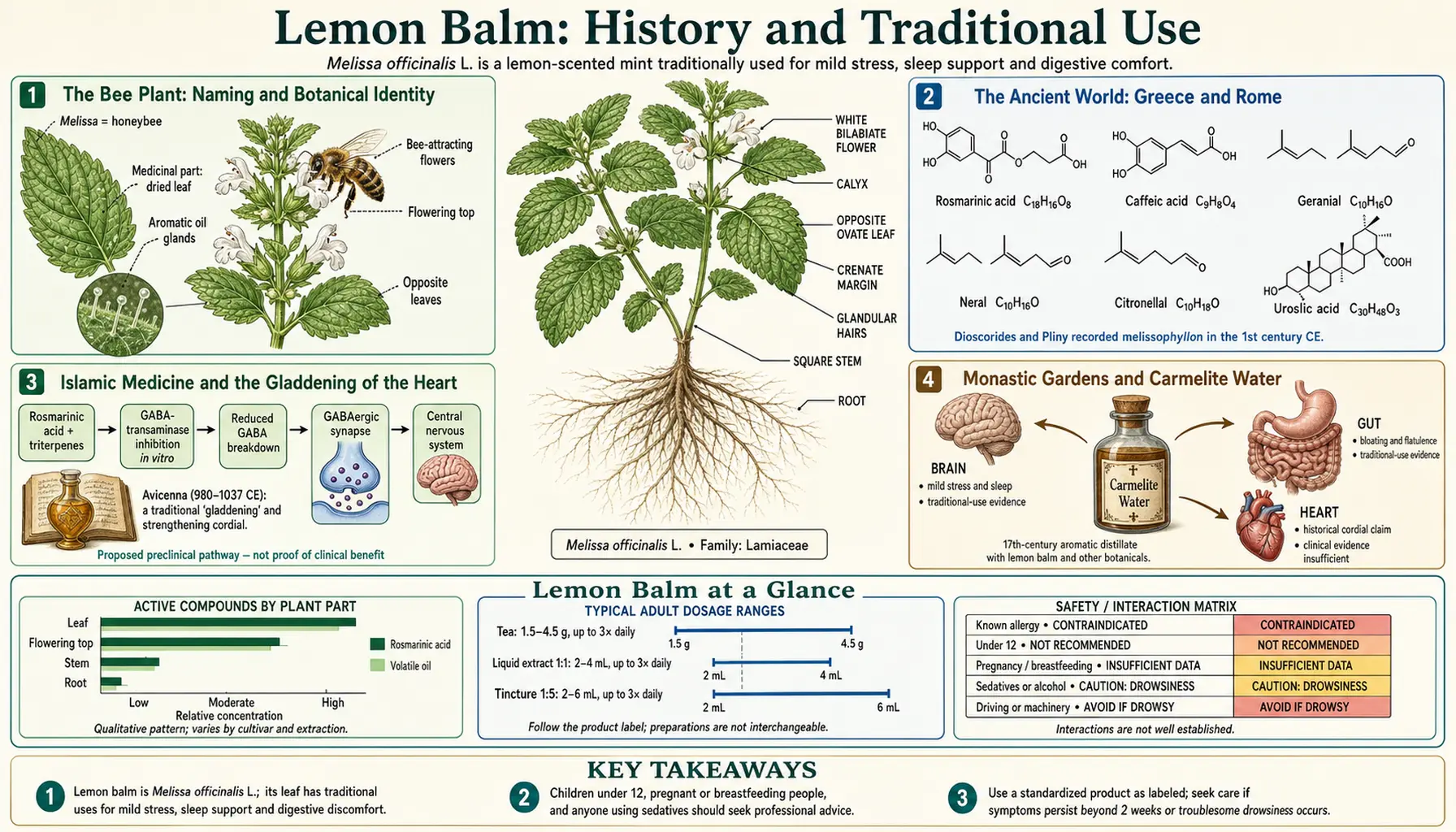
Few garden herbs carry a story as long or as gentle as lemon balm (Melissa officinalis). For more than two thousand years — from the beehives of ancient Greece, through the medicine of the Islamic world, the cloister gardens of medieval Europe, and the herbals of Renaissance England — people have reached for this lemon-scented member of the mint family to calm the nerves, lift a heavy heart, and settle the stomach. Its very name comes from the Greek word for the honeybee, and its history is woven through with bees, monasteries, alchemists, and the simple, enduring idea that a soothing cup of tea can make the heart feel lighter. This article tells that story, marking clearly where we are on solid documentary ground and where we are repeating tradition and folklore.
Table of Contents
- The Bee Plant: Naming and Botanical Identity
- The Ancient World: Greece and Rome
- Islamic Medicine and the Gladdening of the Heart
- Monastic Gardens and Carmelite Water
- Paracelsus, Alchemy, and the “Elixir of Life”
- The English Herbalists: Gerard and Culpeper
- Folklore, Bees, and Symbolism
- From Tradition to Modern Research
- Research Papers and References
- Connections
- Featured Videos
The Bee Plant: Naming and Botanical Identity
Lemon balm is the common English name for Melissa officinalis L., a hardy perennial of the Lamiaceae (mint) family native to the eastern Mediterranean region and western Asia, and now naturalized and cultivated across temperate Europe, the Americas, and beyond. Crush a leaf and you understand the plant at once: it releases a soft, sweet, distinctly lemony scent. That fragrance, and the plant's long human history, are both captured in its botanical name.
The genus name Melissa comes directly from the ancient Greek word for the honeybee (mélissa), which is in turn related to méli, the Greek word for honey. The name is usually traced to the longer Greek melissophyllon — literally “bee leaf.” Bees are powerfully drawn to lemon balm's small, nectar-rich flowers, and this attraction is the single most consistent thread in the plant's entire recorded history. The species epithet officinalis is a Latin term applied to plants kept in the officina — the storeroom or workshop of a monastery or apothecary where medicines were prepared — and its presence in the name is itself a historical fingerprint, marking lemon balm as a recognized medicinal plant of the European apothecary tradition.
Because the plant has been grown and used for so long across so many regions, it has accumulated a cluster of folk names, most of them turning on either its scent or its bees: balm (a shortening of “balm-mint” and an old word for a soothing, fragrant resin), bee balm, sweet balm, honey plant, and the French mélisse. The shared root of all these names tells the same small story: a sweet-smelling, bee-loved leaf, valued and tended by ordinary households for a very long time. The phytochemistry behind that lemon scent — the volatile oils, rosmarinic acid, and other compounds — is covered on the main Lemon Balm page; here the focus is on where the plant has been and how people have used it.
The Ancient World: Greece and Rome
Lemon balm's documented career begins in the classical Mediterranean, and from the very start it is bound up with bees. The Greek physician and pharmacologist Dioscorides, who compiled his great De Materia Medica in the first century CE, described the plant under the name melissophyllon (“bee leaf”), and the herb was understood by ancient writers to be so called precisely because bees delight in it. Dioscorides recorded medicinal uses for the plant that set the pattern for everything that followed: he applied it topically for the stings of scorpions and the bites of dogs and as a poultice for wounds, and the plant was associated with soothing and comforting effects. These ancient texts are named here as historical primary sources rather than as modern citations.
The Roman naturalist Pliny the Elder, writing his encyclopaedic Natural History in the same century, and the poet Virgil both recorded the plant's most famous practical use: beekeepers rubbed the fragrant leaves on the inside of their hives, and planted lemon balm nearby, in the belief that it would keep a swarm contented and stop the bees from wandering off. Pliny also noted the plant's reputation among Roman physicians for binding and closing wounds. The Latin folk name apiastrum — from apis, the Latin word for bee — preserves this same association.
So from its earliest written record, lemon balm already carried the two themes that would define it forever after: it was a bee plant, essential to the ancient craft of beekeeping, and it was a soothing medicinal herb for stings, wounds, and the comfort of the body. The Greek and Roman inheritance — the bee lore and the wound-and-sting medicine — passed intact into the medical traditions that came after, and it is in those later traditions that lemon balm's most famous reputation, as a gladdener of the heart and a calmer of the troubled mind, took clear shape.
Islamic Medicine and the Gladdening of the Heart
It was in the medicine of the medieval Islamic world that lemon balm earned its enduring reputation as a remedy for the heart and the spirits. Physicians of the Islamic Golden Age inherited and expanded the Greek medical tradition, and lemon balm — rendered in Arabic-tradition texts under names related to turunjan or badranjbuyah — was prized as a herb that strengthened the heart and dispelled melancholy and sadness. The single most influential figure here is the Persian physician and philosopher Ibn Sina, known in the Latin West as Avicenna (c. 980–1037 CE), whose monumental medical encyclopaedia, The Canon of Medicine (al-Qânûn fî'l-ţibb), dominated medical teaching in both the Islamic world and Europe for centuries.
Avicenna is very widely credited with recommending lemon balm to lift the mood, comfort the heart, and strengthen what older medicine called the “vital spirits.” The phrase most often quoted in English — that lemon balm “maketh the heart merry and joyful and strengtheneth the vital spirits” — circulates everywhere as Avicenna's. Readers should know that this exact English wording is a much later translation and paraphrase, not a literal transcription, and that the precise sourcing of the line in the original Canon is hard to pin down; what is firmly documented is that the medieval Arabic medical tradition, and Avicenna's Canon within it, established lemon balm's standing as a remedy for the heart and against melancholy.
We have a striking confirmation of this lineage from a much later and entirely independent source. When the seventeenth-century English herbalist Nicholas Culpeper described balm (discussed below), he explicitly credited its mood-lifting, melancholy-dispelling powers to earlier authorities, writing that it “causes the mind and heart to become merry … and drives away all troublesome cares and thoughts out of the mind, arising from melancholy or black choler; which Avicen also confirms.” In other words, an English writer in 1653 was still citing Avicenna by name as the authority for lemon balm's effect on the heart and mind — a direct, traceable thread from the medicine of eleventh-century Persia to the herb gardens of early-modern England.
Monastic Gardens and Carmelite Water
Through the medieval period in Europe, much medical and horticultural knowledge was kept alive in the gardens of monasteries and convents, and lemon balm — an officinalis plant by its very name — was a standard inhabitant of these physic gardens. It is often noted that lemon balm appears in the European monastic and herbal record from the early medieval centuries onward as a calming, digestive, and bee-keeping herb. Its dual usefulness made it a natural fit for the cloister: it soothed the body and the spirits, and it kept the monastery's bees — the source of honey and of beeswax for candles — close to home.
Out of this monastic tradition came lemon balm's most famous historical preparation: Carmelite Water (Eau de Mélisse des Carmes), an alcoholic, spiced extract built around lemon balm. The drink is associated above all with the Discalced (barefoot) Carmelites of Paris: in 1611, at the encouragement of the French queen Marie de Médicis, the Carmelites established a house on the rue de Vaugirard, set up a distillery, and produced a closely guarded blend of lemon balm with herbs and spices such as angelica, lemon peel, nutmeg, and coriander. (Earlier French roots for an “Eau de Carmes” are sometimes traced back as far as the fourteenth century, so the 1611 Paris date marks the famous commercial preparation rather than the very first use of lemon balm by the order.) Carmelite Water became enormously popular across Europe as a restorative tonic, taken for nervous headaches, faintness, digestive upset, and low spirits. Note that lemon balm here is the central but not the only ingredient.
The reputation of the recipe was such that the secret formula was bought and sold for large sums — one well-documented French firm, Boyer, has produced its version of Eau de Mélisse des Carmes in direct descent from the Carmelite tradition since the firm acquired the rights in 1838, and continues to make it today. For our purposes, the importance of Carmelite Water is what it tells us about lemon balm's standing: by the early modern period the herb was esteemed enough to anchor a famous, commercially valuable medicine, and its traditional indications — calming the nerves, easing the stomach, and reviving the spirits — were exactly the ones Avicenna and the ancients had named.
Paracelsus, Alchemy, and the “Elixir of Life”
Lemon balm also acquired a more extravagant reputation during the Renaissance, at the hands of the Swiss-born physician and alchemist Paracelsus (Theophrastus von Hohenheim, 1493–1541), one of the most influential and controversial figures in the history of Western medicine. Paracelsus is traditionally said to have prized lemon balm so highly that he called it an “elixir of life,” believing it could strengthen the body, revive the spirits, and even lengthen life. His name is attached to a famous alchemical preparation of the herb, the Primum Ens Melissae (“the first being of Melissa”), a concentrated lemon-balm essence which alchemical writers credited with remarkable rejuvenating powers.
It is important to read these claims as the writings of Renaissance alchemy rather than as documented medical fact. The most colourful story attached to the Primum Ens Melissae — that an experimenter (often named as a physician in the court of Louis XIV) fed it to an elderly hen, which supposedly molted, regrew its feathers, and began laying eggs again — is best understood as a piece of alchemical legend, and folklore holds it up as a tale of rejuvenation rather than as anything that was ever verified. Whether Paracelsus used the precise phrase “elixir of life” in those words is itself part of the inherited tradition.
What this episode genuinely documents is the extraordinary esteem in which lemon balm was held in the sixteenth and seventeenth centuries. A herb does not become the subject of an alchemical “quintessence” and a reputation for renewing youth unless it already enjoys a deep and widespread reputation as a tonic for vitality and the spirits. The alchemical lore of lemon balm is, in that sense, an exaggerated echo of the same sober tradition — calming, heart-gladdening, restorative — that runs through the whole history of the plant.
The English Herbalists: Gerard and Culpeper
By the late sixteenth and seventeenth centuries, lemon balm was firmly established in the great printed herbals of England, which gathered up the classical and Arabic inheritance and recorded the herb's uses in plain English. The Elizabethan herbalist and barber-surgeon John Gerard, in his celebrated Herball, or Generall Historie of Plantes (1597), described balm in language that has been quoted ever since. In the period's spelling, Gerard wrote that “Bawme drunke in wine is good against the bitings of venemous beasts, comforteth the heart, and driveth away all melancholie and sadnesse.” The classical sting-and-bite use and the heart-and-melancholy use sit side by side in a single sentence — the ancient Mediterranean tradition and the Arabic tradition, fused.
The most famous English account comes a few decades later from Nicholas Culpeper, the radical apothecary whose The English Physician (1652), later and better known as the Complete Herbal (1653), made botanical medicine cheaply available to ordinary people. Culpeper placed balm within his astrological system, writing that “it is an herb of Jupiter, and under Cancer, and strengthens nature much in all its actions.” Crediting the earlier authorities Serapion and Avicenna, he reported that balm “causes the mind and heart to become merry, and revives the heart … and drives away all troublesome cares and thoughts out of the mind, arising from melancholy or black choler.” The reference to “black choler” reflects the old humoral theory of medicine, in which melancholy was thought to arise from an excess of black bile.
Read together, Gerard and Culpeper show lemon balm at the moment it crossed into the modern English-speaking world: a recognized garden and apothecary herb, valued for calming the nerves, easing low spirits and melancholy, comforting the heart, aiding digestion, and dressing bites, stings, and wounds. Every one of these indications has roots reaching back through Avicenna to Dioscorides. These herbals are named here as historical texts, and their humoral and astrological framing belongs to the medicine of their own time, not to modern science.
Folklore, Bees, and Symbolism
Alongside its formal medicine, lemon balm gathered a layer of folklore, and almost all of it returns, once again, to the bee. The age-old practice of rubbing the leaves inside a hive to settle a swarm — recorded by Pliny and Virgil and repeated by beekeepers for centuries — gave the plant a reputation as a symbol of contentment, neighbourliness, and a settled, happy home. Because the plant kept bees close and content, it became loosely associated with sweetness, harmony, and good fortune in the household, and traditional herb-lore lists lemon balm among the “cheering” plants said to drive away sorrow.
This folklore flows naturally from the plant's documented medicinal reputation rather than standing apart from it. A herb believed for two thousand years to “make the heart merry” and to “drive away melancholy and sadness” was always going to attract a body of lore about comfort, gladness, and emotional warmth. In the older European tradition lemon balm was a common strewing and still-room herb, grown by the door, added to cordials and wines, and kept on hand as the household's gentle, pleasant-tasting comforter. Where these associations cross from recorded practice into charm and symbolism, they should be read as folklore — the cultural shadow cast by a plant that ordinary people genuinely loved and relied upon.
From Tradition to Modern Research
The most satisfying feature of lemon balm's history is how closely the old tradition anticipates the modern evidence. For two thousand years, independent cultures — the Greeks and Romans, the physicians of the Islamic world, the monastic gardeners of medieval Europe, and the English herbalists — converged on the same small cluster of uses: calming the nerves, easing anxiety and low mood, settling the digestion, and comforting the heart, with a secondary tradition of topical use for stings and skin. The comprehensive scholarly review of Melissa officinalis by Shakeri, Sahebkar, and Javadi (2016) gathers up exactly this ethnobotanical record and sets it beside the laboratory and clinical findings.
Modern research has begun to supply mechanisms for the inherited reputation. Controlled human trials have reported that standardized lemon balm extracts can reduce anxiety and improve sleep (Cases and colleagues, 2011), ease laboratory-induced stress while increasing self-rated calmness (Kennedy and colleagues, 2004), and improve memory and mood after a single dose (Kennedy and colleagues, 2003) — the very “calm alertness” the old herbalists described as a merry, clear, untroubled mind. A randomized trial even reported benefit from lemon balm extract in mild-to-moderate Alzheimer's disease (Akhondzadeh and colleagues, 2003), and a separate, well-documented line of work confirmed the ancient topical tradition in a thoroughly modern way: a standardized lemon balm cream shortened the healing of cold sores (herpes labialis) in a controlled trial (Koytchev and colleagues, 1999). A 2021 systematic review and meta-analysis found a modest but real effect on anxiety and depression.
The thread that runs from a Greek beekeeper's hive, through Avicenna's Canon, the Carmelites' distillery, and Culpeper's herbal, to a modern clinical-trials database is unbroken. Tradition raised the questions; research is now, carefully, beginning to test the answers. The detailed evidence, dosing, and safety information lives in the companion Lemon Balm Benefits articles and on the main Lemon Balm page. As always, a gentle traditional herb is a companion to good medical care, never a replacement for it — anyone managing anxiety, depression, a sleep disorder, or a thyroid condition should work with a qualified clinician.
Research Papers and References
The list below combines key peer-reviewed studies and reviews of Melissa officinalis with curated PubMed topic-search links into the historical, ethnobotanical, and clinical literature. The historical primary texts named in the article — Dioscorides' De Materia Medica, Pliny's Natural History, Avicenna's Canon of Medicine, and the herbals of Gerard and Culpeper — are cited as historical sources rather than as modern references. Every DOI and PMID below has been checked to resolve to the cited work. Links open in a new tab.
- Shakeri A, Sahebkar A, Javadi B. Melissa officinalis L. — a review of its traditional uses, phytochemistry and pharmacology. Journal of Ethnopharmacology. 2016;188:204-228. — doi:10.1016/j.jep.2016.05.010 · PMID 27167460
- Kennedy DO, Wake G, Savelev S, Tildesley NTJ, Perry EK, Wesnes KA, Scholey AB. Modulation of mood and cognitive performance following acute administration of single doses of Melissa officinalis (lemon balm) with human CNS nicotinic and muscarinic receptor-binding properties. Neuropsychopharmacology. 2003;28(10):1871-1881. — doi:10.1038/sj.npp.1300230 · PMID 12888775
- Kennedy DO, Little W, Scholey AB. Attenuation of laboratory-induced stress in humans after acute administration of Melissa officinalis (lemon balm). Psychosomatic Medicine. 2004;66(4):607-613. — doi:10.1097/01.psy.0000132877.72833.71 · PMID 15272110
- Cases J, Ibarra A, Feuillère N, Roller M, Sukkar SG. Pilot trial of Melissa officinalis L. leaf extract in the treatment of volunteers suffering from mild-to-moderate anxiety disorders and sleep disturbances. Mediterranean Journal of Nutrition and Metabolism. 2011;4(3):211-218. — doi:10.1007/s12349-010-0045-4 · PMID 22207903
- Akhondzadeh S, Noroozian M, Mohammadi M, Ohadinia S, Jamshidi AH, Khani M. Melissa officinalis extract in the treatment of patients with mild to moderate Alzheimer's disease: a double blind, randomised, placebo controlled trial. Journal of Neurology, Neurosurgery & Psychiatry. 2003;74(7):863-866. — doi:10.1136/jnnp.74.7.863 · PMID 12810768
- Koytchev R, Alken RG, Dundarov S. Balm mint extract (Lo-701) for topical treatment of recurring herpes labialis. Phytomedicine. 1999;6(4):225-230. — doi:10.1016/S0944-7113(99)80013-0 · PMID 10589440
- Ghazizadeh J, Sadigh-Eteghad S, Marx W, et al. The effects of lemon balm (Melissa officinalis L.) on depression and anxiety in clinical trials: a systematic review and meta-analysis. Phytotherapy Research. 2021;35(12):6690-6705. — doi:10.1002/ptr.7252
- Melissa officinalis ethnobotany and traditional medicinal use — PubMed: Melissa officinalis ethnobotany and traditional use
- Melissa officinalis history, anxiety, and the nervous system — PubMed: Melissa officinalis history, anxiety, and the nervous system
External Authoritative Resources
- NCCIH — Herbs at a Glance
- MedlinePlus — Herbs and Supplements
- PubMed — All research on Melissa officinalis